Thursday, April 30, 2015

Very large protests across the USA against racist killer cops

Once again the inhumane brutality of the bourgeoisie's thugs, alias police agents (yes, those are the real thugs, not a bunch of people raging because of systematic murder and abuse by the authorities), manages to trigger the just rage of many many thousands across the streets of the cities of the supposedly most powerful state on Earth, totally unable to control its own racist cops.

On Twitter:
→ #BaltimoreUprising
→ #NewYorkCity2Baltimore
→ #BlackLivesMatter
→ #FreddyGray
→ etc.

Tuesday, April 28, 2015

Nuclear emergency: massive forest fire approaches Chernobyl

→ Russia Today.

The Ukrainian National Guard has been put on high alert due to worsening forest fires around the crippled Chernobyl nuclear power plant, according to Ukraine Interior Minister Arsen Avakov.

(...)

"The forest fire is heading in the direction of Chernobyl's installations. Treetop flames and strong gusts of wind have created a real danger of the fire spreading to an area within 20 kilometers of the power plant. There are about 400 hectares [988 acres] of forests in the endangered area." 

(...)

(...) a representative of Greenpeace Russia said that the situation is much worse: “A very large, catastrophic forest fire is taking place in a 30-km zone around the Chernobyl power plant. We estimate the real area of the fire to be 10,000 hectares; this is based on satellite images. This hasn't been officially acknowledged yet.” 

The potential danger in this fire comes from the radioactive contaminants the burning plants have absorbed, ecologist Dmitry Shevchenko told RT. “A lot of radionuclides have accumulated in the soil, the trees and other plants. And of course when something like a fire happens, together with the smoke, the radionuclides can travel great distances.” Shevchenko is the deputy coordinator for the ecology protection organization Environmental Watch on North Caucasus. 

It is difficult to predict where exactly the contaminants will go, Shevchenko told RT. “We don't have a real-time monitoring system for the Chernobyl area. We can hypothesize whether the radionuclides will go here or there, but there is no-one who can reliably predict the situation."

Saturday, April 25, 2015

Gaza Open Port: new Freedom Flotilla to challenge the genocidal siege

A new Freedom Flotilla aims to open the waters of Gaza and challenge the genocidal siege imposed by Zionists and its reactionary Arab allies (Egypt particularly). The first President of Tunisia after the 2011 Revolution, Moncef Marzouki, has announced he will be there. He's obviously not the only one, artists of international renown such as Manu Chao or Xabier Muguruza are also supporting the initiative. 

The list of members of the 2015 Freedom Flotilla is:


Other collaborators:
 
Lifeline to Gaza – Jordan
Miles of Smiles
Palestine Solidatiry Alliance – South Africa

Wednesday, April 22, 2015

Fukushima killing hundreds of millions of animals, driving species to extinction, in Pacific Ocean

There's been some time since I last dedicated time to the Fukushima catastrophe but nothing has improved at all: the "China syndrome" has been confirmed, the situation is absolutely out of control and the effects are becoming more and more serious and widespread. 

Two snippets from EneNews (published today) illustrate how bad it is, but remember that these are just a couple of details in a continuous flood of very bad news:

1. Hundreds of millions of animals dead in North Pacific Ocean in the last two years, dozens of species annihilated → LINK

2. Power outage at Fukushima NPP and new mass discharge to the Ocean of radioactive water → LINK

Monday, April 20, 2015

On the upcoming elections in the Southern Basque Country

As municipal and regional Southern Basque elections loom (one month to go), I've grown somewhat curious about what do the opinion polls tell, what to expect?


The most interesting scenario is that of Navarre, where radical political change is very much anticipated after almost 40 years of Twin Party regime, in which UPN (Navarrese branch of the PP, conservatives) and PSOE (social-liberals) have supported each other against the Basque Nationalist Left, the only real opposition force (along with the much smaller United Left, now just The Left in Navarre). The corruption scandals particularly have taken a major toll for the pseudo-regionalist UPN, but also for the PSOE, who have supported them and rejected snap elections, extending the agony unnecessarily. 

We have two different polls both from March 2015. In one the Ancien Régime collapses, in the other the Ancien Régime miraculously survives albeit in a very fragmented form. What to believe?

A peculiarity of the Navarrese system is that, much as happens in municipal corporations, the party or list with the largest number of seats may form government unless another majority is formed by coalition, so it is still possible that UPN manages to form government if opposition forces can't agree to something better or if they don't reach the threshold of 26 seats. 

source: Electrograph

source: Electrograph

Legend or who-is-who:
  • UPN (Navarrese People's Union): reactionary unionist pseudo-regionalist party allied to all-Spain PP, dramatically shattered by corruption scandals in the last years.
  • EH Bildu (Rally the Basque Nation): Basque Nationalist Left, coalition of four parties around Sortu (Create), which represents continuity with former incarnations of the Basque Nationalist Left.
  • Podemos (We Can): new Spanish radical-reformist party, whose performance in European elections and opinion polls threatens the establishment.
  • PSOE (Spanish Worker Socialist Party): unionist social-liberals who rally the working class for the benefit the banksters. In clear decline for that very reason.
  • Geroa Bai (Yes to the Future): residual leftover of the Nafarroa Bai coalition, which still retains some backing because of its independent leader Uxue Barkos, in spite of most component parties migrating to EH Bildu.
  • PP (People's Party): reactionary unionist all-Spain party, currently in power in Madrid, also shattered by many corruption scandals.
  • n (Izquierda-Ezkerra: The Left): Navarrese branch of all-Spain United Left, a federalist, eco-communist coalition around the Communist Party of Spain.
  • C's (Ciudadanos: Citizens): Le Pen with a shallow make-up. A xenophobic Spanish nationalist conservative party that is dangerously climbing in the opinion polls in the last months.

So which scenario will take place in Navarre after the May elections? Truth is that I do not know but I do hope for something like the first one, where a coalition of EH Bildu, Podemos, Geroa Bai and Izquierda-Ezkerra can save the battered Old Kingdom and revitalize it. 

If something like the second scenario is the final result, we can only expect more of the same. That would be very sad.


In the Western Basque Country instead change will most likely be minor. The January poll gave a very strong performance to Podemos but the March poll shows a quite weaker implementation of this new party, something that is in agreement with opinion polls from Spain in general. 

Here in Biscay, we will continue stuck with the tiresome hegemony by the petty-bourgeois Basque Nationalist Party, being the only Basque region where they retain a clear dominance. They do suffer some erosion but not enough to challenge their dominant position. So more of the same, although no doubt there will be a stronger opposition with the irruption of Podemos as third force, at the expense mostly of the Spanish unionist Twin Party. 

In Gipuzkoa, where EH Bildu has ruled the last four years, everybody seems to keep their positions but all them eroded to greater or lesser extent by the irruption of Podemos. It's safe to think that EH Bildu will continue governing from an even stronger position and with the same general line, which can well be labeled as classical social-democrat, thanks to a predictable coalition with the maverick Spanish party. 

In Araba the only predictable thing is that there will be a hung parliament with five forces (used to be four) each getting a sizable fraction of it. Most likely the Basque Nationalist Party, occupying the de facto center position (which in the Basque case is not just about right-left but also about unionism-independentism) will be the one holding the scales and grabbing the seat of Deputy General therefore. But we better wait for the results anyhow. 


The iron hand of the Aranist sect

The Basque Nationalist Party (EAJ-PNV), in spite of belonging to the Ancien Régime as much as any of the other parties being shattered by the political storm spearheaded by Podemos, has somehow managed to remain relatively untouched by corruption scandals. It is not that the scandals do not exist but rather that the raison-d'état of the state- or bourgeois-held media and the NATOist coalition of political muppets hides them systematically. 

The Basque Nationalist Party is the last line of Spanish unionism in the Basque Country (or rather its Western and most populated third) and the Spaniards know it so they won't even dare to expose the many dirty affairs in which the Aranist force is sunk deep to the eyebrows.

But part of the blame must also fall on the Basque Nationalist Left, which hopelessly hopes for a day in which the Aranists wake up and decide to join them in a push for the independence of the Basque Country. The overall drift of the Basque Nationalist Left has been for much more moderate positions, still very radical for the Ancien Régime but not at all radical enough for a growing sector of its bases, who feel alienated by the new course.

Its continuous vacuous pleas to EAJ-PNV to join forces for independence, its rather pathetic attempts to compete with them for the center of the Basque nationalist political spectrum instead of properly rallying the multicultural Basque worker class and the weakness of its participative structures are taking a serious toll. Toll that may not yet be too apparent in electoral results but is clear in the street and online talk.


The failures of Podemos

Podemos arose with the pretense of being a radical participative new party but has since then drifted dramatically to personalism and centralism. The main exceptions are a handful of regional formations, including Navarre, Aragon, etc., where the officialist lists have not been able to rally the bases in clear but not yet admitted defeat of the Iglesias clique. 

This centralization of the party has obviously disenfranchised many potential voters. The extremely challenging declarations of their leaders against the independence of Catalonia have necessarily also alienated many possible voters, not just in Catalonia but also in the Basque Country, Galicia, etc. 

Disappointment is growing inside and outside the party even before they can rule for all these reasons that exclude key potential supports: anticapitalists and independentists, as well as those focused on true participative democracy. In the end it's not too clear what Podemos stands for or how is it different from other parties.

They still manage to rally many of the discontents but they seem to have touched their ceiling of growth. Additionally the regime has very actively promoted a xenophobic reactionary party (Ciudadanos), which masks itself under a pretense of renovation and an anti-corruption populist discourse, eroding various parties but also Podemos. Of course the media attacks against Podemos have been systematic, using lesser accountancy errors of one of their leaders as if it'd be a clear example of corruption within the new party and accusing them of being pro-Venezuela, which the media systematically characterizes as a dictatorship in spite of being a very respectful and inclusive democracy. 

Probably the weakness of the stand of Syriza before the EU (less weak than it may seem but not radical enough quite clearly) and internally has also affected Podemos somewhat because both parties are seen as similar (although Syriza has no doubt a much more solid team and militancy than its Spanish counterpart).

But in my understanding the greatest weakness of Podemos is it relative low level of internal democracy in spite of the discourse, something that in the end makes it similar to other parties and is a major systematic weakness of the real Left parties, affecting, as I mentioned above, also EH Bildu or its core party Sortu, what alienates much of its grassroots support sooner than later.

Tuesday, April 14, 2015

Death of two literary giants: Eduardo Galeano and Günther Grass

In the very same day, yesterday April 13th, two of the greatest writers of our time left us. 

Eduardo Galeano (Montevideo, 1940) is arguably the greatest author in Spanish language in the second half of the 20th century. His masterpiece Open Veins of Latin America[full PDF text at e-reading club] is a must read, so "must" that Hugo Chávez gifted it to Barack Obama in 2009. It is not just a literary masterpiece but also a most valuable history work, quite comparable to Zinn's A People's History of the United States but surely better in its truly amazing literary quality.

It begins this way:

The division of labor among nations is that some specialize in winning and others in losing. Our part of the world, known today as Latin America, was precocious: it has specialized in losing ever since those remote times when Renaissance Europeans ventured across the ocean and buried their teeth in the throats of the Indian civilizations.

Update (Apr 20th): 10 Galeano books freely available online in Spanish (BGD).

Günther Grass (Danzig/Gdansk, 1927) was certainly less radical initially (he was for long an SPD member) but his work is nevertheless very enjoyable. However he did evolve towards more determined positions in the anti-war movement of the 1980s and was hostile to reunification of Germany in 1991, fearing that it could only lead to a renewed German imperialism, which he opposed.

In 2012 he published the poem What must be said, against the German military support of the Zionist terrorist state and its overly dangerous nuclear capacity.


His most famous work is The Tin Drum. He got the Nobel Prize in 1999.

Wednesday, April 8, 2015

The first Communism, 144 years later.

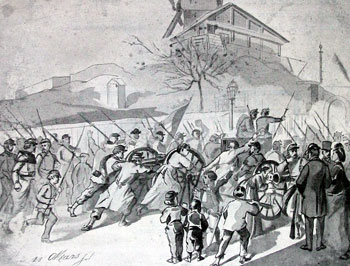
These weeks we commemorate the 144th anniversary of the Paris Commune, the first ever Communist regime, radically democratic and the reference that Marx and Engels adopted as model for the dictatorship of the proletariat.

Naturally the reference work is Marx' The Civil War in France, including the very insightful prologue by F. Engels.

But for those with the inclination for the video format and the patience to watch a long movie, a most interesting take is Peter Watkins' La Commune (Paris, 1871), which, using the anachronistic narrative device of introducing television in the 19th century, reenacts the events:


Also, for those who understand Spanish, I believe that this debate in Escuela de Cuadros (Cadres' School, TeleSur program) is a very interesting complement:


Now, maybe more than ever before we need to retake the concept of Communism and restore it to its originally radical democratic nature, democracy that cannot be just restricted to elections every X years but that, as in the Paris Commune, must imply the election of all offices and their revocable nature. It also cannot be restricted to mere political democracy but must imply economic democracy, that is the collectivization of all means of production and livelihood - property is an unbearable privilege that must be abolished in favor of true democracy.

We shall prevail because Capitalism is unable to face the catastrophe it has created, only an organized and conscious People, Humankind, can do that. Revolution or extinction!

Monday, March 30, 2015

EH Bai rallies Northern Basque left vote in second round of department elections

The Basque Nationalist Left coalition Euskal Herria Bai (Yes to the Basque Country) achieved amazing records of support in the second round of the departamental elections, where they were the only left-leaning force remaining in five cantons for the second round of the vote, whose first round was last week.

EH Bai lists only managed to win in the Errobi-Aturri canton, where they run against the French fascist party FN. In that district they collected 78% of the vote in this second round (was 34% in the first one). 

However, even where they ultimately lost to cocky Sarkozy-strikes-back lists, they achieved record backing never before gathered, for example 45% in Donibane-Lohitzune (Saint-Jean-de-Luz), what caused their conservative and unionist rival Philippe Juzan to acknowledge publicly that the Basque patriots are rallying the youth much better than their party, wowing to learn a lesson from that. 

In the other three cantons the performance of the Independentists was also excellent and without precedent: 44% in Ustaritze-Errobi-Urdazuri, 43% in the Basque Mountain and 38% in Bidaxune-Amikuze-Ostibarre. 

Overall the French right won in most cantons but the social-liberals of Hollande managed to win three (Baiona-2, Baiona-3 and Hendaia). Abstention was very high (48%) suggesting that the people is not satisfied with the rather undemocratic seat assignment method, which strongly favors the Twin Party system and denies the right of representation to weaker but still important currents.

Source: Gara[es].


North of the Adur...

Overall in the French Residual Empire voters backed Darth Vader, oops, I mean: Nicolas Sarkozy. The population seems extremely disappointed about right wing politics by Hollande, demonstrating that terms should be much shorter, in order to impede the breach of electoral promises for too long. In brief:
  • Sarko's likely backers:
    • UMP: 1105
    • Various right: 893
    • UDI: 358
    • MoDem: 46
  • Hollande's usual backers:
    • PS: 912
    • Various left: 384
    • PCF: 118
    • PRG: 62
  • Fascists:
    • FN: 64
    • Various far-right: 4
  • Real Left:
    • EE-LV: 29
    • FDG/PG: 20
  • Independentists: 7
  • Miscellanea: 46
Source: Twitter.

Friday, March 27, 2015

Saudi intervention in Yemen: a major step in the direction of total chaos

Religion in Arabia
Yemen is not Bahrain. Bahrain is a small urban island while Yemen is larger than Spain or Thailand, a largely rural and impoverished country with large mountainous areas. 

Conquering Yemen, as the Saudis and their North American allies seem to hope is pretty much impossible (much less for a mercenary army as the Saudi one, which lacks the ideological motivation and will be easily demoralized). So this attack is a very risky move that allows the troubles of Yemen to split across the border, particularly to 'Asir, which has a very large Shia population which is also ethnically akin to Yemenis.

As we can see in the map, Saudi Arabia is made up of two vast desertic areas in the North and South, plus three more populated areas, primarily the Southwest (largely Sunni but also Shia), then the central "oasis area" (stronghold of the fundamentalist Wahabbi ideology that shapes the theocracy) and finally the Eastern Shia region that used to be part of Bahrain. While an extension of the conflict to the central region can be surely discarded in the short run and the Eastern Shia uprising was quelled in blood (although it is still latent and tightly associated to the developments in Bahrain, where protests continue in spite of brutal repression), a Houti advance in Eastern Arabia, particularly into 'Asir but potentially even threatening Mecca should not be discarded at all. In fact I can't but foresee it as the more natural development of the Saudi invasion in the short run. 


The weakness of Saudi power

Another thing to consider is who rules Saudi Arabia and how solid is their power. The recently crowned King Salman, 79, is widely believed to suffer from Alzheimer disease or some other sort of incapacitating dementia so there is a shadowy junta actually ruling the state and clear fractures in the ruling family are known to exist in spite of the secrecy that governs the Islamist state.

In other words: Saudi power is, in spite of oil revenues, at its weakest point ever, suffering intestine dynastic disputes, facing major dissidence from that 50% of the population that are women (whose condition under Wahabbism is surely one of the worst on Earth) and from the majority of the population in the Eastern Province. Now add to all that a powerful and consolidated Shia militia spawning from Yemen. The only pillars of Saudi power are the more and more questioned totalitarian religious police and a mercenary army, with good equipment and salaries but without the "soul" of a really compromised force, as it lacks of nationalist or otherwise ideological motivation of any sort. 

We are talking after all of a mere feudal state: a pre-modern residue stagnated on oil wealth and international alliances, heavily relying on an immigrant workforce with slave-like conditions, and almost certainly unable to withstand any serious turmoil. 


What can we expect

Yemen conflict (from Al Yazeera)
I foresee short-term Pyrrhic victories of the invaders (high sustained cost, low gain) followed by backslash in both Yemen and SW Saudi territory. Backslash that might well threaten Mecca. The boundaries are artificial and the intervention just made them meaningless: now it's an all-Arabian conflict and not anymore one just circumscribed to Yemen.

I also foresee increased unrest in Saudi Arabia as such: both from the people, for which Wahabbi totalitarianism is not anymore a valid option in this globalized and secularized age, but also from important segments of the dominant elite which have been apparently excluded from power with the still fresh crowning putsch of Salman the Ailing. 

It is probable that the intervention in Yemen is seen by the current shadow junta as a way to reinforce their power: nothing like a glorious military campaign, right? But there is a major problem: the campaign won't succeed and it will be painful and dirty, spilling into Saudi territory, so eventually its promoters will gain only increased weakness and not increased strength from it.

Finally there is another and very serious danger that can't be understated: that the besieged Sunni Islamists in Yemen will join the Islamic State, as those in Libya and Nigeria have done, and roll over Saudia from both Iraq and Yemen with likely opportunist support (as in Iraq) from inside the military. They would offer the rotten Saudi elites the "best" (worst!) of both worlds: a continuation of totalitarian Sunni Islamism and a modernizing fascist regime apparently more capable than the rotten Saudi dynasty. 

No need to say that such a development would dramatically alter the geostrategy of the region and the whole World. I is not unlikely though.

What I wonder at this stage is how controlled does the Pentagon has the situation. Isn't the risk of the Islamic State (effectively supported by Turkey, the USA and Israel but apparently not by Saudi Arabia) going out of control getting too big? This seems more and more like a repetition of the Hitler experiment: we (the Anglo-Saxon Empire) put a dictator in power and a few years later we have no choice but to wage war against him because he's become too independent and is challenging the status quo beyond what we can put up with. 

Obviously the IS is not your usual military junta or old-fashioned fossilized monarchy: they literally know no bounds in their brutal religious madness and are extremely ambitious. They have also shown to be very efficient at taking over weakened states, at least large chunks of them. And Saudi Arabia is one of those.

I wonder if that is what the USA wants and, if so, why? How do they plan to retain hegemony in the middle of such chaos and consolidated state of war? Conquering it in some sort of WW3? Will they be able to rally the masses around such a major imperial campaign in the midst of the worst socio-economic crisis in the history of Capitalism? I don't think so. All this can only backfire, even if I feel unable to foresee the details of the near-future developments.


Update (Mar 29):
06:48 GMT: Houthi rebels are moving artillery units closer to the border with Saudi Arabia, RIA Novosti cited Al Jazeera as saying (from RT live updates blog on the crisis). What did I say about the war spilling to Saudia?

Other details from the same source:
  • Yemeni forces (army or rebels) can hit Saudi targets up to 500 km away (Iranian source)
  • Saudia has massed up 150,000 troops at the border with Yemen. It is unclear if they plan to invade or just defend the border. Analyst suggest that a land invasion would be a disaster, however it is unclear how can the operation succeed without ground occupation, more so when the Houtis are clearly redirecting their efforts against the Saudi aggressor.
  • While Egypt has joined the Saudi-led coalition with 16 airplanes and one frigate, Pakistan has remained uncompromising.
  • The official Yemeni President (with almost no support inside the country) seems to have left the country for Riyadh and then for Egypt to attend an Arab League summit. 

Update 2 (Mar 29): Israel may be an active partner in the coalition bombing Yemen, according to sources in Sanaa mentioned by Fars Agency.


Monday, March 23, 2015

Basque Nationalist Left grows big in departmental elections

The Basque Nationalist Left coalition EH Bai collected 16% of the popular vote in the region of the Basque Country annexed to France, consolidating itself as the third largest political force after the French Twin Party, so far resilient. EH Bai candidates have therefore reached the second round in almost half of the cantons, where they will have an opportunity to be elected to represent their cantons in the council of the Atlantic Pyrenees department imposed by Paris.

The conservative section of the French Twin Party, running under the acronym "Forces 64 + UMP" won the support of 34% of Northern Basques, while the pseudo-left branch known as Socialist Party, did not reach 20% of popular support. 

As usual, the Fascist FN performed quite worse in the Basque Country than in other parts of the Republic, collecting only 13% of the votes, with 11% of the votes going to other all-France options and a mere 1% to the Basque Nationalist Right (EAJ-PNB). 

The five cantons in which the Nationalists will be able to contend the second round are:
  • Errobi-Aturri: 34%, (vs the Fascists, 17%)
  • Bidaxune-Amikuze-Ostibarre: 23% (vs French Right, 44%)
  • Euskal Mendialdea (Basque Mountains): 22% (vs French Right, 29%)
  • Ustaritze-Errobi-Urdazuri: 17% (vs French Right, 28%)
  • Donibane-Lohizune (aka St. Jean de Luz): 15% (vs. French Right, 29%)
Together these cantons make up the bulk of the Northern Basque Country in area, even if not in population, as this map evidences:

Red: EH Bai will be in the second round
Dark Red: EH Bai leads and will probably win in the second round
Bluish: other cases

While in Errobi-Aturri, the division of the Unionist Right favored the Basque Nationalists (as well as the Fascists), in Baigura & Mondarrain a similar intestine competition was not enough and EH Bai could only reach third place with 18% of the vote. Another third place with 14% of the vote was reached in Hendaia. 

The performance was less notable in the Baiona-Miarritze urban area of the Northwest, reaching 6-8% in each of the electoral districts. 

The French electoral system heavily punishes minority options (even if not as extremely as the Anglosaxon one) denying vast sections of the people the right to be represented proportionally, what suggests that the system is not really intended to be democratic but a mere pretense. 

In any case, against all the odds, the Basque Nationalist Left has shown to be a major contender that keeps rallying more and more Northern Basques against the sclerosis of the unionist Twin Party regime. 


North of the Adur...

Preliminary results suggest that the Twin Party wins, no surprises. Anecdotally it is again the turn of the Right-wing brand, which gathers 29-32% , while the pseudo-Left brand manages to hold 19-25% of consumer fidelity (which can grow to 29-32% in the second round as the more serious left routinely surrenders its radicalism to the "lesser evil"). The Fascist FN keeps that 25% conquered in previous elections but makes no further gains, maybe because the establishment sees Le Pen as too pro-Russian to be trusted.


Sources: Gara (detailed results in PDF), Kazeta, EH Bai. 

Thursday, March 5, 2015

Ukranian soldiers: "We need to turn around and march to Kiev because the real enemy is there"

Is Poroshenko and its Nazi "National Guard" and volunteer companies losing their grip on power? This video, filmed with probably a mobile phone on the frontline by three soldiers (recruits) seems to underline the massive discontent after a whole year of civil war and economic looting:


The sentence used in the title is pronounced, with minor modifications, towards then end of the video (6:39). It impacted me particularly because it seems taken from the worker demands at the beginning of World War I and later also taking place in fact in the proletarian revolutions at the end of that conflict. The idea is also present in some poem of Bertolt Brecht and it is very much true in the case of Ukraine. I have been honestly waiting for this moment to happen: when the army turns around and marches against the real enemy in Kiev. It still has to happen but it's clear that idea is floating around. 

Otherwise the soldiers heavily complain about salaries, not just their own but also their families and the pensions of the elderly, the heavy losses in the war and the pampered status of the National Guard (fascists) and the volunteer companies (also fascists), which are used not for frontline fighting mostly but for terrorism against civilians and even against the regular troops, whose moral is at an all time bottom. 

I believe that when they say "ATO" it means "NATO" but unsure.

Via: Basque Committee of Solidarity with Donbass (their video has Spanish subtitles).

Thursday, February 26, 2015

V for Varoufakis (humor)

This is just hilarious:


Pity is that down here in real Earth, Yanis has actually been forced to swallow a lot of crap and Schauble is laughing (if he can laugh at all, does he?) on his wheelchair. 

I take the opportunity to demand from Germany the payment of its war debt and reparations not only to Greece but also the Basque Country (remember Gernika!) and from Britain to return the stolen Parthenon marbles. Otherwise they should expect their share of the Greek inducted debt to be canceled in return - or so I hope. 

Greece is still at the crossroads: be Europe's Haiti or be Europe's Cuba? I think the answer is clear.

Tuesday, February 10, 2015

Those warmongering russkies!


Hilarious but very real if you happen to have enough patience to put up with Minitrue's propaganda machinery (aka "free media").

Tuesday, January 27, 2015

Bravo Greece!

Tasio today at Gara.

Note: I'm probably arriving to the end of my phase as blogger but, while I take a final decision, there's reason to celebrate and hope these days. Thank you Greece for facing Imperialism once again with such courage! Europe owes many things to Greece but it's not just ancient history and the Neolithic: it's also today. Bravo!

Tuesday, November 25, 2014

Protests shatter USA on acquittal of Ferguson cop

Almost every day a black person is killed by police in the USA. Never mind the thousands who are arrested and convicted on minor crimes such as possession of marihuana to feed the slavery system of the private prisons. Ferguson is just the tip of the iceberg of a colonial racist system in an extremely undemocratic context.

No wonder that an uproar has surged in the streets of the cities across the Imperial Core.

→ https://twitter.com/hashtag/Ferguson?src=hash


Los Angeles march took over major highway

This uproar is good and necessary and does not only answers to circumstances. However for things to get straight there needs to be a Socialist focus that tackles the problem of oligarchic rule and lack of democracy. Only People's Power can address the very urgent needs of Humankind in the USA or anywhere else. 

The objective conditions for Revolution are here, and not just in the USA, however the subjective ones are not. People is angry with very good reason but they do not seem to know yet how to tackle the prevalent injustice, how to defeat the bourgeois oligarchy and establish a Real Democracy.

Without conscience we are powerless. With class conscience we can change it all. 


Update:

The situation across the USA seems to have been developing towards increased protests all across the territory as well as towards increased violence, particularly from police forces, which had no qualm about gassing around everyone or even shooting at them with rubber bullets and possibly even live ammo (unconfirmed).  

Twitter reports from Ferguson tell of police commanding the press to leave the city at once and also of heavy automatic gunfire. This kind of violence is not only found in the suburb of St. Louis but also in many other cities. 

LA cop shooting against demonstrators with a drum-fed grenade launcher (source)

Monday, November 10, 2014

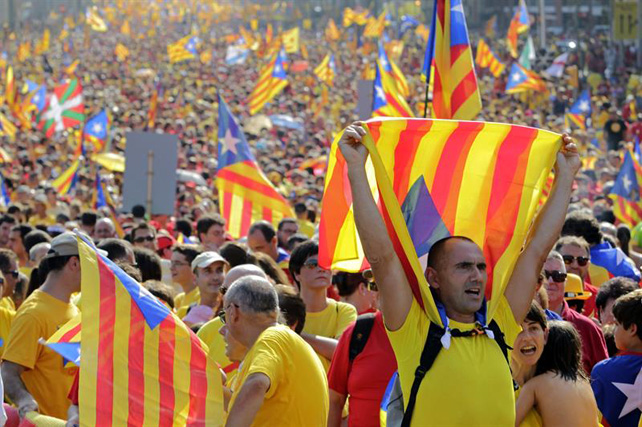
Millions vote in Catalan independence referendum: 81% support independence

2.3 million Catalans (updated figure) voted yesterday in the independence referendum organized by Catalan institutions and declared illegal by the residual Spanish Empire. The worst fears of military intervention did not materialize and Catalans could vote on the future of their country in spite of all, although with most unionist forces not recognizing the vote. 

The figures are still provisional but reflect 96,8% of the votes, with the following results:
  • 80.72% voted for an independent Catalan state
  • 10.09% voted for a Catalan state but against independence (i.e. federalism)
  • 4.45% voted against a Catalan state
  • The rest include blank ballots and irregular choices like yes to independence but no or no choice regarding the concept of "state". This "other" category gathered more than 3% of the votes, suggesting that there is a sizable number of independentists against the state format.

The controversy now is on whether the referendum has any bearing at all, as it is "illegal" by the Imperial dictate of Madrid, and, more subtly if the turnout is enough to legitimate the vote. Obviously this is the burning nail of unionists, who want to somehow count the indifferent in their side this way, even if opinion polls show that the unionist option is much weaker than the independentist one.

For comparison: 
  • The 2014 EU elections had a 2.5 million voter turnout
  • The 2012 Catalan elections had a 3.7 million voter turnout
  • The 2011 Spanish elections had a 3.5 million voter turnout
  • The 2006 new statute referendum had a 2.6 million voter turnout

It is obvious that the majority of those who oppose independence did not vote but rather attempted to sabotage the vote with their abstention, supporting that way the Spanish Imperialist doctrine of negation of the right to self-determination of Catalonia and other nations imprisoned within its borders. But how many these abstaining unionist are? 300,000 or 1.5 million? Almost certainly the real figure is somewhere in between, say 800,000, judging on past electoral behavior and opinion polls. 

So while they may be willing to cast doubt on the result of the referendum, their argument is extremely weak and can only resound in the ears of the ignorant and those who are already persuaded. The reality is that at least 2/3 of Catalans who take a stand strongly support independence.

Figures' source: La Vanguardia[es]


Update: Spanish and even Basque institutional media is just ignoring the vote, as if it never happened.

Sunday, November 9, 2014

Catalonia is voting its independence

Large queues, a clear sign of popular enthusiasm, are the main thing to mention at noon. In spite of all legal prohibitions, the People of Catalonia is voting massively in this journey of democratic hope. 

The main incident so far took place in a polling station of Girona, where a group of fascists attempted to violently sabotage the vote. Two of them were arrested. 

The spirit of disobedience is riding higher than expected and even the Catalan police corps have declined to identify those in charge of opening the polling stations, while the Catalan Government has assumed all responsibility in this act of democratic empowering and defiance. 

Catalan citizens decide today on the following double question: Do you want Catalonia to be a state? If so, do you want this state to be independent?

Unionists therefore can vote no to the first question, federalists yes to the first one and no to the second one and independentists (expected to win the vote by landslide) yes to both questions.


Madrid: damned if you do, damned if you don't

The Spanish authorities, extremely weakened by extreme loss of legitimacy of both of the twin parties of the post-fascist pseudo-democratic regime, sunk in corruption scandals and social-economic collapse under EU-orchestrated anti-social policies, seem powerless. Legally they could even order the establishment of martial law and what not but that would only escalate the conflict and debilitate the already weak state even more.

Spanish President Mariano Rajoy has claimed that he will stay in government for the whole year that he has left, what he can force because of the technical but non-representative majority his party has in Congress. However reality is tough and his position is every day weaker.

In this sense he recently acknowledged that sending the military police to impede the vote would be so terribly shaming for Spain that can't be actually done.

The journey has not finished yet but the first half of it has been so far a total success for democracy and for the demands of the stateless peoples of Europe. Congratulations Catalonia, thank you Catalonia.

Thursday, November 6, 2014

Spanish state at the crossroads

The military-tutored "democracy" in the Kingdom of Spain is clearly collapsing as we speak. Almost 40 years after the death of dictator Franco, his brainchild, the restored Bourbonist constitutional monarchy, integrated in NATO and EU, is dying too. And the almost unnoticed recent change in the identity of the unelected monarch is just a symptom (the former King resigned as the popularity of the Franco's appointed monarchic institution was collapsing, amidst corruption scandals that shatter the whole political establishment, in a rather desperate attempt to refresh the decadent dynasty with a new untested face). 


Catalonia

In three days there will be a referendum in Catalonia for independence almost certainly. It has been declared illegal but it is clear that it cannot be canceled unless whole military occupation of the country is implemented overnight, something that is certainly not impossible but seems quite unlikely to succeed. 

Catalonia, with 16% of the population of the State and probably a larger share of its economy, is almost certainly way too large and its independence movement way too massive, able to take millions to the streets, to be just tackled with a mere military intervention. Never mind the correlative loss of prestige internal and external of the Spanish regime if they dare to do that.

What exactly will happen we will only know on November 9th and rumors abound as a military convoy of 15 armored vehicles, apparently transporting infantry and weapons, crossed through Barcelona yesterday, and a video showing military units being trained for mass unrest quelling has also raised quite an scandal. 


Collapse of the twin party

But surely even more important is the fact of the neo-francoist political establishment suffering a very clear collapse, with the new party Podemos (We Can), which has copied its program almost literally from that of United Left but has a distinct approach to grassroots participation in politics, leading by quite a margin in the most recent official opinion polls (Barómetro CIS Oct. 2014).

Asked about spontaneous vote intention in hypothetical elections tomorrow (question 23), 18% of Spaniards answered that they'd vote for Podemos, followed by 15% for the social-libera PSOE and only 12% for the conservative PP (currently in power). Interestingly, support for the traditional leftist option United Left (coalition around the Communist Party and akin to Greek Syriza although with a more elderly leadership that seems to lack enough charisma) also appears to fall, not reaching 4% in this question.

The combined vote intention plus sympathy compound (table 24b) also places Podemos first in the opinion poll, with 19% of overall popular support, closely followed by the center-left PSOE (18%) and at some distance by the right-wing ruling party PP (14%).


It is interesting to notice that the average popular perception of Podemos, which insists of disdaining the left-right classical polarization, is slightly farther to the left than that of United Left: 2.4 vs 2.7 in a scale where 1 is absolute left and 10 absolute right. Only Amaiur (now EH Bildu, Basque Nationalist Left coalition) is perceived as further to the left, with a 2.2 score.

It is also interesting to notice that the right-wing parties PP and its Navarrese ally UPN lead the extreme distrust results (question 16), with 60% declaring that they would never vote to the PP and (in Navarre only) with 88% declaring that they will not vote to its local ally UPN. Both are ruling in their respective areas and both have been shattered by massive corruption and mismanagement scandals. 

The UPN data evidences that the political situation in Navarre will no doubt change quite radically when local and regional elections are held next spring.

In this question, the best scoring parties are the Catalan Republican Left (ERC) which gets a 3.7 average (on a 1-10 scale) in Catalonia and Podemos with 3.1 (state-wide). These results clearly emphasize the kind of seismic shift that is happening in the Spanish state.

However it must be said that the twin party still probably has enough support to muster a narrow majority in Congress, notably considering the heavily biased Spanish electoral system that strongly favors rural provinces (where sociological change is generally slower and small parties' options almost nil). The deadline for general elections is just a year away and the examples of Italy and Germany show that NATO's quasi-official twin parties are willing to join forces to prevent the much demanded change from happening. 

On the other hand it is not impossible that a snowball effect of sorts attracts even more support to the Podemos phenomenon and hence even that "solution" becomes impossible. In any event, it is clear that the desire for radical change is crystallizing in various forms and that, especially considering its traditional trans-Atlantic links with Latin America, where similar political phenomena (Bolivarianism and also other left options) have been growing in the last decades, the State of Spain becomes a vortex of change in old Europe in the short run.

We will see.

Wednesday, October 29, 2014

Kurdistan, Kobanê, Communism and everything else

Pepe Escobar has written a good article explaining the issue of Kobanê, Kurdistan and Turkish-led Islamism, I strongly recommend reading it:

The Kobani riddle
By Pepe Escobar

The brave women of Kobani - where Syrian Kurds are desperately fighting ISIS/ISIL/Daesh - are about to be betrayed by the "international community". These women warriors, apart from Caliph Ibrahim's goons, are also fighting treacherous agendas by the US, Turkey and the administration of Iraqi Kurdistan. So what's the real deal in Kobani? 


Linked in the article but very much worth a separate mention is the ideological handbook of the Kurdish Revolutionaries: Abudullah Oçalan's "Democratic Confederalism", which is surely one of the most advanced theoretical analyses of the issue of nations, the so-called "nation-state" and how it must be overcome in Communism (of the libertarian kind, naturally). 

As I have mentioned several times the Kurdish revolutionaries are at the forefront of the renovation of Western* (and possibly other) Revolutionary ideals and clearly deserve our respect and attention.

_______________________

*Western understood as West Eurasian (i.e. roughly the lands West of Pakistan and North of the Sahara). I don't really care for the rusty medieval remnant of Islamo-Christian divide, which may be still somewhat noisy and painful but is a dead man walking anyhow.

Tuesday, October 7, 2014

As the Fascists enter Kobane, Kurds protest in Western Europe

Kurdish protest at La Hague
The Fascist Islamist genocidal threat is reaching the streets of the besieged town of Kobane in Western Kurdistan (formally part of the Syrian state). The city is being attacked from the South by the Nazil-like forces of the Western-organized Islamic State and cut from its only possible support via the North by the Turkish Army and Police, which do not allow Kurds to cross the artificial border line on the railroad to join the fight. 

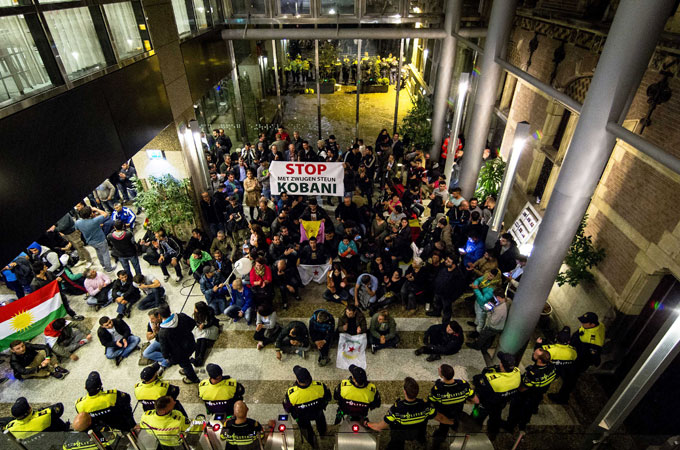
As reaction, Kurdish emigrants in Western Europe have been holding major rallies in London and La Hague, among other places. In London they occupied the largest subway station, Oxford Circus, while in La Hague they took the gates of of the Dutch Parliament. They demand decided action against the Islamic State and in support of Kurdistan. 

Meanwhile in Kobane the self-defenses have declared the town military zone and asked all civilians to leave, as it is well known that the Islamic State holds a genocidal policy against all those they consider their enemies. By the moment it seems that the presence of Fascists in the streets of Kobane is limited to a few outskirts buildings but the situation is dire in any case, with US air attacks (secretly approved by Damascus) shown to be nearly useless. 

In this sense Kurdish forces demand mainly one thing: good weapons that can be used against the Fascists, whose equipment is excellent thanks to Western support and the takeover of large hoards from the Iraqi Army. As we have seen in Ukraine, this kind of technical advantage may not be enough against a decided popular resistance fighting for their lives, but, while the Ukrainian Christian-Fascists have only a very weak grasp on the populace and totally plays the Western Imperial game as subordinates, the Arab Islamo-Fascists seem to have a much better organization, capable to defy established stats like Syria and Iraq and co-opt large chunks of the Sunni Arab population, including expert soldiers, while their game is blurrier: with vague pretenses of establishing a supposedly anti-Western empire but clearly historical and present day support by Western Imperialist forces. 

The most obvious one is Turkey. While Saudi Arabia, the USA and even Israel now pretend to be against the Islamic State, taking some formal and even military actions against it. Turkey is clearly playing in favor of their Arab Fascist allies by blocking any possibility of support from Northern Kurdistan (under Turkish occupation). 

Naturally the USA is playing with two decks here: the IS is designed to be an excuse for the Empire to intervene in Syria and Iraq, weakening the influence of Iran, Russia and China in the area. By the moment the USA has conducted some air strikes, which seem to have no or very limited impact in the developments on the ground. The situation is in nearly all aspects a repetition of the Islamist uprising in Mali, which served the USA to gain some drone bases in the region and for France to return to its traditional role of post-colonial "protector" of the African regimes.

However West Asia is by all means much more geostrategical and volatile than West Africa. And the perilous game that the Western agents are playing there will have no doubt much greater consequences for all, including Europe. 


Biden speaks out

US Vice-President Joe Biden has been saying a few truths as of late, even if he had to apologize for them and some imperialist press paint him as prone to the foot-in-mouth disease. The reality is that he's saying, very mildly, what needs to be said. 

First of all, he accused Erdogan's Islamist Turkey of supporting the IS by allowing many of its members to enter Syria, what is true. Erdogan claimed to Heaven and Hell for his innocence and said that those fanatics crossed the border as unarmed tourists.

He also claimed that, as it is true that they kept the border way too open in the past, now they are keeping it tightly closed. What translated to plain English means: yes, we did allow the Fascist Islamists to enter Syria and provided all kind of help to them and now we won't allow the Kurdish militias to help the defense of Kobane. 

A full confession in diplomatic slang. Still Biden had to apologize, what underlines the actual role that the USA and its allies in the region are playing regarding the IS: covert support and a mere pretense of indignation, mostly oriented to gain imperialist control.

Another interesting remark by Vice-President Biden was that the USA has embarrassed its European allies by forcing sanctions against Russia that mostly harm the EU.


Kurdistan as bastion of Humanism and Progress in West Asia

Kurdistan and the Kurdish People stand today as the main bastion of resistance against Islamism and Imperialism. But they are more than that: in the course of their struggle for self-determination, they have developed strong progressive and socialist ideals, even recently trying to overcome the burden of bourgeois nation-state cages by appealing to confederate democratic self-rule of the peoples and communities of the region. 

It is not needed to mention that, among Kurds, and in spite of the deeply rooted historical burden of Muslim Patriarchy, women enjoy increasingly equal status, largely thanks to their own commitment in the guerrillas and militias that defend their country against their oppressors. Socialist ideals stand high among Kurds and definitely they hold better than anyone else the banner of Humanism in West Asia, being nearly impossible to defeat thanks to their numbers (the largest stateless nation on Earth) and the mountains that shelter them. 

In this sense I can't but issue again another appeal for almost unconditional support for the Kurdish cause, because it is not different in essence to the cause of Humankind. 

Long Live the Kurdish People!
Long Live Free Kurdistan!