Showing posts with label class war. Show all posts

Saturday, March 24, 2018

Spain's fascist repression against Catalonia knows no bounds

Do not cry for a land that fights, fight for a land that cries!
Today several Catalan politicians were jailed on accusation of "sedition" or "rebellion", what is a nonsense because they never used violence to overthrow the status quo but the Spanish Inquisition (Supreme Court in this case) is making things up and twisting the law all they can in order to step up the repression. 

One of them, the Secretary General of Catalan Republican Left (ERC), Marta Rovira, chose to exile herself to Switzerland, joining a growing number of Catalan political leaders in exile, either in Switzerland or in Belgium. 

Another of those imprisoned today was Jordi Turull, who is the only candidate for the Presidency of the Catalan Government (Generalitat de Catalunya), vote that was being held today (he did not get enough votes because the decisive Popular Unity List (CUP) abstained on grounds of wavering republicanism and lack of a social program). 

Also imprisoned were Carme Forcadell (former President of the Catalan Parliament), Raul Romeva (former head of the Republican unity list Together for Catalonia), Josep Rull and Dolors Bassa (former consellers or ministers).

This every day looks more like Turkey. 

But the streets are angry, very angry.

Not only because of Catalonia, there are many other open conflicts feeding into each other, notably the retirees have been staging massive protests in the last weeks against the effective pension cuts while police salaries are increased, military expenditure doubled as Trump demanded, corruption cases keep showing at every corner like mushrooms and the illegitimate debt to save the Spanish banks and other private ventures like useless highways, i.e. to save German and other international banks for slightly longer, is being increased every day. 

The Precariat is also angry and starting to get organized and protest. Also a synchronous conflict has been happening in Murcia City between working class neighbors and the state who illegally is imposing that the bullet train (TAV, another useless waste) goes through their neighborhoods, right by their homes in many cases, above ground, cutting the city in two. The government went so nervous that police was seen patrolling with loaded guns just a couple of days ago, something unseen since ETA began its disarmament process. 

But where anger is really spilling over is in Catalonia, always in the nonviolent manner they have conducted their independence process so far. I do not have yet all the info but I know that semi-spontaneously, organized by the Comittees of Defense of the Republic (CDR, popular assemblies working in national network), there have been many demos and pickets. Notably they have cut the train traffic at the station of Lleida, the border with France at Puigcerdá, and have walked out in most towns across the country, in several cases suffering violent police repression. 

Popular picket at Lleida train station (and some cops)

demo in Barcelona
police brutality today in Catalonia (credit: Jordi Borras)


These images (from FB group We Stand in Solidarity With Catalans) aren't but a tiny relation of what has been happening today again in the forbidden Catalan Republic. And I suspect that it is only the beginning of something huge, because the general mood is clear: if they jail our leaders, they will have to jail millions of us. 

There are informal calls for long-standing general strike, for repeated road, railroad, airport and harbor blockades. Not sure what exactly will come out of this but it looks that, once again, we are in a proto-revolutionary scenario, at the very least in Catalonia. 

And let's not forget that Catalans are 7.5 million people, 16% of the population of the failed state of Spain, and also one of the most vigorous economic areas in spite of Madrid sucking every single large company or almost. 

As a side note, the government can't even pass the budget, because they can't muster a majority to do so, they are resorting to pointless resistance by means of the state apparatus, dominated by fascist currents like the greedy Catholic order Opus Dei, but they lack any sort of coherent governance beyond last trench repression without any sort of compromise with common sense and social consensus. 

The situation is anything but under control: the failed banana kingdom is one step or several closer to total collapse. And I will applaud when that finally happens, because in order to save the Spanairds (by force or grade) Spain must be destroyed, razed to the ground and power returned to the peoples. 

Gora herrien borroka! Long live the struggle of the peoples!

Monday, January 29, 2018

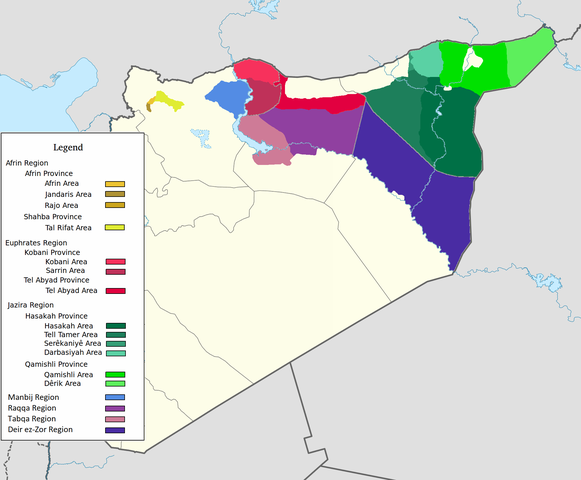
Afrin is the new Kobane, let us all defend it however we can

North Syria Federation
(credit: Editor abcdef, Wikimedia)
In yellow Afrin Region (canton)
Let's begin stating the obvious (but not so-obvious to many apparently):

1. Turkey has a fascist regime led by Hitler-loving and Islamo-Fascist extremist Tayyip Erdogan.

2. Russia and the USA are both capitalist (and thus imperialist) states: there is no monopolar imperialism, imperialism is by (Lenin's) definition the struggle of the various capitalist powers to control the world's resources and attempt to exert quasi-imperial or at least some relative hegemony over the rest. 

3. The SDF (Syrian Democratic Forces, organized around the Kurdish YPG/YPJ core) and the legitimate government of Syria (Baath, Assad) get along even if they clearly have different political projects: the former internationalist and Kurdish-centered, radically democratic and decidedly communist, the latter Arab nationalist (pan-Arabist), not so democratic (in spite of the reforms) and not so socialist (rather state-directed national capitalism). In spite of skirmishes and diverging international alliances this has been the case since the beginning, when the YPG coalesced as a Kurdish self-defense force.

Also maybe not-so-obvious to some may be the fact that Turkey has a huge army but that it is made up mainly of recruits, many of whom hate Erdogan (even by rigging the elections the Turkish neo-sultan only managed to get a narrow majority in parliament and needs the backing of the secular-fascists to stay in power). We have already seen in Ukraine how these conscription armies are very inefficient against motivated popular militias, notably when their commander regime is illegitimate and the war they are waging is as well. 

It is also important to underline that Syria has allowed massive YPG-SDF reinforcements to arrive to Afrin. And that Turkey is working with Islamist militias (roughly Al Qaeda and DAESH, just recently renamed again for PR reasons) just the same they used them as death squads in the brutal repression of the Bakur (North Kurdistan) uprising in 2014-15.

Both the USA and Russia court Turkey. The former want it to return to its former status of reliable ally (vassal) and thus are not taking active action in Afrin, where they are not present, but still signalling they won't retreat from Manbij or other lands of the Northern Syria Federation where they hold some military presence. The latter have snubbed their Syrian ally in regard to air protection of the canton of Afrin, as determined by truce agreements, because they clearly want Turkey to become yet another ally in the region, along with Iran (also anti-Kurdish) and Syria. The powers do not care about Afrin at all: they are interested mainly in the Bosporus Straits, which are Turkey's main asset, and secondarily in projection in the Fertile Crescent.


What's actually going on? 

As far as I can tell there has been heavy bombardment by Turkey of civilian towns, using chemical weapons in at least some cases, and even the destruction of a landmark historical ruin (a signature of Islamo-fascism) but on land Turkey and their allies have made only very limited gains. 

As of today Turkey has only occupied a hill on the border, hailed as a "great victory" by their propaganda machinery, of course. The initial attempts to take over the southeastern extension of the canton north of Aleppo failed, with many more casualties in the Islamo-Turkish camp than in the Kurdish Communist one.

However, let's face it, it's a David versus Goliath scenario in which, in spite of their bravery, the Kurds and allies (including as far as I know some internationalist units) have it very difficult. The same was true in Kobane and they prevailed though... on their own forces alone. 

I would expect that, as soon as the Spring arrives, the Kurdish forces north of the railroad (the official Syro-Turkish border is the old Baghdad railroad in most of its length) will initiate some sort of offensive, forcing the Turkish army to spread wide, but right now it is massively concentrated around the small territory of Afrin, the Mountain of Kurds.

  
Popular forces can win against all odds

But we have seen it before in Donbass and in Kobane: a motivated militia can certainly defeat a poorly motivated conscription army, never mind fascist mercenaries. Why do I "dare" to compare Donbass and Afrin: aren't ones in the side of Russia and the others in the side of the USA? The answer is "no": neither Russia nor the USA care much about their popular "allies", they
fear them in fact, precisely because they are democratic and popular, and only offer them very limited and conditional support at best. They are just forced to cooperate with them because of geostrategical reasons but always with the sight elsewhere: Kiev, the Bosporus, Latakia, etc. Who backs them is not important, what matters is that they are democratic and popular forces.

And I must say that it is most interesting that these great powers are being forced by circumstances, by the inefficiency of other more fascist or authoritarian approaches, to rely on these grassroots militias to some extent. It evidences that Lenin was right when he characterized Imperialism as a clash of oligarchic mafias on which we revolutionaries should not be too interested but rather on the possibility of making some revolutions in the cracks generated by this inter-imperialist struggle.These cracks are every day larger and democratic socialism is arising in them, not without difficulty but with perseverance and admirable toughness. 

And that's why we must help as much as we can to defend Afrin and denounce the Turco-Islamist criminal aggression: because it's not just the people of Afrin and the many thousands of refugees installed there, it's not just the right to self rule of the Kurdish and all other peoples, it is global revolution what is being fought there. Afrin is the linchpin of our hope for a better world, we can't just watch or ignore it.


Tuesday, October 3, 2017

General strike today in Catalonia

1917: sickle and hammer.

2017: tractor and computer.


"Muy Bastas" explain:
Viva the Farmers!!
  1. The Farmers said they would cut the French border with the tractors.
  2. Hundreds of national police agents have gone there to impede it.
  3. It was a trick. When the cops arrived they found nobody there.
  4. The tractors then blocked the highway and roads further south, so the cops can't go back.
They won't be able to do anything against an organized People.

Today a General Strike for freedom was called in Catalonia by several minor labor unions including COS, CGT and CNT and backed by the CUP (socialist independentist party). This call was made several days ago, even before the brutal repression of this Sunday.

In order not to be displaced by a call they did not control but that was going to be followed anyhow by most Catalans, the "moderate" camp has called for a day of "National Halt", which has been seconded by other unions, parties and even capitalists. It is unclear how exactly such a thing as a "National Halt" happens but it somewhat overshadows the fact that there is a political general strike called by the most combative unions and the CUP.

In any case the General Strike has been a massive success: Catalonia is nearly stopped, except for multitudes protesting nearly everywhere. Romanian homeless activist Lagarder Danciu, who forged a name for himself by staging one-man protests against corruption in his adoptive homeland, among other activities, offers us an example of how massive this is:


Another visual example of how a true General Strike is made is offered by this photo shared by one of my favorite bloggers, Borroka Garaia Da! (It's Time of Struggle!):


If you follow the link, you will find the Spanish-language version of the communication of Endavant (Forward), the more radical (i.e. more coherent and serious) half of the CUP.  They argue that the referendum was a success in spite of all the repression and that it was an overwhelming victory for the "yes" to independence. 

Therefore they say that a Catalan Republic must be proclaimed this very week, rejecting any call for "pacts" or "dialogue", which would be attempts to invalidate the referendum. 

They call for the General Strike, they denounce the brutal repression against the Catalan people and they argue that the forces that oppose Catalan independence are the same ones that are attacking the rights of the working class. They conclude that:

The General Strike must be the starting point for the Popular Movement to move ahead, to change everything, to guarantee the conquest of social and labor rights and for the implementation of the right to self-determination. 

Visca Catalunya lliure! Viva the struggle of the Peoples!

Thursday, April 27, 2017

Neither Le Pen nor Macron

Neither fatherland nor boss, neither banker nor racist, neither Le Pen nor Macron. Under such banners lots of French are demonstrating as I write this in the streets of Paris and other towns. 

The runoff of the presidential election is leaving way too many without options: should one vote for a pseudo-democrat bankster in order to stop an outspokenly fascist and racist but farcical "social" führeress? I don't think so, I wouldn't in any case. Sure: Le Pen is scary but Macron is not a bit less scary, it's a lot like the Trump vs Clinton false dichotomy: both are evil ultra-capitalist warmongers and should not be supported by the Left in any case.

We must step out of the bourgeois infighting and demand our socialist and radical-democratic program every single day and in any circumstance. There are no lesser evils, only the greater good is really worth our effort.

Thursday, April 20, 2017

Lenin's April Theses 100 years later

On April 17th, one century ago, Lenin announced what can be understood as the manifesto for the Russian Revolution, known to history as the April Theses. 

Sputnik News has a very cool and detailed infographic on them, go take a look.

The full name of the text is actually The Tasks of the Proletariat in the Present Revolution, it is freely available at Marxists.org.

Context: after the February Revolution, there was a provisional government led by liberal (i.e. center-right) Georgy Lvov and dominated by the Kadet party (also liberal in the classical sense of strongly capitalist). While other "socialist" factions had minor representation in this provisional government, the Bolsheviks did not partake of it. There was however a parallel government in the form of a loose network of local soviets (worker councils), dominated by the Soviet of Petrograd.

On April 16th Lenin arrived from Zürich in the famed train episode and thus the following day he spoke in Petrograd. What he exposed in two successive discourses became known as the April Theses.

A synthesis of the theses may be:
  1. No to the imperialist war, democratic and not violent peace. A revolutionary war may be acceptable but only if: 
    1. The power is in the hand of the working classes (proletariat and landless farmers)
    2. Nothing is annexed
    3. There is radical break with the interests of Capitalism
  2.  Russia is in the first stage of the Revolution, which gave power to the bourgeoisie, but there must be a second stage in which the power passes to the working class. This first stage caused class consciousness to extend to the masses and this newly born consciousness must now serve real emancipation.
  3. No support for the Provisional Government, which he dubs deceitful and confronted to the real interest of the Russian masses.
  4. Acknowledging that the Bolsheviks were in the minority in many soviets, which were controlled by the social-reformists (Social Revolutionary or agrarian populist party and the left wing of the Kadet or liberal party). However the soviets are the only possible form of popular revolutionary government and the Bolshevik task in them must be to expose the treason of the Provisional Government.
  5. No support for a parliamentary republic (a backward step) but for a republic of the soviets. Abolition of the police, army (to be replaced by arming of the whole People) and bureaucracy. Limitation of salaries of all officers, who are to be replaceable at any moment, by that of a qualified worker.
  6. Agrarian programme: confiscation of all landed estates, nationalization of all lands (to be managed by the soviets), creation of "model farms" in all expropriated latifundia.
  7. Fussion of all banks into a single national bank under soviet control.
  8. Bolsheviks should focus on bringing all the economy into the hands of the soviets. 
  9. Call for an immediate Congress of the Bolshevik Party, renaming of the party (would be Communist Party, following Marx' preferences), modification of the party program, mainly on the issues of imperialism and war, on the preference for a "commune state" and on the predicted calendar.
  10. Forging of a new International against the "social-chauvinists" (would be "social-democrats" by our modern terminology). 
Hardly anything to object to Lenin in this moment: I can perfectly embrace his program in full. Daring he may be but daring we must be if we are to succeed. So far so good but history doesn't stop.

Wednesday, March 8, 2017

March 8 1917-2017

Happy and combatant Working Women's Day. 

Today, one hundred years ago, began the Russian Revolution. Its first phase to be precise, the so called "February Revolution" (the Julian calendar in use in Russia back then was 13 days off relative to the Gregorian one). It was the beginning of a revolutionary cycle that affected not just Russia but much of Europe. 

The situation was dire in Russia, the war had been lingering for years already and the masses were utterly exhausted by the ever-growing demands of the totalitarian regime and the war effort. Let's not forget that most of those killed in World War I were subjects of the Russian Empire. 

Since March 3rd, strikes had been popping around like mushrooms, the most famous one being the one at the huge Putilov factory. On March 7th, in spite of the unrest, the Tsar left for the front. On March 8th worker women marched in large numbers demanding something as basic as "bread", their striking male comrades joined them. It was a general strike at the capital of the most backward and reactionary state of Europe.


On March 9th the protesters gathered hundred of thousands and they already demanded the head of the autocrat. By March 10th, in spite of the prohibition, the marches broke all records, not a single industry was active in the city. Four people were killed but the uprising did not stop at all. 

On March 11th an inexperienced commander, General Khabalov, was ordered to put down the protests at any cost. On March 12th the city was besieged by his garrison. However soon troops began quarreling among them and one company was the first to mutiny, opening fire against the police.

That very same day the Petrograd Soviet was formed, while the (very conservative and not really democratic) Duma had been rendered ineffective by an imperial edict.

Before the day was over, four regimients mutinied and even the usually loyal cossacks hesitated. Officers were killed or had to flee for their lives.

The next day, Tsar Nicholas attempted to go back to Petrograd but could not reach it. His guards either deserted or declared "neutrality": the fake Emperor's clothes were gone. On request of the Duma, the Tsar abdicated. Few days later a provisional government under Octobrist (conservative) Rodzianko was formed.

In five days or so, Russia had gone from totalitarian empire to unstable provisional republic(?) That's how revolutions happen: they may only throw down rotten structures but when they do, they are fast and merciless.

In the following months the two opposing powers: the soviets (popular councils) and the Duma will go on a crash course. It may sound "unreal" but this is true history: this actually happened... and will happen again with whatever variations, because the real issues have never been solved but rather just aggravated.

As La Polla Records sang:
This story that was maybe true
seems a lie, we're going to tell it anyhow.
In the Russia of the beloved Tsar
lived a peasant named Ivan,
toiling the land without rest,
always hungry, no time to think.
Sowing, sowing and sowing yet again,
and Count Borrowich gets all the harvest,
the petty priest asks for resignation,
invites himself to Ivan's home
and he eats all the best. 
Ivan was there... (chorus, thrice)
A good day he worked with the hoe,
came some men, they told him: Comrade,
There are no more masters to whom obey,
you are a free man, we've taken power!
Thinking, thinking and thinking yet again,
Ivan gradually gets used to the idea:
the nobility has been deposed,
there will be no more jerks living at his expense.
Ivan was there...
Jumping around one-legged
the sickle and the hammer in the red banner,
with effort and some attention
what extreme flips reality makes!
Hurray!

Original song in Castilian (Spanish):


Sunday, February 19, 2017

How to commemorate the centenary of the Russian Revolution?

I've been chewing on this now and then for some months but really, had not come to any conclusion before seeing the curious concept promoted by RT of #1917Live, a Twitter dramatization of sorts (although subject to all kind of adherences and even trolling, as usually happens in Twitterspace).


So I'm thinking that indeed the best way to cover it is maybe to now and then (weekly?, on special occasion days?, both?) to mention what was happening in Russia (and for context maybe elsewhere). I'm not any expert on Russian Revolutionary history but I'll try to get my facts as straight as possible. Also it will probably be useful to discuss more in depth some characters, factions, episodes...

For example I stumbled today with this History on Trial video on Vladimir Lenin, which is probably about the fairer trial he may get in Western media (yeah, TED is quite Westernist most of the time but still they do a good job here):


So what was happening in February 1917? Well, not yet the February Revolution, which actually happened in early March (blame the Julian calendar for the offset) but certainly the mood was getting quite hot: the war (World War I) was raging and Russia was faring quite poorly, with six million Russians dead for a cause that was not even clear, and famine becoming way too prevalent in the midst of the freezing Russian winter. The Tsar, Nicholas II Romanov, had even rejected to form a constitutional government, alienating much of his own entourage, who hoped for some reforms.

So the Tsar figuratively tweets his worry about treason and deceit all around him... but who is to blame? Is it once again the Russian People (and various oppressed nations such as Poles, Finns, Uzbeks or Georgians) going to die in troves for the Tsar for no obvious good reason? Not this time: the Revolution has not yet begun but decades of worker struggle precede this fated year of 1917. Even a failed revolution has happened 12 years earlier, also after a catastrophic war (against Japan), which was bathed in blood by the autocrat. This time it will be different but the people living it do not yet know.

It is in this period of the 1905 Revolution in which the genial filmmaker Einsestein placed his famous movie Battleship Potemkin:


A bit of background

Before I close this introduction it may be worth mentioning some of the factions that will show up. It wouldn't be Marxist enough if we did not consider class structure first of all: there was a growing but still minor urban working class or "classical proletariat" (of which 82% worked in companies larger than 100 workers and 40% in mega-industries with more than 1000 workers) but the vast majority (80%) of the Empire's population were still rural farmers. Most had been slaves (serfs) until a generation ago but formal emancipation had not ended their troubles at all, lacking as they were of land to farm. In some areas, particularly towards the West (formerly part of Poland or Sweden), there were yeoman farmers, but otherwise the land was property of large aristocratic landowners and to lesser extent communal property of villages.

After 1905, the Tsar agreed to create a parliament called the Duma, however it was soon to be reformed in a reactionary way, making the electoral system very favorable to the aristocrats and anyhow with the autocrat always able to bypass it. It is in this period when the two main "liberal" (bourgeois, capitalist) parties emerged: the more left-leaning Kadets and the very reactionary Octobrists. Socialists of all types boycotted the Duma (although a few individuals were elected to its early version) but they were growing strong at the sidelines of the regime. 

These Socialists had initially two parties: the Socialist Revolutionary Party or Narodniki (Populists) had an agrarian base, was rather bourgeois-leaning and definitely not Marxist, the Socialist Democratic Party had an urban base and was part of the wider Socialist International, then still dominated by Marxist ideology. However in 1904 the Russian SDP split in two: one faction, led by Vladimir Ilyich Ulyanov "Lenin", more radical and claiming to be the The Majority (Bolshevik in Russian) and another one, more moderate or reformist, called The Minority (Menshevik in Russian), led by Julius Martov. Both claimed to be the real Socialist Democratic Party of Russia, so they were distinguished by these labels. They reunified in 1906, with the Mensheviks becoming the majority, rather counter-intuitively, but split again in 1912, this time for good. 

One of the main differences was that the Mensheviks were skeptical of the chances for a socialist revolution in underdeveloped Russia, while the Bolsheviks thought there was no harm in trying. The Mensheviks also sought their allies among the liberal-bourgeois, while the Bolsheviks strongly preferred the peasantry instead. This same story would repeat later in China, albeit without a formal split of the Communist Party, as Stalin's Komintern and the official PCC leadership did not believe in the chances of a socialist revolution there either, preferring to cooperate with the Kuomintang "nationalists", but Mao and his rather unorthodox faction did and actually succeeded in due time. 

Another Socialist faction we just cannot ignore were the Anarchists or Libertarian Socialists/Communists (naming conventions have changed through time and tendency). A venerable figure was still alive when the Russian Revolution unfolded, Piotr Kropotkin, but he had been exiled in Western Europe since 1876. He returned to Russia in 1917 and live there until his death in 1921, being openly critical of the Bolshevik takeover, as he was strongly against authoritarian socialism, which he had predicted a failure ultimately. His funeral would be the last tolerated anti-Bolshevik demonstration in many decades. 

But there were others much more active in these troubled times. In 1881 they even managed to kill Tsar Alexander II, and, a few years alter, in 1887, they failed in a similar attempt against his heir Alexander III. Lenin's older brother Aleksander was the leading conspirator and was therefore executed. A little star shines in his memory (no kidding: asteroid 2112 Ulyanov is named in his honor). Anarchist agitation and armed struggle became very important around 1905 but Tsarist repression was brutal and they were pretty much annihilated by 1909. However they will resurface in 1917, being an important faction in the Soviet movement, in an uneasy alliance with the Bolsheviks, who also nominally supported the soviets (councils), so it is important in all this historical review to ponder what do we mean when we say "soviet": do we mean the autocracy implemented by Lenin's Bolshevik Party by usurping the power of the soviets or do we mean the original grassroots assemblies that represented the working classes?

Anarchists would also become very important after the retreat of the German occupation force in 1918 in Eastern Ukraine (now again shattered by rebellion and struggle against tyranny) under the leadership of Nestor Makhno, and traces of their ideals (all the power to the soviets, a demand usurped by Lenin to his authoritarian convenience) were also present in the Krondstadt uprising, made by Bolshevik Party member soldiers to a large extent.

Back to the Bolsheviks, three characters are particularly important and will come once and again as History unfolds: Lenin, Stalin and Trotsky. Who were these guys? 

I have already outlined the role of Lenin in the formation of the Bolshevik Party, of which he was unquestionable leader all the time. He was also a very notable intellectual, whose work is very much worth reading regardless of what we may think of him. He was imprisoned in Siberia at the end of the 19th century and soon after he founded the newspaper Iskra (Spark). In 1902 he published his most famous work, What Is To Be Done?, in which he argued that class consciousness was only achievable by activism and agitation outside of the industries, that worker spontaneous self-organization can only lead to limited and limiting trade-unionism and not to revolution. There is a point to make from the perspective that only time can give that he may have been right for the Fordist period (formal subsumption of work into capital in Marx' terminology) but that since the arrival of Toyotism (REAL subsumption) and its political branch Thatcherism/Reaganism, unions are pretty much done and the only real sphere remaining for the workers' struggle is certainly outside the companies, where repression is simply brutal and organization tends to zero way too rapidly. An open debate of course. 

Another seminal work of Lenin is Imperialism: The Highest Stage of Capitalism, which comes very handy today as well, as the term "imperialism" is used often and many geopolitical situations resemble very much the inter-imperialist struggle between the great powers of the early 20th century, at least to some extent. In this work he opposed the views of Kautsky (one of the founding fathers of Social-Democracy as we know it today), who argued for the unavoidable cooperation of all capitalist powers in the exploitation of the global periphery (colonies and semi-colonies, the Third World in modern terminology). Lenin correctly argued that imperialist tendencies would instead cause conflict among the various capitalist powers, increasing the contradictions. One could argue that Lenin "cheated" because he wrote that in 1917, after WWI was well advanced, while Kautsky had published his work in 1914 instead. But, "cheat" or not, he was clearly correct and we can see the same happening today with tensions rising between the various capitalist powers: US-China rivalry on top of all but also the US siege of Russia, the, barely hidden, growing tensions between Germany and the Anglosaxon power ring, etc. He also transferred the focus of revolution to the periphery and, at least for the 20th century, he was again right, even if there is much to debate about whether those revolutions are genuinely socialist or rather sui generis versions of Capitalism, a Capitalism without bourgeoisie, which otherwise would be just subservient to the core powers ("comprador bourgeoisie") and hardly a national development force.

One of the early critics of Lenin was Lev Davidovich Bronstein, an Ukranian better known as Leon Trotsky, who was confronted with the Bolshevik leader at the split of the SDP in 1904. However he soon became an "independent" because the Mensheviks were clearly aligning themselves with the liberal bourgeois parties. He worked to reconcile the two factions to no avail and in 1917 he finally joined the Bolshevik Party, where many looked at him with distrust. His main theoretical work is the theory of Permanent Revolution (later partly adopted by the Maoists). The term was originally coined by Marx in several passages, so Trotsky is mostly extending on these early approaches of the genius of Trier. However, much as Lenin, Trotsky has a peripheral focus and thus he argued (correctly) that in Russia the bourgeoisie cannot make a successful progressive revolution but that only the proletariat can do it. This part of the theory, very innovative, was partly adopted by Lenin (April Theses) and was initially rejected even within the Bolshevik Party, however it would later become mainstream. But Trotsky also sustained that the revolution in a single country would unavoidably fail, unless it was quickly followed up by revolutions in other states, a concept never fully debated by the Bolsheviks and clearly opposed by Stalin. The key idea of Permanent Revolution in any case seems to be that the global working class (Humankind by another name) cannot falter until socialist goals have been thoroughly achieved, at risk of success of bourgeois reaction. 

Finally we won't forget the fierce Georgian activist who would eventually become sorta-Tsar himself, Ioseb Besarionis dze Jughashvili, who eventually adopted the alias of Stalin: Steel Man. He would be described today as a "terrorist" no doubt, leading part of the Bolshevik party into acts of robbery, extortion and assassination with terrible clarity and outstanding leadership. While he did write some articles and is co-author of the post-revolutionary concept of "Socialism in one country" (opposed to Trotsky's frantic Internationalism), Stalin was mostly a man of action and doubtlessly a most clever conspirator, whose power grew at the shadow of Lenin, within the Party's activist class preluding the kind of state he would eventually rule and largely shape.

Friday, February 3, 2017

Poroshenko's regime attacked Donbass, breaching Minsk agreement, with no success

The neofascist dictatorship in Kiev launched an attack on January 29th against Avdeeka, a few kilometers north of Donetsk. This attack breaches the Minsk truce so Poroshenko's regime has resorted to put the blame on Novorossiya, accusing them of unspecific "provocations". Seriously? Nazi Germany also did that to "justify" their invasion of Poland but at least they had fake photos with fake "Polish guards", what does Poroshenko have? Nothing at all but words. 


According to the Basque Country-Donbass Solidarity Committee, the attack has been successfully repealed in spite of "severe" initial losses (because of surprise). According to Kiev, Ukraine lost 11 soldiers (4 dead and 7 injured), while the People's Republic of Donbass acknowledges one defender dead and another one injured. The internationalist committee thinks that the figures by both sides are totally unrealistic and that many more people died in the combats. Colonel Cassad (Novorossiya) argues, following the US Department of State, that the Ukranians lost dozens of combatants and he also says that surely the figure is quite high in the side of Donbass. 

The exact short-term goal of the attack is disputed: a water treatment plant just behind the PRD lines is one of the possibilities, or also a coke power plant under threat of closure. However Cassad ponders, on unspecified sources, that maybe the real trigger is an internal dispute among the oligarchs in power in Kiev, trying to retake the former properties of Rinat Ajmetov in the area (after all, what's an oligarch without his property?)

There have also been maneuvering near Mariupol, Volinaja, Donetsk and Popasnaya, but Cassad considers that some of these could be a distraction from actual objectives, as they are too apparent.

What is clear, and Cassad also acknowledges this, is that Kiev is somehow trying to improve their position for the foreseeable scenario of abandonment by the Western, US-led, bloc upon Trump's ascension to power. By triggering war and bloodshed Kiev is using their very limited means to put obstacles between Washington and Moscow. As Cassad says: what matters is bloodshed, not so much whose blood is it. 

Ukranian soldiers: turn around and march on Kiev. It's about time! But it's also about your lives, and your hopes as nation.


Thursday, December 22, 2016

EU probably not competent to sign international trade agreements on its own

The Europe I dream of
The legal dispute has arisen on the Singapur-EU treaty, a precursor of the CETA, TTIP, TISA and similar totalitarian treaties that aim to demolish the capability of sovereign institutions to regulate a lot of things. The contention is that, while the EU (Commission, Council and Parliament) has the "exclusive" power on trade issues, it does not have it on so many related issues (work conditions, environment, transportation, public contacting, etc.) that it seems legally impossible to sign such "trade treaties" without the individual approval of all member states (their governments and parliaments). 

The issue is right now at the EU's Court of Justice, as the Commission (the EU's executive branch, presided by tax-heaven native Adolf Whatshisname Nobody Junker) has been forced to request such an assessment, as more and more eyebrows were being raised. 

The stand of the Commission is that they do have the exclusive competency because it is all "trade", an exclusive EU competency, the rest being just shades of it. But it's quite apparently not the case. It is no minor matter because even the EU's Court of Justice has limited competences and state-level courts could perfectly decide that their own sovereign legal frame, including their interpretation of the EU treaties, is above EU's vertical totalitarianism on these matters. 

But worry not, Junker and his eurocrats won't resign no matter what. The EU will collapse and Hell will freeze before the Eurocrats surrender their power. 

Monday, October 24, 2016

IMNSHO: Spain is about to collapse

*IMNSHO = "in my not so humble opinion"

Where do I begin at: Catalonia?, the irreversible PASOKization of the centenary labor party PSOE?, the upcoming reelection of the boss of the mega-corrupt and reform-fascist PP?, Greece?, Yugoslavia?, Haiti maybe?

Maybe I will begin better with the infamous lapsus linguae of the Secretary General of the People's Party (PP), María Dolores de Cospedal:

We have worked very hard to loot this country

This lapsus linguae or betrayal of the subconscious happened to Ms. Cospedal not once but twice in two separate speeches in two different years. She is the second highest ranking officer in the PP, just after President Mariano Rajoy, she has been President of her region, Castilla-La Mancha, and she is most likely to be appointed minister, maybe even vice-president in the new government to be formed in the next few weeks. 

As top commander of the PP, she is of course involved in all kind of corruption scandals, of which it seems only the tip of the iceberg is known and under trial, including the destruction of key evidence.

Their discourse is almost far-right: strongly in favor of the privileges of the Catholic Church, against human rights (for example they passed the "muzzle-law" by which police can arbitrarily impose huge fines, without any judiciary supervision, on anyone protesting or filming police repression, journalists included), high taxes for the poor and extremely low for the rich, austericide (massive cuts and privatization of social services), histrionic pseudo-patriotism in order to rally the dumb around police, the army, the king and the monuments to Franco and his minions) and lackeyish serfdom towards the banksters, local or international, including their extremely irregular dictatorship on the European Union, the so-called Troika. 

Their real intentions are not always obvious, typical politicians are illusionists after all, but sometimes they do commit revealing errors like this one, stating what they are really about: to keep Spain as a Banana Kingdom they can plunder at whim, as their ilk has done always, since at least Roman times, when the colonial entity named Spain (Hispania) was first established. 

They have a problem though: the younger generations are having nothing of it, they have been deceived so much with the "European dream" that they truly believe they are entitled to be like Germany or Denmark, and not as Greece or Haiti, are they are scheduled to be by the powers that be. And, unlike some Eastern Europeans, they have absolutely no ill feelings towards "communism", even the Soviet-style one, which they acknowledge at least provided jobs, homes and progress, and a quite loved sister country such as Cuba. More moderate versions of radical social-democracy like those experimented with in Venezuela, Nicaragua, Bolivia or Ecuador are seen with even more sympathy. Language and personal connections do help with that, naturally.

However the bourgeois-owned media and, critically, the older generations are much less adventurous: often they have their lives solved (and theirs may well be the only income supporting several unemployed or underemployed younger relatives) and, as most older people, don't think that taking risks is a good idea. Because of high unemployment and low natality in the last many decades, the demographic pyramid is almost reversed and the old are way too many voters. This delays change but cannot impede it in the mid-run, also it prevents the reactionary forces from forming shock squads, as the retirees are not really for that kind of action (and when they are, they rather take the other direction: that of protests and solidarity with the younger generations). Their only force is in an ever shrinking voter power, not just shrinking because of the unavoidable deaths but also because even they are every day more aware of being deceived. 

They have another problem: separatism, particularly strong in Catalonia and the Basque Country, with Catalonia set decidedly in the course of unilateral separation. This the Spanish nationalists are trying to use as rally point for the rest of the peoples of the state and also, as they have always done, as distraction from the other much more serious problems, which are the forced application of the Troika's designs, of austericide, in all the state and not just in Catalonia. 

The latest development, with the "opposition" PSOE (literally Spanish Socialist Worker Party, often shortened to "Spanish Party" to make justice to their real policies) shooting itself in the head in order to allow the right to govern for the banksters, is that these will "abstain" in the relevant vote. In practical terms it means that the party has been kidnapped by a, mostly Andalusian, authoritarian provisional administration, whose aim is to delay sine die any form of internal democracy (the militants are very upset) while allowing the PP and Brussels to do what they will. They will try to posture maybe but they most likely will do almost everything that the Troika and the local oligarchs demand. 

If you hear "Susana Díaz" these days in relation to the political situation in Spain you can translate it as "Venizelos", same thing.

So Spain is like Greece in its sad fate by design of the Big Capital, like Yugoslavia in its complex and hardly solvable inter-ethnic conflicts, that can go extreme at any moment now, and like South Korea in population and GDP. It is much bigger than Greece and much more "strategically relevant" than Yugoslavia, holding two key US/NATO bases that control the entrance to the Mediterranean Sea and the British enclave of Gibraltar. 

It is very large in size (one of the largest European countries, after Russia and France) but its army, not popular at all, after ruling the country in successive coups for most of the last two centuries, is quite small however: 50,000 army troops (half of them officers) and other 50,000 military police, plus some navy (one aircraft carrier, 11 frigates, 18 patrol ships) and air force (138 combat airplanes). It used to be much larger in times of Franco and up to the mid-90s, with up to 300,000 forced recruitment soldiers, but we made sure they would not be able to count on us anymore by a long and very successful campaign of civil disobedience. 

So how is post-military Spain going to be able to impose itself and the Troika against millions of people (more than five million, most of them young, have voted to Podemos and their allies; the pro-independence demonstrations in Catalonia have gathered sometimes almost two million people). Are 25,000 soldiers enough? It depends on how brutal they are willing to go, I guess, but the more brutal they are the less legitimacy they will have left, both inside and abroad. 

So, while it is conceivable that they can occupy Catalonia (just as Serbia did with Kosova for more than a decade -- but with a much larger army, total control of the media and widespread use of state terrorism, all of which are not available for the Spanish case), they are only bringing themselves to a cul-de-sac which they cannot control. Much more likely is that Catalonia effectively establishes its effective independence, maybe with some difficulty at first, and remains unrecognized like Somaliland for some time (too important to be ignored forever). 

But we will see now, because Rajoy has declared that his first goal will be to impose "the law" in Catalonia and that means "war" (not necessarily outright open war, not yet surely, but a situation of unsolvable conflict which can only evolve perilously). 

This is of course the main pretext for the PSOE to shoot themselves dead in support of their alleged "rival": intransigent nationalism. The real reason however is to keep the "cordon sanitaire" around Podemos and allies so the international bankster mafia and the Troika remain in charge and continue applying their austericidal policies in all the state of Spain, as well as elsewhere in Europe. 

Spain has never gone through a successful revolution but I have the strong feeling that now is going to experience one: with 50% of youth unemployment (and the other half in precarious jobs or emigrating) and no light at all at the end of the tunnel (actually the global crisis is going to explode again any day), and no constructive reforms whatsoever being done, there is just no other option, no other way ahead. Only inertia keeps it from exploding in ways even more radical than Greece but the Catalan conflict is a keystone, not in restoring the power of the corrupt and decadent "regime of 1978" but in accelerating the process of change in ways that, as in all revolutionary processes, are too unpredictable. 

And it is a process that is going to affect heavily the rest of Europe. Maybe right now, north of the Pyrenees, the tendency is towards demagogic authoritarian and racist nationalism of the worst kind (Le Pen and the likes) but that is no solution at all, only mindless scapegoating. It may remain relatively strong for some time, it may even make a breakthrough in some particularly backward states like Poland or Austria, but there is absolutely no future in that, they offer no solution but more of the same (but worse: more violent and stupid even). If Europe is going to survive this crisis it needs a totally different attitude: one that is daring to experiment and that is willing to make sure that those that are responsible and cooperative are not the victims of the heartless psychopaths that make up the ranks of the oligarchy.

In Spain the parties of the regime have cut all links with common sense and are heading ruthlessly towards the increase of the conflict at all levels (both against Catalonia and against Spain itself, against its own core population). And they lack the legitimacy nor the real forces for doing that, so it's going to be a major implosion sooner than later.

Let us brace ourselves because it's going to be really harsh.

Monday, July 4, 2016

Macri's Argentina crosses the line into outright fascism

Which is the essence of fascism? Squads of thugs sowing terror with impunity. That's exactly the nature of Mussolini's fasci di combatimento, which eventually put him as Prime Minister of Italy without getting even a single vote.

And that is exactly what happened tonight in Buenos Aires, where a "patota" (squad of thugs) broke into the newspaper Tiempo Argentino, breaking everything under the protection of the police, which impeded workers and sympathizers from defending their workplace.

A Kristallnacht of sorts.


Macri's Argentina is now formally a fascist regime. Down with fascism in America or anywhere else!


Related and suspiciously synchronous: the USA will install "cuasi-bases" in both Southern and Northern Argentina in order to control Drake's Passage and the largest underground aquifer on Earth. 

Wednesday, May 11, 2016

France: Valls demonstrates why he's correctly perceived as fascist

I've been arguing for long that Manuel Valls and his support base at the French PS are true fascists. I admit that, as Basque, I have a vantage point, knowing well the ilk of Valls, who used to be in charge of police, just like Sarkozy, via his repression against my People. 

But now it is apparent before all the French: he has dared to appeal to a seldom-used constitutional article by which he commits his much hated "labor reform" to his own continuity as Prime Minister, forcing the National Assembly to win a motion of no-confidence against him if they want to stop the law. He's not just challenging Parliament but he's challenging nearly every French, many of which have been for a month already protesting in the streets against his outrageous "banana republic" labor project that takes as model a Spain with more than 20% unemployement and below-survival salaries.


This kind of anti-democratic tricks of which the V Republic is full of are owed to the sometimes praised General De Gaulle, the Franco-light of France. As all authoritarian figures, De Gaulle did not like democracy too much, so he made a very authoritarian constitution to fit his ambition. Oddly enough this constitution survived him, deposed by the 1968 quasi-revolution, and has arrived to our times untouched. Obviously it is quite dated, because it embraces an authoritarian scheme of things that is simply inviable under Toyotism, much less in the era of Internet. 

The result is an increased level of unrest through the country and an opportunist motion of no-confidence by the right, to be voted tomorrow, which may well succeed.  


Sunday, April 10, 2016

The social uprising continues in France

As predicted last week, in spite of police repression and significant under-reporting by the bourgeois media, the 2016 Spring protests in France continue with much increased strength a week after they began. 

The trigger is the "loi travail" (labor law), which seeks to cut down worker rights to nothingness and get rid of the 35 hour week conquest (also in effect in some other European countries like the Netherlands), taking as unlikely "model" the collapsed economy of Spain, where there are effectively no more labor rights to be scrapped and yet does not recover at all, with unemployment well over 20% (around 50% among young people) and nearly every single new job as precarious as walking over a tight rope. In other words: the consacration of the "precariate".

In such a situation, even if all this began with a symbolic 24 hr general strike, the right to strike is very diminished and the class struggle takes instead the form of street protests (often illegal because human rights are also under heavy institutional attack), square occupations and electoral politics when possible. 

That's how happened in the very authoritarian scenarios of Western Sahara, Tunisia, Egypt, peninsular Arabia and Turkey, but also in the more "liberal" ones of Greece, Spain or the USA. And now also in France, several years later, with renewed vigor. These strong protests, regardless of their success, evidence that repression is useless or nearly so, unless they go the way of Saudi Arabia, i.e. the way of total fascism (and even then it is most unclear how much longer the Arab theocracy can go on without the unavoidable revolution). 

Even if the revolt has been triggered by the labor law, the goal of the protest remains undefined and is clearly much wider, albeit imprecise. The attempt to impose permanent martial law with the pretext of the Islamist terror attacks, for example, has also caused such unease in the Hexagon that it actually failed. There is a very clear and very strong discontent with the falsehood of the "socialist" label in the French Socialist Party (PS), a party that Paul Lafargue, the first ever socialist MP of France, would fight against no doubt. Not in vain Lafargue, Marx' son-in-law, wrote The Right to Be Lazy, demanding a 20 hr week (on average) already a century ago, but also because he was strongly opposed to the reformist (now already markedly reactionary) tendency led by Jaurés.

I don't feel able to synthesize what exactly is going on in France right now, so I suggest that you check #NoitDebout in Twitter (at a rate of a new tweet every few seconds) or read dedicated media like Paris-Luttes (most is in French though). If you know of other resources (maybe one in English?), please let me know.


In Britain also

Although newer and triggered by the Panama Papers, so maybe not fully comparable, there are also important protests in Britain, demanding the resignation of the conservative Prime Minister David Cameron, after it was known he had an account in a tax haven until recently. Obviously it is not the only motivation: his policies are also hated by many Britons, who nevertheless in many cases did not want to vote "labor" because the party was perceived then (before Corbyn's election) as nearly the same thing, allowing the Tories to achieve a strong majority. In real terms the support for Cameron's government is anything but mainstream. 

Both countries share a very poor representation problem, having old-fashioned single district electoral systems, which can hardly be considered "democratic" at all. 

Sunday, April 3, 2016

Police evicts squares in France again, the struggle continues

Paris yesterday evening
The military police (gendarmerie) forcibly evicted those concentrated tonight again against the labor reform law that aims to imitate the "Spanish model" (almost 25% unemployment and nearly all new jobs extremely precarious). 

While protesters sang Moustakis' songs, police employed riot equipment (rubber bullets, tear gas) to disperse the crowds. They later pretended to the media that they only had to ask politely, what is not what the victims of the gendarmes say.

Organizers claim 1.2 million people have taken part in the protests, while police cuts down the number to 400,000. 

Popular assemblies have been called for today at 15:00 (in two hours) and pickets have been called for Tuesday 5 in the high schools (licées). 


With due caution, this looks pretty much like the squares movements of 2011 in Tunisia, Egypt, Greece and Spain, later extended to the USA even. Something to watch closely and aid all we can.

Friday, April 1, 2016

The People takes over the streets in France

Many central squares and other public spaces were occupied tonight by peaceful but angry crowds demanding the total retrieval of the labor reform, that attacks the 35-hour week and promises to capitalists easier exploitation and Spain-style lay-off rules (i.e. no rules at all, resulting in massive unemployment and only precarious low-pay jobs, sometimes no pay at all even with the pretext of getting "experience"). 

The most affected cities in the "Standing Night" (initially called only for Paris) were Paris, Lyon, Caen, Bordeaux and Nantes. In Toulouse a theater was occupied instead. In most cases, the protesters were evicted by the military police (gendarmerie) but new protests are scheduled for today, beginning now (at 18:00 is the main call for Paris' Place de la Republique).

More than a million people took place in the protests yesterday, a 24 hr. general strike. Some opinion polls estimate that the support for the PS government (totally displaced to the far right in all kind of policies) is extremely low, with the Left Front (FdG) almost taking over the hegemony of the French left (although the most benefited are no doubt the right-wing parties). This should come as no surprise since Hollande disowned all his promises and placed a quasi-fascist, former interior minister Manuel Valls, at the helm of his cabinet, who is the main one pushing for far-right policies like the permanent state of emergency or the controversial labor reform that almost make Marine Le Pen look progressive in comparison (but do not get confused please: she's Mussolini with ovaries). 

Is this protest the much awaited reactivation of the worker aspect of the class war in the heart of Europe? Clearly it is to some extent at least, although it is soon to say what effects will have. What is clear is that there is no exit to the crisis within Capitalism, hence sooner or later the socialist alternatives will take over, because there is no other possibility to get things straight. We only need a real non-manipulated, non-treacherous, real left, truly socialist, radical movement that is ready to set things straight. We also need to build it and keep it strong and healthy. 


Friday, March 25, 2016

France: riots against retrograde labor reform

Barricade in Nantes (Público)
It seems that the psychological effect of engineered terror attacks is rapidly declining. People are already back to business and business in Europe means class war.

The retrograde French labor reform that aims to put an end to the 35 hours week and destroy employment guarantees, has been challenged in several cities, notably Paris, Rouen and Nantes, with large demos and riots.

Police has reacted violently, with at least 40 people arrested already and denounces of many incidents of brutality. Notably this case went viral (video):


In the first seconds of the Euronews video we can see a gendarme gratuitously punching an arrestee who could barely stand (after presumable previous beatings, not recorded).

Update: info in French from the popular side.

Let's not fall to the official deceit on Islamist terror, please

The DAESH attacks in Paris and Brussels should be a total political scandal, because it is obvious to those who dare to scratch the surface that they are under the command of those who rule NATO, EU and their member states. The exact details may be murky but overally it is clear that we are under attack by our own rulers. 

Sadly enough, almost nobody seems willing to hang the bell from the cat's neck but rather feel more comfortable ranting inside the official discourse, regardless of the exact details of their empty discourses. 

Let's get specific. For example, Toni Cartalucci explains at Global Research:

All of the suspects have been under the nose, on the radar, and in the prisons of Western security agencies on and off for years, yet were still able to carry out at least one high profile terrorist attack – possibly two, and with the vast majority of the suspects involved having traveled to Syria to fight alongside ISIS before inexplicably being allowed to re-enter Europe and rejoin society without consequence – as if inviting them to take their extremism to the next level.

Let's not forget that the supply lines of DAESH are controlled by NATO, specifically Turkey, whose Hitler-loving President Erdogan even dared to predict an attack in Brussels just a few days ago (astonishing "coincidence").

Even the official channels of DAESH in the Internet are apparently run by NATO and allies. Specifically the Twitter accounts of DAESH propaganda have been tracked via IP to the British Department of Work and Pensions. This ministry has rejected any responsibility claiming that they sold a large bloc of IP addresses to two Saudi firms, Saudi Telecom and Mobile Telecommunications Company, but it does not matter the least because Saudi Arabia is a very close ally of NATO (and of DAESH, Al Qaeda, etc.) and it is ridiculous to think that they would operate without Royal Saudi and NATO/Pentagon consent.

Another specific, already mentioned in this blog, is the implication of a French agent, former security chief of the fascist party National Front and akin to super-judge Marine Le Vert, Claude Hermant, in the sale of weapons to the DAESH cells that attacked Paris. Luckily for us Europeans, there are honest provincial judges who dare to investigate these matters, because all the anti-terrorist apparatus of Europe would not.

There are many more specifics but in many cases we would be going back to the origins of DAESH, a schism of Al Qaeda/Al Nusra, and its financing and even training by the USA and allies. But this is something they even dare to admit, as they do regarding the CIA training and equipment of Al Qaeda in Afghanistan. They just pretend that the experiment went wrong at some point, that the Islamists have the tendency to bite the hand that feeds them. However nothing suggests, beyond mere words, that anything has changed at all. Obviously Turkey would not be supplying DAESH and buying their illegal oil if NATO was truly at war with DAESH, or, if they did, they would face the rage of the White House, which has the resources to put Turkey back in line easily. Nope. 

The reality is that DAESH, like Al Qaeda before, is nothing but a useful puppet, a convenient fake "enemy" under control in two ways: first, the direct operative control of the Western and allied secret services and, second, the effective control that prevents them from going rogue: that Islamism is a ghetto ideology that can never spread outside very specific cultural groups (unlike what may happen with Communism, a truly universal and genuinely antagonistic ideology) and that every single reactionary ideas recycled from the feudal period are expendable and can't last for long for intrinsic reasons of inviability. 

In fact this recycling of ideas from the Ancien Régime is typical of fascism and conservatism, but their practical function is only to serve as pretext to more practical goals: repression, imperialism and exploitation. In this case it is not even "Muslim" imperialism to what Islamism (at least the Sunni version of it, under tight Saudi control) serves to, it serves only to the imperialism of the West, largely against "Muslim" nations themselves. For example DAESH has been used to threaten key states like Indonesia or Nigeria against their drift towards more independent stances that may favor China and harm US/Western imperialism. 

But, beyond being a pretext for imperialist intervention or a tool in the Cold War II, islamo-fascist terrorism serves another key purpose inside the West: to sow fear that serves to justify repression and a drift towards a quasi-fascist political system, towards a totalitarian police state. Fortunately Europeans are showing to be less gullible in this aspect than their North American "friends" and attempts to enshrine a permanent state of emergency, as already happens in the USA, are being stopped. However that is the agenda of the NATO Empire and its key oligarchic shadow leaders: to consolidate itself as true formal and authoritarian empire, Roman style, and therefore it is likely that we will suffer more attacks until we either break free from NATO and Capitalism or we bow to the designs or the dark "masters of the universe", whose only real power is the control of token money (i.e. nothing too real, nothing that cannot be destroyed by democratic legislative action, because only law backs, or not, the dark magic of money).

I want to close this entry to an appeal to the real left: comrades, please, stop being so gullible and "good-ist", no real leftist, progressive, socialist alternative can be construed on the acceptation of the falsehoods of the official discourse. I know that it is not easy to challenge the mainstream discourse, built mostly by the bourgeois media at the service of their wealthy masters, but nothing is easy in the class war, so please, do your homework, document the many many inconsistencies in that official discourse and denounce them with all the loudspeaker power you can muster. What else?!

Thursday, January 21, 2016

Massive booing of EU hymn in San Sebastian

Donostia seems not anymore what used to be: the bourgeois hymn of the bourgeois European Union was booed in that noisy parade that Donostiarrak hold every year the day of their patron, i.e. yesterday.


Borroka Garaia Da! explains why this makes sense and why it bothers so much to the Basque bourgeoisie. For example Basque workers have a productivity 27% above the European average but get paid 30% below the average, never mind the massive unemployment figures. 

Basque companies invest most of their capital outside of the Basque Country: more than 60 billion euros are invested outside the country, while only 13 billion are invested inside. 

The European Union as we know it and Capitalism in general does nothing for us at all, only supporting the imperialist occupation and colonization of our little country. We need another radically different framework, with or without the rest of Europe.