Showing posts with label revolution. Show all posts

Saturday, March 24, 2018

Spain's fascist repression against Catalonia knows no bounds

Do not cry for a land that fights, fight for a land that cries!
Today several Catalan politicians were jailed on accusation of "sedition" or "rebellion", what is a nonsense because they never used violence to overthrow the status quo but the Spanish Inquisition (Supreme Court in this case) is making things up and twisting the law all they can in order to step up the repression. 

One of them, the Secretary General of Catalan Republican Left (ERC), Marta Rovira, chose to exile herself to Switzerland, joining a growing number of Catalan political leaders in exile, either in Switzerland or in Belgium. 

Another of those imprisoned today was Jordi Turull, who is the only candidate for the Presidency of the Catalan Government (Generalitat de Catalunya), vote that was being held today (he did not get enough votes because the decisive Popular Unity List (CUP) abstained on grounds of wavering republicanism and lack of a social program). 

Also imprisoned were Carme Forcadell (former President of the Catalan Parliament), Raul Romeva (former head of the Republican unity list Together for Catalonia), Josep Rull and Dolors Bassa (former consellers or ministers).

This every day looks more like Turkey. 

But the streets are angry, very angry.

Not only because of Catalonia, there are many other open conflicts feeding into each other, notably the retirees have been staging massive protests in the last weeks against the effective pension cuts while police salaries are increased, military expenditure doubled as Trump demanded, corruption cases keep showing at every corner like mushrooms and the illegitimate debt to save the Spanish banks and other private ventures like useless highways, i.e. to save German and other international banks for slightly longer, is being increased every day. 

The Precariat is also angry and starting to get organized and protest. Also a synchronous conflict has been happening in Murcia City between working class neighbors and the state who illegally is imposing that the bullet train (TAV, another useless waste) goes through their neighborhoods, right by their homes in many cases, above ground, cutting the city in two. The government went so nervous that police was seen patrolling with loaded guns just a couple of days ago, something unseen since ETA began its disarmament process. 

But where anger is really spilling over is in Catalonia, always in the nonviolent manner they have conducted their independence process so far. I do not have yet all the info but I know that semi-spontaneously, organized by the Comittees of Defense of the Republic (CDR, popular assemblies working in national network), there have been many demos and pickets. Notably they have cut the train traffic at the station of Lleida, the border with France at Puigcerdá, and have walked out in most towns across the country, in several cases suffering violent police repression. 

Popular picket at Lleida train station (and some cops)

demo in Barcelona
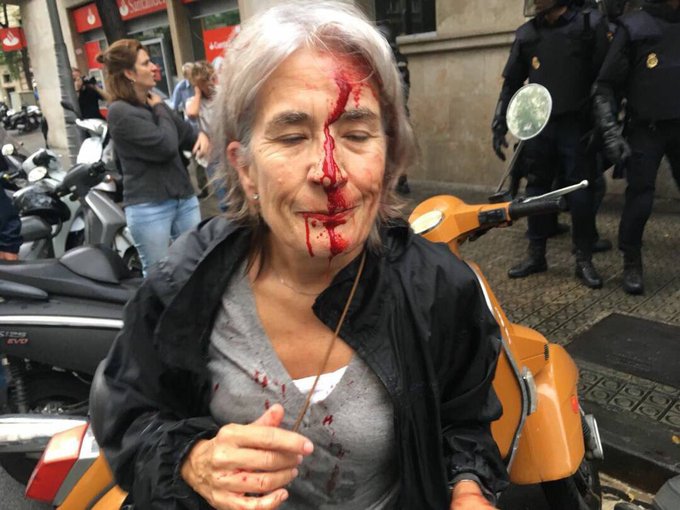
police brutality today in Catalonia (credit: Jordi Borras)


These images (from FB group We Stand in Solidarity With Catalans) aren't but a tiny relation of what has been happening today again in the forbidden Catalan Republic. And I suspect that it is only the beginning of something huge, because the general mood is clear: if they jail our leaders, they will have to jail millions of us. 

There are informal calls for long-standing general strike, for repeated road, railroad, airport and harbor blockades. Not sure what exactly will come out of this but it looks that, once again, we are in a proto-revolutionary scenario, at the very least in Catalonia. 

And let's not forget that Catalans are 7.5 million people, 16% of the population of the failed state of Spain, and also one of the most vigorous economic areas in spite of Madrid sucking every single large company or almost. 

As a side note, the government can't even pass the budget, because they can't muster a majority to do so, they are resorting to pointless resistance by means of the state apparatus, dominated by fascist currents like the greedy Catholic order Opus Dei, but they lack any sort of coherent governance beyond last trench repression without any sort of compromise with common sense and social consensus. 

The situation is anything but under control: the failed banana kingdom is one step or several closer to total collapse. And I will applaud when that finally happens, because in order to save the Spanairds (by force or grade) Spain must be destroyed, razed to the ground and power returned to the peoples. 

Gora herrien borroka! Long live the struggle of the peoples!

Monday, January 29, 2018

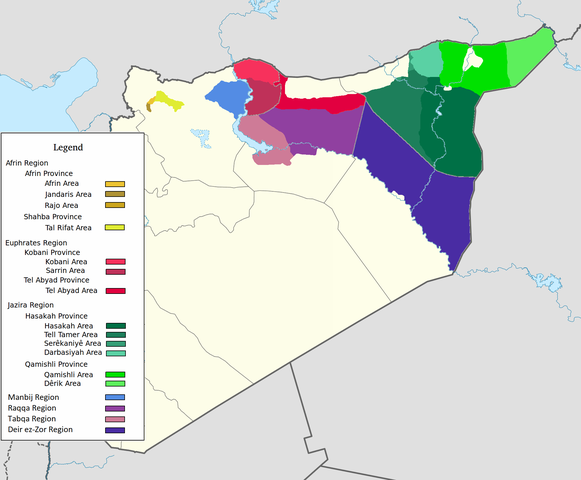
Afrin is the new Kobane, let us all defend it however we can

North Syria Federation
(credit: Editor abcdef, Wikimedia)
In yellow Afrin Region (canton)
Let's begin stating the obvious (but not so-obvious to many apparently):

1. Turkey has a fascist regime led by Hitler-loving and Islamo-Fascist extremist Tayyip Erdogan.

2. Russia and the USA are both capitalist (and thus imperialist) states: there is no monopolar imperialism, imperialism is by (Lenin's) definition the struggle of the various capitalist powers to control the world's resources and attempt to exert quasi-imperial or at least some relative hegemony over the rest. 

3. The SDF (Syrian Democratic Forces, organized around the Kurdish YPG/YPJ core) and the legitimate government of Syria (Baath, Assad) get along even if they clearly have different political projects: the former internationalist and Kurdish-centered, radically democratic and decidedly communist, the latter Arab nationalist (pan-Arabist), not so democratic (in spite of the reforms) and not so socialist (rather state-directed national capitalism). In spite of skirmishes and diverging international alliances this has been the case since the beginning, when the YPG coalesced as a Kurdish self-defense force.

Also maybe not-so-obvious to some may be the fact that Turkey has a huge army but that it is made up mainly of recruits, many of whom hate Erdogan (even by rigging the elections the Turkish neo-sultan only managed to get a narrow majority in parliament and needs the backing of the secular-fascists to stay in power). We have already seen in Ukraine how these conscription armies are very inefficient against motivated popular militias, notably when their commander regime is illegitimate and the war they are waging is as well. 

It is also important to underline that Syria has allowed massive YPG-SDF reinforcements to arrive to Afrin. And that Turkey is working with Islamist militias (roughly Al Qaeda and DAESH, just recently renamed again for PR reasons) just the same they used them as death squads in the brutal repression of the Bakur (North Kurdistan) uprising in 2014-15.

Both the USA and Russia court Turkey. The former want it to return to its former status of reliable ally (vassal) and thus are not taking active action in Afrin, where they are not present, but still signalling they won't retreat from Manbij or other lands of the Northern Syria Federation where they hold some military presence. The latter have snubbed their Syrian ally in regard to air protection of the canton of Afrin, as determined by truce agreements, because they clearly want Turkey to become yet another ally in the region, along with Iran (also anti-Kurdish) and Syria. The powers do not care about Afrin at all: they are interested mainly in the Bosporus Straits, which are Turkey's main asset, and secondarily in projection in the Fertile Crescent.


What's actually going on? 

As far as I can tell there has been heavy bombardment by Turkey of civilian towns, using chemical weapons in at least some cases, and even the destruction of a landmark historical ruin (a signature of Islamo-fascism) but on land Turkey and their allies have made only very limited gains. 

As of today Turkey has only occupied a hill on the border, hailed as a "great victory" by their propaganda machinery, of course. The initial attempts to take over the southeastern extension of the canton north of Aleppo failed, with many more casualties in the Islamo-Turkish camp than in the Kurdish Communist one.

However, let's face it, it's a David versus Goliath scenario in which, in spite of their bravery, the Kurds and allies (including as far as I know some internationalist units) have it very difficult. The same was true in Kobane and they prevailed though... on their own forces alone. 

I would expect that, as soon as the Spring arrives, the Kurdish forces north of the railroad (the official Syro-Turkish border is the old Baghdad railroad in most of its length) will initiate some sort of offensive, forcing the Turkish army to spread wide, but right now it is massively concentrated around the small territory of Afrin, the Mountain of Kurds.

  
Popular forces can win against all odds

But we have seen it before in Donbass and in Kobane: a motivated militia can certainly defeat a poorly motivated conscription army, never mind fascist mercenaries. Why do I "dare" to compare Donbass and Afrin: aren't ones in the side of Russia and the others in the side of the USA? The answer is "no": neither Russia nor the USA care much about their popular "allies", they
fear them in fact, precisely because they are democratic and popular, and only offer them very limited and conditional support at best. They are just forced to cooperate with them because of geostrategical reasons but always with the sight elsewhere: Kiev, the Bosporus, Latakia, etc. Who backs them is not important, what matters is that they are democratic and popular forces.

And I must say that it is most interesting that these great powers are being forced by circumstances, by the inefficiency of other more fascist or authoritarian approaches, to rely on these grassroots militias to some extent. It evidences that Lenin was right when he characterized Imperialism as a clash of oligarchic mafias on which we revolutionaries should not be too interested but rather on the possibility of making some revolutions in the cracks generated by this inter-imperialist struggle.These cracks are every day larger and democratic socialism is arising in them, not without difficulty but with perseverance and admirable toughness. 

And that's why we must help as much as we can to defend Afrin and denounce the Turco-Islamist criminal aggression: because it's not just the people of Afrin and the many thousands of refugees installed there, it's not just the right to self rule of the Kurdish and all other peoples, it is global revolution what is being fought there. Afrin is the linchpin of our hope for a better world, we can't just watch or ignore it.


Wednesday, November 15, 2017

Brian Becker on the Soviet Revolution

Quite an interesting interview with Brian Becker, author of "Storming the Gates: How the Russian Revolution Changed the World", on the Russian Revolution at Empire Files (TeleSur English):


Friday, October 27, 2017

Catalan Parliament approves independence

The Parliament of Catalonia approved this afternoon the independence of Catalonia (full text of the declaration, in Catalan). The voting was secret and the results were as follows: 70 yes, 10 against and 2 blank votes and 52 absentees (hardcore Spanish nationalists who don't recognize the right of Catalonia to self-determination). There seems to be one missing vote in the account, nobody seems to care.

People celebrate Catalan Independence near Parliament

With this action Catalonia ends all procrastination in favor of negotiation, which has not been listened to by Spain at all. On the contrary, the Spanish government, which is weak electorally but, thanks to the many tricks of the Neo-Francoist constitution still has absolute majority in the Senate*, and has managed anyhow to muster the support of the so-called "Spanish Socialst Worker Party" to approve also today the suspension of Catalan autonomy, activating article 155 or the Spanish Constitution, the kind of constitutional provision that Hitler was fond of resorting to in order to consolidate his power some 70 years ago.

Today a conflict between two sovereign states begins: one enjoys international recognition and has 95.000 police agents (plus the military, which won't surely be used because there's no war), the other is unrecognized (yet) and will fight only with the power of NONVIOLENT POPULAR RESISTANCE. Who will win?

I forecast that Catalonia will prevail. Why? Because they have already demonstrated their willpower, discipline and nonviolent firmness, in previous confrontations such as the referendum of October 1st, the General Strike of October 3rd and many other episodes of popular struggle in the last many years.

Against that determination Spain can only exert force. Its appeals to Catalan unionists to walk out have failed (sure: they brought many buses from Spain proper but rallied very few people from Catalonia itself) so they only have the farce of Spanish laws and courts that are, since today, not legal in Catalonia anymore. And they have 95.000 ill-paid and overworked police agents who will soon be shown as useless to implement Spanish law against millions and millions of disobeying Catalans.

Catalonia is Kosova on steroids: it is much larger, richer and visible than poor little Kosova was when it had to confront, in the pre-Internet era, a similar situation. Back then it was obvious that any solution not implying the independence of Kosova would fail. It took eight years of very brutal Serbian occupation but they eventually succeeded, not without a blitz war.

The situation is nevertheless different in Catalonia: Kosova did not matter, it was a mere humanitarian issue, but Serbia/Yugoslavia did not matter much either. Spain however has major geostrategical relevance because of the Strait of Gibraltar (plus French historical backyard geostrategy), so its NATO allies won't betray her. But Catalonia also has major strategical relevance, being one of two main knots linking the Iberian Peninsula to Europe (the other is the Basque Country) and this is a trump card the Catalans can play: sabotaging via strikes and blockades the commercial routes will no doubt have a demolishing impact in Spain's economy and its international reputation. 

Additionally Spain is effectively bankrupt: only the European Central Bank buys Spanish bonds these days, the pensions' reserve fund has been exhausted and Spain is financially unable to pay for almost anything. This is going to lead to a major crisis in Spain but a crisis that will shatter Europe and the World. Because so far the bankruptcy crisis had been delayed in Europe so far but now it will become absolutely unavoidable. 

That's the bargaining chip of the brave Catalan People: that's how a People determined to fight (noviolently) can bring the World to a halt. 

Catalonia will be free. The whole World Order (itself in deep crisis) cannot impede it. How could it? Catalonia is (together with the Basque Country) the motherland of Insubmissió: some three decades ago we gloriously defeated the Spanish Army with NONVIOLENT RESISTANCE, and Catalan society has learned that lesson well, probably better than us Basques. They cannot be defeated, they will prevail and teach the World a lesson.

_____________________________

* Every Spanish province, regardless of population or ethnicity, gets 4 senators, three of which go to the most voted party and the fourth to the second one. Most Spanish provinces are rural, nearly empty provinces of Castilian or assimilated ethnicity.

Wednesday, October 18, 2017

Spain imprisons Catalan "Gandhis", Catalonia walks out in protest

Yesterday morning the Spanish Inquisition (Audiencia Nacional, its conceptual heir) jailed Jordi Sánchez (Catalan National Assembly) and Jordi Cuixart (Omnium Cultural), leaders of two of the most important social movements that have been pushing ahead with Catalan patriotic mobilization and the process of self-determination.

Freedom Jordi Sánchez and Jordi Cuixart. We want them at home!

Protests have been massive across the country. Another sign of Catalan independence being absolutely impossible to repress:


Barcelona (1)

Barcelona (2)


Palma de Mallorca (Balears)


Ripoll


Sitges


Vilanova i la Geltrú

There have been also some protests in Madrid, the Basque Country, etc.

(Credit for most pictures: CjSand).

Monday, October 2, 2017

Catalonia defeated Spain by sheer will of freedom

Yesterday it was a most important day. You all surely know by now about the brutal repression by the Spanish police forces against the Catalan independence referendum and, most importantly, about the brave popular resistance by millions of self-organized citizens in each and every electoral center. 

2.262.424 Catalans managed to vote and had their vote counted. Electoral centers including other 700 thousand electors were closed by the repressive forces. The electoral census is 5.3 million. Among the votes issued and counted the results were: 2.020.144 (90,09%) "yes", 176.566 (7,8%) "no", 45.586 (2%) "blank" and 20.129 (0,89%) "null votes".

One could get lost arguing on the validity of the vote under such quite obviously exceptional and most difficult circumstances, what really matters is the civic pride and nonviolent power demonstrated by the Catalan People, and, on the opposite side, the blind brutality shown by the Spanish state, determined to defend the francoist concept of "indissoluble unity" of the state no matter what. 

What really matters is that, maybe more than ever before, the State of Spain has been shown to be morally bankrupt, a true failed state in the making. Hopefully the socio-political crisis will extend to the rest of the lands occupied by the residual empire. Some signs of it happened yesterday, with thousands protesting in Madrid and Seville, among other Spanish cities (and also in places like London, and earlier in Bilbao and Amsterdam, etc.) in solidarity with Catalonia and its right to self-determination.

Tomorrow there is a General Strike called in Catalonia in support for this right to choose but, quite obviously, marked also by the rejection to repression and authoritarianism. Even if the unions calling for the strike are relatively small (nationalist union COS and libertarian unions CGT and CNT), the strike is backed by the major civic force in all this Catalan uprising: the Catalan National Assembly (ANC) and its right-wing ally Omnium Cultural, as well as by key political forces like the Popular Unity List (CUP), so it is predictable that it will be a massive walk out. 

However this is only one step and one restricted to Catalonia. In my opinion, what will be critical now is whether Spaniards themselves will begin mobilizing, not just or mainly in solidarity with Catalonia, but on their own platforms such as the demolition of the mafioso authoritarian regime consecrated by the controversial constitution of 1978, which was agreed behind closed doors and backed mostly because anything was better than the Fascist dictatorship. 

The constitution is nearly impossible to reform (needs a wide agreement of all-Spain parties because of a horrible electoral system that massively favors rural Castile and hence conservative forces), so only forcing the hand of the twin party system PP-PSOE will work. It's even reasonable to consider that only a true revolution, a constituent process from below, will do the job. 

Sadly enough, the big political hope of Spain, the novel party Podemos (We Can) has so far limited itself to posturing. They basically seem to restrict themselves to try to form a coalition with the PSOE (center-left?) and only very slowly advance on the path of reforms. Clearly insufficient. Also they are clearly renouncing to resort to mass mobilization, which is happening on its own, and they have growing internal quarrels.

So it is unclear how the situation will evolve. Yet it is clear that it is evolving and very fast. 

Once again my applause and respects to the brave People of Catalonia for daring to defend their freedoms in what is clearly an example for the rest of Europe and the World. Visca Catalunya lliure! Viva the struggle of the Free Peoples!

Friday, September 22, 2017

Barcelona is Tahrir Square 2017

The mobilization in Catalunya is very impressive, massive, total, truly revolutionary, a true constituent moment in the making.

Barcelona, yesterday night.


Against that what can the Spanish state, with a corrupt government with minority backing in Parliament, representing more than ever before the (barely reformed) Fascist nature of the state? Well, they are throwing in everything they have, which is brute force. Thousands of police agents have been moved to Barcelona and hosted in three cruise vessels... like this one:


Total failure, right?

It's "Brand Spain", also known as "ACME". And this is the most likely result:


It's not just a "marketing" failure, it's not just surrealism at its best (or worst), it is that with every single repressive move more and more people join the rebels. People who were not in favor of the referendum now favor it, people who were not in favor of independence now say they will vote for it, even in Spain proper the mobilizations in favor of Catalonia are much larger than those against it, which so far have not gathered more than a handful or two of fascists. 

The dock workers have rejected to serve the three police ships, Catalan unions have called for a general strike beginning on October 3rd (the referendum will be on Oct. 1st), in Madrid a demonstration aiming to "surround Congress" has been called for Oct. 5th, these days we have seen thousands of people demonstrating in solidarity with Catalonia all around the rest of the Spanish state, plus also very large protests against local issues (Murcia) or general most serious affairs (Linares). If Madrid keeps the repression against Catalonia they are going to see how the Catalan fire expands to all the peninsula, there's no way around that, particularly because there is no end to the Catalan "Procès" other than independence (or its defeat via referendum, most unlikely at this point). And they just do not have enough cops...

Remember that moment in the Tunisian Revolution of 2011 when the protesters realized that they were many many more than the cops, pushed back and won?

Remember that moment in the Egyptian Revolution of 2011 when the police van shooting water cannons against the demonstrators run out of water and had to retreat, allowing the People to take Tahrir Square again?

That moment will happen, somehow, at some point, also in Catalonia and maybe even in Madrid soon, the rage is just too big and the regime too stagnated, corrupt and discredited. The #MAMBO has just begun. Pay attention because this is most important not just for Catalonia, not even for Spain, but for all Europe.

Wednesday, September 20, 2017

Catalonia: Spain escalates repression, shoots itself on the foot.

Military police car taken over by protesters
Telegraphically: This morning the Spanish state has assaulted the Catalan Government (Generalitat) and arrested 12 people, including many high officers of the elect government. Last minute info indicates that masked police forces have surrounded the offices of the radical left independentist party Popular Unity Lists (CUP). Several separatist parties have abandoned the Spanish Congress as result. The center of Barcelona is full of people in spontaneous demonstration. Protests are being held in other places as well, including here in Bilbao (Basque Country). The only de facto all-Spain opposition party Podemos has called for a conference of mayors and other elect officers tomorrow in Zaragoza (the Spanish nationalist right-wing parties PP and Ciudadanos have not been invited, the Spanish nationalist center-left PSOE has rejected to go but all other forces are going). While we can't say the situation is "revolutionary", it is certainly most anomalous and in many sense "pre-revolutionary", particularly because the Spanish state cannot effectively fight against the peoples, much less with the extremely low level of legitimacy it has after so much corruption, austericide and repression. We cannot exclude at this point that a general strike of political nature could be called, even if the main unions are quite sheeply and definitely unionist.

The situation is definitely critical in any case. Some relevant Twitter hashtags: #ReferèndumCat, #MAMBO.

Thursday, April 20, 2017

Lenin's April Theses 100 years later

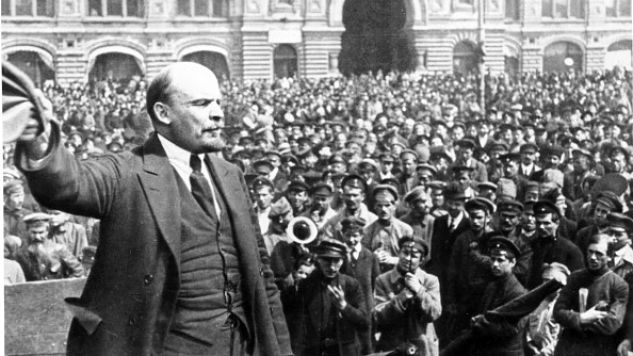
On April 17th, one century ago, Lenin announced what can be understood as the manifesto for the Russian Revolution, known to history as the April Theses. 

Sputnik News has a very cool and detailed infographic on them, go take a look.

The full name of the text is actually The Tasks of the Proletariat in the Present Revolution, it is freely available at Marxists.org.

Context: after the February Revolution, there was a provisional government led by liberal (i.e. center-right) Georgy Lvov and dominated by the Kadet party (also liberal in the classical sense of strongly capitalist). While other "socialist" factions had minor representation in this provisional government, the Bolsheviks did not partake of it. There was however a parallel government in the form of a loose network of local soviets (worker councils), dominated by the Soviet of Petrograd.

On April 16th Lenin arrived from Zürich in the famed train episode and thus the following day he spoke in Petrograd. What he exposed in two successive discourses became known as the April Theses.

A synthesis of the theses may be:
  1. No to the imperialist war, democratic and not violent peace. A revolutionary war may be acceptable but only if: 
    1. The power is in the hand of the working classes (proletariat and landless farmers)
    2. Nothing is annexed
    3. There is radical break with the interests of Capitalism
  2.  Russia is in the first stage of the Revolution, which gave power to the bourgeoisie, but there must be a second stage in which the power passes to the working class. This first stage caused class consciousness to extend to the masses and this newly born consciousness must now serve real emancipation.
  3. No support for the Provisional Government, which he dubs deceitful and confronted to the real interest of the Russian masses.
  4. Acknowledging that the Bolsheviks were in the minority in many soviets, which were controlled by the social-reformists (Social Revolutionary or agrarian populist party and the left wing of the Kadet or liberal party). However the soviets are the only possible form of popular revolutionary government and the Bolshevik task in them must be to expose the treason of the Provisional Government.
  5. No support for a parliamentary republic (a backward step) but for a republic of the soviets. Abolition of the police, army (to be replaced by arming of the whole People) and bureaucracy. Limitation of salaries of all officers, who are to be replaceable at any moment, by that of a qualified worker.
  6. Agrarian programme: confiscation of all landed estates, nationalization of all lands (to be managed by the soviets), creation of "model farms" in all expropriated latifundia.
  7. Fussion of all banks into a single national bank under soviet control.
  8. Bolsheviks should focus on bringing all the economy into the hands of the soviets. 
  9. Call for an immediate Congress of the Bolshevik Party, renaming of the party (would be Communist Party, following Marx' preferences), modification of the party program, mainly on the issues of imperialism and war, on the preference for a "commune state" and on the predicted calendar.
  10. Forging of a new International against the "social-chauvinists" (would be "social-democrats" by our modern terminology). 
Hardly anything to object to Lenin in this moment: I can perfectly embrace his program in full. Daring he may be but daring we must be if we are to succeed. So far so good but history doesn't stop.

Wednesday, March 8, 2017

March 8 1917-2017

Happy and combatant Working Women's Day. 

Today, one hundred years ago, began the Russian Revolution. Its first phase to be precise, the so called "February Revolution" (the Julian calendar in use in Russia back then was 13 days off relative to the Gregorian one). It was the beginning of a revolutionary cycle that affected not just Russia but much of Europe. 

The situation was dire in Russia, the war had been lingering for years already and the masses were utterly exhausted by the ever-growing demands of the totalitarian regime and the war effort. Let's not forget that most of those killed in World War I were subjects of the Russian Empire. 

Since March 3rd, strikes had been popping around like mushrooms, the most famous one being the one at the huge Putilov factory. On March 7th, in spite of the unrest, the Tsar left for the front. On March 8th worker women marched in large numbers demanding something as basic as "bread", their striking male comrades joined them. It was a general strike at the capital of the most backward and reactionary state of Europe.


On March 9th the protesters gathered hundred of thousands and they already demanded the head of the autocrat. By March 10th, in spite of the prohibition, the marches broke all records, not a single industry was active in the city. Four people were killed but the uprising did not stop at all. 

On March 11th an inexperienced commander, General Khabalov, was ordered to put down the protests at any cost. On March 12th the city was besieged by his garrison. However soon troops began quarreling among them and one company was the first to mutiny, opening fire against the police.

That very same day the Petrograd Soviet was formed, while the (very conservative and not really democratic) Duma had been rendered ineffective by an imperial edict.

Before the day was over, four regimients mutinied and even the usually loyal cossacks hesitated. Officers were killed or had to flee for their lives.

The next day, Tsar Nicholas attempted to go back to Petrograd but could not reach it. His guards either deserted or declared "neutrality": the fake Emperor's clothes were gone. On request of the Duma, the Tsar abdicated. Few days later a provisional government under Octobrist (conservative) Rodzianko was formed.

In five days or so, Russia had gone from totalitarian empire to unstable provisional republic(?) That's how revolutions happen: they may only throw down rotten structures but when they do, they are fast and merciless.

In the following months the two opposing powers: the soviets (popular councils) and the Duma will go on a crash course. It may sound "unreal" but this is true history: this actually happened... and will happen again with whatever variations, because the real issues have never been solved but rather just aggravated.

As La Polla Records sang:
This story that was maybe true
seems a lie, we're going to tell it anyhow.
In the Russia of the beloved Tsar
lived a peasant named Ivan,
toiling the land without rest,
always hungry, no time to think.
Sowing, sowing and sowing yet again,
and Count Borrowich gets all the harvest,
the petty priest asks for resignation,
invites himself to Ivan's home
and he eats all the best. 
Ivan was there... (chorus, thrice)
A good day he worked with the hoe,
came some men, they told him: Comrade,
There are no more masters to whom obey,
you are a free man, we've taken power!
Thinking, thinking and thinking yet again,
Ivan gradually gets used to the idea:
the nobility has been deposed,
there will be no more jerks living at his expense.
Ivan was there...
Jumping around one-legged
the sickle and the hammer in the red banner,
with effort and some attention
what extreme flips reality makes!
Hurray!

Original song in Castilian (Spanish):


Sunday, February 19, 2017

How to commemorate the centenary of the Russian Revolution?

I've been chewing on this now and then for some months but really, had not come to any conclusion before seeing the curious concept promoted by RT of #1917Live, a Twitter dramatization of sorts (although subject to all kind of adherences and even trolling, as usually happens in Twitterspace).


So I'm thinking that indeed the best way to cover it is maybe to now and then (weekly?, on special occasion days?, both?) to mention what was happening in Russia (and for context maybe elsewhere). I'm not any expert on Russian Revolutionary history but I'll try to get my facts as straight as possible. Also it will probably be useful to discuss more in depth some characters, factions, episodes...

For example I stumbled today with this History on Trial video on Vladimir Lenin, which is probably about the fairer trial he may get in Western media (yeah, TED is quite Westernist most of the time but still they do a good job here):


So what was happening in February 1917? Well, not yet the February Revolution, which actually happened in early March (blame the Julian calendar for the offset) but certainly the mood was getting quite hot: the war (World War I) was raging and Russia was faring quite poorly, with six million Russians dead for a cause that was not even clear, and famine becoming way too prevalent in the midst of the freezing Russian winter. The Tsar, Nicholas II Romanov, had even rejected to form a constitutional government, alienating much of his own entourage, who hoped for some reforms.

So the Tsar figuratively tweets his worry about treason and deceit all around him... but who is to blame? Is it once again the Russian People (and various oppressed nations such as Poles, Finns, Uzbeks or Georgians) going to die in troves for the Tsar for no obvious good reason? Not this time: the Revolution has not yet begun but decades of worker struggle precede this fated year of 1917. Even a failed revolution has happened 12 years earlier, also after a catastrophic war (against Japan), which was bathed in blood by the autocrat. This time it will be different but the people living it do not yet know.

It is in this period of the 1905 Revolution in which the genial filmmaker Einsestein placed his famous movie Battleship Potemkin:


A bit of background

Before I close this introduction it may be worth mentioning some of the factions that will show up. It wouldn't be Marxist enough if we did not consider class structure first of all: there was a growing but still minor urban working class or "classical proletariat" (of which 82% worked in companies larger than 100 workers and 40% in mega-industries with more than 1000 workers) but the vast majority (80%) of the Empire's population were still rural farmers. Most had been slaves (serfs) until a generation ago but formal emancipation had not ended their troubles at all, lacking as they were of land to farm. In some areas, particularly towards the West (formerly part of Poland or Sweden), there were yeoman farmers, but otherwise the land was property of large aristocratic landowners and to lesser extent communal property of villages.

After 1905, the Tsar agreed to create a parliament called the Duma, however it was soon to be reformed in a reactionary way, making the electoral system very favorable to the aristocrats and anyhow with the autocrat always able to bypass it. It is in this period when the two main "liberal" (bourgeois, capitalist) parties emerged: the more left-leaning Kadets and the very reactionary Octobrists. Socialists of all types boycotted the Duma (although a few individuals were elected to its early version) but they were growing strong at the sidelines of the regime. 

These Socialists had initially two parties: the Socialist Revolutionary Party or Narodniki (Populists) had an agrarian base, was rather bourgeois-leaning and definitely not Marxist, the Socialist Democratic Party had an urban base and was part of the wider Socialist International, then still dominated by Marxist ideology. However in 1904 the Russian SDP split in two: one faction, led by Vladimir Ilyich Ulyanov "Lenin", more radical and claiming to be the The Majority (Bolshevik in Russian) and another one, more moderate or reformist, called The Minority (Menshevik in Russian), led by Julius Martov. Both claimed to be the real Socialist Democratic Party of Russia, so they were distinguished by these labels. They reunified in 1906, with the Mensheviks becoming the majority, rather counter-intuitively, but split again in 1912, this time for good. 

One of the main differences was that the Mensheviks were skeptical of the chances for a socialist revolution in underdeveloped Russia, while the Bolsheviks thought there was no harm in trying. The Mensheviks also sought their allies among the liberal-bourgeois, while the Bolsheviks strongly preferred the peasantry instead. This same story would repeat later in China, albeit without a formal split of the Communist Party, as Stalin's Komintern and the official PCC leadership did not believe in the chances of a socialist revolution there either, preferring to cooperate with the Kuomintang "nationalists", but Mao and his rather unorthodox faction did and actually succeeded in due time. 

Another Socialist faction we just cannot ignore were the Anarchists or Libertarian Socialists/Communists (naming conventions have changed through time and tendency). A venerable figure was still alive when the Russian Revolution unfolded, Piotr Kropotkin, but he had been exiled in Western Europe since 1876. He returned to Russia in 1917 and live there until his death in 1921, being openly critical of the Bolshevik takeover, as he was strongly against authoritarian socialism, which he had predicted a failure ultimately. His funeral would be the last tolerated anti-Bolshevik demonstration in many decades. 

But there were others much more active in these troubled times. In 1881 they even managed to kill Tsar Alexander II, and, a few years alter, in 1887, they failed in a similar attempt against his heir Alexander III. Lenin's older brother Aleksander was the leading conspirator and was therefore executed. A little star shines in his memory (no kidding: asteroid 2112 Ulyanov is named in his honor). Anarchist agitation and armed struggle became very important around 1905 but Tsarist repression was brutal and they were pretty much annihilated by 1909. However they will resurface in 1917, being an important faction in the Soviet movement, in an uneasy alliance with the Bolsheviks, who also nominally supported the soviets (councils), so it is important in all this historical review to ponder what do we mean when we say "soviet": do we mean the autocracy implemented by Lenin's Bolshevik Party by usurping the power of the soviets or do we mean the original grassroots assemblies that represented the working classes?

Anarchists would also become very important after the retreat of the German occupation force in 1918 in Eastern Ukraine (now again shattered by rebellion and struggle against tyranny) under the leadership of Nestor Makhno, and traces of their ideals (all the power to the soviets, a demand usurped by Lenin to his authoritarian convenience) were also present in the Krondstadt uprising, made by Bolshevik Party member soldiers to a large extent.

Back to the Bolsheviks, three characters are particularly important and will come once and again as History unfolds: Lenin, Stalin and Trotsky. Who were these guys? 

I have already outlined the role of Lenin in the formation of the Bolshevik Party, of which he was unquestionable leader all the time. He was also a very notable intellectual, whose work is very much worth reading regardless of what we may think of him. He was imprisoned in Siberia at the end of the 19th century and soon after he founded the newspaper Iskra (Spark). In 1902 he published his most famous work, What Is To Be Done?, in which he argued that class consciousness was only achievable by activism and agitation outside of the industries, that worker spontaneous self-organization can only lead to limited and limiting trade-unionism and not to revolution. There is a point to make from the perspective that only time can give that he may have been right for the Fordist period (formal subsumption of work into capital in Marx' terminology) but that since the arrival of Toyotism (REAL subsumption) and its political branch Thatcherism/Reaganism, unions are pretty much done and the only real sphere remaining for the workers' struggle is certainly outside the companies, where repression is simply brutal and organization tends to zero way too rapidly. An open debate of course. 

Another seminal work of Lenin is Imperialism: The Highest Stage of Capitalism, which comes very handy today as well, as the term "imperialism" is used often and many geopolitical situations resemble very much the inter-imperialist struggle between the great powers of the early 20th century, at least to some extent. In this work he opposed the views of Kautsky (one of the founding fathers of Social-Democracy as we know it today), who argued for the unavoidable cooperation of all capitalist powers in the exploitation of the global periphery (colonies and semi-colonies, the Third World in modern terminology). Lenin correctly argued that imperialist tendencies would instead cause conflict among the various capitalist powers, increasing the contradictions. One could argue that Lenin "cheated" because he wrote that in 1917, after WWI was well advanced, while Kautsky had published his work in 1914 instead. But, "cheat" or not, he was clearly correct and we can see the same happening today with tensions rising between the various capitalist powers: US-China rivalry on top of all but also the US siege of Russia, the, barely hidden, growing tensions between Germany and the Anglosaxon power ring, etc. He also transferred the focus of revolution to the periphery and, at least for the 20th century, he was again right, even if there is much to debate about whether those revolutions are genuinely socialist or rather sui generis versions of Capitalism, a Capitalism without bourgeoisie, which otherwise would be just subservient to the core powers ("comprador bourgeoisie") and hardly a national development force.

One of the early critics of Lenin was Lev Davidovich Bronstein, an Ukranian better known as Leon Trotsky, who was confronted with the Bolshevik leader at the split of the SDP in 1904. However he soon became an "independent" because the Mensheviks were clearly aligning themselves with the liberal bourgeois parties. He worked to reconcile the two factions to no avail and in 1917 he finally joined the Bolshevik Party, where many looked at him with distrust. His main theoretical work is the theory of Permanent Revolution (later partly adopted by the Maoists). The term was originally coined by Marx in several passages, so Trotsky is mostly extending on these early approaches of the genius of Trier. However, much as Lenin, Trotsky has a peripheral focus and thus he argued (correctly) that in Russia the bourgeoisie cannot make a successful progressive revolution but that only the proletariat can do it. This part of the theory, very innovative, was partly adopted by Lenin (April Theses) and was initially rejected even within the Bolshevik Party, however it would later become mainstream. But Trotsky also sustained that the revolution in a single country would unavoidably fail, unless it was quickly followed up by revolutions in other states, a concept never fully debated by the Bolsheviks and clearly opposed by Stalin. The key idea of Permanent Revolution in any case seems to be that the global working class (Humankind by another name) cannot falter until socialist goals have been thoroughly achieved, at risk of success of bourgeois reaction. 

Finally we won't forget the fierce Georgian activist who would eventually become sorta-Tsar himself, Ioseb Besarionis dze Jughashvili, who eventually adopted the alias of Stalin: Steel Man. He would be described today as a "terrorist" no doubt, leading part of the Bolshevik party into acts of robbery, extortion and assassination with terrible clarity and outstanding leadership. While he did write some articles and is co-author of the post-revolutionary concept of "Socialism in one country" (opposed to Trotsky's frantic Internationalism), Stalin was mostly a man of action and doubtlessly a most clever conspirator, whose power grew at the shadow of Lenin, within the Party's activist class preluding the kind of state he would eventually rule and largely shape.

Sunday, April 10, 2016

The social uprising continues in France

As predicted last week, in spite of police repression and significant under-reporting by the bourgeois media, the 2016 Spring protests in France continue with much increased strength a week after they began. 

The trigger is the "loi travail" (labor law), which seeks to cut down worker rights to nothingness and get rid of the 35 hour week conquest (also in effect in some other European countries like the Netherlands), taking as unlikely "model" the collapsed economy of Spain, where there are effectively no more labor rights to be scrapped and yet does not recover at all, with unemployment well over 20% (around 50% among young people) and nearly every single new job as precarious as walking over a tight rope. In other words: the consacration of the "precariate".

In such a situation, even if all this began with a symbolic 24 hr general strike, the right to strike is very diminished and the class struggle takes instead the form of street protests (often illegal because human rights are also under heavy institutional attack), square occupations and electoral politics when possible. 

That's how happened in the very authoritarian scenarios of Western Sahara, Tunisia, Egypt, peninsular Arabia and Turkey, but also in the more "liberal" ones of Greece, Spain or the USA. And now also in France, several years later, with renewed vigor. These strong protests, regardless of their success, evidence that repression is useless or nearly so, unless they go the way of Saudi Arabia, i.e. the way of total fascism (and even then it is most unclear how much longer the Arab theocracy can go on without the unavoidable revolution). 

Even if the revolt has been triggered by the labor law, the goal of the protest remains undefined and is clearly much wider, albeit imprecise. The attempt to impose permanent martial law with the pretext of the Islamist terror attacks, for example, has also caused such unease in the Hexagon that it actually failed. There is a very clear and very strong discontent with the falsehood of the "socialist" label in the French Socialist Party (PS), a party that Paul Lafargue, the first ever socialist MP of France, would fight against no doubt. Not in vain Lafargue, Marx' son-in-law, wrote The Right to Be Lazy, demanding a 20 hr week (on average) already a century ago, but also because he was strongly opposed to the reformist (now already markedly reactionary) tendency led by Jaurés.

I don't feel able to synthesize what exactly is going on in France right now, so I suggest that you check #NoitDebout in Twitter (at a rate of a new tweet every few seconds) or read dedicated media like Paris-Luttes (most is in French though). If you know of other resources (maybe one in English?), please let me know.


In Britain also

Although newer and triggered by the Panama Papers, so maybe not fully comparable, there are also important protests in Britain, demanding the resignation of the conservative Prime Minister David Cameron, after it was known he had an account in a tax haven until recently. Obviously it is not the only motivation: his policies are also hated by many Britons, who nevertheless in many cases did not want to vote "labor" because the party was perceived then (before Corbyn's election) as nearly the same thing, allowing the Tories to achieve a strong majority. In real terms the support for Cameron's government is anything but mainstream. 

Both countries share a very poor representation problem, having old-fashioned single district electoral systems, which can hardly be considered "democratic" at all. 

Wednesday, January 13, 2016

Saudi Arabia's swan song

Main sects in West Asia
The current developments in West Asia clearly signal the end of the Saudi monarchy: they are trying to control much more than they can ever hope to manage while they have less legitimacy than even North Korea or Israel. 

It must be said first of all that the prominent human rights leader that the House of Saud murdered a few days ago, Nimr al-Nimr can only be compared to figures like Martin Luther King or Monsignor Romero, with whom he shares the cleric profession and now also the condition of martyr, not a mere religious martyr but a martyr for freedom, respect and common sense. 

As the other religious-political figures I mention here, he led a peaceful protest movement against oppression and injustice, against the worst tyranny on Earth: the House of Saud. Not an easy task, he surely knew the risks since day one, yet he and his sympathizers dared to challenge the totalitarian theocracy and hope for the best. The best hasn't come, not yet certainly. The Saudi mafia smashed them mercilessly and invaded Bahrain, where a sister movement was about to topple a similar tyranny. 

I must say that I that I do not share the faith of any of the aforementioned leaders but, even from this significant ideological distance, I must speak for their courage, as well as for that of the many less known people who also fought for freedom, with them or in other places, occasions, movements. 

By killing him, the House of Saud has only brought one step nearer its own end: martyrs are way too often the light that guides peoples to fight for freedom. Making martyrs is a most risky bet, one that even the stinkingly rich House of Saud can't afford to make. 

Much less when they have their hands full with problems they are unable to manage. 

I was reading the almost invariably lucid Pepe Escobar on this matter and I must agree with him: Saudi Arabia does not know how to play geopolitical chess... or backgammon either. I'm an enthusiast of good boardgames and particularly the game of Diplomacy (best multiplayer boardgame ever, not for the faint hearted) and you definitely don't play that way, or rather: you don't play that way and have any chances at winning or even surviving. You do not, definitely, want to fight many conflicts in many different fronts at the same time, you do not definitely want to get into a new war before winning the previous one, and, if you depend on some protector, as the Sauds do, you do not want to cause more trouble than they are willing to put up with, lest you will be sacrificed. 

If at least the Sauds would have a slim hope of winning any of the impossible scenarios they have gotten themselves into, be it Syria, Iraq or Yemen, be it Bahrain or its own internal instability, let alone a possible scenario of direct war with Iran that would automatically cut off global oil provisions for a long term... but they do not. Unlike in the game (can't be that good: the map is not reality), it's not just about winning battles and conquering provinces: in real life you have to win peace, and that's the hardest part of all. And a ridiculously pompous absolutist intolerant sexist medievalist theocracy has not the slightest chance to win even within the palatine circles, every day more agitated at the extreme risks assumed by the new king, by the name of Salman, a very elderly man, and his appointed heir (and de facto ruler) Prince Mohammad. 

It is as if the reactionary European order that dominated the 19th century was managed not by consensus of four or five major powers but single-handedly by King Ludwig "the Mad" of Bavaria. Even Mad Ludwig was not as mad as to attempt so much but his decadent lifestyle ruined the country, Ludwig was deposed and Bavaria was annexed to the new state of Germany, with the only remaining privilege of issuing its own stamps.

Is that the destiny of the palaces of the Saud clan? Probably. I can't define a precise timeline but it is every day more clear that they are totally desperate and that Fate only awaits for the best moment to topple them. 

When Fate decides is the right time, the tyrant will be toppled from inside, maybe after growing unrest, probably after some foreign policy fiasco such as the foreseeable loss in Syria and Iraq in few months, much as happened to Mubarak. A gattopardist regime, probably under some other prince, will then take power and try to bargain some reforms, not too many, but without clear legitimacy and with growing pathetism in every action, things may well spiral out of control and get the realm split in three or more states: a conservative stronghold in the center, an unstable most populated region in the West and a Shia-dominated republic in the East, possibly joined with Bahrain and normalizing relations with Iran and Iraq. This Shia-dominated East is where all the oil is. 

The model that worked until Bush Sr. tricked Iraq into a pointless war, destabilizing everything, was a model established almost a century ago by Britain: the resources were not in the hands of the inhabitants or even some sort of arbitrary but locally legitimate figurehead, but in the hands of rather alien Sunni Arab powerhouses. These powerhouses have been terminated thoughtlessly by the twisted games of the Bush clan, out of fear of secular pan-Arabism and the desire to reinforce the direct military presence in the strategic inner sea. Ironically enough Saud can't exist without Saddam: in spite of one being fanatically religious and the other presumptively secularist, both exerted the domination of Sunnis over Shias by Machiavellan British design inherited by the USA. This kind of undemocratic power system just cannot work in the present time, not for long at least, and therefore the House of Saud is bound to fall. 

There is a lot of confusion about what is the so-called "Arab Spring" among certain Left, which confuses the genuine desire for democracy and human rights, maybe even some degree of socialism, with the crude manipulations of the Western powers. No revolution exists in a vacuum and the Arab one could not be different: the various powers will no doubt intervene one way or another, with more or less success, but the revolutionary process in itself was and is genuine. And it has not yet ended, not at all.

Wednesday, April 8, 2015

The first Communism, 144 years later.

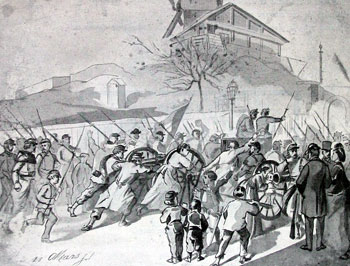
These weeks we commemorate the 144th anniversary of the Paris Commune, the first ever Communist regime, radically democratic and the reference that Marx and Engels adopted as model for the dictatorship of the proletariat.

Naturally the reference work is Marx' The Civil War in France, including the very insightful prologue by F. Engels.

But for those with the inclination for the video format and the patience to watch a long movie, a most interesting take is Peter Watkins' La Commune (Paris, 1871), which, using the anachronistic narrative device of introducing television in the 19th century, reenacts the events:


Also, for those who understand Spanish, I believe that this debate in Escuela de Cuadros (Cadres' School, TeleSur program) is a very interesting complement:


Now, maybe more than ever before we need to retake the concept of Communism and restore it to its originally radical democratic nature, democracy that cannot be just restricted to elections every X years but that, as in the Paris Commune, must imply the election of all offices and their revocable nature. It also cannot be restricted to mere political democracy but must imply economic democracy, that is the collectivization of all means of production and livelihood - property is an unbearable privilege that must be abolished in favor of true democracy.

We shall prevail because Capitalism is unable to face the catastrophe it has created, only an organized and conscious People, Humankind, can do that. Revolution or extinction!