Showing posts with label history. Show all posts

Sunday, July 15, 2018

The Perestroika that could be but was aborted

Fascinating first-person narration by Prof. Buzgalin, back then a young Marxist enthusiast who tried, with some success, to push for a real democratic collectivism in the late USSR.


Part of a series of 12 episodes on the collapse of the USSR that you can watch at The Real News.

Wednesday, November 15, 2017

Brian Becker on the Soviet Revolution

Quite an interesting interview with Brian Becker, author of "Storming the Gates: How the Russian Revolution Changed the World", on the Russian Revolution at Empire Files (TeleSur English):


Thursday, April 20, 2017

Lenin's April Theses 100 years later

On April 17th, one century ago, Lenin announced what can be understood as the manifesto for the Russian Revolution, known to history as the April Theses. 

Sputnik News has a very cool and detailed infographic on them, go take a look.

The full name of the text is actually The Tasks of the Proletariat in the Present Revolution, it is freely available at Marxists.org.

Context: after the February Revolution, there was a provisional government led by liberal (i.e. center-right) Georgy Lvov and dominated by the Kadet party (also liberal in the classical sense of strongly capitalist). While other "socialist" factions had minor representation in this provisional government, the Bolsheviks did not partake of it. There was however a parallel government in the form of a loose network of local soviets (worker councils), dominated by the Soviet of Petrograd.

On April 16th Lenin arrived from Zürich in the famed train episode and thus the following day he spoke in Petrograd. What he exposed in two successive discourses became known as the April Theses.

A synthesis of the theses may be:
  1. No to the imperialist war, democratic and not violent peace. A revolutionary war may be acceptable but only if: 
    1. The power is in the hand of the working classes (proletariat and landless farmers)
    2. Nothing is annexed
    3. There is radical break with the interests of Capitalism
  2.  Russia is in the first stage of the Revolution, which gave power to the bourgeoisie, but there must be a second stage in which the power passes to the working class. This first stage caused class consciousness to extend to the masses and this newly born consciousness must now serve real emancipation.
  3. No support for the Provisional Government, which he dubs deceitful and confronted to the real interest of the Russian masses.
  4. Acknowledging that the Bolsheviks were in the minority in many soviets, which were controlled by the social-reformists (Social Revolutionary or agrarian populist party and the left wing of the Kadet or liberal party). However the soviets are the only possible form of popular revolutionary government and the Bolshevik task in them must be to expose the treason of the Provisional Government.
  5. No support for a parliamentary republic (a backward step) but for a republic of the soviets. Abolition of the police, army (to be replaced by arming of the whole People) and bureaucracy. Limitation of salaries of all officers, who are to be replaceable at any moment, by that of a qualified worker.
  6. Agrarian programme: confiscation of all landed estates, nationalization of all lands (to be managed by the soviets), creation of "model farms" in all expropriated latifundia.
  7. Fussion of all banks into a single national bank under soviet control.
  8. Bolsheviks should focus on bringing all the economy into the hands of the soviets. 
  9. Call for an immediate Congress of the Bolshevik Party, renaming of the party (would be Communist Party, following Marx' preferences), modification of the party program, mainly on the issues of imperialism and war, on the preference for a "commune state" and on the predicted calendar.
  10. Forging of a new International against the "social-chauvinists" (would be "social-democrats" by our modern terminology). 
Hardly anything to object to Lenin in this moment: I can perfectly embrace his program in full. Daring he may be but daring we must be if we are to succeed. So far so good but history doesn't stop.

Wednesday, March 8, 2017

March 8 1917-2017

Happy and combatant Working Women's Day. 

Today, one hundred years ago, began the Russian Revolution. Its first phase to be precise, the so called "February Revolution" (the Julian calendar in use in Russia back then was 13 days off relative to the Gregorian one). It was the beginning of a revolutionary cycle that affected not just Russia but much of Europe. 

The situation was dire in Russia, the war had been lingering for years already and the masses were utterly exhausted by the ever-growing demands of the totalitarian regime and the war effort. Let's not forget that most of those killed in World War I were subjects of the Russian Empire. 

Since March 3rd, strikes had been popping around like mushrooms, the most famous one being the one at the huge Putilov factory. On March 7th, in spite of the unrest, the Tsar left for the front. On March 8th worker women marched in large numbers demanding something as basic as "bread", their striking male comrades joined them. It was a general strike at the capital of the most backward and reactionary state of Europe.


On March 9th the protesters gathered hundred of thousands and they already demanded the head of the autocrat. By March 10th, in spite of the prohibition, the marches broke all records, not a single industry was active in the city. Four people were killed but the uprising did not stop at all. 

On March 11th an inexperienced commander, General Khabalov, was ordered to put down the protests at any cost. On March 12th the city was besieged by his garrison. However soon troops began quarreling among them and one company was the first to mutiny, opening fire against the police.

That very same day the Petrograd Soviet was formed, while the (very conservative and not really democratic) Duma had been rendered ineffective by an imperial edict.

Before the day was over, four regimients mutinied and even the usually loyal cossacks hesitated. Officers were killed or had to flee for their lives.

The next day, Tsar Nicholas attempted to go back to Petrograd but could not reach it. His guards either deserted or declared "neutrality": the fake Emperor's clothes were gone. On request of the Duma, the Tsar abdicated. Few days later a provisional government under Octobrist (conservative) Rodzianko was formed.

In five days or so, Russia had gone from totalitarian empire to unstable provisional republic(?) That's how revolutions happen: they may only throw down rotten structures but when they do, they are fast and merciless.

In the following months the two opposing powers: the soviets (popular councils) and the Duma will go on a crash course. It may sound "unreal" but this is true history: this actually happened... and will happen again with whatever variations, because the real issues have never been solved but rather just aggravated.

As La Polla Records sang:
This story that was maybe true
seems a lie, we're going to tell it anyhow.
In the Russia of the beloved Tsar
lived a peasant named Ivan,
toiling the land without rest,
always hungry, no time to think.
Sowing, sowing and sowing yet again,
and Count Borrowich gets all the harvest,
the petty priest asks for resignation,
invites himself to Ivan's home
and he eats all the best. 
Ivan was there... (chorus, thrice)
A good day he worked with the hoe,
came some men, they told him: Comrade,
There are no more masters to whom obey,
you are a free man, we've taken power!
Thinking, thinking and thinking yet again,
Ivan gradually gets used to the idea:
the nobility has been deposed,
there will be no more jerks living at his expense.
Ivan was there...
Jumping around one-legged
the sickle and the hammer in the red banner,
with effort and some attention
what extreme flips reality makes!
Hurray!

Original song in Castilian (Spanish):


Sunday, February 19, 2017

How to commemorate the centenary of the Russian Revolution?

I've been chewing on this now and then for some months but really, had not come to any conclusion before seeing the curious concept promoted by RT of #1917Live, a Twitter dramatization of sorts (although subject to all kind of adherences and even trolling, as usually happens in Twitterspace).


So I'm thinking that indeed the best way to cover it is maybe to now and then (weekly?, on special occasion days?, both?) to mention what was happening in Russia (and for context maybe elsewhere). I'm not any expert on Russian Revolutionary history but I'll try to get my facts as straight as possible. Also it will probably be useful to discuss more in depth some characters, factions, episodes...

For example I stumbled today with this History on Trial video on Vladimir Lenin, which is probably about the fairer trial he may get in Western media (yeah, TED is quite Westernist most of the time but still they do a good job here):


So what was happening in February 1917? Well, not yet the February Revolution, which actually happened in early March (blame the Julian calendar for the offset) but certainly the mood was getting quite hot: the war (World War I) was raging and Russia was faring quite poorly, with six million Russians dead for a cause that was not even clear, and famine becoming way too prevalent in the midst of the freezing Russian winter. The Tsar, Nicholas II Romanov, had even rejected to form a constitutional government, alienating much of his own entourage, who hoped for some reforms.

So the Tsar figuratively tweets his worry about treason and deceit all around him... but who is to blame? Is it once again the Russian People (and various oppressed nations such as Poles, Finns, Uzbeks or Georgians) going to die in troves for the Tsar for no obvious good reason? Not this time: the Revolution has not yet begun but decades of worker struggle precede this fated year of 1917. Even a failed revolution has happened 12 years earlier, also after a catastrophic war (against Japan), which was bathed in blood by the autocrat. This time it will be different but the people living it do not yet know.

It is in this period of the 1905 Revolution in which the genial filmmaker Einsestein placed his famous movie Battleship Potemkin:


A bit of background

Before I close this introduction it may be worth mentioning some of the factions that will show up. It wouldn't be Marxist enough if we did not consider class structure first of all: there was a growing but still minor urban working class or "classical proletariat" (of which 82% worked in companies larger than 100 workers and 40% in mega-industries with more than 1000 workers) but the vast majority (80%) of the Empire's population were still rural farmers. Most had been slaves (serfs) until a generation ago but formal emancipation had not ended their troubles at all, lacking as they were of land to farm. In some areas, particularly towards the West (formerly part of Poland or Sweden), there were yeoman farmers, but otherwise the land was property of large aristocratic landowners and to lesser extent communal property of villages.

After 1905, the Tsar agreed to create a parliament called the Duma, however it was soon to be reformed in a reactionary way, making the electoral system very favorable to the aristocrats and anyhow with the autocrat always able to bypass it. It is in this period when the two main "liberal" (bourgeois, capitalist) parties emerged: the more left-leaning Kadets and the very reactionary Octobrists. Socialists of all types boycotted the Duma (although a few individuals were elected to its early version) but they were growing strong at the sidelines of the regime. 

These Socialists had initially two parties: the Socialist Revolutionary Party or Narodniki (Populists) had an agrarian base, was rather bourgeois-leaning and definitely not Marxist, the Socialist Democratic Party had an urban base and was part of the wider Socialist International, then still dominated by Marxist ideology. However in 1904 the Russian SDP split in two: one faction, led by Vladimir Ilyich Ulyanov "Lenin", more radical and claiming to be the The Majority (Bolshevik in Russian) and another one, more moderate or reformist, called The Minority (Menshevik in Russian), led by Julius Martov. Both claimed to be the real Socialist Democratic Party of Russia, so they were distinguished by these labels. They reunified in 1906, with the Mensheviks becoming the majority, rather counter-intuitively, but split again in 1912, this time for good. 

One of the main differences was that the Mensheviks were skeptical of the chances for a socialist revolution in underdeveloped Russia, while the Bolsheviks thought there was no harm in trying. The Mensheviks also sought their allies among the liberal-bourgeois, while the Bolsheviks strongly preferred the peasantry instead. This same story would repeat later in China, albeit without a formal split of the Communist Party, as Stalin's Komintern and the official PCC leadership did not believe in the chances of a socialist revolution there either, preferring to cooperate with the Kuomintang "nationalists", but Mao and his rather unorthodox faction did and actually succeeded in due time. 

Another Socialist faction we just cannot ignore were the Anarchists or Libertarian Socialists/Communists (naming conventions have changed through time and tendency). A venerable figure was still alive when the Russian Revolution unfolded, Piotr Kropotkin, but he had been exiled in Western Europe since 1876. He returned to Russia in 1917 and live there until his death in 1921, being openly critical of the Bolshevik takeover, as he was strongly against authoritarian socialism, which he had predicted a failure ultimately. His funeral would be the last tolerated anti-Bolshevik demonstration in many decades. 

But there were others much more active in these troubled times. In 1881 they even managed to kill Tsar Alexander II, and, a few years alter, in 1887, they failed in a similar attempt against his heir Alexander III. Lenin's older brother Aleksander was the leading conspirator and was therefore executed. A little star shines in his memory (no kidding: asteroid 2112 Ulyanov is named in his honor). Anarchist agitation and armed struggle became very important around 1905 but Tsarist repression was brutal and they were pretty much annihilated by 1909. However they will resurface in 1917, being an important faction in the Soviet movement, in an uneasy alliance with the Bolsheviks, who also nominally supported the soviets (councils), so it is important in all this historical review to ponder what do we mean when we say "soviet": do we mean the autocracy implemented by Lenin's Bolshevik Party by usurping the power of the soviets or do we mean the original grassroots assemblies that represented the working classes?

Anarchists would also become very important after the retreat of the German occupation force in 1918 in Eastern Ukraine (now again shattered by rebellion and struggle against tyranny) under the leadership of Nestor Makhno, and traces of their ideals (all the power to the soviets, a demand usurped by Lenin to his authoritarian convenience) were also present in the Krondstadt uprising, made by Bolshevik Party member soldiers to a large extent.

Back to the Bolsheviks, three characters are particularly important and will come once and again as History unfolds: Lenin, Stalin and Trotsky. Who were these guys? 

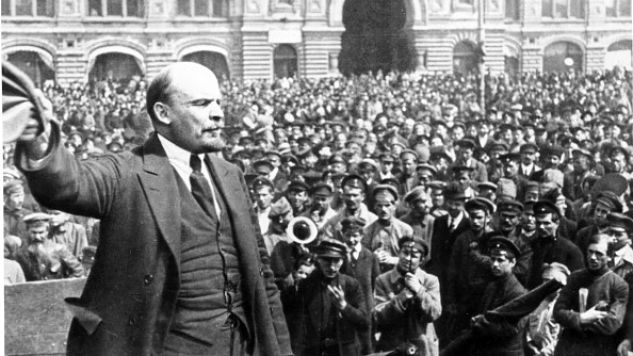
I have already outlined the role of Lenin in the formation of the Bolshevik Party, of which he was unquestionable leader all the time. He was also a very notable intellectual, whose work is very much worth reading regardless of what we may think of him. He was imprisoned in Siberia at the end of the 19th century and soon after he founded the newspaper Iskra (Spark). In 1902 he published his most famous work, What Is To Be Done?, in which he argued that class consciousness was only achievable by activism and agitation outside of the industries, that worker spontaneous self-organization can only lead to limited and limiting trade-unionism and not to revolution. There is a point to make from the perspective that only time can give that he may have been right for the Fordist period (formal subsumption of work into capital in Marx' terminology) but that since the arrival of Toyotism (REAL subsumption) and its political branch Thatcherism/Reaganism, unions are pretty much done and the only real sphere remaining for the workers' struggle is certainly outside the companies, where repression is simply brutal and organization tends to zero way too rapidly. An open debate of course. 

Another seminal work of Lenin is Imperialism: The Highest Stage of Capitalism, which comes very handy today as well, as the term "imperialism" is used often and many geopolitical situations resemble very much the inter-imperialist struggle between the great powers of the early 20th century, at least to some extent. In this work he opposed the views of Kautsky (one of the founding fathers of Social-Democracy as we know it today), who argued for the unavoidable cooperation of all capitalist powers in the exploitation of the global periphery (colonies and semi-colonies, the Third World in modern terminology). Lenin correctly argued that imperialist tendencies would instead cause conflict among the various capitalist powers, increasing the contradictions. One could argue that Lenin "cheated" because he wrote that in 1917, after WWI was well advanced, while Kautsky had published his work in 1914 instead. But, "cheat" or not, he was clearly correct and we can see the same happening today with tensions rising between the various capitalist powers: US-China rivalry on top of all but also the US siege of Russia, the, barely hidden, growing tensions between Germany and the Anglosaxon power ring, etc. He also transferred the focus of revolution to the periphery and, at least for the 20th century, he was again right, even if there is much to debate about whether those revolutions are genuinely socialist or rather sui generis versions of Capitalism, a Capitalism without bourgeoisie, which otherwise would be just subservient to the core powers ("comprador bourgeoisie") and hardly a national development force.

One of the early critics of Lenin was Lev Davidovich Bronstein, an Ukranian better known as Leon Trotsky, who was confronted with the Bolshevik leader at the split of the SDP in 1904. However he soon became an "independent" because the Mensheviks were clearly aligning themselves with the liberal bourgeois parties. He worked to reconcile the two factions to no avail and in 1917 he finally joined the Bolshevik Party, where many looked at him with distrust. His main theoretical work is the theory of Permanent Revolution (later partly adopted by the Maoists). The term was originally coined by Marx in several passages, so Trotsky is mostly extending on these early approaches of the genius of Trier. However, much as Lenin, Trotsky has a peripheral focus and thus he argued (correctly) that in Russia the bourgeoisie cannot make a successful progressive revolution but that only the proletariat can do it. This part of the theory, very innovative, was partly adopted by Lenin (April Theses) and was initially rejected even within the Bolshevik Party, however it would later become mainstream. But Trotsky also sustained that the revolution in a single country would unavoidably fail, unless it was quickly followed up by revolutions in other states, a concept never fully debated by the Bolsheviks and clearly opposed by Stalin. The key idea of Permanent Revolution in any case seems to be that the global working class (Humankind by another name) cannot falter until socialist goals have been thoroughly achieved, at risk of success of bourgeois reaction. 

Finally we won't forget the fierce Georgian activist who would eventually become sorta-Tsar himself, Ioseb Besarionis dze Jughashvili, who eventually adopted the alias of Stalin: Steel Man. He would be described today as a "terrorist" no doubt, leading part of the Bolshevik party into acts of robbery, extortion and assassination with terrible clarity and outstanding leadership. While he did write some articles and is co-author of the post-revolutionary concept of "Socialism in one country" (opposed to Trotsky's frantic Internationalism), Stalin was mostly a man of action and doubtlessly a most clever conspirator, whose power grew at the shadow of Lenin, within the Party's activist class preluding the kind of state he would eventually rule and largely shape.

Tuesday, April 14, 2015

Death of two literary giants: Eduardo Galeano and Günther Grass

In the very same day, yesterday April 13th, two of the greatest writers of our time left us. 

Eduardo Galeano (Montevideo, 1940) is arguably the greatest author in Spanish language in the second half of the 20th century. His masterpiece Open Veins of Latin America[full PDF text at e-reading club] is a must read, so "must" that Hugo Chávez gifted it to Barack Obama in 2009. It is not just a literary masterpiece but also a most valuable history work, quite comparable to Zinn's A People's History of the United States but surely better in its truly amazing literary quality.

It begins this way:

The division of labor among nations is that some specialize in winning and others in losing. Our part of the world, known today as Latin America, was precocious: it has specialized in losing ever since those remote times when Renaissance Europeans ventured across the ocean and buried their teeth in the throats of the Indian civilizations.

Update (Apr 20th): 10 Galeano books freely available online in Spanish (BGD).

Günther Grass (Danzig/Gdansk, 1927) was certainly less radical initially (he was for long an SPD member) but his work is nevertheless very enjoyable. However he did evolve towards more determined positions in the anti-war movement of the 1980s and was hostile to reunification of Germany in 1991, fearing that it could only lead to a renewed German imperialism, which he opposed.

In 2012 he published the poem What must be said, against the German military support of the Zionist terrorist state and its overly dangerous nuclear capacity.


His most famous work is The Tin Drum. He got the Nobel Prize in 1999.

Wednesday, April 8, 2015

The first Communism, 144 years later.

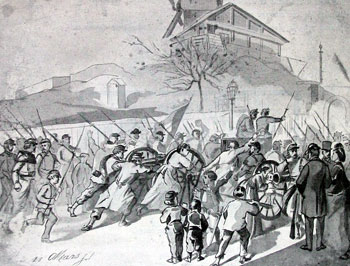
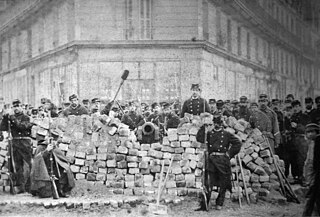
These weeks we commemorate the 144th anniversary of the Paris Commune, the first ever Communist regime, radically democratic and the reference that Marx and Engels adopted as model for the dictatorship of the proletariat.

Naturally the reference work is Marx' The Civil War in France, including the very insightful prologue by F. Engels.

But for those with the inclination for the video format and the patience to watch a long movie, a most interesting take is Peter Watkins' La Commune (Paris, 1871), which, using the anachronistic narrative device of introducing television in the 19th century, reenacts the events:


Also, for those who understand Spanish, I believe that this debate in Escuela de Cuadros (Cadres' School, TeleSur program) is a very interesting complement:


Now, maybe more than ever before we need to retake the concept of Communism and restore it to its originally radical democratic nature, democracy that cannot be just restricted to elections every X years but that, as in the Paris Commune, must imply the election of all offices and their revocable nature. It also cannot be restricted to mere political democracy but must imply economic democracy, that is the collectivization of all means of production and livelihood - property is an unbearable privilege that must be abolished in favor of true democracy.

We shall prevail because Capitalism is unable to face the catastrophe it has created, only an organized and conscious People, Humankind, can do that. Revolution or extinction!

Friday, August 15, 2014

August 15th the day Basques kicked Frankish Imperial ass

It happened in 778 at dusk. The Frankish Imperial Army had failed in the plot to conquer Zaragoza and returned home through Basque lands. For unclear reasons Charlemagne had ordered to demolish the walls of Pamplona, maybe because they did not expect to be able to control it against both Basques and Muslims, what apparently outraged the Basque People to no avail. 

Some days later, a day like today 1236 years ago, they had to cross the Pyrenean passes and mostly they did without problem, but when the rearguard, made up of the elite knights of the Frankish Empire, including some of the most powerful men in the realm, marched through them, they were ambushed and massacred.

It was the only major defeat of Charlemagne ever. 

12th centenarian commemorative plate


Later two subsequent battles in 812 and 824 consolidated Basque independence south of the Pyrenees.

Some more details at Wikipedia, for example.

Monday, August 11, 2014

Zionism as an Anglosaxon Imperial and Messianic project

That is what Thierry Meissan explains in one of his latest articles, available in several languages.

Excerpt:

What is Zionism?

In the middle of the seventeenth century, British Calvinists gathered around Oliver Cromwell and questioned the faith and the hierarchy of the regime. After overthrowing the Anglican monarchy, the "Lord Protector" presumed to allow the British people to achieve the moral purity necessary to weather a 7-year tribulation, welcome the return of Christ and live peacefully with him for 1000 years (the "Millennium" ). To do this, according to his interpretation of the Bible, the Jews were to be scattered to the ends of the earth, then regrouped into Palestine to rebuild the temple of Solomon. On this basis, he established a Puritan regime, lifted the 1656 ban against Jews settling in England and announced that his country was committed to create the State of Israel in Palestine [4].

The Cromwell sect was in turn overthrown at the end of the "First English Civil War," his supporters killed or exiled and the Anglican monarchy was restored. Zionism (that is to say, the proposed creation of a state for the Jews) was abandoned. It reappears in the eighteenth century with the "Second English Civil War" (according to UK school history textbooks), which the rest of the world knows as the "War of Independence of the United States" (1775 - 83). Contrary to popular belief, it was not undertaken on behalf of the Enlightenment ideal that animated a few years later the French Revolution, but funded by the King of France and conducted on religious grounds shouting "Our King is Jesus! ".
George Washington, Thomas Jefferson and Benjamin Franklin, to name a few, presented themselves as the successors of the exiled supporters of Oliver Cromwell. The United States logically resumed the Zionist project.

In 1868, in England, Queen Victoria appointed Jewish Benjamin Disraeli as Prime Minister,. He proposed to grant a share of democracy to the descendants of Cromwell supporters to be able to rely on all the people to extend the power of the Crown in the world. Above all, he proposed an alliance with the Jewish Diaspora to lead an imperialist policy of which it would be the avant-garde. In 1878, he put "the restoration of Israel" on the agenda of the Congress of Berlin in the new redivision of the world.

If nothing else, it is an interesting theory and one that explains the strange phenomenon of Christian-Zionism. Read the full article at Voltaire Net.

Wednesday, May 28, 2014

Hitler 1933, Le Pen 2015? The same horrible story

While the raise of fascism in Italy or Spain was caused mostly by paramilitary or military violence, we cannot, we must not ever ignore that the right-wing wolf under the "democratic" sheep skin was key in their rise in both states, giving them the economic resources and the political power that allowed them to thrive. Fascism and conservatism are just the same thing in two different modalities: the same individuals and their networks of economic and political power switch between one and the other at their convenience. 

Good cop, bad cop. The same dungeon and the same torture. 

But this reactionary hubris of the oligarchies and their political and media cronies is probably best understood in the case of Hitler's raise to power, which is sometimes claimed to be a democratic rise by popular election, what is not really true. 


Austerity policies cause Fascism

Not worth the paper it was printed on.
Hungarian worthless currency in 1946.
Another typical myth about the raise of fascism is that it was propelled by hyper-inflation. This is again false. While German hyper-inflation was going on, the Nazis were weak. It was only when hyper-inflation was drastically tackled by hyper-austerity measures very similar to the ones we suffer now, when Hitler found his niche in popular discontent. 

And what politics did he apply when he rose to power? Military Keynesianism (heavy state expenditure), which was totally unsustainable in the mid-run and therefore required of a sustained imperialist expansion, which was designed to head East: against the Soviet Union primarily, which was meant to become "the India of Germany", the great colonial empire that would sustain Germany as great power able to feed and cloth its own population at the expense of those supposedly "sub-human" Slavs.

But between Germany and the USSR was Poland and, not geographically but conceptually, Great Britain. The British bourgeois oligarchies had been toying with fascism in Europe for more than a decade and were happy with it... as long as it did not become a competitor. Nazi Germany dared to try and was therefore involved in a Western war it did not desire at all. 

While the Soviet war effort and sacrifice no doubt saved Europe from Nazism later on, initially it was the inter-imperialist competition between London and Berlin, the same one that triggered World War I, which delayed the blow against Russia. 


The dirty facts of Hitler's rise to power or how the conservatives put him there

But back to Hitler's rise. Which are the facts? Did he really reach power "democratically" as some claim?

First of all the Weimar's Right courted the Nazis and did not outlaw them, even if there were plenty of reasons to do so, as they openly advocated for a coup and the destruction of the Republic. Instead they attacked the socialdemocrat government of Prussia, putting the largest and most central German lander under federal (right-wing) control by means of an institutional coup, using the same Presidential emergency powers that Hitler would use later on (not even with Nazi support Von Pappen held a majority in the Reichstag).

In the elections of June 1932, in which the Nazis resorted to populist violence measures such as supporting a worker strike with their SA militia, the Nazis managed to get a plurality of the vote (37%) and of seats (230). However they lost the Presidential election as everybody else rallied around Hindenburg, much as they did around Chirac in France a decade ago, out of fear of something much worse. 

The socialdemocrats, as the rest of the Weimar bloc, were being electorally punished but were still the second force (133 seats), while the communists managed to gain third position (89 seats). 

In such circumstances no stable government could be formed so back to the ballots. In November 1932, the Nazis lost some ground, while only the communists and the DNVP (national-conservatives) gained support. The Nazi plurality (193 seats) was not that strong anymore compared with that of the wider Left (221 seats, even if divided in two parties). The Weimar "moderate" Right Wing held the key to power with 169 seats (split in many parties).

This resulted in the appointment of Hitler as vice-Chancellor of a coalition government.

On January 1933 Hitler was made Chancelor with conservative support (again a coalition government). 

On February 1933, the Nazis burned the Reichstag and blamed the communists, what was used as pretext to persecute many KPD members and also to weaken their popular appeal. It was also pretext for the general abolition of most human rights and civil liberties: a state of emergency ensued.

Nazi patrol 1933
The last "elections" were held on March 1933, in which the Nazis openly resorted to large scale violence and coercion against communists and socialdemocrats alike, banning newspapers, etc. SS militiamen patrolled the streets menacingly, while all the resources of the Big Capital were poured onto the Nazi campaign. Even with such methods, Hitler could not assure a majority for the NSDAP (288/647 seats). 

The KPD was then banned and their seats declared null. A new Nazi-Conservative coalition ensued with Hitler as Chancellor.

The Enabling Act allowing the Cabinet (i.e. Hitler, Hindenburg's influence as President was almost never exerted) to enact laws without need of Parliament approval, required of 2/3 of the votes: 431. With the 81 communist seats and the opposition of the 120 socialdemocrat ones, Hitler needed everybody else to pass the dictatorship bill. 

He got that support: not just his national-conservative allies voted for but also the Catholic (Christian-Democrats of today), the Bavarian Right, the all-German Right, etc. Every single right-winger representative voted for Hitler's dictatorship (but for two absent deputies). Only the SPD voted against (the communist were already banned and several socialdemocrat deputies were in prison already).

The next months were of formal change to the III Reich. All thanks to the "moderate" Right Wing and the bourgeoisie in general (never mind the gullibility of wide sectors of the working class, of course).


Germany 1932, France 1914

At this point all avenues are open but the fact that Marine Le Pen and her National Front, which advocates not just for racism and xenophobia but also against the right to abortion and for sending women back to the kitchens and for the suppression of human rights in general, have won the elections with 25% of the vote is extremely dangerous. 

The notorious socialdemocrat (social-liberal) defeat of this Sunday (only 14% of support) and the weakening of real Left parties, which have been dragged by the PS collapse in popular appeal, it seems, puts one of the most crucial European states in the same situation, more or less, as Germany in 1932.

In all logic Hollande will have to call for early elections because his support is obviously way too weak to continue without them, nor with them. Then the French Nazis will almost certainly get a plurality of the Parliament and force the hand of the conservatives. Alternatively the conservatives (second force in these elections) can benefit from the Nazi scare and get power for themselves within a coalition, maybe even one including the PS. Their policies will satisfy nobody, no doubt, so in the next elections, whenever they are, the Nazis will win (or hopefully not but very likely they will). 

At least this is one of the most likely chain of events. Once Le Pen is in power, she will never allow democracy again and the French Republic will enter a long shadowy night of darkness and fear unknown since the German occupation. And it will no doubt affect its neighbors as well.

Which is the solution? I say round them up before it is too late. But it is already too late probably. Fascism is best eradicated when young and weak, when it grows it becomes a clearly unmanageable problem. That is why we say once and again: zero tolerance against fascism!

We must get ready for the worst because it will come no doubt. Fascism and freedom cannot coexist, so Europe will be dragged to wars of all kind.

Be strong, be prepared. No pasarán!

Saturday, May 24, 2014

Navarre: institutional apology of historical fascist terror protected by today's fascist prohibition of protest

Rally poster
The rally called by Ahaztuak 1936-1977 for Friday in Pamplona was suspended after the Spanish Government forbade it and therefore would have been attacked by police forces, making protest nearly impossible and most risky.

The rally, which has been moved to the next weekend, was meant to protest for the institutional apology of fascist terrorism by the Spanish Army's infamous "America 66" regiment, which raped and murdered many citizens in Valdedios, Asturias, in 1937.

The regiment, still active, is being institutionally honored for their alleged "service to Spain" with an exposition in the Citadel of Pamplona (a fortress meant to control the oft rebellious city) with the support of the far-right unionist city council.

The popular anger about this act of fascist apology by the neo-Francoist Spanish Regime is so strong that the authorities ordered to protect the citadel with a massive police deployment. 

Four antimilitarist activists of the Conscientious Objection Movement (KEM-MOC, War Resistants International) attempted to enter the fascist exposition dressed in denounce costumes as publicity men but were impeded to do so by police. 

United Left has denounced the exposition at court. 

For the organizers, Ahaztuak 1936-1977 (The Forgotten Ones 1936-1977, an association dedicated to the recovering of the historical memory and denounce of the many crimes against Humankind of the Spanish Fascist regime):
The prohibition is another instance of the persistence of the Spanish model of impunity that we have denounced since long ago, a model where the insult to the victims of Francoism and the impunity of their aggressors are combined; the continuous obstacles to mobilizations and claims by the victims of Fascism, together with all the facilitations and praise for the Francoist criminals; the abandonment by the institutions of our denounces and claims, together with the help and support by those same institutions to the Francoist criminals via subsidies and homages like this one we pretend to denounce... a prohibition that furthermore takes place in a city that, to greater shame, still retains other Francoist symbols: a mausoleum "to the fallen for God and for Spain", were putschist generals Mola and Sanjurjo rest and are honored yearly by their acolytes.

Sources[es]: Ahaztuak 1936-1977, Naiz Info.

Saturday, March 8, 2014

March 8th: maybe the most glorious day for the Working Class in history

March 8th was proclaimed International Working Women's Day in 1910 by the Second International and soon became a day of struggle against Capitalism and Patriarchy through the World. 

There is anyhow one particularly critical March 8th: that of 1917. On that day, the working women of Petrograd marched in troves through the streets of the Russian city demanding something as basic as bread. 

The day before the workers of Putilov had declared a strike and the demands of the women were central to mobilize the rest of the workers of the city. By March 10th there was a general strike and the city was paralyzed. The demand of bread had become a generalized cry of "down with the Tsar!" and "down with the war!". 

When on March 11th, the totalitarian regime sent the few "reliable" troops they had to repress the masses, these mutinied. The Russian Revolution had begun. 

Who is still alive don’t say “never”,
firmness is not firm,
not everything will continue the same,
when the dominating will have spoken
the dominated will speak.
Who dares to say “never”?
Who does it depend on that oppression continues? On us.
Who does it depend on that it ends? On us, too.
Let the one who’s defeated get up!
The one who’s lost, let him combat!
Who could stop the one who knows his situation?
Hence today´s losers will be the winners of tomorrow
and never will become today.

Bertolt Brecht.

Also a good one from historical Basque Punk band La Polla Records, "Iván":


Translation:
This story which was could well be true
seems a lie, we are going to tell it anyhow:
In the Russia of the beloved Tsar
lived a peasant known as Ivan.
Laboring the land without pause,
suffering much hunger, with no time to think.

Sowing, sowing, sowing and sowing
and Count Borrowich gets all the harvest.
The petty priest asks resignation, 
he invites himself to diner and eats the best food.

Ivan was there, Ivan was there, Ivan was there...

One good day he was with the hoe
came some men, told him: "komrade,
there are no masters anymore to be obeyed;
you are a free man, we've got the power!"

Thinking, thinking, thinking and thinking,
Ivan gradually gets used to the idea: 
nobility has been overthrown, 
there will be no more jerks living out of the rest.

Ivan was there, Ivan was there, Ivan was there...

Jumping on one leg, 
the sickle and the hammer on the red flag. 
With persistence and some attention, 
what kind of somersaults makes reality!

Yesterday I was involved in a conversation in which certain woman complained without much sense "as if we need one special day!" I had to protest: this is something that women have given themselves by choice and to the whole humankind. It is a holy day of the working class, of the people and, of course, of women in particular, no kidding!

Keep the struggle up, sisters!

Sunday, October 6, 2013

Obituary: Vo Nguyen Giap

A 20th century legend died on Friday. Revolutionary General Vo Nguyen Giap died in Hanoi at the venerable age of 102. He is also known as Ge Luo: volcano under the snow.

Castro and Giap


He was born in August 25th 1911 in a landless but literate farmer family. He began his revolutionary career already in high school, joining nationalist organizations at the age of 15. He was first arrested in 1930. 

In 1933 he began studying at the university but was expelled for his political activities. It was there when he met Truong Chinh, the main communist ideologue of Vietnam, joining then the Communist Party. He finally graduated as attorney in 1937 and got work as history teacher in a high school.

In 1938 he married a Thai woman, Dang Thi Quang, who was also communist.

In 1939 he published his first book, jointly with Truong Chinh, titled "The farmer question", in which they pondered about the role of the farmer class in the joint struggle with urban workers. 

In 1940 the Communist Party was banned by the Vichy regime and he escaped to China. However his relatives were not so lucky: his sister-in-law was beheaded and his wife sentenced to life in prison, dying a few years later because of tortures. His son, his father, two sister and other relatives were also murdered. 

In spite of all this tragedy, he studied the work of Mao in China and met the also legendary Ho Chi Minh. They founded the Dang Minh (Vietminh), which was a broad front of nationalist forces. 

In 1941 he went back to Vietnam to initiate the guerrilla war, in alliance with ethnic minorities. After a few years of frantic armed and political activism, he was in 1945 at the command of a 10,000 strong force, taking an offensive stand against the Japanese and proclaiming the independence of Vietnam with Ho Chi Minh as President. 

However defeating the Japanese was just the beginning. Soon France attempted to reclaim its colony, leading Giap to the epic battle of Dien Bien Phu, in which the guerrilla decisively defeated 15,000 French soldiers supported by US air forces. The arrogant imperialists were unaware of the ability of Giap's forces to move heavy artillery through the jungle. 

The French commander, ashamed, committed suicide soon after the Vietnamese guns began pounding their positions. The whole army was captured or died in combat. However the Vietnamese loses were also very important (exact figures are debated). 

After that, he defeated one after the other, the top generals of the French Army, resulting in the truce by which Vietnam was temporarily divided in two states. 

Giap's struggle did not end there. The war continued in the South, a tyrannical US neo-colonial protectorate, in a guerrilla war that lasted for more than whole decade. In 1973, the USA finally withdrew their forces and two years later Vietnam was united again under a red banner. 

Giap held the position of Defense Minister until 1980. 

In the meantime he also wrote the masterpiece of guerrilla warfare theory "People's War, People's Army", published in 1961. He also authored "Big Victory, Great Task", "Dien Bien Phu" and "We Will Win".

Main source: Webguerrillero[es].

Sunday, August 25, 2013

Uruguay protests against the forgetfulness of Mujica

The authors of a massacre in 1994 against those supporting Basque exiles remain not just at large but with power to commit again any such massacre or worse. Hundreds demonstrated in Montevideo against such impunity, demanding justice and memory.


Roberto Facal and Fernando Morrone were the victims of a massacre executed by police in 1994 to break the resistance of some 4000 Uruguayans against the extradition of Basque exiles, who were in hunger strike at Hospital Filtro. At least 500 police officers took part in the attack, using nothing but live fire. 

Not just demonstrators were killed or injured but also nurses like Esteban Massa who was shot in the back while he aided another victim. 

The murderous repression continued mercilessly in union offices and through the neighboring streets. It was then when the two mortal victims were shot. 


It was a bourgeois elected government which assumed all responsibility with no shame nor remorse. Minister of Interior Gianola was backed by the government in full, nobody resigned, nobody was ever prosecuted. 

Every year in the anniversary of the massacre people march through Montevideo demanding justice and memory. The Frente Amplio ignores the issue and one of its leaders even said it was a massacre "to forget". 

Forget? Never! Forgive? Never! The culprits must pay or something of the like will happen again. 

Source: Borroka Garaia Da![es]

Saturday, August 24, 2013

Marx as "Anarchist"

Or almost. Maybe more like modern Autonomists.

The Commune publishes today a very interesting article by David Adams questioning in depth the notion of Marxism, or more precisely Marx' own thought, as authoritarian and statist, being in fact quite different from the Leninist model (as well as from the Socialdemocratic or Bersteinian one).

A key excerpt on the dictatorship of Proletariat as being nothing but radical grassroots democracy:
A little-known text by Marx, his 1874 “Notes on Bakunin’s Book Statehood and Anarchy,” explains the concept of proletarian dictatorship more clearly than any other. In his book Bakunin ridicules Marx’s concept of the transitional state power of the proletarian dictatorship, and Marx critically responds in his “Notes.”  Bakunin writes, “If there is a state, then there is domination and consequent slavery. A state without slavery, open or camouflaged, is inconceivable-that is why we are enemies of the state. What does it mean, ‘the proletariat raised to a governing class?’”26 Marx responds, “It means that the proletariat, instead of fighting in individual instances against the economically privileged classes, has gained sufficient strength and organisation to use general means of coercion in its struggle against them; but it can only make use of such economic means as abolish its own character as wage labourer and hence as a class; when its victory is complete, its rule too is therefore at an end, since its class character will have disappeared.”27 The claim that through revolution the proletariat will be “raised to a governing class” thus has nothing to do with creating a dictatorship of a political sect, but is rather a claim that the proletariat will use “general means of coercion” to undercut the bourgeoisie’s power (by abolishing the private ownership of the means of production, disbanding the standing army, and so forth). It is the entire proletariat that is to exercise this power.  Bakunin asks, “Will all 40 million [German workers] be members of the government?”28 Marx responds, “Certainly! For the system starts with the self-government of the communities.”29

Can there be a more Anarchist statement? Or rather we may want to describe it as genuine Communism. 

Another excerpt: Leninism as Blanquism:

Blanqui, for example, advocated an educative dictatorship of a small group of revolutionaries. Marx’s use of the word “dictatorship” in the phrase “dictatorship of the proletariat,” however, is original and deliberately distinct from Blanqui’s usage. Engels emphasizes this point in a passage on Blanqui: “From the fact that Blanqui conceives of every revolution as the coup de main of a small revolutionary minority, what follows of itself is the necessity of dictatorship after it’s success-the dictatorship, please note, not of the entire revolutionary class, the proletariat, but of the small number of those who made the coup de main and who themselves are organized beforehand under the dictatorship of one person or a few. One can see that Blanqui is a revolutionary of the previous generation.”37 It is clear that the Leninist model of a particular sect or political party exercising political power is much closer to the Blanquist conception of “dictatorship” than to Marx’s (...)

Much of the divergence between Anarchists and Marx seems merely semantic: the use of the word "state" (polity):
For Marx, this form of power can be a “state” from the perspective of its political, coercive function of uprooting the foundations of the rule of capital. It cannot be a “state” in the sense of a “parasitic excrescence” usurping power from the mass of workers.50

Again much closer to Kropotkin or Durruti than to Lenin, never mind Stalin.
Marx saw the mandated and revocable delegates of the Commune as an example of working class state power in action.

Mandated and revocable delegates? Isn't that precisely what Anarchists propose?

So what do Marx and Engels mean by "state" and "class dictatorship"? In the words of Richard N. Hunt:
The full-time army as parasite disappeared, but the part-time National Guard remained as the coercive instrument of the workers’ state. Here in sharpest focus one can perceive Marx and Engels’ double usage: the parasite state is to be smashed immediately; the state as instrument of class coercion is to remain until the need for it fades away.

A people's militia under popular command, it seems.

The criticism of bourgeois "democracy" and state is persistent and merciless, and Engels charged against the USA as archetype of this separation between society and state by means of ritual and pointless elections:
Nowhere do “politicians” form a more separate and powerful section of the nation than precisely in North America. . . . It is precisely in America that we see best how there takes place this process of the state power making itself independent in relation to society, whose mere instrument it was originally intended to be. Here there exists no dynasty, no nobility, no standing army, beyond the few men keeping watch on the Indians, no bureaucracy with permanent posts or the right to pensions. And nevertheless we find here two great gangs of political speculators, who alternately take possession of the state power and exploit it by the most corrupt means and for the most corrupt ends-and the nation is powerless against these two great cartels of politicians, who are ostensibly its servants, but in reality dominate and plunder it.

Naturally, although many have forgotten, the term Communism itself derives from commune (municipality or local government in French and other languages) and very specifically from the 1871 Paris Commune.

In this pioneering communist "state", not just the army became part of the people in full but the whole state did by suppressing the bureaucracy and getting managers to be paid common workers' salaries and be under the command of the People directly. Totally different to what happened in the Soviet Union.

Marx did not live to see the Russian Revolution but he witnessed the beginnings of the rise of what is now the Socialdemocracy, especially in France and Germany. It was then when he famously declared "I am not a Marxist myself". He was very critical of Lassalle and his socialdemocratic or proto-Keynesian ideas of building socialism from above by means of state loans and other nonsense. 

One of the key issues is democratic centralism, centralization or central planning. In this certainly Marx and Bakunin were very much at odds:
While Bakunin was a sworn enemy of all political and economic centralization, Marx had a very different perspective, but one that was in no way more “authoritarian”: “National centralization of the means of production will become the natural basis of a society composed of associations of free and equal producers, carrying on the social business on a common and rational plan.”70 Marx thought that both centralism (a common plan) and democratic control from below were necessary for building socialism.

Read the original article, "Karl Marx and the State", at The Commune.

Tuesday, August 20, 2013

Basque Country: 200 years of "Liberal" Spanish imposition

Today 200 years ago the Parliament ("Cortes") of Navarre was dissolved in the name of the new post-Napoleonic "Liberal" regime of Cádiz. 

You may not know it, but in all the Kingdom of Spain, it were the Basque provinces the only ones who remained indifferent towards Napoleonic occupation. There was no guerrilla (except for some late offshoots triggered by the abuses of occupation) and the French Army had absolutely no problem in holding in our little country. Why? Obviously there was no sympathy for Spain and their Nationalist ideas and soon also it became obvious that the new "Liberal" ideology sought to impose the notion of a single nation-state against the wish of our people and its long-held liberties. 

The liberties of Spain became the yoke of the Basque Nation. 

For centuries, the Basque provinces had retained their unique (and quite "Liberal") institutions in the context of the Feudal system that dominated the Kingdom of Castile (later Spain). Our provinces were ruled by elected bodies since at least 1200, date of the Castilian annexation of the Western Basque Country, rooted in the Navarrese Law, very distinct from the Latin one. 

Residual Navarre had however evolved its "Cortes" into an more feudal-like body, similar to other European Parliaments of the time, in which the different estates (castes) were represented in less-democratic form. It was still better than what Castile/Spain had: absolute monarchy, with its intrinsic tendency to corruption and decadence.

With the Spanish War of Independence against the illustrated Napoleonic protectorate, a new and short-lived Spanish Liberal Monarchy arose from the Cortes of Cádiz, under Machiavellian British support. This new state suppressed the Navarrese Cortes altogether exactly 200 years, and also forced the Western Provinces' Juntas (Parliaments) to swear the new constitution, which incidentally suppressed them altogether. 

Ironically the return to Absolutism restored the Basque liberties, what set the stage for a whole century of Taliban-like support by the Basque institutions and people of the most reactionary camp in Spanish politics. Two Carlist wars, almost only manned by Basques, were the product of that imposition. Eventually it became obvious that the Spanish reactionaries were not either our friends and that the Basque society was much more liberal than its forced affiliation may have suggested and a more modern Basque Nationalism emerged, first with the Navarrese Republican Party, then the Basque Nationalist Party and finally with Basque Nationalist Action and its more recent offshoots: ETA and the Basque National Liberation Movement, with its various tactical names.

Partial source: El Blog de Fernando Mikelarena[es].

Wednesday, July 31, 2013

Chile: torturer physicians' list is made public

A list with the names of 36 physicians who tortured political prisoners under Pinochet's Fascist-Thatcherist regime has come to light. Many of them still exert their profession freely. 

The full list is available in Spanish language at WPChile and Webguerrillero.

Sunday, June 30, 2013

Basque Country: hundreds commemorate the Battle of Noain (video)

Basques from Navarre and the other regions paid homage to the fallen in the Battle of Noain, one of the last stands of Navarrese resistance against the Castilian invasion of 1912-21, demanding once again the right to free self-determination. 


Source: Ateak Ireki.

Friday, June 14, 2013

Basque official report on the victims during the guerrilla war

Fascist mercenaries at the Montejurra massacre
The semi-autonomous Western Basque Government has issued a report[es] that attempts to quantify the numbers and typology of the victims in the period of the guerrilla war from 1960 to 2013. 

Actually ETA was only active in armed form from 1968 and officially declared the end to armed struggle in 2011. Guerrilla war and state repression should be quantified, in my understanding since 1936, when the fascist coup ignited the fire of popular armed resistance, which existed since then in many forms (grouped in the catch-all term maquis, inherited from the French Resistance), some of them with clear independentist undertones. 

The report also seems somewhat biased in favor of certain kind of victims, not counting, for example, deaths in prison or those killed or mutilated in car accidents when traveling to far away prisons to visit their relatives or friends. People in prison for political reasons, with or without sentence, should be accounted and in most cases are not. The report mentions once and again the various associations of "victims of terrorism" but never any association against torture, for the rights of prisoners, etc. Those killed in police operations against armed groups, such as the Pasaia Massacre, don't seem to be accounted for either. It is not clear if the reports of police violence include those by French agents (surely not).

Fascist PM Carrero Blanco was killed by ETA(m)
In any case, the report accounts for the following figures for the 1960-1978 period:
  • 136 killed by ETA, Autonomous Anti-Capitalist Commandos (CCAA) and other anti-system groups. In detail:
    • ETA (prior to schism): 18
    • ETA (militar): 89
    • ETA (political-militar): 9 (2 in kidnappings)
    • CCAA: 4
    • Iberian Directorate for Liberation (DRIL): 1
    • Others: 2
    • Not sufficiently clear: 13 (2 in kidnappings).
  • 87 killed by the Spanish police (74), death squads (13) or death penalty. In detail:
    • Police abuses, confusion and other causes: 23
    • Police violence in demonstrations: 22
    • In road controls: 19
    • In police custody: 5
    • By out-of-service agents: 5
    • By the Basque-Spanish Battalion (BVE): 3
    • By the Apostolic Anti-Communist Alliance (Triple A): 2
    • By fascist violence against demonstrators: 3
    • By execution after military trial: 2 (the famous Txiki and Otaegi, 10 others were sentenced to death but never actually killed).
  • Other anti-system violence:
    • 236 seriously injured in attacks (230 by ETA in its various forms).
    • 14 people kidnapped and later released (3 after being shot to the knee).
    • 8 attacks against media.
    • An undetermined number of police agents injured in demonstrations.
    • Some 3600 major attacks (by organized groups) in this and the following period.
    • Some 4500 minor attacks (in the so called "street fight") in this and the following period.
  • Other state violence:
    • 422 injured by police violence in demonstrations. 
    • 355 death squad arson attacks and death threats.
    • 238 subject to military trials.
    • 103 terror attacks by death squads (not including kidnappings).
    • 32 journalist brought to trial or otherwise jailed.
    • 22 injured in road controls.
    • 22 death squad attacks against demonstrations.
    • 13 hospitalized after arrest.
    • 11 death squad attacks against media.
    • 9 kidnappings with violence and torture by death squads.
    • 6 injured by out-of-service police agents.
    • An undetermined number of arbitrary arrests, preventive prison, etc.
    • An undetermined number of media closures, censorship and prohibitions.
    • Not researched but mentioned: abuses and torture against prisoners.
  • Unclear: 4 people missing.

Not accounted for? (Pasaia 1984)
In the 1979-2013 period:
  • 703 killed by anti-system groups:
    • In attacks by ETA(m): 644 
    • In attacks by the CCAA: 38
    • In attacks by ETA(pm): 12
    • In attacks by Iparretarrak (IK): 3
    • In attacks by Iraultza: 1 (but a member of Iraultza, which never targeted people).
    • In kidnappings by ETA(m): 8
    • In kidnappings by ETA(pm): 2
    • In kidnappings by the CCAA: 2
    • In kidnappings by ETA-VIII: 1
    • In "street fight" actions: 3
    • Itsasondo man who got tired of police persecution and killed two with a hunting rifle (later run away and joined ETA): 2. 
    • Not clarified: 314 (figure by FVT, highly suspect, not added to total).
  • Some 126 killed by the state and satellite groups:
    • In attacks by the Anti-Terrorist Liberation Groups (GAL): 24
    • By police (abuse, confusion or other causes): 18
    • In attacks by the Basque-Spanish Battalion (BVE): 14
    • In police custody: 12
    • By out-of-service police agents: 12
    • In road controls: 11
    • By police violence in demonstrations: 10
    • In attacks by the Spanish Anti-Terrorist Groups (GAE): 7
    • In attacks by the Triple A: 3
    • By death squad attacks against demonstrations: 3
    • In prison: 2 (only?)
    • Women raped and killed by the BVE: 2
    • Other death squad kidnappings with murder: 2
    • Missing people whose corpses were found: 2
    • In attacks by "Antiterrorismo ETA" (ATE): 1
    • Deaths by death squads never clarified: at least 3. Most cases were never investigated properly anyhow.
  • Other anti-system violence:
    • Injured in attacks: figures vary: from 2068 to 16,000.
    • Kidnapped and released: 
      • ETA(pm): 24 (11 after being shot to the knee)
      • ETA(m): 17
      • ETA-VIII: 5
      • ETA (prior to schism): 3
      • CCAA: 3
      • ETA-VII: 1
      • Not clarified: 8 (these may be mafia violence in fact)
    • Attacks against media: 32
    • Major arson attacks (by armed groups): some 3600 (both periods)
    • Minor arson attacks (by the so-called "street violence"): some 4500 (both periods)
  • Other state violence:
    • Torture: maybe as many as 10,000 victims, some 5500 public denounces.
      • Hospitalized after police arrest: 124
      • Only 62 agents (who tortured 31 victims) were declared guilty of tortures, 27 of them were later pardoned by the government.
    • Injured in road controls: 30
    • Injured by police (confusion, abuses and other causes): 39
    • Injured by out-of-service police agents: 13
    • Injured by police in demonstrations: 222 (only?)
    • Undue closure of media: 2 (Egin newspaper and radio, Egunkaria)
    • Violations of human rights in prison: not researched (lots!)
    • Injured in death squad attacks: 232
    • Injured by death squads in demonstrations: 10
    • Women raped by death squads: 13
    • Kidnappings with intimidation and torture: 49
    • Arson attacks and death threats by death squads: 633 (10 against media)
  • Not clarified: 2 missing people and another unspecified case.

While I do not necessarily subscribe the data produced in this report (too many blanks and question marks), it is clear that it serves as partial reference for historians and political debate.