Friday, February 17, 2012

Who works how much in the European Union? (or 'I want to be Dutch')

As mentioned in June, the myths about Mediterranean alleged laziness are without any merit. Now again by the hand of the OECD statistics' bureau (hat tip: Marie commenting at NC), we unveil again who works how much in Europe:


If there is a lazy zone in Europe that one is towards the Northwest. Of course Norwegians are living off the oil but what about the Dutch or the Danes? Or also Germans or Brits?

Only a few peoples work above 40 weekly hours on average in Europe and, against all the Neonazi imperialist propaganda by Merkel and cronies, the Greek People is among them.


____________
Note: even if weekly hours are not provided for the USA, the yearly hours are and are exactly as Italy (1778 hrs), what means that in the USA they also work on average less than 40 hrs per week, whatever they say (37.8 to be precise).

Thursday, February 16, 2012

From the Net: 'Why Bahrain is not Syria' (Pepe Escobar at ATOL)

How poignant that the first anniversary of a true Arab pro-democracy movement in the Persian Gulf - then ruthlessly crushed - falls on February 14, when Valentine's Day is celebrated in the West. Talk about a doomed love affair.

And how does Washington honor this tragic love story? By resuming arms sales to the repressive Sunni al-Khalifa dynasty in power in Bahrain.

So just to recap; United States President Barack Obama told Syria's President Bashar al-Assad to "step aside and allow a democratic transition to proceed immediately" while King Hamad al-Khalifa gets new toys to crack down on his subversively pro-democratic subjects.

Is this a case of cognitive dissonance? Of course not; after all Syria is supported by Russia and China at the United Nations Security Council while Bahrain hosts the US's Fifth Fleet - the defender of the "free world" against those evil Iranians who want to shut down the Strait of Hormuz.

A year ago, the overwhelming population of Bahrain - most of them poor, neglected Shi'ites treated as third-class citizens, but also educated Sunnis - hit the streets to demand the ruling al-Khalifas allow a minimum of democracy.

Just like Tunisia and Egypt - and unlike Libya and Syria - the pro-democracy movement in Bahrain was indigenous, legitimate, non-violent and uncontaminated by Western or Gulf Cooperation Council (GCC) infiltration.

... full article at Asia Times Online.

From the Net: 'On the Black Bloc' (S. Mohandesi at Viewpoint Magazine)

I'm not sure if I agree in full with what is being said in this lengthy and rather well-documented opinion article by Salar Mohandesi but I find it's worth reading in any case. Some excerpts:

(...)

The obsession over the black bloc in the past few months is a distorted reflection of the very real predominance of this tactic in contemporary struggles. This is somewhat odd, because in our current cycle of struggle, the black bloc has genuinely appeared in only a few areas, mainly the Northwest United States. But while the tactic’s geographic reach is somewhat localized, its presence in the movement’s collective imagination has grown to immense proportions. It seems like the black bloc is everywhere, a palpable reality, something everyone has to take a side on – even, and perhaps especially, those who haven’t actually seen it in action firsthand.

But it’s precisely the continued obsession with this single tactic that prevents us from seriously interrogating the necessary other term in this relationship: strategy. The discussions over the so-called “diversity of tactics” indicate the problem: by focusing all our energies on disputing the merits of a tactic, we end up neglecting strategy altogether. A “diversity of tactics” has little to do with strategy; in fact, it seems to replace strategy with liberal pluralism. The question isn’t whether to pursue a “diversity of tactics,” but rather: what kind of strategy allows us to effectively incorporate a diverse range of tactics?

It soon becomes clear that the hypertrophy of this tactic is actually a direct result of the atrophy of any corresponding strategy. As Alberto Toscano has recently written, “if something marks out the contemporary resurgence of theoretical interest in communism, across its various species, it is the almost total neglect of the question of strategy.” We might also add that since strategy and tactics can only exist in a reciprocal relationship, the deformation – or perhaps even absence – of former can only lead to a destabilization of the latter.

The symptom of this destabilization is the compulsion to repeat. The tactic of street-fighting is now being repeated obsessively, overcompensating for the shortage of strategy. At its crudest, this just means repeating the same thing over and over again in the hopes of forcing some kind of breakthrough; some claim that the repetition of a tactic will in itself generate a strategy.

(...)

After the “Free Republic of Wendland” – a liberated space in Gorleben – was violently dispersed in 1980 by the largest deployment of police in Germany since Hitler, and after a wave of systematic attacks on squatters in West Berlin in December of that year, it became obvious that if they were to survive, the Autonomen would have to protect themselves in more militant ways. Groups of armed Autonomen, whose power was rooted in the social centers, quickly emerged to defend these spaces. A necessary task, no doubt, but one which would eventually consume all the energies of the movement, polarizing the Autonomen and weakening their solidarity.

“As their militant actions became attacked even by their allies,” notes historian George Katsiaficas, “radicals became increasingly autonomous – some would say isolated – from mainstream protesters and came to constitute their own source of collective identity.” These militant groups, who now engaged in offensive strikes as well strictly defensive maneuvers, began to forge a collective identity through the monopolization of a single tactic: militant confrontation through street-fighting. By the mid-1980s, as repression continued to escalate, these militant groupings solidified their cultural identity, sometimes in opposition to the rest of the movement. “The black leather jackets worn by many people at demonstrations and the black flags carried by others signalled less an ideological anarchism than a style of dress and behavior,” Katsiaficas writes. Black clothes, black flags, ski masks, helmets, and punk became “symbols of a way of life.” It is here that the modern black bloc was born.


But it was precisely at this point, when the black bloc began to fuse itself into a distinct entity, that the autonomous movements that originated it actually began to decline. This was the historical reality underlying the ideology of the black bloc. The tactic, in fact, emerged in large part as a way to stop this internal disintegration. Many activists believed that their instability was purely the result of state repression, and they assumed that the organized defense of the social centers would actually reverse this process of decomposition.

In truth, the autonomous movements, in both Germany and Italy, were on the verge of collapse. As they developed a strongly internal and oppositional identity, they found themselves increasingly incapable of reaching beyond the hegemony of a single proletarian figure. They failed to link with different layers of the working class, and were unable to form a coalition with the broader masses. Earlier in the century, when soviets were first born, this had meant linking the proletariat to the peasantry. In the late 1970s and 1980s, it meant linking the “advanced” sector of the proletariat, in this case the “social worker” – or less contentiously, a kind of amalgam of students, youth, and precarious workers that drifted through a disintegrating welfare system – to the rest of the working class. Unable, or perhaps unwilling to link the different segments of the class together, the black bloc became nothing but the rudiments of a defensive military force.

(...)

The tactic was reborn, and in fact truly came into its own, only after being transplanted to the United States – specifically Seattle in 1999 – where a movement comparable to the German Autonomen had never existed.

(...)

It was really with the eruption of the anti-globalization movement, stretching from around 1999 to 2003, that the black bloc tactic, now totally disconnected from the very idea of the social centers, began to survive independently by refashioning itself into something other than just a tactic. The vast majority of those who formed the ranks of the black bloc in Seattle had no direct memory of the German Autonomen of the early 1980s, separated by a sharp generational divide, and so had little choice but to reconstruct a new identity for themselves. The rebirth of the black bloc came at a price: the insurmountable contradiction between its existence as a tactic and its existence as an identity. Though the defeat of the anti-war movement, the onset of the Bush years, and the decline of an organized Left, forced the black bloc to more or less disappear as a material tactic, it paradoxically consolidated its identity, granting it a mystical afterlife that is being resurrected and fetishized today.

(...)

Neither a liberalism of the present nor a communism of the past is adequate today. The only thing we’re after is a communist strategy for the present. Our task is to attempt to lay the foundations for an organization of proletarian self-activity, in a form that is historically appropriate. It means reinventing the “soviets” for our time, as the autonomists did for theirs; discovering, through a process of collective experimentation, a form of struggle that will resonate with the composition of our class, linking together the various layers of that class, and recomposing this disparate body into an antagonistic subject. Only then will we be able to determine the place in our struggle for the tactic of militant confrontation through street-fighting. Without that, without a coherent communist strategy, all we have is a zombie chasing its own shadow.


... full article at Viewpoint Magazine and, mirrored, at Kasama.

From the Net: 'Demonstrators arrested on Sunday 12/02/12 in Athens were just imprisoned without a trial' (OL-FTGS)

Demonstrators arrested in Athens were just imprisoned, until their trial that it may take months until it starts. Obviously it is only riot police officers who claim that they saw the arrestees breaking the law, so in a very unusual movement for their standards -and actually breaking the law, given that no trial convicted them yet- the police publish in its webpage and in their friendly TV channels the photos of the arrestees, asking for people to give any relevant information about the demonstrators. 

From Occupied London - From the Greek Streets.

From the Net: 'One year later in Bahrain, killers are still free and martyrs' family members assaulted and detained' (BCHR)

Families of martyrs in Bahrain have been suffering a punitive campaign of punishment since the start of the movement, as they have been targeted with arrests, intimidation, house raids and deliberate attacks by toxic gases. While none of the officials responsible for the protesters' deaths has been convicted at a court, and while the families should have been compensated both morally and materially for their losses, instead they are being attacked deliberately in an attempt of the Bahraini regime to punish them for openly accusing the regime with the murder of their sons and demanding to hold the officials accountable for these deaths. The families are being treated in a discriminative manner to force them and others into silence on the crimes of the regime. Many of the relatives have either been arrested or are in hiding in fear of an arrest.

The following are a number of cases which prove the regime's systematic manner of targeting families of martyrs. These cases are only a fraction of what the families go through, and do not include all of the attacks which they have been subjected to.

... read full article at the Bahrain Center for Human Rights (warning: some shocking pictures).

Basque General Strike called for early Spring

The two major unions of the Basque Country: Basque Workers' Solidarity (ELA) and Unity of Patriotic Workers (LAB), together with the smaller or sectoral unions: Left Union Coordination (ESK), School Workers Union of the Basque Country (STEE-EILAS), Union of Farmers of the Basque Country (EHNE) the transport union HIRU (not an acronym but meaning "Three", for the three unions united in it) have called for a General Strike against the brutal reform against workers' rights imposed by the Spanish government of M. Rajoy, who is only backed by less than 25% of all citizens in the state of Spain.

The reforms basically suppress decades of conquests, bringing us back almost to the Europe of the 19th century when working from dawn to dusk in near-slavery conditions was the norm.

The General Strike will take place on March 29th and has seen the main Spanish unions (UGT and CC.OO.), which have bowed to these impositions in the hope of retaining their pathetic subsidies a few years longer, excluded from any form of participation which is not unilateral. 

The answer in our hands - March 29th General Strike

Mobilize!! - General Strike!! - Antifascist workers and students on arms!!


Source (partial): Sare Antifaxista[es].

From the Net: 'February 14: The Bahraini Authorities Brutally Suppress the Protests' (BCHR)

Mass arrests and suffocating residential areas with tear gas on the morning of 14 February. Tens of protestors tried to reach Lulu early morning and got attacked by tear gas, stun grenades, shotguns. Many got arrested as they walked towards Lulu. Armored vehicles were reported to be seen in Budaiya highway and inside villages. Bahraini authorities arrests prominent activists Nabeel Rajab and Naji Fateel during their attempt to march towards Lulu roundabout.

... full story (and many links) at Bahrain Center for Human Rights. 

Wednesday, February 15, 2012

From the Net: 'Statement of the United Nations Special Rapporteur on the situation of human rights defenders, Margaret Sekaggya, on the conclusion of her official visit to Honduras' (UNHR)

From the 7 to 14 February 2012, I visited Honduras and travelled to Tegucigalpa, San Pedro Sula and La Ceiba. During my visit, I met with the President; the Minister of Justice and Human Rights; the Minister of the Indigenous and Afro-Honduran people; the Vice-Minister of Foreign Affairs; the Vice-Minister for Defense; the Vice-Minister of Internal Affairs; the Vice-Minister of Security; the Director of the National Agrarian Institute; the President of the Human Rights Commission within the National Congress; the President of the Supreme Court of Justice; the Special Prosecutor Office for Human Rights, the Human Rights Commissioner. However, I regret not having met the Ministers of Foreign Affairs, Security, Defense, Interior and Populations. I met as well with members of the diplomatic community (G16) and the United Nations agencies, including the Resident Coordinator.

(...)

Honduras faces serious challenges in combating violence and insecurity. The pervasive impunity and absence of effective investigations of human rights violations undermine the administration of justice and damages the public’s trust in authorities. The 2009 coup d’état aggravated institutional weaknesses, increased the vulnerability of human rights defenders and provoked a major polarisation in society. Due to the exposed nature of their activities, human rights defenders continue to suffer extrajudicial executions, enforced disappearances, torture and ill-treatment, death threats, attacks, harassment and stigmatisation.

I have observed that certain categories of human rights defenders are at particular risk, including journalists, staff of the National Human Rights Commission, lawyers, prosecutors and judges, as well as defenders working on the rights of women, children, the Lesbian, Gay, Bisexual, Transgender, and Intersex community, the indigenous and Afro-Honduran communities as well as those working on environmental and land rights issues.

I am concerned that public officials, including high-ranking authorities, have made public statements which stigmatise human rights defenders. In particular, I have received information indicating that human rights defenders working on the protection of the rights of LGBTI have been threatened and persecuted because their work is perceived to defend immoral behaviour. Defenders working on children’s rights have been harassed, particularly those denouncing social cleansing of children and youth at the hands of public and private actors. Women’s organisations raised concerns that, due to pervasive gender discrimination, their complaints of violations against their integrity and work are dismissed and that they suffer intimidation by the authorities, in particular members of the police force.

(...)

From the Net: '[Catalonia and] Spain: Solidarity with Greece' (Contra Info)

In Barcelona on February 3rd, at 22.40, several CCTV cameras were smashed throughout the metropolitan area as a solidarity gesture to the call in Athens for the next day against the ‘state of emergency’ imposed in Greece. On February 6th, at 20.30, a group of 10 comrades burned five street trash bins and made some graffiti (‘No control’, ‘Prisoners to the streets’, ‘Love freedom; attack the State’) in the context of the week of decentralized actions called in solidarity with comrades inmates who are mobilizing against torture and abuse in prisons throughout Spain via fasts, sit-ins and other acts of disobedience. Nihilist anarchists claimed responsibility for both direct actions, stating: ‘We have seen in Chile, the banlieues, in our beautiful and rebellious Exarchia, in Charleroi, Heraklion or Barcelona that the revolt is possible.’

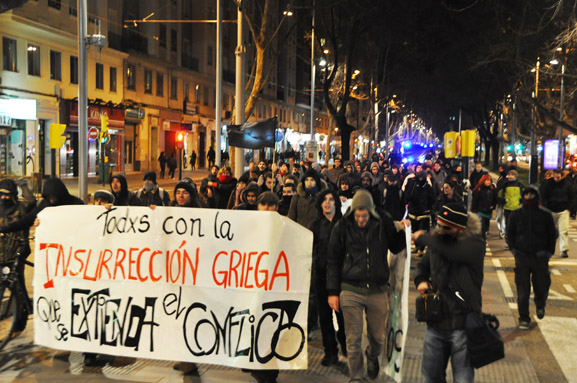
In the city of Zaragoza, a spontaneous call spread through ‘social networks’ in the afternoon of February 13th; at the last minute, more than a hundred people marched in the city centre in solidarity with the people in Greece, protesting against the scam called crisis. The banners in the photos read: ‘All with the Greek insurrection; to extend the clash’ and ‘Solidarity with the arrestees in Greece’. Cops of the national and local police followed the march without intervening. A young protester doing graffiti was withheld by cops, but released after a few minutes. The protest ended at the university campus with the reading of a statement bearing information about what happened on Sunday night in Greece and other issues gagged by the mass media.

In Madrid, several hundred people gathered on Monday night, February 13th, outside the embassy of Greece to protest against police violence, in solidarity with the Greek people, of which the European Union demands huge sacrifices. They were monitored by numerous national police agents. Also, cops asked for many protesters’ IDs. The attendants chanted slogans similar to those of the 15-M movement, as well as ‘It only takes a strike as in Greece’, ‘Mariano [Rajoy —Prime Minister of Spain], listen up, people are not for sale’ and ‘Solidarity with the Greek people’. There was also a banner in Greek: ‘Murderers’.

From Contra Info, where there are more photos and a video.

Slavery after slavery after slavery...

Widespread forced labor in the United States after 1865, mostly imposed to African Americans, is reviewed by this most interesting, impressive, shocking historical documentary: Slavery by another name, which can be watched in full for free HERE (must watch, really).

The USA was not so much built on fake self-made men but rather on the shoulders of millions of African Americans and other poor people exploited and abused mercilessly in a deeply rooted conspiration of slavery upheld by the whole social and political system, even against its own proclaimed principles.

Found via Kasama.

From the Net: 'The No-TAV Struggle in the Susa Valley' (Struggles made in Italy)

[en] The No-TAV* Struggle in the Susa Valley

Background

TAV is the italian acronym for Treno ad Alta Velocità i.e. HSR, High-Speed Rail. This is a railway that allows a sustained speed higher than 200 km/h (124 mph) and its peak speed is around 300 km/h. Even though for the most recent project of the Turin-Lyon it would be more appropriate to call it TAC (Treno ad Alta Capacità, High-Capacity Train), since it’s intended mainly for transport of goods, the misleading name of TAV remains.

In 1991 a new high-speed railway between Turin and Lyon was planned to be added to the current line across the Alps in the context of the creation of a European HSR network. The Turin-Lyon TAV is part of EU project TEN (Trans-European Network), particularly of the PP6 axis, from Lyon to the Ukrainian border. TEN project doesn’t require the railway to be of high-speed type, but the Italian and French governments agreed to build the Turin-Lyon as part of such technology.

... read full story at Struggles made in Italy.

From the Net: 'NO TAV – "‘Rebel or Fuck Off’ by comrades of Bologna (Italy)" (ecologists communication at 325)

Rebel or fuck off

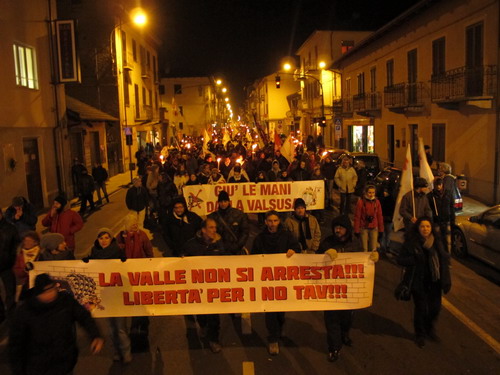
On 27th June the forces of order evicted the Free Republic of the Maddalena [in Val Susa] in order to start the works for the construction of the high speed railway. Hundreds of NO TAV people opposed directly the military occupation of the territory. On 3rd July 70,000 people assaulted the TAV yard in Val Susa. A very special yard, as no worker could be found there but antiriot troops and police were entrenched there. This is an outstanding example of devastation of the environment, and of the interests of big capital and the mafia that goes along it. On 26th January the State arrested 32 comrades all over Italy ‘for the events of those days’. An operation that means just one thing: active resistance against infrastructures, powers, armed forces and institutions that rape and impoverish the planet is considered illegal.

In fact this police operation is the climax of a series of repressive attacks that started in Bologna last April and carried on in Florence and Cuneo in the following months, and in Modena these last days. The goal is always the same: to totally eliminate all realities and individuals in struggle against the oppression that banks, governments and bosses impose every day; to prevent these realities and individuals from joining the struggles that are now on the increase; to put a spoke in the wheel of movements that have already undertaken trajectories of conflict, like the movement against the TAV.

Not by chance these arrests came at a particular time of social unrest, which started off with the movement of the ‘Forconi’ in Sicily last week.

Italy is on the verge of a generalized revolt. The blockades of lorry drivers on the highways and the protests in Sicily and Sardinia demonstrate that capitalism can be brought on its knees, and finally annihilated by the joint action of more individuals. In this context of economic depression any person who individually or collectively opposes the system is considered a criminal, and gets arrested and repressed. 

... read full communication at 325.

From the Net: 'Italy: NO TAV comrades still in prison' (Contra Info)

These are the latest news about our comrades who were arrested on January 26th. Many of the NO TAV resistants were released and are now under house arrest and other restrictive measures. Nevertheless, the judges have decided the continuation of pre-trial detention for the following comrades (we add their addresses):

Alessio Del Sordo, C.C. via Pianezza 300, 10151 Torino
Matteo ‘Mambo’ Grieco, C.R. San Michele, Strada Statale 31, 15100 Alessandria
Maurizio Ferrari, Carcere San Vittore, Piazza Filangeri 2, 20123 Milano
Marcelo Damian Jara Marin, Carcere San Vittore, Piazza Filangeri 2, 20123 Milano
Gabriele Filippi, Carcere di Marassi, Piazzale Marassi 2, 16139 Genova
Giorgio Rossetto, C.R. loc. Cascina Felicina via Regioni Bronda 19/b, 12037 Saluzzo (CN)
Luca Cientanni, C.C. corso Vercelli 165, 10015 Ivrea (To)
Juan Antonio Sorroche Fernandez, C.C. Via Beccaria, 13, Loc. Spini di Gardolo, 38014 Gardolo, TN
Antonio Ginetti, Casa Circondariale, Via dei Macelli 13, 51100 Pistoia – Riesame il 16-2-2012

transl. ParoleArmate
read more 1, 2, 3, 4, 5, 6


From the Net: 'Al Jazeera English Doesn’t Care About Khader Adnan' (L. Alsaafin at Electronic Intifada)

Palestinian prisoner Khader Adnan has entered his 55th day of hunger strike. He has long passed the critical stage and is in danger of organ failure any moment now. In other words, Khader Adnan is dying.

The silence from international media is deafening. Much of the publicity highlighting Adnan’s case came from social media via Twitter and blogs.

Does a young father of two arrested in the dead of night from his home, held under illegal administrative detention i.e. no charges have been brought against him, beaten and tortured during his interrogation, hunger striking since December 18th—a day after his arrest—not warrant headlines?

... full story at Electronic Intifada.

From the Net: 'For those we don't hear about' (Random Pottins on Khader Adnan's hunger strike)

Khader Adnan (from Alternative News)
WITH British TV news leading on whether some Muslim cleric should be deported to Jordan, and some people much concerned for the freedom of the Iranian government-sponsored Press TV, I thought we should devote a bit of space to some more deserving cases that have not had so much attention.

First, as reported by JNews among other campaigners or alternative media, tomorrow is day 60 of Khader Adnan's hunger-strike, which he started on 18 December 2011 in protest against his administrative detention (internment without trial) and the humiliating conditions of his interrogation by Israeli forces.

Physicians for Human Rights-Israel (PHR-I) is among those worried.

"Khader's condition is deteriorating. PHR-I's doctor, who visited him in hospital yesterday, said 'the clock is ticking'. At this stage, even if he stops his fast, re-feeding will be a highly complex medical procedure.

"Yesterday, 13 February, the Israeli military court of appeals rejected an appeal against Khader's detention and ordered him to complete the full four months imposed on him, until 8 May 2012".

That is four months without trial, so far.

"This is the longest hunger strike by a Palestinian detainee. For comparison, IRA Long Kesh prisoner Bobby Sands died after 66 days on hunger strike in 1981".

... full story at Random Pottins.

From the Net: '[Japanese] Governor: Why no arrests over [nuclear] crisis?' (Japan Times)

Wednesday, Feb. 15, 2012

Governor: Why no arrests over crisis?

By MINORU MATSUTANI
Staff writer

Saitama Gov. Kiyoshi Ueda wants to see Tokyo Electric Power Co. held criminally responsible for the Fukushima nuclear crisis.

At a regular news conference, he sharply criticized the utility and questioned why nobody in Tepco has been arrested.

"Tepco has caused this big trouble to everyone under the sun and nobody has been arrested. I want to ask, 'Doesn't anyone (in Tepco) want to turn themselves in?' " Ueda said Monday.

He was asked for comments about Tepco raising electricity bills for big users like corporations by 10 to 20 percent in April.

"Some people would be arrested if gas tanks explode or a fire breaks out in a department store," he said angrily, blaming Tepco for not taking full responsibility for the harm caused by the disaster at the Fukushima No. 1 plant. "The procedure of raising power bills without fully explaining it is unacceptable. It is extremely cruel treatment of (big users) who have been forced up to now to cooperate in saving electricity."


It is ironical however how he only rises his voice when big corporate users are affected. But still it was about time someone said that in japan.

Tuesday, February 14, 2012

The ABC of things... or why we should never yield to fear.

Yesterday, the Spanish far right newspaper ABC published an article of totally false lies, and the worst of all lies: half truths, about a blog that I happen to follow: Borroka garaia da! (It's time of struggle!) This blog, whose name the fascists do not even know and whose sentences are all misquoted and horribly deformed, is written by a single person but is full of sincerity and sharp critical analysis, and has suddenly grown (in the imaginary of those who read such Spanish fascist pamphlet pretending to be a newspaper) to be a pro-ETA political current, always according to the Spanish fascist liars I. Reyero and J. Pagola. 

It may be just inconsequential nonsense but it may well be part of a campaign of criminalization. As I wrote in the comments: ABC sets the target, Marlaska [Spanish Inquisitor] shoots and the Guardia Civil [Spanish police] tortures.

Whatever the case it is not just a manipulation and brutal lie but it is scary. For much less they have closed blogs and even full fledged newspapers and radio stations in this country, so tired of putting up with the boot of the invaders. And for much less people has gone to jail for years and years and are still awaiting to be set free.

Whatever the case, today Borrokagaraia replies again with a new entry full of poetical bravery and penetrating truth. I am translating some fragments here:
 
If you were not afraid, what would you do?
(...)

Repression has a function: to scare and set example. Such an old tactic as detached heads on pikes placed at strategical points for the people to see them in awe.

Fear knocked at the door, trust opened and there was nobody.

Repression has another function: to suppress someone or something.

First we will kill all the subversives, then their collaborators, then... their sympathizers, soon after that... those who remained indifferent, and finally we will kill the shy ones.

Repression needs criminals. And these must be constructed.

Nobody is innocent when his rival is the judge.

In the Basque Country repression is the law and is older than any acronym.

(...)

Choose 1, 2 or 3:

1. There is no police force nor repressive system on Earth, no matter how powerful, that can stop a rising popular mass.

2. There is no police force nor repressive system on Earth, no matter how powerful, that can stop a rising popular mass.

3. There is no police force nor repressive system on Earth, no matter how powerful, that can stop a rising popular mass.

(...)


Yes, the video of La Polla Records titled And what are you going to do me now? is part of the response.

That's how things are in the Basque Country under the reign of terror of the Spanish Inquisition and the legal blurriness of "all is ETA".  Scary, uncertain, oppressive... but hopefully all that will not be enough to shut us up. 

Because shutting up and giving up hope and struggle would be like surrendering to fascism, and I know already the sad stinking cowardice of those who surrendered to fascist terror without even a fight. Survival is not worth it.

Ernesto Prat to be extradited to Spain

The tribunal of Pau has decided to extradite Basque citizen Ernesto Prat to Spanish jurisdiction, where he risks torture, unjust extended imprisonment and has no chance of a fair trial. 

Prat was targeted by the Spanish Inquisition (Audiencia Nacional, special political tribunal which used to be known under fascism as Tribunal of Public Order) for his political activity, being member of the 2007 municipal list of Basque Nationalist Action in Doneztebe, Navarre. He was accused of being member of the ghostly political group known as Ekin, which proclaimed its self-dissolution months ago anyhow. 

Under the Garzón doctrine of "all is ETA" almost any kind of Basque nationalist activism can be persecuted and punished on grounds of "terrorism". The French Republic has extensively collaborated with this political repression. 

Source: Ateak Ireki[eu].

Anti-Nazi protests in Dresden

Massive Red mobilization in Dresden to prevent yearly Nazi march in the anniversary of Dresde bombing.

Photo-Galleries: gallery 1, gallery 2.

Source: Sare Antifaxista[es].

From the Net: 'Switzerland: Communiqué by ecoanarchist prisoner Silvia Guerini about her hunger strike from 20th to 29th of January 2012' (Contra Info)

Nanotechnologies are going to be one of the discussion points of the World Economic Forum (WEF). This is exemplary of how, along with biotechnologies, they are something more than a simple technological development. They represent a strategic and fundamental choice for the survival of this techno-industrial system; they are the bricks with which the system will rebuild itself in every sector.
 
‘Control the oil and you will control the nations, control the food and you will control the populations.’ (Kissinger, 1970)

(...)

I was transferred to the federal prison of Hindelbank (in the canton of Bern) in the ‘high security with psychological support’ section, which is in reality a psychiatric section, even if not defined as such. The absurd justification for this is the ‘risk of escape’, the only motivation they can use for putting me in this separated and more closed section, in this prison with no walls around but only a fence. Next to this section there is the high security one, built in the 70s for a comrade of the RAF; it is significant that afterwards it was transformed into the section for ‘dangerous’ women with ‘serious psychiatric problems’…

... full story at Contra Info.