Showing posts with label geopolitics. Show all posts

Monday, June 11, 2018

G7, G-what?

By snubbing the most important imperial tool for governability (aside NATO but not really different from NATO), Donald Trump is throwing rocks at his own roof, because it's hard to see how would the USA project its power through the world without the G7. G7 is the backbone of NATO, all its members except Japan (the backbone of "Eastern NATO" on its own right) are major NATO powers and that's why the G7 exists and why it has been instrumental to establish US imperial hegemony over the world. Trump is destroying that, and I for one welcome it, even not without some vertigo, as all major changes should inspire. 

The pouting face of Merkel, the tears of British newspapers crying foul about Brexit and the non-existent "special relationship" (bootlicking vassallage I call it, because Britain gets nothing from its subservience to the USA) and then of course the stupid childish face of Trump himself, they are all very worth a sinking global system that was already sinking anyhow, so why to spare this old man the joys of laughing at this childish game of armchairs?

NATO was already cracking, notably because of the major difficulties that the Berlin-Washington relation undergoes as the USA and its most loyal puppets (France, Britain) have rampaged with no criterion across the Mediterranean and the Black Sea, against Libya, Syria and Russia. Remember how Italy and Germany rejected to join the adventurerist toppling of Muamar el Gaddafi, mostly because it was an attack on Italian interests in favor of French and British ones? Most people don't grasp this well: they tend to think in terms of unilateral imperialism but imperialism is always multilateral, multipolar, and it always leads to conflict and wars (even if nukes seem to prevent major global wars, smaller localized wars and the ever growing "cold war" tension is certainly there); in the case of Libya, it was Italy the main loser (after Libya itself, of course) and Germany was already upset enough to align themselves with Rome rather than with the big boss in Washington D.C.

That's because Germany, as manufacturer-exporter power, has a very long history of searching for all kinds of markets and one of them used to be Iran. And who have therefore harmed US/EU sanctions against Iran? Germany among others. And it is exactly the same with the anti-Russia sanctions but I'd dare to say that even much more severe. Germany has been a good dog anyhow and bowed to what master commanded, albeit reluctantly, but this was only or mostly because the other markets it had access to compensated. But now? With all this Trumptard "nationalism" in form of tariffs, what will keep Germany in line? The military occupation? Well, it does not seem enough: if Germany says "US and NATO bases out" it's hard to see how NATO will be able not to comply. They'd move just a few steps away to Poland but that's another story.

But of course Germany does not want that because NATO and EU are extremely imbricated with each other, and Germany needs EU, which is its primary market and a major pillar of its imperialist policy, what Varoufakis called the "postmodern IV Reich". So basically Trumptard Washington is playing with fire and putting Germany between a rock and a hard place: threatening to blow up Germany's most prized market and subservient sphere of influence (EU, which will blow up anyhow on its own contradictions, sooner than later: watch Italy, remember Brexit, ponder Spain about to blow up in pieces, look at the massive strikes and related street fights in France) if Germany does not behave as a bootlicking slave of the USA. 

And Germany does but there will be a point where it won't anymore. When and how is that? Probably not very far away in time. I already explained how Trump wants to destroy the EU and make sure Europe becomes a colony of the US empire, at least to a much larger degree it has been so far (because of the cold war cum class war of the mid 20th century, and also the transition from a Europe-centered world to a US-centered one), and it is clear that the EU will blow up in pieces soonish (something that the US wants but while keeping NATO as intact as possible, what may not be possible). 

Another crack in NATO is Turkey. Turkey is under Erdogan almost identical to Nazi Germany in its arrogant warmongering and incontrollability (and Erdogan makes no secret of his admiration for the German genocider). All major powers love (and secretly hate) Erdogan because of that: the USA wants Turkey to remain in NATO and keep aiding them to de-stabilize the Middle East, Russia wants Turkey to leave NATO and especially to be "independent" enough to act as their ally, including in the infamous "Pipelinistan", which is another facet of imperialism. But the most coveted asset of Turkey are the straits (Bosphorus-Marmara-Dardanelles) that join the Aegean and Black seas, of critical importance to Russia since times immemorial.

So we have the following cocktail of instability:
  1. The USA wanting to reform the Empire in favor of the metropolis even at rist of destroying the Empire itself.
  2. Germany wanting to get their way in both exploiting the EU as a semi-colony and being allowed to have unrestricted business with Russia, Iran, etc., this last against the will of the Imperial master, now asserting itself as "iron fist" madman in charge and reminding everybody else they are nothing but minions.
  3. Turkey playing to be the Muslim version of Nazi Germany and being flirted by a despaired former lover (USA) and an aspiring new lover (Russia).
  4. Latin Europe exploding at slow motion but in ways that seem impossible to stop. This happens in different ways in each state but it happens all across the region (except for Portugal, where social-democracy with a green touch has made the country gain stability).
  5. Poland playing to be Mussolini's Italy in Eastern Europe, with full backing of the USA but directly in contradiction since long ago with the interests of Germany (and of course, those of Russia). 
  6. Britain drifting aimlessly between the Brexiter despair, the Corbynist hope and the nearly total indifference by all its "allies", including the USA.
And then of course in the background is China, whose local expression in Europe typically comes by the name of Russia. Mind you that Russia would prefer a more balanced independent role but that the USA has cornered it against the all-embracing arms of China. Remember that no long ago the G7 used to be called the G8... but then Russia was kicked out.

Probably the most crucial element in all this is the weakness of Germany as power: it is an economic powerhouse that cannot assert itself against its master and overlord the USA. Or can it? And, if so, how? Nobody, as far as I know, defends in Germany a more belligerant and independent stand... yet. But, on the other side, it seems like there is no alternative for Germany than actually becoming more belligerant. However becoming more belligerant, asserting itself as power by means other than economic and diplomatic would not just break taboos but actually would initially cause its global market share to shrink dramatically. And those are the marked cards Trump is playing with: you may pout all you want, Angela, but if you dare to do anything, you won't sell a single Volkswagen or Siemens thing in the USA, and your darling EU house of cards may easily fall down with a single but determined blow.

The question is: can the USA survive that kind of upheaval of its own imperial structure? My bet is that it cannot and that it's actually only doing that out of desperation because it's already riddled with holes and problems it can hardly overcome.

Monday, January 29, 2018

Afrin is the new Kobane, let us all defend it however we can

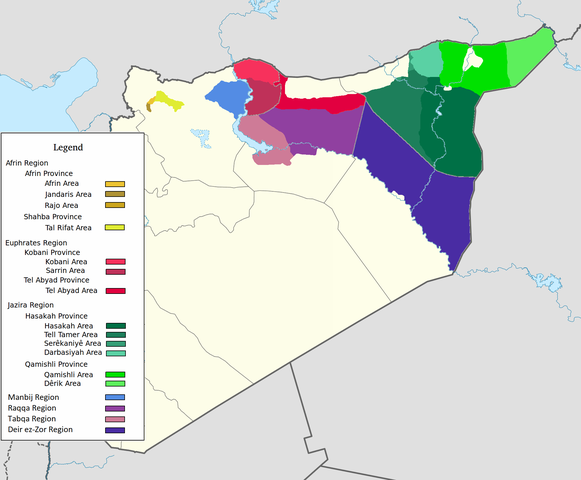
North Syria Federation
(credit: Editor abcdef, Wikimedia)
In yellow Afrin Region (canton)
Let's begin stating the obvious (but not so-obvious to many apparently):

1. Turkey has a fascist regime led by Hitler-loving and Islamo-Fascist extremist Tayyip Erdogan.

2. Russia and the USA are both capitalist (and thus imperialist) states: there is no monopolar imperialism, imperialism is by (Lenin's) definition the struggle of the various capitalist powers to control the world's resources and attempt to exert quasi-imperial or at least some relative hegemony over the rest. 

3. The SDF (Syrian Democratic Forces, organized around the Kurdish YPG/YPJ core) and the legitimate government of Syria (Baath, Assad) get along even if they clearly have different political projects: the former internationalist and Kurdish-centered, radically democratic and decidedly communist, the latter Arab nationalist (pan-Arabist), not so democratic (in spite of the reforms) and not so socialist (rather state-directed national capitalism). In spite of skirmishes and diverging international alliances this has been the case since the beginning, when the YPG coalesced as a Kurdish self-defense force.

Also maybe not-so-obvious to some may be the fact that Turkey has a huge army but that it is made up mainly of recruits, many of whom hate Erdogan (even by rigging the elections the Turkish neo-sultan only managed to get a narrow majority in parliament and needs the backing of the secular-fascists to stay in power). We have already seen in Ukraine how these conscription armies are very inefficient against motivated popular militias, notably when their commander regime is illegitimate and the war they are waging is as well. 

It is also important to underline that Syria has allowed massive YPG-SDF reinforcements to arrive to Afrin. And that Turkey is working with Islamist militias (roughly Al Qaeda and DAESH, just recently renamed again for PR reasons) just the same they used them as death squads in the brutal repression of the Bakur (North Kurdistan) uprising in 2014-15.

Both the USA and Russia court Turkey. The former want it to return to its former status of reliable ally (vassal) and thus are not taking active action in Afrin, where they are not present, but still signalling they won't retreat from Manbij or other lands of the Northern Syria Federation where they hold some military presence. The latter have snubbed their Syrian ally in regard to air protection of the canton of Afrin, as determined by truce agreements, because they clearly want Turkey to become yet another ally in the region, along with Iran (also anti-Kurdish) and Syria. The powers do not care about Afrin at all: they are interested mainly in the Bosporus Straits, which are Turkey's main asset, and secondarily in projection in the Fertile Crescent.


What's actually going on? 

As far as I can tell there has been heavy bombardment by Turkey of civilian towns, using chemical weapons in at least some cases, and even the destruction of a landmark historical ruin (a signature of Islamo-fascism) but on land Turkey and their allies have made only very limited gains. 

As of today Turkey has only occupied a hill on the border, hailed as a "great victory" by their propaganda machinery, of course. The initial attempts to take over the southeastern extension of the canton north of Aleppo failed, with many more casualties in the Islamo-Turkish camp than in the Kurdish Communist one.

However, let's face it, it's a David versus Goliath scenario in which, in spite of their bravery, the Kurds and allies (including as far as I know some internationalist units) have it very difficult. The same was true in Kobane and they prevailed though... on their own forces alone. 

I would expect that, as soon as the Spring arrives, the Kurdish forces north of the railroad (the official Syro-Turkish border is the old Baghdad railroad in most of its length) will initiate some sort of offensive, forcing the Turkish army to spread wide, but right now it is massively concentrated around the small territory of Afrin, the Mountain of Kurds.

  
Popular forces can win against all odds

But we have seen it before in Donbass and in Kobane: a motivated militia can certainly defeat a poorly motivated conscription army, never mind fascist mercenaries. Why do I "dare" to compare Donbass and Afrin: aren't ones in the side of Russia and the others in the side of the USA? The answer is "no": neither Russia nor the USA care much about their popular "allies", they
fear them in fact, precisely because they are democratic and popular, and only offer them very limited and conditional support at best. They are just forced to cooperate with them because of geostrategical reasons but always with the sight elsewhere: Kiev, the Bosporus, Latakia, etc. Who backs them is not important, what matters is that they are democratic and popular forces.

And I must say that it is most interesting that these great powers are being forced by circumstances, by the inefficiency of other more fascist or authoritarian approaches, to rely on these grassroots militias to some extent. It evidences that Lenin was right when he characterized Imperialism as a clash of oligarchic mafias on which we revolutionaries should not be too interested but rather on the possibility of making some revolutions in the cracks generated by this inter-imperialist struggle.These cracks are every day larger and democratic socialism is arising in them, not without difficulty but with perseverance and admirable toughness. 

And that's why we must help as much as we can to defend Afrin and denounce the Turco-Islamist criminal aggression: because it's not just the people of Afrin and the many thousands of refugees installed there, it's not just the right to self rule of the Kurdish and all other peoples, it is global revolution what is being fought there. Afrin is the linchpin of our hope for a better world, we can't just watch or ignore it.


Thursday, November 16, 2017

Hariri's kidnapping is just part of a major coup in Saudi Arabia

This intereview with Lebanese journalist Marwa Osman at The Corbett Report is most interesting:


The most luxurious hotel in Riyadh is now a prison for all the princes in the realm. Furthermore at least one key prince, Fahed bin Abdullah was killed by gunfire. Incidentally this man was best friend since childhood of kidnapped Lebanese PM Hariri and his business partner.

Israel and Washington behind the scenes

In min. 14:55 she says: "He [Mohamed bin Salman] sees Hizbollah as a threat to himself. I don't know why, because Hizbollah is a threat to Israel not to him".

To understand that one has to take in account the revelations that Prince Khalid bin Farhan al-Saud made in June to the Middle East Monitor: Mohamed has made a deal with Trump by which the USA backs his bid for total power, including speedy ascension to the throne (his father, the nominal king, has Alzheimer). in exchange for Saudi blessing and financing for the Final Solution against Gaza Strip, a territory that Israel now covets for their version of the Suez Canal. 

I discussed this and the sudden hostility against Qatar here.

Saturday, July 29, 2017

USA moves against Germany with an anti-Russian pretext - the EU is doomed

Remember what I said months ago about Europe being bound to become a US colony or worse? Well, it is happening right now. All that blah-blah about Trump siding with Russia was of course just a smokescreen: Trump has managed instead to lead a massive consensus in US politics for new Cuba-style sanctions against Russia. Why? Because that is the perfect opportunity to start a trade war against Germany and shatter the EU into pieces.

I won't cry for the EU but we will all cry for the conflicts that this IMPANSIONISM of the US Empire is about to trigger. 

Germany and its close ally Austria are clearly angry but I am not at all so sure as they claim to be about the EU standing united against the US intentions. Certainly Britain is out for good but also Bankster-President Macron of France has been actively and shamelessly courting Donald Trump, with greater success than Angela Merkel, no doubt, but unclear consequences as of now. 

Actively anti-Russian regimes in the EU are also Poland, Sweden and the three small Baltic states. Norway is probably also siding with the USA and the rest is all indecision. 

Anyway, what can Germany do? Well, first of all expel all US and other "ally" bases from its territory, a legacy of a long occupation that was formally ended in the 1990s. They could also choose to exit NATO's integrated military command, as De Gaulle (France) did in the 1950s, and they could once again demand from the USA the return of their gold reserves stored in Fort Knox (which the USA already declined to do a few years ago). But of course they'd be much more effective if they could rally the EU around them in a proper trade war against the USA, in which there is no clear winner other than China. The problem is that Germany's austericidal policies have already alienated any hope of internal solidarity within the EU. Basically Merkel's Germany has wasted its chance at leading the bloc in a way that is good for all, and not just for Germany, and now nobody will care too much if Germany suffers a bit or two. 

That does not mean I'm declaring Germany's position lost, just that it's much much weaker than they imagine (wishful thinking never solved anything). In any case Germany and whoever rallies around it is bound to clash with Washington: the interest they have in the Nord Stream pipeline is way too serious and they are already pissed off by the US and allies' troublemaking in Ukraine, including the first round of anti-Russian sanctions. Worse, the issues come from older times: anti-Iran sanctions also harmed Germany's economy and the intervention in Libya was shunned by Germany and Italy. To a large extent Germany is in the same difficult position as Russia was put into, just that, while Russia has a much larger degree of sovereignty, not just because of its huge and very effective military but also because of its extension and natural resources, Germany is much smaller in size, has a relatively weak military (and no nukes!) and, above all, it is extremely dependent on the EU trading bloc, which it has used and abused to further their own interests. 

What does the USA want? Forcing Germany to accept an even more marked subservient position, to reduce their exports (something that Trump has been outspoken about but would mean the collapse of the German economy) and in general establish a truly imperial rule on Europe by Washington. 

I can't say how this new major conflict will evolve but my best hunch is one of conflict inside Europe, the quite possible collapse of the EU as we know it, maybe of NATO too (the remnants would be recycled into a satellite US "province" with unmistakable US dominance) and I would definitely not discard wars and military coups. But what I do think is very clear is that Germany cannot afford the luxury to budge once again at Washington's demands, no matter how extended is the anti-Russian consensus which is used as a pretext, because it is transparent that the target is not so much Russia but Germany. 

I'm sure I will have to write more on this soon, because it is clear that this conflict is bound to become the epicenter of European and even global politics in the next months and years. Serious stuff, really!

Tuesday, June 27, 2017

Behind Qatar's crisis: Israel's plan to annex Gaza and expel all its inhabitants

I have been as puzzled as anyone about what on Earth was going on behind the sudden blockade and blackmail by Saudi Arabia, Egypt and a couple of lesser players (UAE and Bahrain) against Qatar. But today suddenly the puzzle begins to take shape with the addition of two new pieces:

1. Egypt's Parliament voted to cede two strategic islands to Saudi Arabia. The islands of Tiran and Sanafir are located at the mouth of the Gulf of Aqaba, making that strait Egyptian territorial waters. This cession was done against Egyptian national interest and historical pride and without Saudi Arabia having ever staked any claim on those islands. Actually the cession is not about Egypt nor Saudi Arabia but about Israel, because by giving away those strategic islands, the Zionist Colony gains free access to the Red Sea via what will suddenly become international (and not anymore Egyptian) waters. 

Tiran and Sanafir Islands
Tiran and Sanafir islands (source: The Real News)


2. Prince Khalid Bin Farhan al-Saud, who lives outside the rigors of the Saudi courtly plots in Germany, has revealed that the conditions imposed by the USA to the current Crown Prince (heir) and effective strongman of Saudi Arabia, Mohamed Bin Salman, in order to allow his raise to the throne before his (demented) father's death are that Saudi Arabia accepts the genocide in Gaza and finances the resettlement of Palestinians in Sinai, and also the internationalization of the waters of the Gulf of Aqaba.

The alleged conditions include “absolute obedience to the US and Israel and carrying out whatever they ask him to do.” Three other conditions, claimed Khalid, are stated in return for helping Bin Salman take the throne before the death of his father: “Working to settle all Gaza residents in north Sinai as an alternative homeland and Saudi Arabia along with the UAE will afford the needed funds; getting rid of Hamas and whoever supports it; and getting Sanafir Island from Egypt.”

Bin Farhan said that the last condition would make the Gulf of Aqaba international waters instead of Egyptian territorial waters, which would facilitate Israeli shipping to and from the port of Eilat. It would also help Israel to carry out a project planned to operate in parallel to the Suez Canal. A retainer of around $500 million is also involved, he claimed.

Sinai Peninsula, Gaza Strip and Gulf of Aqaba (credit: Graphic Lab (ru))

For the last many years Gaza has been ruled by Hamas, originally a branch of the Muslim Brotherhood, against whose elected government arose the current military strongman and President of Egypt. Both moderate islamist organizations are the main pretext for the Saudi-Egyptian aggression against Qatar. 

It is worth reminding that Turkey, whose autocratic President Erdogan seems to have been falling apart with the USA and even flirting with Russia and Iran, has rushed to protect Qatar from any possible Saudi invasion and can be perceived as a historical mild ally of the Muslim Brotherhood and even Hamas (remember the Mavi Marmara). However Turkey remains part of NATO and provides a key air base (Inçirlik, near the Syrian border) to the USA and its European vassals ("allies").

It would seem that when Israel's Prime Minister Netanyahu expressed his happiness about Trump's election, he knew well what was going on behind the obvious political and geostrategical clumsiness of the White House's buffoon (so-called "President"). Only someone of the low stock as Trump would allow for such a blatant a genocide to take place before our noses.

The plan is quite apparently already ongoing, the cession of the islands is a clear sign, so we should expect that in few weeks, months at most, the plan to invade Gaza and expel all its inhabitants, more than one million people, most of them refugees from what is now Israel, will begin.

Let's not be mere spectators, let us make everything possible to prevent this new genocide.

Saturday, February 25, 2017

DAESH is finished, what next?

The so-called Islamic State (DAESH by its Arab acronym) will be finished in a matter of weeks: Mosul is being liberated without almost any resistance, Kurdo-Arab forces have cut off Raqqa from Deir-el-Zor, Turkey marches on Al Bab along with their Al-Qaeda "moderate opposition" militias, while Syria is also force-marching to cut the Turkish advance on their sovereign territory, as well as against Palmyra. On top of that the USA has been mass-bombing Raqqa itself (and nope, nobody has cried about the "humanitarian situation" this time). There is no coalition but a general recognition that DAESH is the legitimate target, which each one is using for their own purposes. 

Military situation in Syria around February 12 per Wikimedia Commons (author: Ermanarich)

The expected end-game situation will be a partition of Syria in three areas: the main one under the legitimate Baath government, a very sizable chunk in the Northeast (plus a Kurdish enclave in the Northwest) under independent Kurdo-Arab control (Syrian Democratic Forces) and a strip of the rural Northwest under Turkish control and that of their allied militias who until recently flew the banner of Al Qaeda. 

DAESH will be then limited to dormant cells and a few guerrilla enclaves in Africa and Yemen, which may well turn their allegiance towards Al Qaeda/Turkey/Saudia/USA again or suffer the consequences. 

My big question is what next for Syria. I'm uncertain that Damascus and the YPG can get along once the common enemy has been smashed, although it will remain in the form of the FSA (Al Qaeda) and Turkey, they may both feel powerless to fight against the Turkish regional power and their NATO fallback line. Surely that won't dissuade the Kurds, who are in open war against Turkey (not by whim but because Erdogan imposed it) but I'm quite uncertain that Syria, which has not fought for the Golan Heights in many decades, was pushed out of Lebanon and has been struggling to win the "civil war" without support (Russian intervention proved decisive, no doubt) is ready to fight against the much stronger Islamo-Fascist Turkey of Erdogan. 

So my guess is that it will settle in some sort of unstable status quo, with Damascus demanding the pull back of Turkey with words rather than action, Turkey demanding "dialogue" (i.e. concesions to Islamo-Fascism and Turkmen tiny minorities) just to delay any retreat, Kurds growingly confronted with Turkey as leftover weapons and hardened warriors flow into the North of the country under Ankara's occupation, Turkey pressuring Syria to do something about it, Syria rebuilding while it looks at both sides between amused and concerned, etc. It's possible even that the Syrian Army and the SDF join forces to finally expel both "moderate" Islamo-Fascists and Turkish troops from Syrian territory but there will be no doubt a lot of distrust. 

Unless NATO collapses in the meantime (that would be very nice indeed but most unlikely), the Baghdad Railroad line (Turco-Syrian border) is a red line that Syrian forces will never cross, nor will Russian air forces if involved, only Kurds will because for them that border does not exist, just as they do not seem to exist as nation for the rest of the world. 

In any case the murderer, torturer, rapists and slavers DAESH will be gone for good. And that is indeed good. I can just hope that they arrest them as they flow back into Europe and other places, instead of letting them in as their Western protectors usually do, with the obvious intention of using them as pretext to implement every day more extremist dictatorial measures such as the permanent state of emergency in effect in France and to prop up the extremist Christo-Fascists and outright Nazis that seem to be groomed to replace the current constitutional regimes, once these are exhausted, as has happened in the USA with Trump, in Poland with Duda, etc.

Sadly enough hope alone won't do much.

Friday, February 3, 2017

Poroshenko's regime attacked Donbass, breaching Minsk agreement, with no success

The neofascist dictatorship in Kiev launched an attack on January 29th against Avdeeka, a few kilometers north of Donetsk. This attack breaches the Minsk truce so Poroshenko's regime has resorted to put the blame on Novorossiya, accusing them of unspecific "provocations". Seriously? Nazi Germany also did that to "justify" their invasion of Poland but at least they had fake photos with fake "Polish guards", what does Poroshenko have? Nothing at all but words. 


According to the Basque Country-Donbass Solidarity Committee, the attack has been successfully repealed in spite of "severe" initial losses (because of surprise). According to Kiev, Ukraine lost 11 soldiers (4 dead and 7 injured), while the People's Republic of Donbass acknowledges one defender dead and another one injured. The internationalist committee thinks that the figures by both sides are totally unrealistic and that many more people died in the combats. Colonel Cassad (Novorossiya) argues, following the US Department of State, that the Ukranians lost dozens of combatants and he also says that surely the figure is quite high in the side of Donbass. 

The exact short-term goal of the attack is disputed: a water treatment plant just behind the PRD lines is one of the possibilities, or also a coke power plant under threat of closure. However Cassad ponders, on unspecified sources, that maybe the real trigger is an internal dispute among the oligarchs in power in Kiev, trying to retake the former properties of Rinat Ajmetov in the area (after all, what's an oligarch without his property?)

There have also been maneuvering near Mariupol, Volinaja, Donetsk and Popasnaya, but Cassad considers that some of these could be a distraction from actual objectives, as they are too apparent.

What is clear, and Cassad also acknowledges this, is that Kiev is somehow trying to improve their position for the foreseeable scenario of abandonment by the Western, US-led, bloc upon Trump's ascension to power. By triggering war and bloodshed Kiev is using their very limited means to put obstacles between Washington and Moscow. As Cassad says: what matters is bloodshed, not so much whose blood is it. 

Ukranian soldiers: turn around and march on Kiev. It's about time! But it's also about your lives, and your hopes as nation.


Wednesday, January 25, 2017

Europe is bound to become a colony (or worse) with Trump

Trump's policies may mean that Europe will have to become a colony of the USA, to transfer even more wealth to the core of the Empire. Let me explain...

Geopolitic irrelevance

This is a real story I was told in the Montenegro of the early 90s, in first person, by a liberal (center-right) politician who had a friend in the US embassy, whom he believed was probably a CIA spy. They had the following conversation (from memory):

-- Your country [Yugoslavia] has lost its geopolitical relevance -- said the diplomat.
-- I'm glad to hear that -- replied the politician.
-- I wouldn't be happy if my country became irrelevant, honestly. 

The narrator ended the story saying that this is why, he understood, the federation was broken and war took over just a few months after that chat. 

A bit of history

Of course Europe, the European Union and associated states, is much much bigger and therefore the loss of geopolitical relevance cannot be so extreme but there is something like that going on anyhow. After World War II, Europe was pampered (Marshall plan, etc.) rather than outright exploited by the Western co-victor, the USA, because of two reasons: 
  1. It was required to prevent a "communist" or "real socialist" takeover by the desperate and disgruntled masses, which had already been leaning very strongly to the left in the pre-war period (this was countered by engineering fascist coups but in the end these caused too much trouble anyway, so some alternative was needed).
  2. A relatively wealthy Europe could then buy the excess of production of the USA, helping to keep the transatlantic hegemon affluent and happy. Later the USA would evolve towards becoming a market itself, rather than a producer and exporter, via perma-debt and dollar hegemony but that is a second phase beginning in the 1970s, when the gold standard was definitely abandoned (largely to prevent excessive independence of European powers like France, which had been hoarding gold and dumping the dollar).

Well, the USSR fell in 1991 and the likes of Thatcher had been successfully attacking the power base of the Fordist working class (mass workers) since a decade earlier. Public investment (partial "socialism") was replaced by easy credit, a lifeline for short-term prosperity without which the system would have imploded, creating the infamous bubble that burst in 2007. 

Without a "real socialist" power in Europe and with the labor unions pretty much dismantled, there was almost no resistance to the "Washington consensus" (also known as Neoliberalism), while workers were individually bribed with way-too-easy credit, credit that they would eventually pay in blood and flesh, like in Shakespeare's The Merchant of Venice, thanks to endless small print provisions in laws and contracts nobody paid much attention to... until it was too late. 

Anyhow this "easy credit" lifeline lasted for much longer than it was probably expected to. It was meant to keep people content while the last remnants of socialist dreams were dismantled but it ended up caught in its own autonomous dynamics (those of a pyramidal scam) and persisted for maybe a decade after it was actually necessary. For more than 15 years Capitalism seemed triumphant thanks to it: "communism" had been proven wrong and Capitalism right. It was a mirage but a mirage that lasts some 16 years (or more depending on when you start counting at) is as good as hardcore reality for the short lives of people, right? 

Europe's growing irrelevance

Anyway, the USSR has been out of the picture since 1991, when a maverick politician named Boris Yeltsin declared the "independence" of Russia from its "socialist" empire, go figure! For most of the 16 year period, Russia was an ally of the Western Imperial regime, even after Putin took over (since 1999). The alternative bloc, the BRIC (later BRICS) was, quite curiously, formed between 2006 and 2009, coincident with the structural crisis that began in 2007-08 and has yet to end, and Russia was not suspended from the G8 (former G7) until 2014. 

For all this time, until this very day, Europe was an integral part of the core Western Empire, even if it was clearly subservient, growingly so, towards Washington in all the spheres. Europe did pay some hard tribute to the USA in form of a way too rigid and clearly over-valued euro, relative to the US dollar, what helped to make the mega-crisis more bearable for the North American hegemon, but otherwise the transatlantic solidarity of the 1% and their regional or "national" interests was clearly unbroken. 

This is what is changing now with Trump. Sure, people focus on the most obvious aspects of his vocal foreign policy plans: Russia, China, Iran, Mexico, etc. But in what regards to Europe only one aspect matters: Russia. If Russia is not anymore a rival for the USA and particularly if Russia is not the main rival, then Europe's strategic relevance is greatly diminished. 

This is not really something new: it has been that way for the last quarter of century in fact but the sheer size of European economy, the strength of the historical alliance, the globalist "free trade" doctrine and the Russian nukes have somehow kept Europe in the loop long past the expiration date of the realistic need. It is even plausible that the Ukraine conflict was engineered with this "need" for Europe of a "Russian foe" in mind, although the inertias of Mackinderian geostrategy must have also played a role from the "insular" viewpoint of the USA, which greatly exaggerates the "threat" of Russia, a country with the GDP of Spain or Australia (although a much more independent policy and national self-respect), in spite of being much larger in size and population. 

And since the Maidan putsch it has become obvious that Russia is relatively impervious to trade sanctions and that all that Western pressure only has served to strengthen the Kremlin's alliance with China and give a determined push to "silk road" overland trade and pipeline projects China is very interested in. Trump and his advisors know that and want to reverse the trend because, after all, Russia is just a secondary power, while China is the real threat to US global hegemony. 

So Europe now has no role: keeping it affluent appears meaningless for great capitalists who do not fear revolution anymore (overconfidence can be very dangerous) and who consider that is much better to have Russia on your side (or at least neutral) than on the side of China. Worse: Europe is not that important as market for US products (other than "cultural" and computer-related ones) and instead, notably the regional power: Germany, it exports a lot to the USA, while buys from China and also invests there (transferring technology and know-how). This deal, especially now that the dollar is stronger and the euro a bit weaker, is bad for the USA: Europe must pay serious tribute or suffer the consequences.

Europe has become weak and divided

And the last decade of persistent systemic crisis, with absolute lack of statesmanship, let alone continental leadership by the regional main power, Germany, has been extremely bad for Europe: it's not just broke, it's broken, what is much worse. While in the early 21st century Europeans looked at each other growingly as almost equals, since the crisis broke up, we see each other with extreme distrust, distrust that is particularly strong towards the European institutions, which have burdened the masses and gave all kind of advantages to the mega-rich (all within the Washington consensus, it must be said). 

The European Union is so weak right now that it can easily break at any moment. Brexit may be not enough but it is a stern warning: any day now it can be Italexit, Frexit or even Spaxit (although deep inside we all hope for Germaxit, that will not happen while Germany is the main beneficiary of what some call "the postmodern IV Reich"). It may of course linger for five years or whatever but it is very severely wounded, with the camps divided between the ones who can't think of anything less bad (Grosse Koalition) and the ones who can't imagine anything worse ("nationalists" or "populists" of all kinds). Nobody is able to imagine anything better, at least within the "realism" of mere reform. 

Such a broken Union is unable to resist any pressures, especially those coming from the USA, more so if backed by covert action (Gladio is alive and kicking and it serves the Pentagon). And if anything brings together Trump and Putin is strong disrespect for the role played by European "leaders" in the global scene, something that I must agree with: it's absolutely pathetic, lackeyish, short-termist and very hostile towards European citizens, whom they have almost completely alienated from the economic redistribution and therefore from he socio-political consensus of power.

Not sure if it was Chirac or Miterrand who said: "after me they will all be petty merchants". And it was quite prophetic. And those "petty merchants", those ink-stained accountants, those swindlers who pretend to "rule" Europe only to serve global banksters and other great capitalists, without the slightest regard for the well being of Europeans ourselves, are destroying the very dream of European unity they once managed to sell to us as a great hope. 

Expectations: from bad to worse

Just wait and see: this extreme fragility of the European Union will pay into the hands of Trump soon. And it will be for the worst, because Trump main goal here is to get rid of what he considers a useless burden and an economic competitor, which just doesn't pay enough tribute (economic flows towards the USA in general) to be worth "protecting" (protection racket it is: there's no actual threat to Europe but it can be groomed if need be) and worse: it is suspect of conniving with "the enemy", China, to whom it buys trinkets and sells technology (for a profit, of course). 

So Europe, and particularly Germany, had to cut its business with Iran first, then with Russia and now it is probably expected to do the same with the remote but growingly powerful China. Furthermore, it will be now expected to prove itself useful for the USA by means of enriching it. This will not pave out well: Europe will break apart catastrophically, what will not solve anything anyhow but will be even worse almost certainly. 

There is an alternative: European socialism, real socialism of one variant or another, but Europeans are not psychologically ready for that in most cases. In fact what we see in most states is the growth of far right nationalisms, which are basically the European version of Trump and Putin, or worse, and cannot solve anything at all: they serve the rich and the rich always want more and that can only be extracted from either the masses or some neo-colonies, these extremely competed for nowadays. 

Britain, Spain and Greece are rather exceptional and look like they could actually lean towards socialism but, as we see in Greece, the road to emancipation is paved of all kinds of obstacles: external pressures which can be most extreme but also internal weaknesses when the very leaders are pretty much in the dark about what needs to be done, flirting too much with a reformism that is nowadays impossible.

Saturday, January 14, 2017

The bilionaire behind Trump's sucess

So much noise, fake news, about Putin and then we find out that the real guy behind Trump's success is 100% made in the USA, as everything behind the blondie elderly far-right decadent phenomenon.

From The Real News:


Also it seems already that all that spam about "getting along with Russia" was just electoral propaganda: his appointees are now clearly saying that Russia is the enemy to beat. So once again there was no choice in foreign or imperial policies in this US election, the Deep State always wins:

→ Finian Cunnigham (op-edge at RT): 'Deep State' wins… Trump is being tamed to toe the line.

Thursday, February 25, 2016

Saudi road to nowhere: even the EP calls for isolating the theocracy

In an unprecedented resolution, the European Parliament has called for an arms embargo on Saudi Arabia in relation to its brutal military intervention in Yemen. Other issues such as the occupation of Bahrain, its horrible human rights record, the fact that it is a most cruel and totalitarian dictatorship or that it has been for decades behind Sunni Islamist terrorism everywhere, have not been included in the resolution, yet, considering the very conservative and imperialist policies that the EU institutions distill all the time, it is a remarkable vote and a sign that a growing amount of people in the West is getting most annoyed at the Islamist terror chaos unleashed in West Asia by NATO and its local allies: Saudi Arabia, Turkey and Israel primarily. 

As you may know the EP has, sadly enough, almost no power (only approving or not the EU budget and minor stuff like that) but it still exerts a moral influence on the EU, being the only democratic body of this sui-generis confederation. Therefore we should not undermine its importance. 


Forecast

Personally I feel that all what is happening will soon result in a dramatic socio-political crisis in Saudi Arabia: you can't rule a country of 30 million without other feedback than just police reports. Not for long in any case. The question of democracy is not merely a question of rights and freedoms but, from the rulers viewpoint, primarily one of feedback and cohesion. 

Anyhow, with such low oil prices, the money is running out and Saudia is just rushing forward to nowhere, risking even a World War with its threats of invading Syria. If this happens, the conflict in West Asia will run out of control in no time: Iran will no doubt intervene, backed by Russia and China, and that would be a major event. My opinion is that the West will doubt and finally not intervene directly, largely because there is such an exhaustion of the fictional narrative of "war on terror" and "clash of civilizations" that a lot of people even in key power positions will be tempted to let Iran do the moping instead of risking not just World War but also internal political stability to save a totally despicable regime such as the Saudi one. 

I can only imagine that, possibly, the Turkish intervention (which may be the key WW trigger) will be halted on its heels by a military coup and/or suspension of its NATO membership. 

But I'm trying to be rational-optimistic. It can also all degenerate in an uncontrolled WW-like conflict, whose result may well be the destruction of Humankind. Let's try to avoid this worst possible outcome by all means necessary. 

Tuesday, February 9, 2016

Serious erosion of US economic hegemony in two key details

One is that Russia is about to replace the USA as main global wheat exporter. Being an agricultural exporter may seem minor but it is an strategical way to make sure you hold the pan by the handle and that, of course, in case of crisis your state is self-sufficient to feed its own people and maybe also its allies. The USA knows it and that is why agriculture is over-protected, mega-subsidized and systematically exempt from foreign trade agreements. A few decades ago only the USA, Canada and Argentina were global grain exporters. This is changing fast. 

The other one is that Iran is selling oil for euros, not dollars anymore. This is a direct attack against the dollar hegemony and to the ability of the imperial power to finance its own deficit, caused by consumerism and military costs. The US' imperial power heavily depends on the denomination of oil in dollars but sales of oil in US dollars have decayed to just 60% globally. The last one in the OPEC who tried to do that was Saddam Hussein, however Iran is a much bigger and better backed state and therefore invasion is not likely at all.


Wednesday, January 13, 2016

Saudi Arabia's swan song

Main sects in West Asia
The current developments in West Asia clearly signal the end of the Saudi monarchy: they are trying to control much more than they can ever hope to manage while they have less legitimacy than even North Korea or Israel. 

It must be said first of all that the prominent human rights leader that the House of Saud murdered a few days ago, Nimr al-Nimr can only be compared to figures like Martin Luther King or Monsignor Romero, with whom he shares the cleric profession and now also the condition of martyr, not a mere religious martyr but a martyr for freedom, respect and common sense. 

As the other religious-political figures I mention here, he led a peaceful protest movement against oppression and injustice, against the worst tyranny on Earth: the House of Saud. Not an easy task, he surely knew the risks since day one, yet he and his sympathizers dared to challenge the totalitarian theocracy and hope for the best. The best hasn't come, not yet certainly. The Saudi mafia smashed them mercilessly and invaded Bahrain, where a sister movement was about to topple a similar tyranny. 

I must say that I that I do not share the faith of any of the aforementioned leaders but, even from this significant ideological distance, I must speak for their courage, as well as for that of the many less known people who also fought for freedom, with them or in other places, occasions, movements. 

By killing him, the House of Saud has only brought one step nearer its own end: martyrs are way too often the light that guides peoples to fight for freedom. Making martyrs is a most risky bet, one that even the stinkingly rich House of Saud can't afford to make. 

Much less when they have their hands full with problems they are unable to manage. 

I was reading the almost invariably lucid Pepe Escobar on this matter and I must agree with him: Saudi Arabia does not know how to play geopolitical chess... or backgammon either. I'm an enthusiast of good boardgames and particularly the game of Diplomacy (best multiplayer boardgame ever, not for the faint hearted) and you definitely don't play that way, or rather: you don't play that way and have any chances at winning or even surviving. You do not, definitely, want to fight many conflicts in many different fronts at the same time, you do not definitely want to get into a new war before winning the previous one, and, if you depend on some protector, as the Sauds do, you do not want to cause more trouble than they are willing to put up with, lest you will be sacrificed. 

If at least the Sauds would have a slim hope of winning any of the impossible scenarios they have gotten themselves into, be it Syria, Iraq or Yemen, be it Bahrain or its own internal instability, let alone a possible scenario of direct war with Iran that would automatically cut off global oil provisions for a long term... but they do not. Unlike in the game (can't be that good: the map is not reality), it's not just about winning battles and conquering provinces: in real life you have to win peace, and that's the hardest part of all. And a ridiculously pompous absolutist intolerant sexist medievalist theocracy has not the slightest chance to win even within the palatine circles, every day more agitated at the extreme risks assumed by the new king, by the name of Salman, a very elderly man, and his appointed heir (and de facto ruler) Prince Mohammad. 

It is as if the reactionary European order that dominated the 19th century was managed not by consensus of four or five major powers but single-handedly by King Ludwig "the Mad" of Bavaria. Even Mad Ludwig was not as mad as to attempt so much but his decadent lifestyle ruined the country, Ludwig was deposed and Bavaria was annexed to the new state of Germany, with the only remaining privilege of issuing its own stamps.

Is that the destiny of the palaces of the Saud clan? Probably. I can't define a precise timeline but it is every day more clear that they are totally desperate and that Fate only awaits for the best moment to topple them. 

When Fate decides is the right time, the tyrant will be toppled from inside, maybe after growing unrest, probably after some foreign policy fiasco such as the foreseeable loss in Syria and Iraq in few months, much as happened to Mubarak. A gattopardist regime, probably under some other prince, will then take power and try to bargain some reforms, not too many, but without clear legitimacy and with growing pathetism in every action, things may well spiral out of control and get the realm split in three or more states: a conservative stronghold in the center, an unstable most populated region in the West and a Shia-dominated republic in the East, possibly joined with Bahrain and normalizing relations with Iran and Iraq. This Shia-dominated East is where all the oil is. 

The model that worked until Bush Sr. tricked Iraq into a pointless war, destabilizing everything, was a model established almost a century ago by Britain: the resources were not in the hands of the inhabitants or even some sort of arbitrary but locally legitimate figurehead, but in the hands of rather alien Sunni Arab powerhouses. These powerhouses have been terminated thoughtlessly by the twisted games of the Bush clan, out of fear of secular pan-Arabism and the desire to reinforce the direct military presence in the strategic inner sea. Ironically enough Saud can't exist without Saddam: in spite of one being fanatically religious and the other presumptively secularist, both exerted the domination of Sunnis over Shias by Machiavellan British design inherited by the USA. This kind of undemocratic power system just cannot work in the present time, not for long at least, and therefore the House of Saud is bound to fall. 

There is a lot of confusion about what is the so-called "Arab Spring" among certain Left, which confuses the genuine desire for democracy and human rights, maybe even some degree of socialism, with the crude manipulations of the Western powers. No revolution exists in a vacuum and the Arab one could not be different: the various powers will no doubt intervene one way or another, with more or less success, but the revolutionary process in itself was and is genuine. And it has not yet ended, not at all.

Wednesday, November 25, 2015

Forecast: Moscow's reaction?

Russia Today's latest poll:

After Turkey shot Russian jet over Syria Moscow will:
  • respond to Ankara with economic sanctions
  • intensify bombing campaign on Syria-Turkey border
  • establish no-fly zone along Syria-Turkey border
  • increase support to Kurdish fighters 

Most correct answer (in my humble opinion): all of the above. And probably something else that nobody has yet anticipated, not me either.

The relation between Russia and NATO has been degrading in the last years, beginning precisely in Syria:
  1. 2011: NATO and allies (Saudia, Zionistan, Qatar) begin proxy military intervention in Syria
  2. June 2011: China and Russia veto anti-Syrian UN Security Council resolution
  3. 2012: China and Russia veto another anti-Syrian UN Security Council resolution
  4. Winter 2013-14: NATO intervenes via proxy in Ukraina: Euromaidan putsch, largely manned by Neo-Nazi death squads
  5. 2013-14: The so-called Islamic State (DAESH) expands to Iraq (Fallujah conquered in January 2014, Mosul conquered in June)
  6. Late Winter 2014: Crimea democratically self-determinates in favor of annexation to Russia
  7. 2014: NATO & allies initiate economic sanctions against Russia, Russia responds with counter-sanctions
  8. 2014-15 Ucraine conflict stagnates, unsolved
  9. Fall 2015: Russia intervenes in Syria in favor of the Damascus regime, putting the Islamists in a very difficult situation. Some Islamic State groups are flown to Ukraine and Yemen by their state allies
  10. November 24: Turkey shoots down a Russian bomber in Syria, local Turcoman militias shoot and kill the pilot, the co-pilot is rescued. NATO blesses Turkey's attack: they claim that Turkey has "the right to defend itself" but Syria does not. 
What can happen now? On one side it is clear that Russia is deeply offended and has canceled all cooperation with NATO members regarding Syria. On the other extreme, all-out war, which would be nuclear war, is almost certainly a no-go zone, no matter what... or almost. Anything in  between can happen however. 

Russia has shown that they can lay back and wait for the best moment to counter-strike, they have also shown that they can respond very quickly and effectively against provocations, be it in Crimea or in South Ossetia.

Turkey clearly cowers under the skirt of NATO but that does not make the Erdogan regime invulnerable, not at all. Erdogan has in his megalomaniac and authoritarian rise offended many people, even inside the, once all-powerful, Turkish Military. Of course the Left, be it Kurdish or Turkish, hates Erdogan, but he also has enemies in the Right. 

Turkey's Achilles' heel is anyhow the very consolidated Kurdish guerrilla (PKK), which, after upholding a unilateral cease-fire for many years, was pushed into war again recently. Erdogan is known to have used the Islamic State as pretext to bomb Kurdish positions and even civilians in both Syrian and Iraqi territory. Violations of sovereign airspace by Turkey are just a matter of course in fact, and they are usually unmistakable acts of war. 

Even if Putin and co. probably hate it, their best chance at retaliation against Turkey is in fact arming the Kurdish rebels, just as Turkey and their allies (NATO or otherwise) have been arming groups in Syria and Iraq. Why do I say that they probably hate it: mostly because the PKK is a leftist revolutionary force and the Putin regime in Russia is a Right-wing bourgeois conservative force. They have almost nothing in common, except one thing: both have the same enemy: Erdogan and his Islamist regime. And the enemy or my enemy is my friend. But it cannot be an easy relation, no matter what, because the enemy of the PKK is Capitalism, while Putin is a guardian of Capitalism, who sympathizes with reactionary forces like Le Pen, the Lega Nord and the UKIP. But life makes strange allies, you know.

Thursday, October 8, 2015

A historical inflection point?

The recent Russian intervention in Syria, after 25 years of allowing the USA to do as they wanted (with horrible results) seems to define a critical inflection point in global geopolitics. It is not the only such marker of a changing global scenario in which the formerly uncontested "Western" (USA, NATO) hegemony is revealing itself as a powerless bluff or ill-designed strategy without clear goals. The recycling of the financial system of the BRICS so they walk around the dollar-centric system established by Washington is another shot to the floating line of the US Empire, whose gold reserves are considered by way too many to be just imaginary and whose "real economy" is at least largely based on consumption and financial speculation rather than on production, being therefore quite feeble.

Before anyone jumps at my throat accusing me of "Putinism" or whatever, I must clarify that I reckon that the BRICS are Capitalist regimes, some of them quite authoritarian. But that's pretty much the same I think of the USA with its twin party system, its winner-takes-all farcical elections, its perpetual emergency laws and its extreme concentration of the media in very few oligarchic hands. So let me be clear: all are pretty much the same bourgeois junk internally but they don't play exactly the same externally anyhow, probably because there is a historical imbalance of power that the BRICS, and particularly Russia and China as main powerhouses of this bloc, need to manage very carefully if they want to compensate. And there is a major difference between playing carefully and being the elephant in the china shop.

The current geopolitical scenario (click to expand)


A short history of the period between the two Cold Wars

Of course we are now in the Second Cold War but for 25 years this was not so obvious: Russia and China were still too weak to conform the new polarity, the European Union seemed a bit more independent (and hopeful for Europeans ourselves) than it really was in the end, and nobody dared to challenge the US hegemon but rather undersigned all its daredevil interventions rather naively.

In the 1990s, we witnessed the sudden collapse of the socialist states of Europe, not just the Soviet bloc but also, and very painfully, that of Yugoslavia, which used to be the most developed state of Mediterranean Europe. The fall of the racist regime of South Africa, after providing guarantees for private property of the means of production, produced the false impression that the World was becoming a better place under Capitalism.

In that context, so favorable for the USA, George Bush Sr. tricked Saddam Hussein into invading Kuwait. Why? In order to reinforce the US military presence in the Persian Gulf. This first Gulf War was relatively limited in extent but set the scenario for what would happen in the 2000s.

Meanwhile only the Zapatista uprising of 1994 gave us a tiny slit of hope, like announcing that Fukuyama's "end of history" was nothing but a brief illusion, that everything changes sooner or later. Otherwise the US Empire ruled as unique hegemon and even China, let along Yeltsin's Russia, bowed to them.

Things began to speed up around the turn of the century: in 1999 a "soft coup" removed the drunkard Boris Yeltsin from the Kremlin and had him replaced by a former KGB agent: Vladimir Putin, in September 2001 the USA engineered the most spectacular false flag attack ever, with the obvious goal of invading Afghanistan and imposing emergency legislation in all its empire. The main ojective was to establish a wedge between Russia and China and also between these and Iran and India. Afghanistan as such was not the main objective but rather Uzbekistan and the wider Central Asia region in a replica of the century old Great Game that Tsarist Russia and Victorian England used to engage in before the Revolution of 1917.

The very evening of September 11 2001, the recycled Nixonian minister Donald Rumsfeld was already lobbying inside his own administration to use the pretext also to invade Iraq, which had been suffering regular US bombings since the First Gulf War. The invasion was much harder to justify and, with Russia and China slightly more alert, they had to act almost unilaterally, but it was done anyhow.

The USA ruled the world solo... or not?

In 2002 an officer named Hugo Chávez reached the presidency of Venezuela, in 2003 Lula da Silva that of Brazil, in 2006 a coca farmer named Evo Morales became the first indigenous president of Bolivia and that same year the Sandinista National Liberation Front retook power in Nicaragua after a long period of Contra rule, in 2007 Rafael Correa took over a troubled and "dollarized" Ecuador... Latin America was slipping out of US hands while these were focused in Asia. What did the US do? Mostly intervene in Haiti and finance coups in Honduras and Paraguay, while keeping a growingly troubled Mexico tightly close in a deadly embrace. They also tried, insistently, to overthrow Chávez in Venezuela... but they failed miserably.
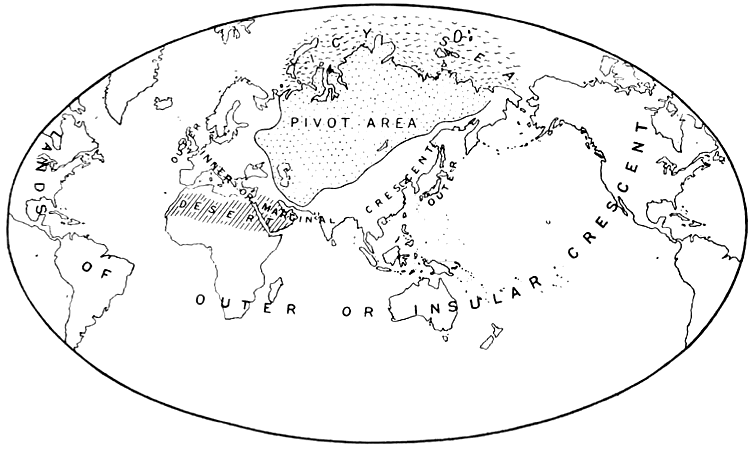
Mackinder's concept of geostrategy
El que mucho abarca poco aprieta, warns a Spanish saying, which I'd translate liberally as who grabs too much, holds too little. The USA was too focused on their own arbitrary goals, defined by Mackinderian geostrategy, oil reserves and the total commitment with the abhorrent Zionist neo-crusade. Meanwhile their classical colonial "backyard" became growingly independent under the coy leadership of Brazil and the more militant one of Venezuela.

Brazil would soon become crucial in the formation of the loose BRIC bloc, which also gathered the three independent Eurasian powers: China, Russia and India. While the acronym BRIC was coined in 2001, it was only since 2006 that this bloc became increasingly real. Earlier only some China-Russia collaboration existed, with India and Brazil fully inside the US imperial bloc.

The first BRIC formal meeting was held only in 2009 and in 2010, with the inclusion of South Africa, it became the BRICS. South Africa may seem relatively small compared to the other four giants but its area of influence, consolidated in the Congo War, is significant, including almost half of Africa south of the Sahara. This area nicely complements the projected power of the four original BRIC states and establishes a key link between Brazil and India, who may well hold claims to inherit the legacy of the historical Portuguese and British colonial empires respectively, albeit in a much more constructive fashion hopefully.

Besides growing economic and geostrategical collaboration, the main apparent goal of the BRICS is to displace the US dollar financial centrality, which gives the North American power a dubious advantage in global affairs.

How did the USA and allies answer to this patent threat to its hegemony? If all you have is a hammer, every problem seems to be a nail, they say. The USA and allies (Britain and France very particularly, also Poland, Sweden, Netherlands, Spain) reacted in clear anger: they are going to see how we do things in Tombstone! So they helped to destroy Libya, what was not pleasing to Italy nor Germany, who abstained to intervene.

But Libya was just the entrant, the main course was meant to be Syria. Unlike "crazy" Gaddafi's Libya, Syria was and is indeed integrated in the geopolitics of the region, having established a long term cooperation with Iran, who, even if not formally a BRICS member, is clearly close to the independent powers' bloc. Syria also used to have strong relations with the Soviet Union, again unlike Libya, considered by all to be too unpredictable.

After some initial induced trouble, quickly a UN Security Council resolution was ready to be signed authorizing the USA and allies to intervene against Syria. Russia vetoed it.

That was too much for the arrogant Pentagon generals and Wall Street oligarchs, so they orchestrated a coup in Ukraine with massive fascist participation. In turn that was a red line for the Kremlin, because it potentially implied NATO missiles a few kilometers away from Moscow. Crimea quickly voted themselves out of the new fascist Ukraine, asking for and obtaining re-incorporation to Russia. But when Russian-speaking Eastern Ukrainians tried to do the same thing, Russia remained distant, sending humanitarian aid and diplomatic mediation but refusing to fall in the trap of annexing those territories. Why? Because Russia needs to have a neutral Ukraine in full and breaking it into pieces would be bad for her. Crimea is too strategic to ignore but otherwise Ukraine must remain together and non-aligned: Kiev and Kharkov are what really matter, rather than just Donetz and Lugansk.

Meanwhile, even if less dramatically, the Cold War has also been escalating in East Asia. The earlier developments focused on North Korea and Myanmar (Burma), as well as Cambodia and Thailand. More recently the focus has been on several strategical uninhabited islands, where China has demonstrated to be a most strong regional power.

TISA likely signatories
The overall answer of the USA has been to strengthen its weakened empire. The Ukraine conflict has served to, more or less forcibly, rally the European states (Germany was and is particularly reluctant) around Washington's dictates but what really is consolidating the imperial structure of the US bloc are the secret trade treaties (TPP, TTIP, TISA, etc.) being negotiated behind closed doors in order to establish US-like "free market" chaos in all its area of influence, be it Japan, Australia or Europe, severely undermining state sovereignty. This is not substantially different from the "pay or die" blackmail imposed to Greece or Ukraine, or the sale of the military bases, Gibraltar or Guantanamo style, that Spain recently signed with the USA. All converge into a more centralized, and also more hyper-capitalist imperial structure in which "rights" only exist for corporations, not for people.


Back to the present

What the Russian reaction to the latest US-orchestrated threats shows is that Washington can't expect to get away with its persistent plotting and de-stabilization in all circumstances. In fact, while the US Empire has got some mild victories, mostly costly and unstable ones, in Haiti, Honduras, Paraguay and the barrens of Afghanistan, it has also suffered many defeats and stalemates: most of Central Asia is still aligned with Russia and China, Iraq has grown closer and closer to Iran and China, Syria had no choice but to ally with Russia, Georgia was defeated in South Ossetia in spite of its Zionist "elite training", Hizbollah has demonstrated to be perfectly able to bomb Tel Aviv, Iran has finally got away with its nuclear program, the Wahabbite regimes show growing weakness in spite of their massacres in Yemen, Bolivarians still rule Venezuela and other Latin American countries in spite of all the attempts at de-stablizing them. Etcetera.

After all the wars, the USA is not a tiny bit stronger. I'd dare say that it is in fact weaker than in the 1990s and that it has been its unilateral arrogance what has caused its own weakening. 

First, it has lost Russia, India, Brazil and South Africa as allies, mostly being Washington's fault that this happened. The fault being in wanting to be a colonial empire in a post-colonial world, a single superpower in a multipolar world, a blunt and trigger-happy cowboy in a world that wants peace, cooperation and prosperity. Of course, this is just how Imperialism, the final phase of Capitalism in the words of Lenin, works. In a way this is semi-automatic and expectable but not less despicable for that reason.

Second, Japan and the North Pacific are now heavily polluted by Fukushima deadly radiation, which has already reached North American coasts, causing massive sea life mortality. Together with other factors, such as drought, unsustainable debt, etc., this means that the North Pacific key "province" is growingly weaker by the day and that the US Empire is almost totally reliant on the "loyalty" of its North Atlantic "province", namely Europe, for it to be considered an empire any longer. 

Third, Europe is much much weaker than it was just eight years ago. The financial crisis has hit it badly: partly it has paid US costs by means of keeping a hyper-strong euro for way too long, what is a tribute of sorts, a heavy one. But the most visible cracks in the European construction are internal: on one side the hegemony of Northern Europe, organized around Germany, has clearly transformed the Union into a IV Reich of sorts, in which there is no hope for Southern Europeans. But this German-centric imbalance is also dramatically affecting Western Europeans such as the French and the British and the election of Jeremy Corbyn is a symptom of something that runs much deeper: class struggle becomingly growingly patent, mostly not thanks to propaganda or organizing efforts by the few class-conscious people in the Worker camp but to the growing extremist abuses by the Capitalist oligarchs, who have enjoyed total impunity under the imperial order. 

As I say, if Europe cracks the Empire collapses. So we Europeans should be most alert, not just because our hard-fought, yet mild, social rights have been totally destroyed but because, as class war grows in the subcontinent, what is inevitable and already happening, actual war and brutal repression, Ukraine-style, may become more and more common. 

The European Union is an ailing gothic monster, nobody should expect it to last. However its collapse will be brutal because the oligarchies won't allow the peoples to regain even some of their rights without the most violent of fights. The final showdown of the class war is going to take place here in Europe, I have little doubt, even if it may take still some years to fully unfold (working class consciousness is still a bit weak), they won't be too many. Give it a decade, not more. 

And it is not totally independent of what happens across the Mediterranean. In fact I consider the most important current revolutionary reference to be the Kurdish popular movement, with their going beyond the state format program (Democratic Confederalism), that blends once again Anarchism and Marxism in a single praxis, much as Bismark feared it might happen. Europe, West Asia and North Africa are a single historical and socio-geographical region in spite of so many centuries of religious sectarianism, and that is why destroying Wahabbism, along with all other intolerant totalitarian fascist religious ideologies is so important. We are a single People of Peoples, religion belongs to the private sphere, not the social one.

The USA, inspired by historical British colonial praxis, has thrown its lot along with the reactionary forces, ignoring the fact that reaction is powerless in the long run. Not only they have actively supported and manipulated the Sunni Islamist networks but also they have actively supported the most fascist terrorist elements in Ukraine for example. And they can well do it in Western Europe: Gladio never died: NATO is first and foremost a system to control Europe, even by fascist means. 

Let me say that, even if I do support the Russian well-calculated intervention in Syria, because the Islamists must be destroyed at almost any cost, Moscow is no angel either. If you read, as I do, Russian media, you can't but notice their sympathies for the European far right, be it the Hungarian government of FIDESZ or the French National Front. 

This is a true problem for us European workers, because we do not have any allies outside, barring a handful of Latin American progressive governments, not truly socialist, rather just patriotic social-democrat, and the general but imprecise Human solidarity. This circumstance has some pros: we have to create from zero and not follow any model, but also many cons. However if revolutionary or at least truly social-democratic (not Blairite mercenariate) power manages to arise in one or several large European states, the subcontinent is objectively powerful enough to bring that revolutionary process to a successful end. And the growing multipolarity of international relations allows for the necessary balance in whose interstices we have to create our own socialist reality, the only one that can give us not just hope but also expectations of a better future for ourselves and our children. 

The situation resembles that of World War I, with the USA in the role of the declining British hegemon, China in that of the German challenger, etc., but it is not identical: history does not repeat itself, it could not in the age of nuclear weapons anyhow. There can't be a real major war because it would mean total destruction, so the reality of the conflicts is more similar to that of the First Cold War in fact. And it was in this context in which the colonies became independent, in which more or less alternative "third way" projects (be it Tito's Yugoslavia or Palme's Sweden) could happen, in which the Cuban and Vietnamese revolutions succeeded, etc.

But one thing at least is also different: to some extent Europe has lost its strategical relevance. The scenario is too global and as "last major province" of the Empire, Europe is expected and demanded to contribute at any cost. The Empire is declining even before adopting fully imperial form, and it is unavoidable that many of the contradictions arise here in Europe, because it is ethnically complex and because the socialist tradition was never eradicated. 

There is yet another reason: Europe has a fully mature, very illustrated working class. Highly educated and growingly desperate: the perfect recipe for the worker revolution. At least that's the theory. The praxis... only time will tell.