Showing posts with label Russian Revolution centenary. Show all posts
Showing posts with label Russian Revolution centenary. Show all posts
Wednesday, November 15, 2017
Brian Becker on the Soviet Revolution
Quite an interesting interview with Brian Becker, author of "Storming the Gates: How the Russian Revolution Changed the World", on the Russian Revolution at Empire Files (TeleSur English):

Thursday, April 20, 2017
Lenin's April Theses 100 years later
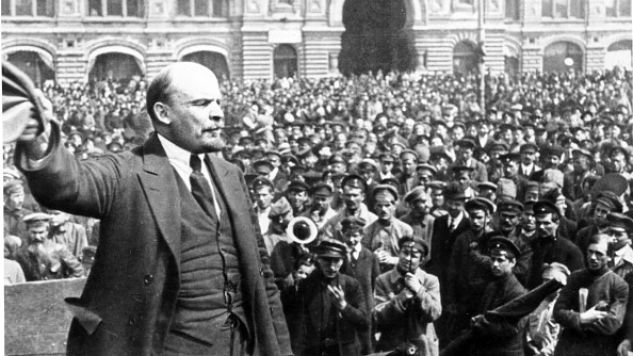 On April 17th, one century ago, Lenin announced what can be understood as the manifesto for the Russian Revolution, known to history as the April Theses.
Sputnik News has a very cool and detailed infographic on them, go take a look.
The full name of the text is actually The Tasks of the Proletariat in the Present Revolution, it is freely available at Marxists.org.
Context: after the February Revolution, there was a provisional government led by liberal (i.e. center-right) Georgy Lvov and dominated by the Kadet party (also liberal in the classical sense of strongly capitalist). While other "socialist" factions had minor representation in this provisional government, the Bolsheviks did not partake of it. There was however a parallel government in the form of a loose network of local soviets (worker councils), dominated by the Soviet of Petrograd.
On April 16th Lenin arrived from Zürich in the famed train episode and thus the following day he spoke in Petrograd. What he exposed in two successive discourses became known as the April Theses.
A synthesis of the theses may be:
- No to the imperialist war, democratic and not violent peace. A revolutionary war may be acceptable but only if:
- The power is in the hand of the working classes (proletariat and landless farmers)
- Nothing is annexed
- There is radical break with the interests of Capitalism
- Russia is in the first stage of the Revolution, which gave power to the bourgeoisie, but there must be a second stage in which the power passes to the working class. This first stage caused class consciousness to extend to the masses and this newly born consciousness must now serve real emancipation.
- No support for the Provisional Government, which he dubs deceitful and confronted to the real interest of the Russian masses.
- Acknowledging that the Bolsheviks were in the minority in many soviets, which were controlled by the social-reformists (Social Revolutionary or agrarian populist party and the left wing of the Kadet or liberal party). However the soviets are the only possible form of popular revolutionary government and the Bolshevik task in them must be to expose the treason of the Provisional Government.
- No support for a parliamentary republic (a backward step) but for a republic of the soviets. Abolition of the police, army (to be replaced by arming of the whole People) and bureaucracy. Limitation of salaries of all officers, who are to be replaceable at any moment, by that of a qualified worker.
- Agrarian programme: confiscation of all landed estates, nationalization of all lands (to be managed by the soviets), creation of "model farms" in all expropriated latifundia.
- Fussion of all banks into a single national bank under soviet control.
- Bolsheviks should focus on bringing all the economy into the hands of the soviets.
- Call for an immediate Congress of the Bolshevik Party, renaming of the party (would be Communist Party, following Marx' preferences), modification of the party program, mainly on the issues of imperialism and war, on the preference for a "commune state" and on the predicted calendar.
- Forging of a new International against the "social-chauvinists" (would be "social-democrats" by our modern terminology).
Hardly anything to object to Lenin in this moment: I can perfectly embrace his program in full. Daring he may be but daring we must be if we are to succeed. So far so good but history doesn't stop.
Wednesday, March 8, 2017
March 8 1917-2017
Happy and combatant Working Women's Day.
Today, one hundred years ago, began the Russian Revolution. Its first phase to be precise, the so called "February Revolution" (the Julian calendar in use in Russia back then was 13 days off relative to the Gregorian one). It was the beginning of a revolutionary cycle that affected not just Russia but much of Europe.
The situation was dire in Russia, the war had been lingering for years already and the masses were utterly exhausted by the ever-growing demands of the totalitarian regime and the war effort. Let's not forget that most of those killed in World War I were subjects of the Russian Empire.
Since March 3rd, strikes had been popping around like mushrooms, the most famous one being the one at the huge Putilov factory. On March 7th, in spite of the unrest, the Tsar left for the front. On March 8th worker women marched in large numbers demanding something as basic as "bread", their striking male comrades joined them. It was a general strike at the capital of the most backward and reactionary state of Europe.
Thousands of women have just left street near our store. Heard they’re heading towards Nevsky Prospekt #1917LIVE #womensday pic.twitter.com/3XfkAEdTpN— Filippov Bakery (@FilipBakery1917) March 8, 2017
On March 9th the protesters gathered hundred of thousands and they already demanded the head of the autocrat. By March 10th, in spite of the prohibition, the marches broke all records, not a single industry was active in the city. Four people were killed but the uprising did not stop at all.
On March 11th an inexperienced commander, General Khabalov, was ordered to put down the protests at any cost. On March 12th the city was besieged by his garrison. However soon troops began quarreling among them and one company was the first to mutiny, opening fire against the police.
That very same day the Petrograd Soviet was formed, while the (very conservative and not really democratic) Duma had been rendered ineffective by an imperial edict.
Before the day was over, four regimients mutinied and even the usually loyal cossacks hesitated. Officers were killed or had to flee for their lives.
The next day, Tsar Nicholas attempted to go back to Petrograd but could not reach it. His guards either deserted or declared "neutrality": the fake Emperor's clothes were gone. On request of the Duma, the Tsar abdicated. Few days later a provisional government under Octobrist (conservative) Rodzianko was formed.
In five days or so, Russia had gone from totalitarian empire to unstable provisional republic(?) That's how revolutions happen: they may only throw down rotten structures but when they do, they are fast and merciless.
In the following months the two opposing powers: the soviets (popular councils) and the Duma will go on a crash course. It may sound "unreal" but this is true history: this actually happened... and will happen again with whatever variations, because the real issues have never been solved but rather just aggravated.
As La Polla Records sang:
This story that was maybe trueseems a lie, we're going to tell it anyhow.In the Russia of the beloved Tsarlived a peasant named Ivan,toiling the land without rest,always hungry, no time to think.Sowing, sowing and sowing yet again,and Count Borrowich gets all the harvest,the petty priest asks for resignation,invites himself to Ivan's homeand he eats all the best.Ivan was there... (chorus, thrice)
A good day he worked with the hoe,came some men, they told him: Comrade,There are no more masters to whom obey,
you are a free man, we've taken power!
Thinking, thinking and thinking yet again,Ivan gradually gets used to the idea:the nobility has been deposed,there will be no more jerks living at his expense.Ivan was there...
Jumping around one-leggedthe sickle and the hammer in the red banner,
with effort and some attention
what extreme flips reality makes!
Hurray!
Original song in Castilian (Spanish):
Sunday, February 19, 2017
How to commemorate the centenary of the Russian Revolution?
I've been chewing on this now and then for some months but really, had not come to any conclusion before seeing the curious concept promoted by RT of #1917Live, a Twitter dramatization of sorts (although subject to all kind of adherences and even trolling, as usually happens in Twitterspace).
Retweet the Revolution: What if Twitter existed 100 years ago? https://t.co/vaj0OrbdDX #1917LIVE pic.twitter.com/q8bGpYVapY— RT (@RT_com) January 12, 2017
So I'm thinking that indeed the best way to cover it is maybe to now and then (weekly?, on special occasion days?, both?) to mention what was happening in Russia (and for context maybe elsewhere). I'm not any expert on Russian Revolutionary history but I'll try to get my facts as straight as possible. Also it will probably be useful to discuss more in depth some characters, factions, episodes...
For example I stumbled today with this History on Trial video on Vladimir Lenin, which is probably about the fairer trial he may get in Western media (yeah, TED is quite Westernist most of the time but still they do a good job here):
So what was happening in February 1917? Well, not yet the February Revolution, which actually happened in early March (blame the Julian calendar for the offset) but certainly the mood was getting quite hot: the war (World War I) was raging and Russia was faring quite poorly, with six million Russians dead for a cause that was not even clear, and famine becoming way too prevalent in the midst of the freezing Russian winter. The Tsar, Nicholas II Romanov, had even rejected to form a constitutional government, alienating much of his own entourage, who hoped for some reforms.
So the Tsar figuratively tweets his worry about treason and deceit all around him... but who is to blame? Is it once again the Russian People (and various oppressed nations such as Poles, Finns, Uzbeks or Georgians) going to die in troves for the Tsar for no obvious good reason? Not this time: the Revolution has not yet begun but decades of worker struggle precede this fated year of 1917. Even a failed revolution has happened 12 years earlier, also after a catastrophic war (against Japan), which was bathed in blood by the autocrat. This time it will be different but the people living it do not yet know.
It is in this period of the 1905 Revolution in which the genial filmmaker Einsestein placed his famous movie Battleship Potemkin:
A bit of background
Before I close this introduction it may be worth mentioning some of the factions that will show up. It wouldn't be Marxist enough if we did not consider class structure first of all: there was a growing but still minor urban working class or "classical proletariat" (of which 82% worked in companies larger than 100 workers and 40% in mega-industries with more than 1000 workers) but the vast majority (80%) of the Empire's population were still rural farmers. Most had been slaves (serfs) until a generation ago but formal emancipation had not ended their troubles at all, lacking as they were of land to farm. In some areas, particularly towards the West (formerly part of Poland or Sweden), there were yeoman farmers, but otherwise the land was property of large aristocratic landowners and to lesser extent communal property of villages.
After 1905, the Tsar agreed to create a parliament called the Duma, however it was soon to be reformed in a reactionary way, making the electoral system very favorable to the aristocrats and anyhow with the autocrat always able to bypass it. It is in this period when the two main "liberal" (bourgeois, capitalist) parties emerged: the more left-leaning Kadets and the very reactionary Octobrists. Socialists of all types boycotted the Duma (although a few individuals were elected to its early version) but they were growing strong at the sidelines of the regime.
These Socialists had initially two parties: the Socialist Revolutionary Party or Narodniki (Populists) had an agrarian base, was rather bourgeois-leaning and definitely not Marxist, the Socialist Democratic Party had an urban base and was part of the wider Socialist International, then still dominated by Marxist ideology. However in 1904 the Russian SDP split in two: one faction, led by Vladimir Ilyich Ulyanov "Lenin", more radical and claiming to be the The Majority (Bolshevik in Russian) and another one, more moderate or reformist, called The Minority (Menshevik in Russian), led by Julius Martov. Both claimed to be the real Socialist Democratic Party of Russia, so they were distinguished by these labels. They reunified in 1906, with the Mensheviks becoming the majority, rather counter-intuitively, but split again in 1912, this time for good.
One of the main differences was that the Mensheviks were skeptical of the chances for a socialist revolution in underdeveloped Russia, while the Bolsheviks thought there was no harm in trying. The Mensheviks also sought their allies among the liberal-bourgeois, while the Bolsheviks strongly preferred the peasantry instead. This same story would repeat later in China, albeit without a formal split of the Communist Party, as Stalin's Komintern and the official PCC leadership did not believe in the chances of a socialist revolution there either, preferring to cooperate with the Kuomintang "nationalists", but Mao and his rather unorthodox faction did and actually succeeded in due time.
Another Socialist faction we just cannot ignore were the Anarchists or Libertarian Socialists/Communists (naming conventions have changed through time and tendency). A venerable figure was still alive when the Russian Revolution unfolded, Piotr Kropotkin, but he had been exiled in Western Europe since 1876. He returned to Russia in 1917 and live there until his death in 1921, being openly critical of the Bolshevik takeover, as he was strongly against authoritarian socialism, which he had predicted a failure ultimately. His funeral would be the last tolerated anti-Bolshevik demonstration in many decades.
But there were others much more active in these troubled times. In 1881 they even managed to kill Tsar Alexander II, and, a few years alter, in 1887, they failed in a similar attempt against his heir Alexander III. Lenin's older brother Aleksander was the leading conspirator and was therefore executed. A little star shines in his memory (no kidding: asteroid 2112 Ulyanov is named in his honor). Anarchist agitation and armed struggle became very important around 1905 but Tsarist repression was brutal and they were pretty much annihilated by 1909. However they will resurface in 1917, being an important faction in the Soviet movement, in an uneasy alliance with the Bolsheviks, who also nominally supported the soviets (councils), so it is important in all this historical review to ponder what do we mean when we say "soviet": do we mean the autocracy implemented by Lenin's Bolshevik Party by usurping the power of the soviets or do we mean the original grassroots assemblies that represented the working classes?
Anarchists would also become very important after the retreat of the German occupation force in 1918 in Eastern Ukraine (now again shattered by rebellion and struggle against tyranny) under the leadership of Nestor Makhno, and traces of their ideals (all the power to the soviets, a demand usurped by Lenin to his authoritarian convenience) were also present in the Krondstadt uprising, made by Bolshevik Party member soldiers to a large extent.
Back to the Bolsheviks, three characters are particularly important and will come once and again as History unfolds: Lenin, Stalin and Trotsky. Who were these guys?
I have already outlined the role of Lenin in the formation of the Bolshevik Party, of which he was unquestionable leader all the time. He was also a very notable intellectual, whose work is very much worth reading regardless of what we may think of him. He was imprisoned in Siberia at the end of the 19th century and soon after he founded the newspaper Iskra (Spark). In 1902 he published his most famous work, What Is To Be Done?, in which he argued that class consciousness was only achievable by activism and agitation outside of the industries, that worker spontaneous self-organization can only lead to limited and limiting trade-unionism and not to revolution. There is a point to make from the perspective that only time can give that he may have been right for the Fordist period (formal subsumption of work into capital in Marx' terminology) but that since the arrival of Toyotism (REAL subsumption) and its political branch Thatcherism/Reaganism, unions are pretty much done and the only real sphere remaining for the workers' struggle is certainly outside the companies, where repression is simply brutal and organization tends to zero way too rapidly. An open debate of course.
Another seminal work of Lenin is Imperialism: The Highest Stage of Capitalism, which comes very handy today as well, as the term "imperialism" is used often and many geopolitical situations resemble very much the inter-imperialist struggle between the great powers of the early 20th century, at least to some extent. In this work he opposed the views of Kautsky (one of the founding fathers of Social-Democracy as we know it today), who argued for the unavoidable cooperation of all capitalist powers in the exploitation of the global periphery (colonies and semi-colonies, the Third World in modern terminology). Lenin correctly argued that imperialist tendencies would instead cause conflict among the various capitalist powers, increasing the contradictions. One could argue that Lenin "cheated" because he wrote that in 1917, after WWI was well advanced, while Kautsky had published his work in 1914 instead. But, "cheat" or not, he was clearly correct and we can see the same happening today with tensions rising between the various capitalist powers: US-China rivalry on top of all but also the US siege of Russia, the, barely hidden, growing tensions between Germany and the Anglosaxon power ring, etc. He also transferred the focus of revolution to the periphery and, at least for the 20th century, he was again right, even if there is much to debate about whether those revolutions are genuinely socialist or rather sui generis versions of Capitalism, a Capitalism without bourgeoisie, which otherwise would be just subservient to the core powers ("comprador bourgeoisie") and hardly a national development force.
One of the early critics of Lenin was Lev Davidovich Bronstein, an Ukranian better known as Leon Trotsky, who was confronted with the Bolshevik leader at the split of the SDP in 1904. However he soon became an "independent" because the Mensheviks were clearly aligning themselves with the liberal bourgeois parties. He worked to reconcile the two factions to no avail and in 1917 he finally joined the Bolshevik Party, where many looked at him with distrust. His main theoretical work is the theory of Permanent Revolution (later partly adopted by the Maoists). The term was originally coined by Marx in several passages, so Trotsky is mostly extending on these early approaches of the genius of Trier. However, much as Lenin, Trotsky has a peripheral focus and thus he argued (correctly) that in Russia the bourgeoisie cannot make a successful progressive revolution but that only the proletariat can do it. This part of the theory, very innovative, was partly adopted by Lenin (April Theses) and was initially rejected even within the Bolshevik Party, however it would later become mainstream. But Trotsky also sustained that the revolution in a single country would unavoidably fail, unless it was quickly followed up by revolutions in other states, a concept never fully debated by the Bolsheviks and clearly opposed by Stalin. The key idea of Permanent Revolution in any case seems to be that the global working class (Humankind by another name) cannot falter until socialist goals have been thoroughly achieved, at risk of success of bourgeois reaction.
Finally we won't forget the fierce Georgian activist who would eventually become sorta-Tsar himself, Ioseb Besarionis dze Jughashvili, who eventually adopted the alias of Stalin: Steel Man. He would be described today as a "terrorist" no doubt, leading part of the Bolshevik party into acts of robbery, extortion and assassination with terrible clarity and outstanding leadership. While he did write some articles and is co-author of the post-revolutionary concept of "Socialism in one country" (opposed to Trotsky's frantic Internationalism), Stalin was mostly a man of action and doubtlessly a most clever conspirator, whose power grew at the shadow of Lenin, within the Party's activist class preluding the kind of state he would eventually rule and largely shape.
Subscribe to:
Posts (Atom)