Showing posts with label Marxism. Show all posts

Sunday, July 15, 2018

The Perestroika that could be but was aborted

Fascinating first-person narration by Prof. Buzgalin, back then a young Marxist enthusiast who tried, with some success, to push for a real democratic collectivism in the late USSR.


Part of a series of 12 episodes on the collapse of the USSR that you can watch at The Real News.

Saturday, May 10, 2014

Borotba revolutionary union explains today's Ukraine to the World

On the situation in Ukraine (for the Antifascist meeting in Athens)


Dear comrades,

The union ‘Borotba’ and collective of the Ukrainian web-journal Liva.com.ua greet all the participants of the anti-fascist meeting. Our periphery East-European country witnesses one of the most dramatic moments in its modern history. The Ukrainian lefts face challenges they have never confronted for many years. After some violent and bloody clashes in the centre of Kiev the power in our country was seized by the coalition of ultra-right and neoliberal political forces. The newly established regime immediately started the close cooperation with the richest oligarchs – with those who (along with the representatives of the EU and US) provided the financial aid and international support to Euromaidan. Some of these oligarchs were recently appointed as governors in the key industrial regions (that are the least loyal to new rightwing government) – with the expectation that they would suppress the anger of indignant protesters there.

The rightwing ideology – a kind of synthesis of neoliberal illusions about the nature of ‘decent European capitalism’ and clerical bigotry of Ukrainian nationalism – dominated in Euromaidan from the very beginning and almost everything there was under control of rightwing politicians. They managed to exploit the anger of many impoverished and marginalized Ukrainians dissatisfied with the corrupt bourgeois regime of Yanukovich – the regime that we also have been fighting against for many years. After 20 years period of mass anti-communist propaganda the lefts in Ukraine were ousted into margins of politics while the rights managed to use social populism combined with pro-capitalist and nationalist slogans.

And it is not accidental that Euromaidan was greeted and backed by the most reactionary forces and politicians of the EU and US. The new Ukrainian authorities are ready to open Ukrainian markets to their patrons and to impose on society (still suffering from the crisis) the package of neoliberal reforms so that to receive the next IMF loan that should help them to stay in power. The property and capitals of the super-richests remained untouched for new regime but new authorities are ready to overcome the crisis at the expense of imposing social cuts and the rise of prices that will affect the impoverished majority of Ukrainians. So that to divert attention from the issues of own politics, the rightwing authorities skillfully use the issue of Russian intervention in Crimea and ignite nationalist and militarist hysteria inside the country. Unfortunately, a part of our liberal-patriotic ‘left’ willingly buys into this rhetoric. Thus, new authorities try to channel the anger of defrauded people toward different ‘internal’ or ‘external’ enemies.

Meanwhile, the clashes and shooting spree in the centre of Kiev still happen – the rivaling paramilitary units fight with each other for the control over seized buildings or property and continue to unlawfully detain, beat or torture people. Neo-Nazi gangs openly show off their racism, sexism or homophobia. They even do not try to hide their weapons when roaming Kiev streets. Moreover, they have killed some people in Kharkov. The office of ‘Borotba’ in Kiev was looted as well as offices of opportunist Communist Party of Ukraine – neo-Nazis seized their offices and turned them into own ‘bases’. Many monuments to Lenin, to WWII soldiers or October revolution participants were demolished or desecrated (including the grave of workers killed in the uprising in Kiev ‘Arsenal’ and other plants in 1918).

Meanwhile, extraordinary elections are nearing: disappointed or duped people will have to make a choice just between well-known bourgeois politicians – corrupt super-riches. At the same time, new authorities by all possible means try to prevent democratic referendums over the issue of self-governing in South-eastern regions – where protests against new regime are glowing. New rulers of Ukraine try to present these protests as only ‘pro-Russian’ or ‘inspired by the Kremlin’, but the union ‘Borotba’ is effectively fighting for wringing them out of the influence of pro-russian nationalism. We are irreconcilable opponents to the Putin’s regime that our Russian comrades are fighting with. We are against war and any interference into Ukrainian conflict as it may trigger the military confrontation of two imperialisms.

Expecting the intensification of the current crisis, we are getting ready to take part in the process of organization of mass protests against anti-social reforms and far-right terror of new authorities. And in this context any international support is rather crucial for us. We are thankful for your attention and solidarity. And especially we would like to thank our comrades from Southern and Eastern Europe that witness the rise of ultra-right influence against the background of crisis caused by neoliberal policy of the EU.

The new government of Ukraine is the most rightwing government of all that have ever been in Europe since the end of WWII. And this is not only Ukrainian phenomena but also an alarm call for all European lefts. Taking into account that EU authorities actively helped Ukrainian rightwingers to come to power, we understand that it will be a rather difficult task for us to win a victory over them without responsive international actions of the lefts in different countries.

The recent protests in Ukraine (November-February 2013-14) have resulted in establishing of the rightwing political regime, namely the coalition of ultra-right and neoliberal forces. Paramilitary squads of the ultra-right groups now control the capital of the country using the tactics of pogroms and violence against dissenters. They openly demand to vest them with the power of police and state security service officially or give them full control over the law enforcement services.

However, the events are unfolding in Ukraine rather quickly, therefore, demanding a constant correction of the analysis. Some offices of the left organizations were looted. Activists of left organizations and trade-unions have undergone violent assaults. The parliament of Ukraine (in fact controlled by the vice-speaker from the far-right ‘Svoboda’ party) has taken upon itself the power in the country. It appointed another member of ‘Svoboda’ party as a general prosecutor and released without court decision all the neo-Nazi militants that were convicted for crimes including murders.

Many rightwing politicians (from ‘Svoboda’ and other rightwing parties) were promoted to the positions of ministers. In particular, they will control education. Nazis started a campaign of mass destroying of Soviet monuments: to the October Revolution of 1917 and WWII fighters.

In fact we can speak that it is the most rightwing government in the history of post-WWII Europe and the most pro-Nazi in its ideology regime that was imposed in Ukraine. And this thesis is not a kind of exaggeration – the real consequences of the recent events in Ukraine we’ll be able to assess properly in the course of time because we still have not enough full information needed.

Nevertheless, the mass protests in Ukraine were the result of the deep social-economic crisis – a consequence of neoliberal economic policy that was being implemented in Ukraine under the pressure of international banks and other financial structures.

At first sight it could seem a kind of paradox, but the crisis that was triggered by the rightwing neoliberal policy has led to the uncontrolled rise of the far-right influence in result. The thing is that the crisis developed under condition of almost total dominance of the far-right ideology that didn’t allowed building in Ukraine a somewhat strong left force. In fact, the rightwingers have occupied the same niche that the lefts couldn’t occupy. It was the absence of the left alternative that served as a main pre-condition of providing the sweeping rise of the far-right groups that have taken over a kind of monopoly over social protests of Ukrainians.

The lefts – ranging from social-democrats to the groups of new-left – were driven to the margins of political and social life. It became possible due to the establishing of the right-liberal consensus that dominates in social consciousness since the collapse of the USSR. The intellectuals tolerated ultra-rights backing them politically and providing the process of de-marginalisation of far-right groups for Ukrainians. Meanwhile, mass-media demonized and stigmatized left ideology simultaneously transmitting to social consciousness a historic mythology of the far-right forces – namely those ones that collaborated with German Nazis in WWII and are responsible for ethnic cleansing of Polish population in western Ukraine. It was this kind of propaganda that has mostly designed the views of the active part in Maidan movement including significant part of the ‘crisis victims’ – of some of the ‘lumpenized’ layers of society.

And conservative and liberal European politicians have also contributed to such a grievous result – they recognized ultra-right ‘Svoboda’ party as a legitimate member of the so-called ‘pro-democracy’ opposition to Yanukovich’s regime. Thus, they turned a blind eye to the xenophobic, homophobic and chauvinist program of this party as well as on the pogroms and violent actions of its activists.

Moreover, a group of super-rich Ukrainians has also contributed in organizing Maidan. Those were in particular some oligarchs that were dissatisfied with the dominance of Yanukovich clan and feared the rise of his influence that could threaten their economic interests.

This group of oligarchs participated in sponsorship of the ultra-right groups and provided technical and material equipment for their actions.

Under such circumstances the Rights succeeded in exploiting and monopolizing the protest against oligarchic regime of Yanukovich. From its very beginning they controlled and organized protest actions in Kiev, therefore, attributing to them rightwing ideology and nationalist sentiments. Nazi symbols were openly shown off in Maidan while Nazi slogans were heard quite often there. ‘Pro-democracy’ part of this movement couldn’t confront such a total domination of the Rights that succeeded in taking a leading role in Maidan. The real force was on their side. Well-trained squads of neo-Nazis that were given out military ammunition have served as the storm-troopers. Despite the fact that the protest started under ‘pro-European’ slogans, the ultra-rights initially didn’t hide their hostility to the ‘European’ values and publicly denied them in their speeches and articles.

The fact that many European observers preferred either to ignore the domination of far-rights in Maidan or to diminish their influence has only aggravated the whole situation. In fact such a position was being perceived as a pardon legitimizing any kind of far-right actions.

Thus, as overall results we have got the disastrous rise of street violence in Kiev, infighting of armed groups and killing of people – both supporters and opponents to Maidan. That has led to the collapse of Yanukovich’s regime. However, as we had warned, it was our ultra-rights that have essentially benefited from it. De facto they became the ruling power in most parts of the country because they established conditions when no one social-political force can really confront them there.

As a consequence we witness the change of just elites in power but the interests of the whole ruling class remained untouched. Therefore, the changes haven’t led to real democratic reforms in the interests of the majority of people. The situation is deepening now and the oncoming collapse of the Ukrainian economics is looming. We witness the fast devalue of Ukrainian currency that threatens with impoverishment of millions people in Ukraine. The new regime has no funds enough to guarantee the providing of the basic public spending. Thus, it negotiates with IMF, EU and US so that to receive new loans that would be given under condition of total dismantling of the remnants of social benefit system and rise of the prices for public utilities, electricity and gas. Moreover, the EU demands from Ukraine to open its internal market and that may lead to the total undermining of the home production that cannot survive without some protectionist measures.

This trend when being coupled with violent confrontation in eastern Ukraine may lead to the dismantling of the state basis and complete economic and political collapse in the country that in its turn may lead then to the outburst of the ultra-Right terror. Such a prospect seems to be quite real in Ukraine and it can happen even in the nearest future. We think that new regime will use ultra-right paramilitary squads for suppressing of the social protests and individual dissenters among ordinary citizens.

Under such circumstances the only alternative is an immediate and active building of the mass left and antifascist movement, namely the creation of a subject that may become a base for opposition to the rightwing regime and possible to organize people that are angry and dissatisfied with antisocial neoliberal policy.

Moreover, the rightwing ‘revolution’ in Ukraine is also an alarm clock for all European pro-democracy anti-fascist forces. This trend actually reveals quite openly that in times of economic crisis – the uncontrolled rise of the far-right clears the way to a seizing of the political power. And such a prospect is even more dangerous when we try to underestimate it. 

Andrew Manchuk


________________________________________________________________

Reposted from the Borotba union site.

Borotba was founded in 2011 by the Organization of Marxists, dissidents of the Ukrainian Communist Party and its youth organization, the All-Ukrainian Union of Workers, the Youth Association Che Guevara, etc. They held their first congress in April 2012.

Their self-defined ideology is Revolutionary Marxism and was founded to respond to the deep crisis of all Ukrainian parties, including the CPU. They have chosen a non-parliamentary method of political struggle but also support that their members take part in elections, as long as they promote social revolution in office. 

They have also been very active against fascist political forces in Ukraine.

Internationally Borotba has campaigned for Cuba, Palestine and Venezuela.

Monday, August 26, 2013

The ever-growing surplus value

I'm borrowing here a graph appeared at Naked Capitalism (data for the USA but it could be anywhere):

http://www.nakedcapitalism.com/wp-content/uploads/2013/08/Worker-Productivity-Annual-Wage-Compensation.png 

The implications are obvious: capitalists have been taking an ever growing share of the produced wealth since c. 1972. Previously, in what some have described as the period of "generous capitalism" (caused by the Cold War and fear of socialist revolutions) surplus value (the share of production appropriated by capitalists as manager class of the economy) was more or less stable, but since the 1970s it has grown steadily up to more than double, while real wages have remained stable. 

Wages are the share of production kept by producers, workers. But beware: salaries have remained stable but the share of wealth retained by producers has declined very sharply. 

This is how Capitalism works normally in fact. Marx explained it in Das Kapital with the example of the pin factory, in which vast improvements in technology and organization of production (~ productivity) led only to loss of jobs, not any improvement to the conditions of workers but exactly the opposite. 

Only radical and global class struggle caused a parenthesis in this natural tendency of Capitalism: the post-war decades of relatively shared affluence, which marked a generation that is now dying out.

But for all other generations of workers this is just the normal. And that is why Communism is extremely necessary and urgent.

Saturday, August 24, 2013

Marx as "Anarchist"

Or almost. Maybe more like modern Autonomists.

The Commune publishes today a very interesting article by David Adams questioning in depth the notion of Marxism, or more precisely Marx' own thought, as authoritarian and statist, being in fact quite different from the Leninist model (as well as from the Socialdemocratic or Bersteinian one).

A key excerpt on the dictatorship of Proletariat as being nothing but radical grassroots democracy:
A little-known text by Marx, his 1874 “Notes on Bakunin’s Book Statehood and Anarchy,” explains the concept of proletarian dictatorship more clearly than any other. In his book Bakunin ridicules Marx’s concept of the transitional state power of the proletarian dictatorship, and Marx critically responds in his “Notes.”  Bakunin writes, “If there is a state, then there is domination and consequent slavery. A state without slavery, open or camouflaged, is inconceivable-that is why we are enemies of the state. What does it mean, ‘the proletariat raised to a governing class?’”26 Marx responds, “It means that the proletariat, instead of fighting in individual instances against the economically privileged classes, has gained sufficient strength and organisation to use general means of coercion in its struggle against them; but it can only make use of such economic means as abolish its own character as wage labourer and hence as a class; when its victory is complete, its rule too is therefore at an end, since its class character will have disappeared.”27 The claim that through revolution the proletariat will be “raised to a governing class” thus has nothing to do with creating a dictatorship of a political sect, but is rather a claim that the proletariat will use “general means of coercion” to undercut the bourgeoisie’s power (by abolishing the private ownership of the means of production, disbanding the standing army, and so forth). It is the entire proletariat that is to exercise this power.  Bakunin asks, “Will all 40 million [German workers] be members of the government?”28 Marx responds, “Certainly! For the system starts with the self-government of the communities.”29

Can there be a more Anarchist statement? Or rather we may want to describe it as genuine Communism. 

Another excerpt: Leninism as Blanquism:

Blanqui, for example, advocated an educative dictatorship of a small group of revolutionaries. Marx’s use of the word “dictatorship” in the phrase “dictatorship of the proletariat,” however, is original and deliberately distinct from Blanqui’s usage. Engels emphasizes this point in a passage on Blanqui: “From the fact that Blanqui conceives of every revolution as the coup de main of a small revolutionary minority, what follows of itself is the necessity of dictatorship after it’s success-the dictatorship, please note, not of the entire revolutionary class, the proletariat, but of the small number of those who made the coup de main and who themselves are organized beforehand under the dictatorship of one person or a few. One can see that Blanqui is a revolutionary of the previous generation.”37 It is clear that the Leninist model of a particular sect or political party exercising political power is much closer to the Blanquist conception of “dictatorship” than to Marx’s (...)

Much of the divergence between Anarchists and Marx seems merely semantic: the use of the word "state" (polity):
For Marx, this form of power can be a “state” from the perspective of its political, coercive function of uprooting the foundations of the rule of capital. It cannot be a “state” in the sense of a “parasitic excrescence” usurping power from the mass of workers.50

Again much closer to Kropotkin or Durruti than to Lenin, never mind Stalin.
Marx saw the mandated and revocable delegates of the Commune as an example of working class state power in action.

Mandated and revocable delegates? Isn't that precisely what Anarchists propose?

So what do Marx and Engels mean by "state" and "class dictatorship"? In the words of Richard N. Hunt:
The full-time army as parasite disappeared, but the part-time National Guard remained as the coercive instrument of the workers’ state. Here in sharpest focus one can perceive Marx and Engels’ double usage: the parasite state is to be smashed immediately; the state as instrument of class coercion is to remain until the need for it fades away.

A people's militia under popular command, it seems.

The criticism of bourgeois "democracy" and state is persistent and merciless, and Engels charged against the USA as archetype of this separation between society and state by means of ritual and pointless elections:
Nowhere do “politicians” form a more separate and powerful section of the nation than precisely in North America. . . . It is precisely in America that we see best how there takes place this process of the state power making itself independent in relation to society, whose mere instrument it was originally intended to be. Here there exists no dynasty, no nobility, no standing army, beyond the few men keeping watch on the Indians, no bureaucracy with permanent posts or the right to pensions. And nevertheless we find here two great gangs of political speculators, who alternately take possession of the state power and exploit it by the most corrupt means and for the most corrupt ends-and the nation is powerless against these two great cartels of politicians, who are ostensibly its servants, but in reality dominate and plunder it.

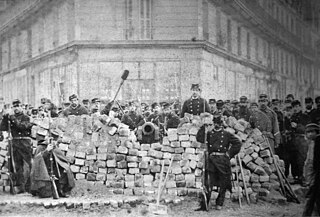
Naturally, although many have forgotten, the term Communism itself derives from commune (municipality or local government in French and other languages) and very specifically from the 1871 Paris Commune.

In this pioneering communist "state", not just the army became part of the people in full but the whole state did by suppressing the bureaucracy and getting managers to be paid common workers' salaries and be under the command of the People directly. Totally different to what happened in the Soviet Union.

Marx did not live to see the Russian Revolution but he witnessed the beginnings of the rise of what is now the Socialdemocracy, especially in France and Germany. It was then when he famously declared "I am not a Marxist myself". He was very critical of Lassalle and his socialdemocratic or proto-Keynesian ideas of building socialism from above by means of state loans and other nonsense. 

One of the key issues is democratic centralism, centralization or central planning. In this certainly Marx and Bakunin were very much at odds:
While Bakunin was a sworn enemy of all political and economic centralization, Marx had a very different perspective, but one that was in no way more “authoritarian”: “National centralization of the means of production will become the natural basis of a society composed of associations of free and equal producers, carrying on the social business on a common and rational plan.”70 Marx thought that both centralism (a common plan) and democratic control from below were necessary for building socialism.

Read the original article, "Karl Marx and the State", at The Commune.

Wednesday, June 19, 2013

Revolutionary Nationalism

I translate here an article[es] by Josemari Lorenzo Espinosa recently published at the Cultural Society Pepe Rei, which I believe has great interest in the debate on national liberation and socialist revolution:

Josemari Lorenzo Espinosa. Revolutionary Nationalism.


Federico Krutwig Sagredo
Historian Josemari Lorenzo Espinosa rescues an article by Federico Krutwig, published at Branka magazine in April 1966, in which the author dissected the revolutionary vision of nationalism. For Krutwig, the nationalist prism gives the revolution of a content that non-nationalist communism lacks. For Krutwig, the national and revolutionary components within Revolutionary Nationalism are impossible to separate. 

Soon it will be the 50th anniversary of the birth of Branka magazine, published in the 1960s in Belgium by Basque exiles. Among the collaborations of its first issue, one by F. Krutwig (1) had a notable influence in that time. Under the title "Revolutionary Nationalism" (2), "a new way of struggle of man for his freedom and, very especially, of the working classes for their national liberation" was applied to the Basque case. The author established differences between this "revolutionary nationalism" and communism, although he assured that its roots were in Lenin and Bakunin. He said that Lenin introduced a new vision of nationalism, compared with that of the founders of Marxism, which implied an essential change. Lenin considered that the "national liberation struggle of every people is an integral part of the struggle of liberation of the oppressed in general". According to Krutwig, the development of that theory would have produced revolutionary nationalism, which "is the form of struggle (...) adopted by the peoples submitted to imperialism". In the author's opinion, and in spite of the Leninist contributions to Marxism, "the peoples not submitted to foreign occupation (...) are not able to understand the great revolutionary and progressive force that the struggles of the oppressed against colonialism do contain". Therefore, with the birth of revolutionary nationalism, communists would be finally ready to understand the just national claims of workers and these to participate in their own revolutionary movements. According to Krutwig, "in revolutionary nationalism, national and revolutionary components form a chemical compound. They are inseparable". For this author, revolutionary nationalism was a dialectic jump in the revolutionary struggle of workers. A new reality and, even though partly similar to bourgeois nationalism, its essence and praxis were different. 

This revolutionary nationalism, which was being experimented in Latin America, in Asia or in Africa, applied to the Basque case had a major impact. Krutwig charged, in his article, against the Spanish and French communist parties. This last one criticized also for its attitude towards Algeria, accusing them of "bringing a new imperialism to the Basque Country, this time under proletarian command". Simultaneously he opened the door for the participation of the Basque petty bourgeoisie, something, that he admitted as unthinkable without the foreign occupation. That is, the possibility of bourgeois-proletarian collaboration (what was then called National Front) existed only because of the existence of shared national interests. Krutwig saw a revolutionary fraternity beyond the undeniable class confrontation, because "the Spanish revolutionary fights against a foe within his own people, while in the struggle of the Basque People, the enemy is first and foremost defined by its character as foreign looter". On the other hand, in this struggle, "if Spanish proletarians side with the oppressor state, they will become our enemies".

Among the enemies of the Basque People, Krutwig mentioned notably those "Basque by surname": "Esteban Bilbao, Areilza, Lequerica, Careaga and so many agents of imperialism", saying that the fatherland of these people is Spain. Also to the North he pointed them: the Ibarnegaray, Ibarrondo, Elizabide, etc., who held ranks in French parties. "From all this that the Basque national liberation struggle must to be carried on against all that means the chimera Spain..." For Krutwig the historical moment must be interpreted and to each case the specific revolutionary solution applied. And, even if he cites Lenin, Mao and others, he wants to avoid mimicry and to demand the application of the socialism most adequate for each particular case. For that purpose, he rejects the experience and contributions of the Spanish and French communist parties, who ignore Leninist texts in favor of self-determination and do not seem able to interpret the specific needs of the oppressed peoples of these states, and resorts instead to the liberation examples of the communist parties of China, Vietnam, Cuba or Korea, concluding that national liberation cannot be achieved without social emancipation. 

The author does not ignore the problems of a national front with the bourgeoisie. "Basque nationalist bourgeoisie", he claims, "tends to collaborate with the Spanish bourgeoisie" and also: "the jelkide* is by nature bourgeois". However for Krutwig, in revolutionary nationalism "the primary condition is to be nationalist". In this aspect, Krutwig dedicated ample room to quotes from Mao. Among them he brought forward a cue: "In a nation which struggles against a foreign enemy, the class struggle takes the shape of national struggle and, under this form, unity manifests". Not forgetting ever that the main contradiction is which confronts the exploiter class (bourgeoisie) and the working class, Krutwig says that many examples of colonial liberation show that there is variance to it. And then the problem of the "pure leftist" ones is that they become "reactionary imperialists". For Krutwig this demonstrates a complete ignorance of the specific conditions of revolutionary struggle in Vasconia. These people, sometimes, for rejecting the bourgeois nature of the Basque Nationalist Party, what they did was to throw the baby with the dirty water down the sink. In support of this thesis he cites again Mao: "In the event of a war of aggression (...) the different classes can join forces provisionally to carry on a national war against imperialism". Doubtlessly the situation is much less dramatic today in the Basque case, where the occupation is not always as crude as in the Chinese, Vietnamese, Algerian and other cases, or even in the Basque Country of 1936. But for this Mao also had an advise: "When imperialism does not resort to war, it can use other means: political, economical and cultural ones as more moderate forms of oppression". Then "the dominant class of the semicolonial country can capitulate to imperialism: an oppressor alliance is then formed against the popular masses". 

Krutwig does not forget either the fundamental role that the native language acquires in the processes of national liberation. He dedicates many paragraphs and offers ideas against cultural or linguistic oppression. And he did propose, based on the thesis of the Vietnamese Troung Chinh, the creation of the well known fronts (which later ETA would try to adopt) among which the cultural one would deal with the promotion of the Basque language and to create contradictions with bourgeois nationalism, which, in addition to being bourgeois is also promoting the Spanish language. This and other writings by Krutwig on revolutionary nationalism, or also on Basque history, enlightened and marked the thought of a whole generation in a period of unprecedented cultural repression. But they have not lost all their relevance. For whoever has this article at hand, we recommend its re-reading. In any case, we leave floating the possible actuality of these, then revolutionary theories, that are now almost 50 years old, and which in some aspects may require mending but in others retain their original lucidity.
_____________________________________________________

(1) Federico Krutwig (1921-1998): Basque scholar and militant. One of the most influential members of ETA in the period of the V Assembly. 
(2) "Nacionalismo Revolucionario" Branka, nº1 - April 1966. Ediciones vascas (1979).

Translation note:
* Jelkide: member of the bourgeois Basque Nationalist Party. The term means "follower" or "supporter of the JEL", which is the acronym of the barely reformed Carlist principles, after removal of allegiance to the King: "God and the Old Law" (Jainkoa Eta Legizarra).


***


Addendum by Maju:

As Lorenzo Espinosa says in the last paragraph, some of the details and emphasis of Krutwig's Revolutionary Nationalism require mending or revision. I personally find a bit annoying his insistence on inter-classist alliance with the petty bourgeoisie, which in the mid term is not too productive and appears to lead to an incomplete revolution. However he is right that in the event of national oppression, as in any other form of oppression, every ally is valuable and we should not disdain them. 

My opinion on the matter is that the petty bourgeoisie is generally weak and cowardly, however many of them are also borderline proletarians, so harsh is the Capitalist exploitation, especially in times of crisis like the one we suffer today, that they are also pushed against the ropes and their objective interest converges with that of the working class: dignified life vs the Capitalist offer of slavish survival.

In the mid twentieth century probably the petty bourgeoisie was perceived as a stronger and more dynamic sub-class, however nowadays they lack even personality of their own, as the "middle classes", as they call them, are being wiped out altogether with very few exceptions, to make room for the insatiable greed of the grand bourgeoisie. 

This is in any case not a major problem for the proletarian camp, because 90% and 99% are not that different. It is however a serious problem for the capitalist one, because 10% and 1% have almost no comparison. The door is always open for whoever in the petty bourgeoisie wants to join us but this time we, the 90%, the working class, shall set the terms: terms of dignity, terms of freedom, terms of equality but without concessions to private property privileges of any kind. They must choose between a worthy human life and their coveted but extremely eroded property privileges: it is not us who are in the middle of the most colossal struggle ever: we are one side, the one who has the big numbers and the productive skills, so we really do not need their help. If they are welcome is only because our camp is the camp of Humankind, so every person who chooses this camp deserves praise and support, but there is no other reason. 

The reality of Revolutionary Nationalism today has more to do with the fact of ethnic identity being a real social agglutinative force, something that Krutwig also grasps. Nearly all people, not just the bourgeois, but actually even more intensely the workers, feel this kind of, maybe subtle but very real, social organization which is the ethnicity or nationality. Fighting against it is futile and counter-productive, and doing so in the case of oppressed peoples is plainly unfair, a treason to the principles of Humanism that we have as our standard. If all peoples are equal, all peoples have the same right to self-rule and should not be submitted by others.

Blending together these two vectors of liberation can only add up and become enriched fuel for World revolution from the local communitarian level. Reality confirms it: nationalist or otherwise ethnic-based revolutionary forces are almost invariably much stronger and persistent in the long run than similar ones in the context of imperialist nations, precisely because they blend two (or more) legitimate demands of emancipation, making a much more stable platform for popular struggle.

But the petty bourgeoisie is totally unnecessary as ally: they are nearing extinction and add nothing of value to the power of the Working Class.


Update: the original text (in Spanish, with occasional quotes in French) by Krutwig (signed with his pen name F. Sarrailh de Ihartza) is available online in PDF (thanks to Petriko Barreno for the info). Some translated key fragments:

Lenin demands from the socialists that they must support without reservations the national liberation struggles of the oppressed peoples. This demand he proclaims very especially for very proletarian class of the oppressor nation. He imposes to the communist parties the duty of making the workers of the oppressor nations understand the just rights of the oppressed peoples. And he sees in this preaching of the right of self-determination of the oppressed peoples, preaching that must be realized by the worker parties of oppressor nations among their members, the ultimate proof of true proletarian internationalism. Without such support of the right of self-determination (and for greater clarity Lenin declares that for right of self-determination we must understand the right of the oppressed people to separate themselves from the oppressor people and to create their own state), Lenin proclaims that there is no proletarian internationalism.

He then mentions other examples of strong criticism by Russian revolutionaries of the Jacobin-chauvinist stand of Spanish and French communist parties on the national issue. Koltsow, Pravda journalist in the time of Stalin, and Trotsky alike made such sharp criticisms, condemning the chauvinist stand of these as anti-Leninist (Koltsow) and debilitating of the class struggle (Trotsky).

While Lorenzo seems to prefer the, somewhat inter-classist, quotes of Mao, he ignores, for some reason, the ones by Lenin, which are much more rotund, unequivocally proletarian, and more directly applicable to the European reality, for example:

The Working Class of the oppressor nations cannot limit itself to generic and stereotyped sentences repeated by any pacifist bourgeois against the annexations and in favor of equality among nations in abstract. The Working Class cannot remain silent in front of the question, particularly "upsetting" for the imperialist bourgeoisie of the state borders based on national oppression. The Working Class cannot stop fighting against the violent retention of oppressed nations within the borders of any given state, and that means fighting for the right of self-determination. The Working Class must demand the freedom of political separation of colonies and nations oppressed by "their" nation. Otherwise proletarian internationalism will become a hollow and merely verbal concept; class trust and solidarity will become impossible between the workers of the nations oppressed by "their own" nation and held captive by the violence of "their own" state. 
Lenin again with particularly fiery verb:
If Finland, Poland or Ukraine separate themselves from Russia there is nothing wrong with it. What could be wrong? Whoever claims that is a chauvinist!

Wednesday, May 1, 2013

Basque bourgeoisie and imperialisms (translation of article by Iñaki GdSV)

I translate here a very interesting analysis by Iñaki Gil de San Vicente, one of the best minds of the Basque Country and possibly all Europe, originally published in Spanish language at Borroka garaia da! (it's time of struggle!)

Basque bourgeoisie and imperialisms


It's always necessary to dive into the roots of reality, otherwise we end up wandering in clouds, forgetting or ignoring that the great Basque bourgeoisie, the one that commands, has been and is a key piece of the State of Spain,  and is determined to remain in that position; that her sister, the bourgeoisie, never dared to confront the elder sister, folding to her and supporting her in the decisive moments; and that the younger sister, the small bourgeoisie, be it new or old, has always been broken in pieces, oscillating fearfully with the exception of very small fractions of her. By not stepping down to the contradictions we even end up forgetting the evident: that capitalism does exist as an objective, structuring, reality in which we survive rather than live by force and that it is even embedded in our own heads. It is so deeply embedded that every day we use more and more its own language and concepts. What is the bourgeoisie? Almost nobody seems to know anymore, it's felt, it's suspected, but a key concept like this one, which implies to know what is the working people, the working class, etc., is like vanished from the language of the independentist left, excepted maybe some texts that nobody reads.

However the bourgeoisie does exist, as does exist also imperialism. In the Southern Basque Country, the bourgeoisie has its own state: the Spanish one, and it also has the petty governments lent by the Kingdom of Spain. But the future of these and other tools of power and national class oppression does not depend anymore only on the will of the dominant classes within the State but every day more on the inter-imperialist quarrels, on one side, and the decisions of Eurogermany, on the other. The Basque-Spanish bourgeoisie knows that well, much better than [Western Basque regional president] Urkullu when he begs the support of Spanish bourgeoisie, partly represented by [Spanish political leaders] Rajoy and Rubalcaba. Now it uses Urkullu as it did before with [former regional presidents] López, Ibarretxe, Ardanza, Garaikoetxea... For the social class that owns the productive forces and our mortgages and debts, people are just numbers in their mean profit rate, and, for this reason, for her are actually more important the current decisions of the USA and Japan, which try to unload the weight of the crisis on the euro, getting smoke from the state machine of minting dollars and yens, for example, than all the prizes about a supposed peace.

Right now, the growing inter-imperialist non-antagonistic centrifuge tensions are being countered by the centripetal forces of Western imperialism, lead better or worse by the USA. The Free Trade Treatises being negotiated with the EU and Japan; the demand to the UE to increase its contribution to NATO along with the support to Japanese weapon escalation; the systematic obstacle to any reform of the UN, IMF, World Bank, etc., in order to abort any bourgeois democratization of these fundamental imperialist institutons; the sharpening of the underground war against the so-called BRIC (Brazil, Russia, India, China); the internal protectionism versus Chinese technology; the advance of the military siege to Russia and China; the political-military soft coups and the impulse to hardcore pustchist terrorism all around the World; the maneuvers to manipulate the price of gold, of energy, of food and medicines; the pressures to impose the capitalist law on private patents, especially in the bio-economy; the systematic hoarding of edible water; the theoretical and practical war against human rights and the rebirth or patriarchal-bourgeois terror and of Christian fundamentalism, hidden by the manipulation against Islam; the reactivated fear of communism; the reinforcement of the right to loot, plunder and violations inherent to the false right of humanitarian intervention; these and other praxes show the imperialist counter-offensive at global scale, led by the USA with support of the EU and other powers.

The fundamental goal of this offensive is no other than to attempt to open a new long phase of expanded accumulation of capital, a long phase of sustained growth of the mean profit rate at the hands of Western imperialism firstly, and secondly of the imperialisms and subimperialisms that accept the hegemony of the high-tech industrial-financial North American capital. Another goal as important as the previous one, insert in the same logic, is to stop the global rise of subimperialisms and, if possible, force them down in the world hierarchy. One of the strategic battles in this economic war is that of financial supremacy, that of unity of the financial system under Anglosaxon control to direct in its benefit the tendencies towards the disarticulation of the global financial system. And, to be brief, another even more important goal than the financial one is the Western monopolistic control of a new techno-scientific industrial revolution that multiplies exponentially its work productivity, securing energy resources and military supremacy. The military-industrial complex has already welded itself to the financial capital and knows that techno-science does not only depend on private capital but above everything else on state planning strategy in order to expand constant capital in everything related to R&D&I.

The bourgeoisie established in the Basque Country wants and needs to join to this imperialism as much as they can. They want for conviction and class essence, and they need it for class survival. It can negotiate punctually with China or Russia, or even with Venezuela or Cuba, because money is money, in any of these or other business it needs of the Spanish and French states, of the EU, of the Western stock markets and of the armored fist of NATO, which is the ultimate material reason of the invisible hand of markets. The bourgeoisie established in the Basque Country is aware of the multiple crises that sap the Spanish state (industrial and techno-scientific collapse, weakening of its bourgeois national unity, cancerous corruption, descent in the imperialist hierarchy and relative and absolute impoverishment), the same that it knows of the reports on the monarchic rot, the collapse of the political caste, the rising trend of reactionary and racist populisms, the importance of narco-capitalism, of the prostitution industry, of the underground economy and of tax evasion. Nothing of all this is unknown to them but it accepts it all because it knows that it is the only trampoline that can impel them to new business, especially to not lose what they already have, and because, in spite of all, that rotten state is its own co-production, it is an instrument that it has helped to create and adapt to each new need.

It is this structural context which explains us why the bourgeoisie does not want to open any peace process, because they only need their own peace: that of so-called "normalized" economic and national class exploitation. The bourgeoisie established in the Basque Country needs its own peace because it is economically more efficient to grant them a share in the realization of profit and to enjoy a material and symbolic space of their own in which to hold part of their expanded accumulation. The symbolic space acquires every day more relevance in current capitalism, based on growingly complex work, what demands a space of qualification of the docile, alienated and submissive workforce, and bourgeois symbolism is decisive for this. For this very reason, it is a peace fundamentally linked to the permanence within the Spanish state in our [Basque] nation. And for reason of raw unity dialectics and struggle of the opposites, it is this context which gives meaning to the sixth Basque general strike on May 30th, as yet another shape of the struggle of our people against the national class exploitation it suffers, a strike that will demonstrate that the emancipating forces in our "worker nation", to use a phrase of Marx, are growing.


A selection of articles by Iñaki Gil de San Vicente is available at La Haine. His e-book Cooperativismo Obrero (Worker Cooperativism) can be downloaded at Quedelibros. All materials in Spanish language.

Saturday, April 13, 2013

A very short graphic history of late Capitalism

Ever heard of surplus value, Thatcher & Reagan or the Credit Bubble? I bet you did. What you might not have realized is that, in the golden decades of Capitalism, at the middle and third quarter of the 20th century, the system, deeply trampled in a protracted class war at home and abroad, decided to effectively apply semi-socialist measures allowing a much greater share of this surplus value to be shared by workers. 

These figures, which apply only to the USA but surely have strong parallels elsewhere within the core Capitalist Empire, come from Campaign for America's Future (via Hullabaloo), a self-described progressive site, but most informative in any case.

The most revealing chart is this one:


We can easily see how in the 1940s, with the war effort and all that (heh, not the New Deal but many years later in fact) the 10% bourgeois elite took more than just a haircut in their share of the surplus value, from c. 45% to 35% or less. Those ten or fifteen percentile points were enough to keep most of the popular classes content and hopeful for the following decades. 

However, since the 1980s, that interested generosity of the 20th century capitalism, was dramatically reversed and today the levels of wealth concentration among the bourgeois elites are record high, what implies that the working class is having a very bad time, as we know too well. 

Why?, could well a naive person ask. Because the top bourgeois elite is taking it all in their bottomless pockets, as they always did except (partly) for that anomalous parenthesis of the Cold War.

Other parallel charts, all of which are coincident in pointing to Reagan as the trigger culprit:

Share of workers in the benefits

Less income means less savings
What meant disparage growth of credit while tolerated (the bubble)

So now you know the secret of the "happy capitalism" of mid-century: a bourgeois-managed "Robin Hood" strategy of sorts in order to prevent the masses from siding with Communism. Once they estimated that the danger had passed, they removed the benefits, feeding a gigantic credit bubble as buffer. Bubble that eventually burst, of course. 

So here we are back in the 1920s, so to say, just that almost everything else has changed. That's the cycle of Materialist Dialectics, which is not circular but spiral. Spiral that unavoidably leads to the end of the Capitalist regime.

Sunday, December 23, 2012

Basque and Red: excerpts of Argala's thought

Some days ago I mentioned the anniversary of the execution of the fascist and Christian fundamentalist top leader Luis Carrero Blanco some 39 years ago. What I did not mention was that the mastermind behind that attack, Jose María Barañain Ordeñana, best known by his nickname Argala (Slim), was murdered by the Spanish secret services five years and one day later on December 21st of 1978, using very similar methods (bomb under the car) in a clear gesture of revenge. 

On the anniversary, the political debate blog Borroka Garaia da! (Is Time of Struggle!) published integrally a key document[es] to understand this man and his ideological and political legacy, which, on one side, reflects much of the collective feeling of the doubly oppressed Basque Working People and, on the other, has been so influential on the politics and ideological foundations of this nation as it is now, and very especially its sizable revolutionary fraction. 

After reading it I was tempted to translate it in full, so the people from around the World can understand better what is behind Basque struggle for emancipation, both national and socio-economically. But it is too long and my commitment too weak, so I will select some excerpts in the hope that they reflect the whole somewhat. 

The document is the introduction he wrote for the book by Jokin Apalategi Nationalisme et question nationale au Pays Basque, 1830-1976 (Nationalism and national question in the Basque Country, 1830-1976), published in 1977.

Banner with the image of Argala and a quote:
But neither ETA nor all KAS nor HB nor any political organization will
be able to solve the problems of the Basque Working Class. Only
the Basque Worker People itself can solve its own problems.

Excerpts:

...

What I recall vividly is the impossibility to have any relation with my maternal grandmother. She barely spoke any Spanish and I did not know any Basque, so our conversations were never went beyond a brief exchange of unrelated words.  She had to die without us having ever a real conversation.

...

Since I have some reasoning --so to say-- I have been able to watch the exploitation of the working class, even without understanding it as such for long. I have seen workers ---my neighbors--- who after the working journey had to work after hours in the construction business of my father¹ or others, and all only in order to reach to survive along with their families: At about the age of seventeen I joined a Catholic organization known as Legion of Mary, one of whose goals was to dive in social misery to offer consolation to those who were forced to suffer it. Through my participation in it, I knew what I thought did not exist in our country, but I did not know the causes of that suffering I saw; what became gradually evident to me was that consolation does not remedy hunger nor illness. Only with the worker struggles that in the midst of the decade of the sixties happened in my area, and especially with the strike of Bandas and the repression unleashed under the subsequent "state of exception", and also with the reading of novels about worker priesthood I finally reached to the understanding of the social division in classes with opposed interests.

...

... I began to study Marxist theory. 

By that time we heard already rumors about a new patriotic and socialist organization that fought for the independence of the Basque Country, it was E.T.A. The Ikastolas² spawned all around and you could see young people singing in Basque language. The Basque question arose back to light and with all its problematic. Our people, almost annihilated, resurfaced and its awakening was also felt in Arrigorriaga³. Evening classes of Basque language for adults began and Basque speakers began losing their inferiority complex to show pride of speaking the Basque language. 

As result of both factors --study of Marxism and national Basque awakening--, I reached clear conscience of the existence of the Basque Country as differentiated nation, integrated by seven regions separated by the weapons of the oppressor French and Spanish states; of the division of society in classes confronted by irreconcilable interests; of the Basque Country itself not being any exception in this aspect. I understood what was the "evangelization of America" by the Spaniards and what were "the crusades", what were "the reds"⁴ and the "glorious national uprising"⁵; that it was not about the rich helping the poor, nor merely about the working class salaries being raised, but about socializing the means of production; that in order to reach social solidarity a cultural revolution is needed, and that, in order to achieve that, it is not enough with goodwill but that a transformation of the Capitalist mode of production currently dominant into another socialist one is necessary; that for such thing it is required that the working class gets the political power; that a State apparatus is not neutral and that this forces the working class to destroy the bourgeois State in order to create a new one of their own, that bourgeoisie resorts to weapons when they see their privileges threatened, what suggests that if the working class does not face the problem in similar terms, we will have to watch many massacres and very few revolutions.

Once begun this process of comprehension, that I hope to never dare to consider mature enough, I was offered entry in E.T.A., and I accepted.

...

... It was not the Francoist dictatorial State with its extreme centralism and imperialism the only reason of the existence of the independentist option, but alos the historical incomprehension demonstrated by the Spanish worker parties towards the Basque question. The independentist option was the political expression of national affirmation of the popular sectors with a national consciousness, which were expanding every day. The Basque People had the opportunity to check along the history that a socialist revolution at state level is not any automatic solution for their national oppression; that Spanish worker parties are too impregnated of the Spanish bourgeois nationalism. On the other hand, the achievement of independence demanded the defeat of the Spanish State at least in the Basque Country, that is: a true political revolution that could only be carried on by the popular layers under the direction of the working class, only one able to assume today in the Basque Country, with all consequences, the direction of a process of such dimensions. Precisely, this assumption of the Basque question by the working class is what has allowed the national awakening of the Basque Nation.

My later relationships, as representative of E.T.A., with representatives of diverse Spanish worker revolutionary parties, did only confirm this vision. Such parties did not understand the Basque question but like a problem, an inconvenient problem that should be made to vanish. I always felt that the unity of "Spain" was for them as sacred as for the Spanish bourgeoisie. They never came to understand that the national character of the class struggle in the Basque Country was a revolutionary factor; on the contrary, it was for them nothing but a discordant note in the Spanish revolutionary process that they hope to orchestrate.

...

... it is evident that the only viable economic solution for the continental Basque Country⁶ is its integration with the peninsular area, where it can find the capital and the technology it needs to stop being a mere touristic reserve and producer of workforce doomed to emigration.

...

But what is worker internationalism? Does being internationalist demand to the workers of a divided and oppressed nation to renege of their national rights to fraternize that way with those of the dominant nation? Not in my opinion. Worker internationalism means class solidarity, expressed in mutual support, among workers of the various nations, but respecting each other in their peculiar ways of national being. If the relationships between the Spanish and Basque patriotic worker forces have not been better, it is not because of the just demands of the latter but to the incomprehension and opportunist acting by the former towards the Basque national question. Does worker internationalism demand that the workers of the more politically advanced nation slow down their rhythm in order to walk hand by hand with those of the less developed ones? If that would be the case Humankind would still be stagnant⁷.

...

... The Spanish worker parties are not anymore the main enemy of the state because this role has been taken by the Basque patriotic worker forces, notably E.T.A.

...

Today, before the double solution ---Basque petty-bourgeois or Spanish socialist-- that was offered to the Basque People in the first third of century, a sector of the Basque working class is in condition of offering a third way: the Basque socialist revolution.

We must not deceive ourselves however: the success of this option is difficult. ...

...

Among the Spanish People we have found also true revolutionaries who were able to acknowledge the existence and rights of our people; but sadly very few of them. If the Spanish worker parties would have been like them, maybe today we who defend the independence of the Basque Country would have chosen a more unitary solution. In any case, the peoples walk towards their economic and political integration and workers must impel the international solidarity and unity as long as that does not force us to sacrifice our national personality.

...


The article at Borroka Garaia da! ends with a brief biography or Argala, which explains, among other details, that, upon his death, Arrigorriaga was taken by the Spanish military police (Guardia Civil) and that it was forbidden that the funeral procession entered the town. In response it was agreed by a popular assembly that everybody would stay locked at home except a small group of relatives and close acquaintances who would carry the coffin preceded by the ensign of KAS (the Patriotic Socialist Coordination, then the political platform of the Basque Nationalist Left).

Upon arrival to the town hall, with the Basque ensign at half staff with a black cloth on it in sign of mourning, three Spanish policemen saluted the coffin in respect.


Source and full text in Spanish: Borroka Garaia da!


_________________________________________________________

Notes:

¹ Earlier he talks in length of his father, of humble origins but who had luck with lottery and invested in construction business, what did not quell his worries because the Capitalist system is also implacable for small businesspeople. 

² Ikastola: lit. learning workshop, term used for Basque-only schools, originally private which began spreading in the 1960s. The more common Basque term for school is ikastetxe (lit. learning house). 

³ Arrigorriaga, small town near Bilbao where Argala lived all his childhood and early youth. 

⁴ Los rojos (the reds) was a term used continuously by the Spanish Fascist propaganda machinery to stigmatize all those who opposed their military coup and subsequent totalitarian regime. Being rojo back then meant that you would be socially stigmatized at the very least and that all evils that might befall on you, like being imprisoned and tortured, or even killed arbitrarily, or simply to lose your job... were morally deserved. 

⁵ Term used by the Fascist regime as pedantic apology of their coup. 

⁶ Iparralde (the North), the area under French control. 

⁷ Notice please that this was written in the context of the 1970s, when ample areas of the World had achieved what was then understood (by most Marxists at least) as a more advanced way of socio-economical organization, if not political.

Tuesday, October 2, 2012

Historian Eric Hobsbawm's life thread merged with the Universe again

If there is one field other than politics in which Marxism is truly influential that is History. And much of that we owe to Eric Hobsbawm, who died yesterday at the venerable age of 95 at his home in London. 

His work, together with that of other Marxist historians, allows us to understand History not as mere sequence of monarchs and oligarchs, as the Conservative historians would like us to see it all, but from the real depths of the sociological reality of the common workers and due emphasis on the economic forces that drive history to a large extent. 

He remained a communist for all his life, even if he was radically critical of the Stalinist invasions of Hungary and Czechoslovakia, describing their revolutions as ones of workers against a merely pseudo-socialist bureaucracy. 

Good work, comrade.

Thursday, June 7, 2012

A criticism of Marxist economics

I profess communism (not just socialism, unless it's transitional to communism): the system of total democracy in which the economy itself is controlled by the People and for the People in a society that is effectively of the People. No rhetoric here, just real and total democracy beyond the feudalist residue of private property.

But, even if I have left my most purely Anarchist ideas behind as unworkable and somewhat utopic and have embraced at least some aspects of Leninism (although I still profess strong respect for Kropotkin). My conflicts with Marx' economics are most important and have come to light recently in a number of debates, making myself to reconsider even if I should use the label "Marxist" at all when talking in first person or even at all. 

The issues are as follow:


Value: use vs. exchange value

Marx insists in using a virtual case or particular solution for the problem of value. He picks exchange value instead of use value as the real or at least practical measure of value. 

I understand that exchange value only exists in market conditions and is highly variable, being often unrelated to the actual practical worth of the good. For example food has a first quality use value (because we all need to eat regularly, demanding such good once and again), instead gold has almost no intrinsic worth, as its practical uses are very limited beyond exchange and hoarding in market conditions. 

For a self-proclaimed communist and scientist, Marx really disappoints by insisting not just in picking the exchange value above the use value, but also by reinforcing the bourgeois notion of gold and money (in his age still an extension of gold and silver) as commodities and not as what they really are: mere accountancy tokens. 

The only value I can accept, from a revolutionary viewpoint, is use value: things are worth the use we can make of them. 

I admit that this concept is slippery because it is strongly affected by subjectivity (although there are measures like caloric intake and in general energy fluxes which are pretty much objective, albeit also impractical for economic purposes) and that complex approximative measures must be undertaken to evaluate it. But I also understand that exchange value is no better: it is a mere approximation of bourgeois nature and does not capture well the real value, use value, of things.


Labor theory of value

The labor theory of value was first stated as such by Ricardo, a major bourgeois economist who had an undue influence in Marx. By reason of it, all value is claimed to be ultimately product of human work (not mechanical or animal, never mind untamed nature). This is so obviously wrong that I strive to understand why I should even discuss it.

Let's say that a lush and healthy fruit tree has grown naturally in a wild patch of land, never attended by human hand. For whichever reason I end up setting up camp, building my home just a few meters away from that wild tree, whose presence I can't but consider propitious, and, just beside it I plant some other fruit trees, which take a decade or more to grow, tended by my caring hands, with hundreds, maybe thousands of working hours invested in them. 

In due time I collect the fruits, the wild kind from the wild tree, where I just need a few minutes to grab them and bring them home (where by convention I realize their value as food) and the domestic kind from the planted trees, where I also need just a few minutes to collect the product but have hundreds of hours of previous work invested. Both tree types produce about the same amount of fruit and both fruit types are similar and give equivalent food in terms of calories and other nutrients. 

Which fruit is more valuable? Logically both are similar, so both are similarly worth, let's say equal to simplify. That according to use-value. However according to Marx' misconceptions the domestic kind of fruit is worth, say a month's salary, while the wild kind is worth almost nothing. 

How obviously wrong!

Of course, normally, human work can add (or subtract) worth, value, from a commodity, but this is far from being a universal law. 200 diggers with teaspoons do not produce more value in terms of ditches than a single one with a decent hoe and spade even if both work the same in terms of human effort and working hours. 

But crucially, and hence my first example, Nature's work is also most important but almost never accounted for. This is a bourgeois vice that got ol' good Karl as well.


Conclusion

These two are my major and fundamental complaints about Marx' economics.

Marx' economic theory still has some value. For example, in spite of all its vices, he was still able to make quite decent forecasts about his focus of work: Capitalist economy and society. He was able to forecast the inevitability of overproduction crisis, caused by the internal dialectic of Capital between cost-reduction and price-minimization, leading to the drop of profit towards zero.

Or he was also very much able to foresee as far as our social stage in his posthumous manuscripts, where he describes an advanced Capitalist society (real subsumption of labor into capital, alias Toyotism) that was not even imagined in his time - except by the genius of Trier.

For all the constituent vices of Marx' economics, it can still produce in the right hands, good results. But obviously, some 145 years later (and what 145 years of accelerated change!), we can't rely only on Marx, much less treat him as some sort of all-knowing God-inspired prophet, as so many do.

145 years after the publication of Capital, we need to move on and forge a genuine economic science that can effectively be a scientific tool to plan in a post-Capitalist era. 

I can't really outline it, we'd need more knowledgeable and dedicated people, but it's clear that it needs the following pillars:
  • Value = use value
  • An ecological theory of value in which human work is just a particular case in the perpetual transformation of things, sometimes into valuable commodities for the human taste
  • A physical theory of production in which the factual concept of transformation is emphasized over the misleading Promethean concept of production, which resembles that of creation and appears to disdain the raw materials and other resources destroyed in the process of production, or rather transformation.
My two cents, as is usually said.

This entry will be published as separate page for greater visibility but the discussion thread is here.