Showing posts with label euro. Show all posts

Wednesday, July 8, 2015

Greece: what will happen now?

This very honest interview by The Real News Network to Kostas Lapavitsas (Syriza's independent MP and columnist at The Guardian) is a must watch (two videos as "playlist"):


Lapavitsas is very clear: the banks must and will no doubt be nationalized, IOUs denominated in euros will be issued to put up with the lack of liquidity caused by the ECB and the Greek banking oligarchy. 

There is no hope in negotiations: Germany won't budge and neither can Greece, much less after the massive rejection of the Troika's take-it-or-leave-it proposal by the Greek People on Sunday. 

Changes will happen in a matter of days, very possibly after the last attempt at negotiating a deal this week, which is desperate and won't produce any results.

Less clear is what will happen to the European Union and the Eurozone, but that is not, I guess, Greece's problem anymore.

Tuesday, July 31, 2012

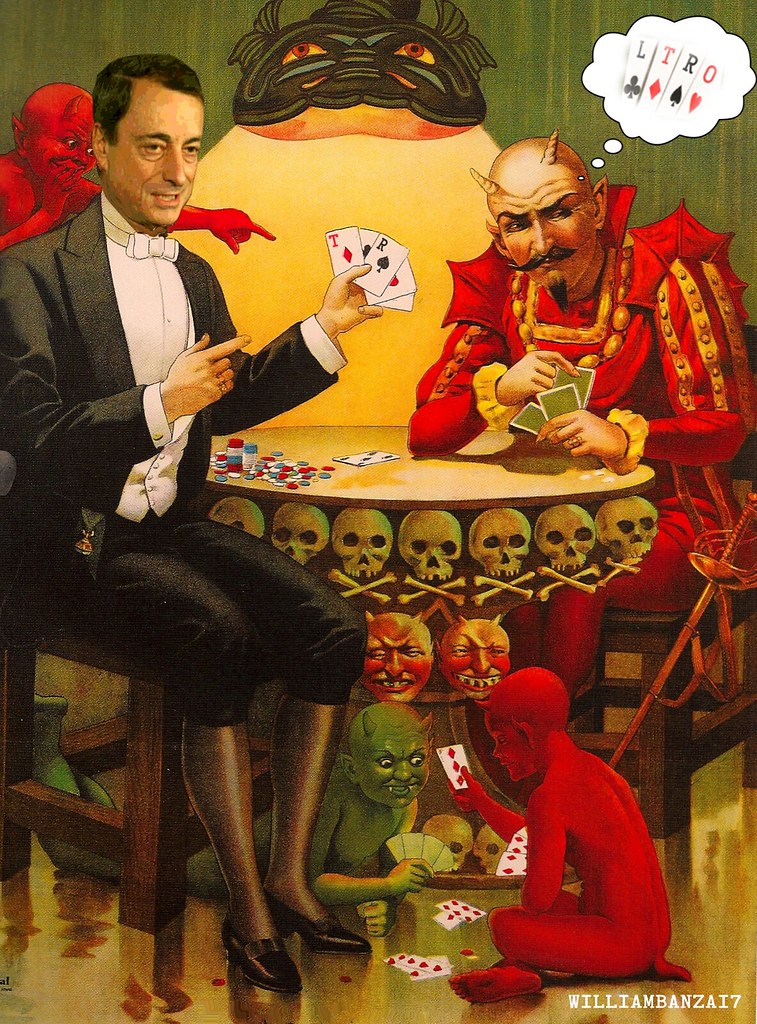
The shadow of Goldman Sachs is elongated - or Draghi and the G30

(source)
As you probably know by now, Euro-bankster capo di capi Mario Draghi is a former partner of the infamous Goldman Sachs, whose political clout was enough to send the Western World to Hell just for them to stay alive, while their rivals of Lehman were left to die. As you may know also, GS employees are well known by their loyalty to the firm (or should we say "cult"?), whose global power is truly disturbing and would seem to demand chop-chop anti-monopoly action (but nope).

But we do not know everything about Draghi, arguably the most powerful man of Europe and one of the key financial players of the World. Naked Capitalism discusses today some of his story past and present:

Draghi, dubbed "a craven moneyman" by former Italian President F. Cossiga, was responsible of the European operations of Goldman Sachs from 2002 to 2005, precisely when the Greek accounts got muddied by GS intervention. Only for that reason we can well say that putting him on the ECB's gilded throne is like putting the fox to guard the chickens.

But there is more. Draghi is member of the powerful and ill-known banking lobby (promoted by the Rockefeller Foundation since 1978) which goes under the name of Group of Thirty (G30 for short), incidentally chaired by his predecessor at the ECB, Jean Claude Trichet.

The membership (32 people) of the G30 is quite revealing (in purple Goldman Sachs adepts):

  • Paul Volcker - Chairman Emeritus; former Chairman of President Barack Obama's Economic Recovery Advisory Board; former Chairman of the US Federal Reserve
  • Jacob A. Frenkel - Chairman of the Board of Trustees, Chairman of JPMorgan Chase International; former Chairman, Bank of Israel; former Chairman, Merryll Lynch; former Chairman, Inter-American Development Bank; former Vice-Chairman, Board of Governors, European Bank for Reconstruction and Development; Member, Trilateral Commission; Member, Investment Advisory Council to the Prime Minister of Turkey; Member, International Advisory Council, China Development Bank
  • Geoffrey L. Bell - Executive Secretary; President Geoffrey Bell and Company
  • Jean-Claude Trichet - Former President, European Central Bank; Honorary Governor, Banque de France
  • Leszek Balcerowicz - Professor, Warsaw School of Economics; former President, National Bank of Poland
  • Mark Carney - Governor, Bank of Canada; member, Board of Directors, Bank for International Settlements; Chairman, Financial Stability Board; former Partner and Managing Director, Goldman Sachs.
  • Jaime Caruana - General Manager, Bank for International Settlements; former Governor, Banco de España
  • Domingo Cavallo - Chairman and CEO, DFC Associates, LLC; former (infamous!) Minister of Economy, Argentina
  • E. Gerald Corrigan - Managing Director, Goldman Sachs; former President, Federal Reserve Bank of New York - politically investigated in Britain for the Greek debt cover-up scandal
  • Guillermo de la Dehesa - Director and Member of the Executive Committee, Grupo Santander; former Deputy Director, Banco de España
  • Mario Draghi - Governor, European Central Bank; former Chairman, Financial Stability Board; former Governor, Banca d'Italia, former Goldman Sachs Managing Director and Partner
  • William Dudley - President, Federal Reserve Bank of New York; Former Partner and Managing Director, Goldman Sachs
  • Martin Feldstein - Professor of Economics, Harvard University; President Emeritus, National Bureau of Economic Research - a prominent Fundamentalist Neoliberal
  • Roger Ferguson - President and Chief Executive Officer, TIAA-CREF; former Chairman, Swiss Re America Holding Corporation
  • Stanley Fischer - Governor, Bank of Israel; Former First Managing Director, International Monetary Fund; former Vice-Chairman, Citygroup; member, Bilderberg Group
  • Arminio Fraga Neto - Founding Partner, Gávea Investimentos (now owned by JP Morgan); Chairman of the Board, BM&F-Bovespa; former President of the Central Bank of Brazil; former (conservative) government advisor in Brazil
  • Gerd Häusler - CEO, Bayerisch Landesbank; Former Managing Director and Member of the Advisory Board, Lazard and Company
  • Philipp Hildebrand - Senior Visiting Fellow, Blavatnik School of Government, Oxford University; Former Chairman of the Governing Board, Swiss National Bank; Former Partner, Moore Capital Management
  • Mervyn Allister King - Governor of the Bank of England; Former Professor, London School of Economics; Fellow, The British Academy
  • Paul Krugman - Professor of Economics, Woodrow Wilson School, Princeton University; Former Member, Council of Economic Advisors
  • Guillermo Ortiz Martínez - President and Chairman, Grupo Finaciero Banorte; Former Governor, Banco de México; Chairman of the Board, Bank for International Settlements
  • Raghuram G. Rajan - Professor of Economics, Chicago Booth School of Business; Economic Advisor to Prime Minister of India
  • Kenneth Rogoff - Professor of Public Policy and Economics, Harvard University; Former Chief Economist, International Monetary Fund
  • Tharman Shanmugaratnam - Minister of Finance, Deputy Prime Minister Singapore; Former Managing Director, Monetary Authority of Singapore
  • Masaaki Shirakawa - Governor, Bank of Japan; Former Professor, Kyoto University School of Government
  • Lawrence Summers - Charles W. Eliot University Professor, Harvard University; Former Director, US National Economic Council; Former President, Harvard University; Former US Treasury Secretary
  • Lord Adair Turner - Chairman, UK Financial Services Authority; Member of the House of Lords, United Kingdom
  • Sir David Walker - Senior Advisor, Morgan Stanley International, Inc.; Former Chairman, UK Securities and Investments Board (now FSA)
  • Axel A. Weber - Chairman, UBS Visiting Professor of Economics, Chicago Booth School of Business; Former President, Deutsche Bundesbank
  • Yutaka Yamaguchi - Former Deputy Governor, Bank of Japan; Former Chairman, Euro Currency Standing Commission
  • Ernesto Zedillo - Director, Yale Center for the Study of Globalization, Yale University, and Former President of Mexico
  • Zhou Xiaochuan - Governor, People's Bank of China; Former President, Chinese Construction Bank; Former Asst. Minister of Foreign Trade (China)

The European Union's Ombudsman, Nikiforos Diamandouros, thinks that Draghi's membership in this lobby is incompatible with his role as Supereme Pontiff of the Euro-finances. The matter is under investigation and may take months before any conclusion is reached. 

But the real fact is that this G30 and possibly other less known forums are shadow governments (or senates if you wish) of the World's effective administration. And we all know that if banksters and super-oligarchs rule the World, the World has a big problem. 

Real Democracy Now! Banksters to the guillotine!

Tuesday, June 12, 2012

€100 billion new debt without referendum or even explanations

Nothing is clear. Neither in Madrid nor in Brussels the main actors speak out neatly. The details of the deal are murky and even more murky are the reasons behind it. 

What they tell us is that the European Union will lend to the Spanish banks (which banks? why?) some not too well defined €100 billion (36% of the Spanish government's budget). What is not said too clearly but we must all know is that the Kingdom of Spain is guaranteeing those loans and that, if banks can't or simply do not pay, the Spanish state will be held responsible. 

All that generosity with the banks comes while the salaries of public servants and all kind of social services or even economic stimulus like construction contracts are being slashed down. 

The Spanish people has not been asked but they (we, because we Southern Basques are also Spaniards against our will) are being held hostage as in Greece or Ireland. Hostages that are being treated quite brutally, so the Stockholm syndrome is not likely to come as result.

What is also not likely to come as result is any sort of stability either. While stock markets rallied briefly upon the announcement, they collapsed soon after.

Not only Spanish citizens are feeling that they are not being treated fairly, with all the corrupt banksters and their political cronies at large and getting even more money at their expenses, while they get nothing but cuts, other countries in trouble are as well. The Cypriot authorities suddenly decided that their turn has arrived and are also waving quite frantically for an emergency loan for their banks, a loan that will amount to "only" €3-5 billion - they say: the Bankia affair also began with a mere €5 bn and some Cyrpiot banks are quite big.

Ireland, who underwent a situation similar to that of Spain two years ago, also feels that she was badly treated in the day and is asking for a renegotiation. 

Finally the online rumor is that France is not in good shape either and comes next. Although others think that first will be the turn of Britain (not in the Eurozone but with plenty of problems of their own).

Friday, May 25, 2012

Rajoy admits it: austerity doesn't work

That's what he told him to the French President, F. Holland: 

The policies that we Europeans believe in, such as controlling state spending and reforms to boost growth, ultimately have no effect.

For once I have to agree with him. There's no way Europe can work as it does now: like a colony of Germany. 

In his rather unusual ability to speak out the obvious he also said:

Europe has to come up with an answer because we can't go on like this for long.

I knew that several years ago, Mariano. But well... better late than never. 

Raxoi (that's the correct spelling of his surname in the native language of his country: Galicia) is not the only right-wing European leader forced to pragmatism after the IMF recipes have failed once and again (no news here but maybe in Tory Street it is), Britain's Cameron is also asking now for stimulus policy at European level.

Source: Telegraph, who also hints at the formation of a Latin bloc in the Eurozone, now that that rat of Sarko is gone.

Friday, May 11, 2012

'Greece: What prospects for a SYRIZA-led left government?' (Christos Kefalis at LINKS)

Greece: What prospects for a SYRIZA-led left government?


By Christos Kefalis, Athens
May 10, 2012 – Links International Journal of Socialist Renewal -- (See postscript below) The parliamentary elections of May 6 have produced a sensational result, opening a new chapter in the political history of Greece. It will have important repercussions on the European political situation as well.

The result shows a clear polarisation between left and right and a break-up of the hitherto ruling political forces, the Pan-Hellenic Socialist Movement (PASOK) and New Democracy, the so-called “two party system” that has dominated Greek political life since 1974. 

The two traditional parties, pillars of neoliberal policies, lost more than half of their previous vote. Combined they now have the support of just 32% of the electorate, compared to 77% in the 2009 elections. New Democracy dropped from 33% in 2009 to 19%, while PASOK has sunk even more dramatically, from 44% to 13%, losing more than 2 million votes.

This was punishment for their reactionary austerity “memorandum” policies, which they implemented in cooperation with the European Union and the International Monetary Fund. These policies led to vast impoverishment for the majority of the people and mass unemployment officially already at 23%, resulting in a plethora of suicides by desperate men and women. 

The vote for the broad left rose from a modest 12% in 2009 to an impressive 35.5% -- 17% for SYRIZA (Coalition of the Radical Left), 8.5% for the Communist Party (KKE), 1.2% for the anti-capitalist left party ANTARSYA, 6.1% for the moderate Democratic Left and 2.9% for the Greens. However, the prospect of a left government is doubtful since the KKE, an ultra-Stalinist party, ruled out beforehand any cooperation with “opportunists”, by which it means all other left parties except from itself. Moreover, the Democratic Left and the Greens are moderate centre-left parties that do not differ radically from PASOK. Even so, the collective result of the three radical left parties, SYRIZA, the KKE and ANTARSYA, was an impressive 26.5%.

... full story at LINKS (very good article). 

Thursday, April 26, 2012

And the core of the Euro-problem is... Germany

Very very interesting read the article I just stumbled upon at Yanis Varoufakis' blog:


I believe it is very worth reading in full but I will entice you with some key excerpts that, in my opinion, represent the best of this thoughtful economic and political analysis (plus my own observations):

The question οn almost everyone’s lips is: “How long before Germany recognises that a new architecture is necessary to keep the Eurozone together?” Implicit in the question is a mistaken premise: that Germany’s view of the Eurozone is wrong, that its stance is predicated upon a mistaken analysis concerning the nature of Europe’s macroeconomy.

Yes, I also fell for that fallacy at times but I believe I do for didactic purposes: I'm assuming that European politicians/managers/statespeople know what they are doing and have the prosperity and social stability of Europe as their main objective. Not correct enough, I guess. 

...

When Bretton Woods died, in 1971-2, and the DM rose in value (as it would now if the euro breaks down), the Bundesbank oversaw a large shift in German finance from what Halevi describes as ‘extensive’ to ‘intensive’. From a situation where Germany was exporting industrial goods and importing labour (including Greeks) plus finance capital from abroad, it shifted to a new posture: it exported advanced industrial products plus financial capital (now that the DM had appreciated) while importing low level industrial goods. It was indeed the Bundesbank that, during that transition, pressurised German companies to turn to financing external to their usual ‘comfort zone’. How? By guiding Frankfurt, i.e. Germany’s large banks, to extend the length of their money contracts.

So this is how the Germany and Europe we know arose. Earlier it is explained that this was the culmination of a three-phase process. 

This position of Germany as overlord of international markets is strong but not immune to normal crisis:


[Halevi] challenges the views of two great scholars that he evidently admires: R. Hilferding and J. Schumpeter. The two men had presumed that, because German capitalism had utilised effectively corporatist structures for planning markets, Germany’s ‘trustified’ capitalism would be immune to crises of aggregate demand. Halevi challenges this view, arguing with Kalecki that, while trustification and corporatism did give German capitalism a capacity to accumulate and hoard productive capital over and above the level of its neighbours, it does not shield it, in the end, from recessionary forces. Indeed, German corporatism generates recessionary forces from within and has a tendency to export them without.

But it is not something created by markets but planned by the Bundesbank:


Turning again to the Bundesbank’s crucial role, Halevi argues that during the post oil-crisis global stagnation, the Bundesbank was dead keen to avert a situation in which German foreign direct investment abroad was financed through liabilities against Germany itself. So, the only way that German industry could extend its reach, and establish foreign productive facilities, without such liabilities, was to finance their outward expansion through aggressive trade surpluses with the [Rest of Europe]. Halevi’s interesting point was that this did not simply transpire; that it was not just a result of markets-at-work, but that it was an outcome designed and directed, to a large extent, by a Bundesbank dead keen to preserve German finance under strict German (and Bundesbank) control.
The strategy worked well from 1980 to 1985, at a time when the dollar was rising and the US was sucking in Germany’s net exports. In the meantime, with Germany sitting on its surpluses and with European currencies pegged on the DM, the RoE was becoming a source of increasing demand for Germany while transforming itself into Germany’s periphery. And what does periphery mean in this context? Halevi’s answer is: an economic vital space that provides demand but which grows slower (than Germany) during the good times and contracts faster during the downturn.

And that's the root of the current European social, political and economical puzzle. A puzzle whose solution can't be unlocked easily because it implies displacing Germany from its hegemonic position, something that the whole political class is dead set not to allow, no matter who dies in the process.

The EMS and later the euro were created and, from the viewpoint of the German oligarchy, the goal was to prevent that countries like France or Italy could compensate against the German hegemonic position by means of controlled inflation (competitive currency devaluation). The deal was so good that Bundesbank was even willing to drop their beloved Deutsche Mark.
 
The problem is that the Rest of Europe was stuck with a Deutsche Mark of sorts, a useless (too strong) currency for them, that, in the long run, when things turned ugly as do now, could only make them horribly non-competitive in the international markets. Germany however could extend and pretend for longer because the DM, oops the euro, allows them to import cheap (not anymore from the Rest of Europe but from outside the Eurozone at the very least) and sell expensive (because of the very specific high-value products they are specialized in). 

But the problem is that, as their markets collapse, the crisis also reaches Germany and by now everybody is more or less angry at them for their lack of commitment to European solidarity, for using the EU as a colonial empire of sorts. True that much of the blame falls on the shoulders of the oligarchies and political classes of the other European states, apparently unable to understand and/or correct this vicious system... it is hypothetically plausible that these "national" political classes could impose their own terms to Germany... as they do not we can only assume that they are being bribed to behave as neocolonial minions. 

But the "national" bourgeoisies (never mind the working classes, of course) are not being bribed, however their elites are still allowed to mass up huge amounts of wealth and that way they are kept at bay: as long as their banks pay dividends, they won't complain too much. 

But for how long can this farce, in which the citizens are squeezed to near death to pay a handful of stagnated decadent banksters, continue? In the end money is just a tool for an economy to work (and within such a working economy to mass up power): if the economy does not work, then what? 


En fin...

Thursday, April 19, 2012

Alternative currency in Volos (Greece)

As happened in Argentina a decade ago, crisis ravaged Greece is being forced to look for alternatives to Capitalist structures in order to survive. They have developed a system of credits by which they can offer and get products and services outside the official EU-IMF bourgeois economy and without using the now most scarce euros.


From Ex-SKF.

Thursday, January 12, 2012

Germany in recession: you can't import everything

The secret of strong and weak currencies is simple: who runs a strong currency (relative to others, specially the US dollar or in the past the gold pattern) imports cheap but has difficulties exporting because domestic costs are high, instead who runs a weak currency imports at high price (and hence imports less) but has it quite easier to export. 

Late Yugoslavia (or Serbia-Montenegro) under Milosevic exported very cheap (mostly weapons for the international black markets) thanks to hyper-inflation. The experiment is worth studying because it is probably the longest lasting case of hyperinflation and a conscious attempt at it. The regime lasted that way almost 20 years, not without facing revolts and wars and ultimately isolation and defeat but it is clear that it keeps you going for a while if properly managed. 

Much more controlled inflation rates were the norm in Europe for last decades before the euro experiment was conceived. France, Italy, Spain, Greece, Turkey and Britain... all suffered from variably troublesome rates of inflation and all them landed on their feet in spite of them (in most cases there was no hyperinflation however). Thanks to that the state got short-term resources at will not being reliant on international usurists and kept production costs relatively low at the expense of the worker's income mostly (what was compensated sometimes by other means such as inflation-plus adjusted salaries, etc.) and/or at the expense of domestic consumers, including capitalists, who found imports, including raw materials and basic components, increasingly expensive (but as purchasing power was increased because the economy overall grew, this was less noticeable). 

In brief: if you want to export and not to rely on big usurists, then let the currency depreciate reasonably. Otherwise you will end up buying more and more and selling less and less until the currency and the economy itself collapse. 

That is what has happened in the Eurozone. The collapse hit first the weakest link: Greece, but it has been eroding the strength of the European real economy (the debt blah blah is much less important than what happens with the industrial production in the end) until it has finally hit the main paladin and apparent beneficiary of the failed model of irrational deflation and anti-inflationist hysteria: Germany's GDP shrank in the last quarter of 2011 and it is expected that it will repeat in this quarter, what is technically a recession (although this is just an academic convention: the Western Imperial Economy is in deep trouble since 2007 and has never recovered from that - nor probably will, at least not in a globalized Capitalist context - and anything else means creative and radical revolution). 

What to do? It is too late for just hope that calculated inflation and euro-deprecation alone wills solve the problems: Brussels should have tracked and mimicked the inflationist maneuvers of the USA, which controls the global reference currency and can dictate the terms. That is what China did in fact and what other states with satisfactory economies (so far) have done. 

But what to do now? Surely we will need still years to realize but actually no solutions within the obsolete Capitalist model can work anymore. A reason is that the the parasitic nature of the Capitalist system has already externalized to Earth almost all it could and we are now well in the decreasing yields phase, with each new externalization backfiring for more than the profit made. Another reason is that Capitalism is Imperialism but Imperialism is nearly impossible now (again too costly, largely because of nuclear weapons but also because Earth is very much exhausted in general).

Will this affect the global markets? No doubt. The late role of the imperial centers has been to be more and more mere consumers and therefore exporting developing economies rely heavily on the ability by Europe and North America to import. So, for as long as they depend on others buying their products, these economies will unavoidably suffer. There has been much talk of China redirecting its economy inwards and becoming a demand generator but I have to see to believe: China is still for the most part a poor country that has succeeded largely thanks to the practice of internal colonialism (exploiting hierarchically different regions and social groups, same for India) so most of the country is necessarily still poor and unable to buy much, be it to Chinese capitalists or to Western ones.

Maybe the USA briefly takes the role of locomotive again? Maybe but it does not have much fuel left either: the globalization it has promoted has not been too keen with its own productive capacity either. If it does it will be for just a short time: it has no strength to do much, not even in the military aspect, it seems to me (although this remains and will likely remain for some time the main bargaining chip of the Washingtonite Empire).

Japan is disintegrating in a radioactive cloud of mistrust in the authorities and can only play an ever shrinking role unless it first addresses (if it can) the key issue of a capitalist-bureaucratic caste that has no scruples in destroying the whole country. 

So honestly, I do not expect much other than continuous recession until the real problems are faced with real aim: radically and revolutionarily. You can't heal a drug addiction (and Capitalism is ultimately an addiction to money and useless consumerism) without interrupting the drug administration.

Time to heal, time to change everything.


Update: Financial Armaggedon reports that the following states are all in recession or nearing it: 
  • China: in slowdown
  • Japan: economic recovery has paused (c'mon: a radioactive country can't grow!)
  • Germany: in recession
  • France: in recession
  • Brazil: slows down, GDP stalls
  • UK: likely to shrink
  • Italy: growth contracts and recession fears

Monday, December 12, 2011

Former German finance deputy secretary speaks out on the Eurocrisis

Heiner Flassbeck was deputy of Oskar Lafontaine, when this one was briefly Minister of Finances of the Federal Republic. He now speaks out his mind on why the euro experiment has gone awry. He does not blame Southern Europe but rather German selfishness and failed neocolonial experiments.


From the Real News Network, via Naked Capitalism.

Tuesday, December 6, 2011

Self-proclaimed "rating agencies" threat to downgrade all the Eurozone

This is getting strangely funny, the self-proclaimed rulers of our lives, the self-proclaiming "rating agencies" located overseas, have gone on rampage of downgrade warnings through Europe. Not even Germany or, say, Finland, have been spared.

Of course, I understand that it is about time for European governments of all colors to face the dictatorship of the Bankster Mafia and downgrade the downgraders. States do NOT need credit: they can print their own money and they can nationalize banks and companies at whim, and so can the EU as a whole if its members could even get their act together and their leaders had even a minimal commitment to their own dignity.

Under the pressure of the so called "markets" (the Bankster Mafia) European Peoples have been accruing unbelievable and unnecessary sacrifices: it is more than due the time of declaring external bankruptcy, monetizing domestic debt and nationalizing all banks. 

Otherwise it will be this torture day after day, week after week with no end in sight: because the IMF "remedy" is actually worsening the illness.

Wednesday, November 16, 2011

The European Directorate, false technocrats and the God of Markets

Merkozy plan their colonial empire
Pepe Escobar, as always, makes great remarks in his latest analysis, this time on the European Union/Eurozone but there are two semantic things I cannot agree with:
  1. His use of the term Politburo for the EU's totalitarian de facto government. They are not socialist enough (not even slightly), I'd rather use a more neutral term such as Directorate or Directory.
  2. His suggestion of Zeus being the god of Markets, when everybody knows that this office belongs to his sidekick, Hermes, best known as Mercury (etymologically related to market, indeed).
Mercury was also god of thieves, for good reason indeed.

Still his description of the Directorate is very informative. The Eurozone is constituted by 17 member-states, which, in theory at least, hold control of the single-currency zone by means of the informal Eurogroup and by voting without the other 8 states (UK, Denmark, Poland, Czech Republic, Hungary, Latvia and Lithuania) at Ecofin meetings. In these institutions the member states have voting rights either by reason of being a member state or proportional to demographic weight. 

Never mind that Van Rompuy wants to deprive states of their voting rights... it doesn't matter. 

What Escobar highlights is how, for all practical matters, the Eurozone is ruled by an 8 member directorate, in which only two states are represented somehow: Germany (Prime Minister Merkel, conservative) and France (President Sarkozy, conservative). The other six members are:
  • IMF boss Christine Lagarde, close ally of Sarkozy and former chair of international law firm Baker and McKenzie.
  • ECB boss Mario Draghi, former vice chairman of Goldman Sachs International and godfather of Mario Monti (the new puppet ruler of Italy and another Goldman Sachs man).
  • European Commission President Jose Manuel Durao Barroso (former PM of Portugal, conservative)
  • European Council President Herman van Rompuy (former PM of Belgium, conservative)
  • European Commissioner for Economic and Monetary Affairs Olli Rehn (center-right)
  • Chairman of the Ecofin Jean-Claude Juncker, former PM of Luxemburg (conservative)
So we have a bunch of bureaucrats, almost all of them conservative (in spite of the EPP only holding 36% of the seats in Strasbourg), most of them from Northern Europe (in spite of Southern Europe being quite more important in terms of population), lead by Merkozy.
... there's only one road map ahead as far as the EU is concerned; implacable "austerity", duly supervised by Madame Lagarde and her IMF minions.
It is this gang of eight who have appointed the so-called technocrat Prime Ministers in Rome and Athens, Monti and Papademos. And have done so without going through any sort of elections. These supposedly efficient managers who stink to the single thought ideology of late decadent neoliberalism are there to impose that workers pay to the banks what the states have borrowed and quite a good deal of interest... and blood if need be (no second Icelands allowed).
From Greek to Latin, the problem with Greece and Italy has nothing to do with the EU's alleged dysfunctional periphery. The point is the excesses of casino capitalism - financial capital operating in total deregulation. Thus the pre-eminence of this glossy/shady character - the liquid modernity technocrat - averse to democracy yet legitimate enough to call for popular repression, all in the name of satisfying the Almighty financial God. 
 The union of equals has become a colonial empire in the name of the markets.
"Merkozy" - responsible for 48% of the eurozone's gross domestic product - and the Gang of Eight are now first-class practitioners of neo-colonial power.
More like new, ex novo, colonial power against their southern partners who, so naively, believed in the European dream. If this bankster neocolonial exploitation continues the EU will explode.

Tuesday, August 16, 2011

German economy slows down abruptly: the result of so many cuts in the EU?

I'd say so. After all 70% of German exports go to the EU (datum mentioned by Schultz yesterday at Euronews), so if the EU's demand fall, German exports fall and German production economy (and that's all the relevant German economy) collapses.

With all the cuts imposed on so many states with the less Keynesian approach to Capitalist economics ever, the EU's demand has been merely destroyed and the German econo-chickens are now going back home to roost.

What could have been done and what will probably be done soon, now that there is no other option?

(1) Devaluing the euro, so all European economies can compete internationally (and by internationally, I mean outside of EU's borders). Sure, inflation can be nasty but inflation is not a problem currently and is not likely to be even if the ultra-high euro (45% more expensive in relation with the USD than in 2001) is adjusted down a bit. Appealing to inflation right now is just hysteria.

(2) Nationalizing falling banks without the state assuming all their collateral, only the basics (current accounts and such). What Ireland did is suicidal, what Iceland did is the way to go instead.

(3) Let the private investors assume their loses, let the public sphere (EU, member states) manage public debt and money-printing with some ease. The public sphere should not be dependent of banks as it has been in the last years, with such disastrous results.

Will the far-right EU's leadership, or the center-right cross-dressed as "left" that still rules in some peripheral states, be able to do all this? It's not even revolutionary, just old-fashioned Keynesian policies, just burying the useless Reaganism so pervading and so harmful in the last decades...

I think they will not. Or that they will only act reluctantly and badly (too little, too late) because their interests are with the Big Capital and the banks, who are the ones who pay their electoral campaigns and their diverse bribes, as well as being the Moloch they worship.

So plan B: socialist revolution now!


Ah, by the way, the reference for the German economic collapse was BBC.

Friday, June 24, 2011

Southern Europe lost 8-17% industrial output since 2005

That's what a graph at Der Spiegel shows: that Southern Europe, including France, have lost a lot of industrial output since 2005:


This is surely because of loss of international competitiveness because of a too strong euro, which has increased its exchange value some 40% since its inception in 1999 - what is almost the same as saying that the EU as a whole has lost 40% of competitiveness in that period.

Oddly enough Germany and the small satellite states around it have increased their industrial output, which in most cases they surely sell in Southern Europe charging it to increased debt. 

The fact that France and Italy are not exempt (at all) from these bad figures (not either from low growth in general nor increased debt) offers at least some hope because the states affected negatively by the bad German-led EU policies makes up a vast majority of EU citizens, specially of those in the Eurozone. But France and Italy, and Spain too, should begin forging an alliance against the bad EU policies and not just bow to German hegemony. 

In fact, they either face Germany upfront or they are done because by now it is clear that Germany holds no interest in a EU of equal partners in which the interests of all are treated equally but one in which the Germanic powers are hegemonic and treat the rest as mere colonies: Hitler's dream.

But the blame must fall also on Latin (and other peripheral) Europeans for not realizing what they were signing to. At least the French voted "no" to the Euro-scam in 2005 but the Spaniards were so blind that only the Basques opposed. My conservative brother, who has pro-Spanish ideology also, argued that he was against the constitution but that he believed that Spaniards should not appear as opposing the EU, that such role should be of others. What a cowardice and duplicity! But I presume that Spaniards in general genuinously believed that the EU was a desirable project, even if the constitution included no bill of rights whatsoever nor made the decision-making process more democratic at all.

I voted against, you can imagine. And not because I am against a continental confederation but because I am for a democratic and socialist one, and not this rotten nest of vampires.

Shame on us, shame on Europeans for not being able to force things straight, for bowing to the predetermined plans of our Capitalist masters. 

Now we pay for it.

The data is horrible also for the future because youth unemployment is extreme: 


As a Portuguese mentions in the associated article: the prospect for many is to get occasional jobs while young and then stop being hired altogether after hitting the 40s, still 20 or more years away from a retirement that will never come in any proper terms. 

It does not matter if you have a degree in Physics and speak several languages, as the Catalan interviewee, who is forced to live with his parents for lack of a job: there are simply no jobs, there were never many but now is much worse. 

And don't deceive yourself by colors above, green states like France, Belgium or Finland are still bad with youth unemployment figures above 20% in most cases. It's not the extreme Spanish case but it's still very bad. We must not get used to people not being able to find jobs - even if it actually happens that no so many workers are needed, then we MUST proceed to a leisure society in which work is split more or less equally and benefits are as well. We cannot accept that maybe as many as half the people is condemned to marginality just because the system does not work. 

In brief: the Capitalist system on which the European Union we know of was built cannot deliver anymore. In addition to that the European Union has a too strong pro-German bias, even for Capitalist parameters, and the euro is extremely overvalued. Something must be done: if within Capitalism, devalue the euro a lot, even if that means kicking Germany out of it; if beyond Capitalism... then the options are wide open and hope may be restored completely. But that first needs to permeate in the consciences of Europeans and people around the World in general.

Monday, June 20, 2011

Notes on the financial aspects of the Eurocrisis

Because it is not a mere Greek issue but a pan-European one and it is not a financial or even economic issue but one of democracy and sovereignty.

But there is also a Greek facet and a financial facet to all it.


Exposure

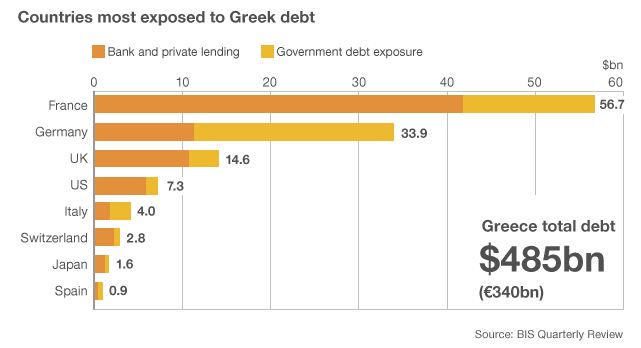
Naked Capitalism offers us this graph (originally from BBC, it seems):


The graph is consistent with the data published by the BIS months ago plus the first rescue package (that explains the large German public exposure) but hide the main exposed country: Greece itself.

It is not consistent however with the data provided by The Guardian, which states that the French exposure is of "only" € 9.4 billion, the German one of € 7.9 billion and the Greek one of € 45.9 billion. Other exposed states are the Netherlands and Belgium (together € 7.2 billion), Cyprus (as much as € 5.9 billion), the UK (€ 2.1 billion), Portugal (€ 1.3 billion) and Italy (€ 1.2 billion). This data seems to refer to exposure of private banks only but is still not coincident with the BBC figures above (total is "only" € 91.8 billion) . 

In any case, The Guardian's  data has the advantage of listing the allegedly most exposed banks:
  • NBG (Greece): € 19.4 billion
  • Agricultural Bank (Greece): € 10 billion
  • Piraeus (Greece): € 8.7 billion
  • EFG Eurobank (Greece): € 7.9 billion
  • Hellenic Postbank (Greece): € 5.4 billion
  • BNP Paribas (France): € 5.0 billion
  • Alpha Bank (Greece): € 4.6 billion
  • Dexia (Belgium): € 3.5 billion
  • Marfin Popular (Cyprus/Greece): € 2.9 billion
  • Komerzbank (Germany): € 2.9 billion
  • Societé Generále (France): € 2.5 billion
  • ING (Netherlands): € 2.4 billion
  • Bank of Cyprus: € 2.0 billion
  • Landesbank Baden (Germany): € 1.4 billion
  • Postbank (Germany): € 1.2 billion
  • DZ Bank (Germany): € 1.2 billion
  • BPCE (Germany): € 1.2 billion
  • Bank of Scotland (UK): € 1.1 billion

Who should exit the Eurozone?
Oddly enough a column at the conservative British newspaper The Telegraph suggests that it is not Greece who should exit but Germany. According to Edmund Conway:

Without Germany, the euro would obviously be a significantly weaker currency (particularly if Germany was joined by the Netherlands). But it would no longer be torn apart by the unhealthy dynamics that have haunted it in its first decade.

True, very true. However Germany would lose much of its internal competitive advantage within the EU and for that reason alone, Germany will not exit the euro, not even if the other states impose a more flexible monetary policy devaluing the currency. Germany is just too dependent on its sales to other EU states to allow itself losing such neocolonial markets. What they will do instead is to try to keep the euro policies as fascist as they have been so far, and that is what is causing all this havoc. 

So the Eurozone will unavoidably collapse because for Germany it is easier to let the neocolonies go away one by one, weakened by immense debt and social collapse, than allow them to take control of the European Union. Technically the southern states, specially if supported by France, could take complete control of the Union and force the hand of Germany but for that they would need to have compromised leaders who were not sold to foreign "investors", who really cared about their countries future. These do not seem to exist in most cases and that's why the peoples in all the southern European Union are so upset at their leaders and political systems.

Saturday, May 7, 2011

May 7 news

Europe


European Union: euro falls 2 cents in two days in relation with dollar.

Pushed by the threat of Greek default the European currency (euro, €) felt from $1.43 to $1.41. If this trend would continue (what I rather support, because I think the euro is highly overpriced, hindering European exports), it could reach parity with the US dollar in little more than a month (not likely but dreaming is for free).

Source: Naked Capitalism.

Related: Euronews report on Portuguese economic disaster, the shadow of Chinese imports looming before local bankrupt textile mills:


Basque Country: Many protest with noisy whistles the visit of Spanish Interior Minister, A. Pérez Rubalcaba, to Pamplona.

Image gallery and video at Ateak Ireki.


Basque Country: Bizkargi Eguna celebration forbidden, not since fascism.

The Bizkargi Eguna (Bizkargi Day) is a homage to Basque fighters that has been celebrated in Mt. Bizkargi, site of some of the bloodiest battles of the war of 1936-37. Back in the day, it used to be illegal and the fascist authorities sent the police to dissolve the marchers. This year, by decree of the Spanish Inquisition (Audiencia Nacional) it has been declared illegal again.

Source: Larrabetzutik.org[es].


West Asia

Yemen: Youth movement calls for Saudi Arabia and USA to stop meddling

In their own words:

We call on the leaders of the Gulf Co-operation Council to stop any initiatives that result in alienating the Yemeni people. We call on the United States, the European Union and the permanent Security Council members to assume their moral responsibility and stop ... meddling directed against the will of the Yemeni people to ensure freedom and democracy.

Source: Al Jazeera (includes video).

Related: video of recent protests in Yemen (from Protestation.org):


Syria: Government tanks enter Baniyas 

After bloodily quelling uprising in Deraa, tanks and gunboats are allegedly shooting against civilian areas under the pretext of fighting against Salafism.

Source: Al Jazeera.

Related: video of recent protests in Damascus (from Protestation.org):


Arab Spring reaches Palestine

Obviously because of the militarization and apartheid in Palestine the situation won't be like any other country in the region but it is also clear that the revolutionary process can't but end up reaching by.

And in fact that is what is happening, the recent unity agreement by Hamas and Fatah being just one aspect of this new drive. But Palestinian Youths are overwhelming these two old political forces and forming their own boundless movement.

More on this story at Al Jazeera.

On the privileged side of the wall of shame, Jews sans frontieres report today how the establishment of the racist Jewish state is extremely worried about the BDSM (Boycott, Disinvestment and Sanctions Movement) and the growing pressure it will unavoidably put on Israel until the apartheid is finally dismantled.


America

Guerrero, Mexico: Gay activist stoned to death in Chilipacingo

Quetzacoatl Leijia Herrera, prominent speaker of the local CEPRODEHI institute, was murdered by unknown aggressors near the Palace of Congress, where the first Mexican Congress met in 1813. Forsenic analysis allowed to know that he had been killed by several stone blows to his head.

Source: Sare Antifaxista[es].


Honduras: violent police repression against popular demonstration

More arrested as police repress protests at San Pedro Sula against the Honduras is open for business campaign, that offers almost slave labor, the possibility of destroying the environment without punishment and virtually no taxes for foreign investors.

At least the following people have been arrested: Wendy Aguilar, Simey Flores, Ian Díaz, Jaime Martínez, Apdi Baquedano, María Leocadia Hernández, Yovana Isidora Cabrera y José Alexis Gómez (minor).

Source: LINYM[es], Honduras a la Venta.

See also: yesterday's entry in this blog.


USA: Environmental Protection Agency (EPA) to take no more radiation measures

EPA leaves the super-power intentionally blind as more and more radiation arrives from Japan. It would seem that, being invisible, if nobody measures radiation then there is no radiation problem.

Source: Washington's Blog.

Tuesday, March 15, 2011

Ireland threatens default

The new Irish minister of European Affairs, Lucinda Creighton, has hinted that unless Brussels helps to make the debt burden bearable for the Irish people, the Republic may default. 

This is one of those cases where owing a lot is "beneficial" for the borrower because surely Greece or Portugal, with much smaller foreign debts than Ireland, do not hold any similarly strong bargaining position. Ireland owes (to German and British banks mostly) almost as much as Spain, even if it is 10 times smaller in terms of population and almost the same proportion by GDP, what is really a big problem but not only for the Irish (after all, the indebted banks were mostly foreign-owned).

While a conjectural collapse in Spain would cause much more damage to the European real economy (as this is described, even if only approximately, by GDP) than a collapse in Ireland, a default by Ireland would be quite as bad for EU finances (virtual economy) as a hypothetical default by Spain. 

Of course, the creditor states may want to send the thugs (a military intervention of some sort) but that's not any realistic option, as it would only make things worse. It's no doubt a lot cheaper to devalue the euro and to allow the ECB to directly lend to the states, so they can maneuver with greater flexibility than they have now under the stringent euro policies.

However, as some commenters at the ultimate source of this news for me, Naked Capitalism, say, the ultra-low Irish tax policies are perceived by other EU states as dumping and certainly not helping at all to pay off the debt. It is not easy to demand comprehension when you are not even taxing business properly.

But it is clear that Ireland did not need to assume the private debts of toxic banks (it should have never done that: if you nationalize a toxic company, do always after bankruptcy is declared, not before, so creditors have to put up with their willfully assumed risks and not the public) and that therefore the EU should be offering credit to the Republic at the same rate that it does to private banks (i.e. near 0%) and not at an abusive 5% rate, which is a total scandal.

Thursday, October 28, 2010

Germany's ivory tower

It seems that Germany is drifting apart from the rest of EU.

Highly privileged in the euro currency system (that essentially means the adoption of the former Deutsche mark by all other members), Germany now calls for a greater neocolonialism inside EU: chancellor Merkel proposed yesterday that countries unable to meet the draconian budgetary constraints imposed by the Eurozone system are denied the right of vote. For that she demanded that the Treaty of Lisbon (already implemented against the will or the people) is reformed.

This is a no-no, it seems, as even the EC president Joao Barroso, has said it is unacceptable.

Another German proposal is to create a mechanism for the orderly bankruptcy of a member state, mechanism that would be participated not just by the states but also by the private banks.

In my opinion, it would be a lot simpler to put the European Central Bank (and the Commission) under direct supervision from the European Parliament. This would allow for careful manipulation of the common currency in accordance not just to the selfish colonialist needs of Germany but of the 25 members.

A clear conflict of interests exists between the German desire for a strong euro and the general EU need of a weaker currency, able to compete with China and the USA. This should be solved in favor of the majority needs of EU citizens and not just of German corporations. I don't see why German "needs" are more important than, say, Greek ones.

Source: Gara[es]