The repressed and censored Basque counter-information site Ateak Ireki (Open the Doors) is still available for those connecting from outside the Spanish legal prison of peoples and therefore I still get uncensored feeds even if I can't directly contact with the site. I can also reach to their YouTube account without problems.
Today they publish an interview with Diego Cañamero, leader of the combative Andalusian Workers Union (SAT), which has promoted supermarket and land expropriations in order to highlight the extreme social injustice that the Capitalist system provokes in Andalusia. Therefore he has dozens of legal cases open against him, as happens with many other activists of this union and sympathizers, but has declared himself total resister against trials, ignoring citations. He explains that he has been repressed with every single government, so let them do whatever they will.
Partly in an attempt to overcome neo-fascist censorship, I am translating below the text surrounding the video but I cannot translate the video-interview itself, which is in Spanish language.
[Video] Diego Cañamero (SAT): "We are legitimate to throw down governments who do not fulfill their word".
The speaker of the Andalusian Workers Union announces that they are preparing a great march to Madrid, to be participated by unions and social movements from all the state, including its nationalities.
Ateak Ireki has used the visit of Diego Cañamero to Iruñea [Pamplona] to speak in length with him on the economic, political and social situation in the State of Spain.
Cañamero assures that the land is "not any merchandise" but a good that must be "at the service of all human beings".
After recalling that he has been arrested in the dictatorship and under all and each governments of "democracy", he states that "the repression against the people who struggles has not changed" but that, nevertheless, this repression "never could defeat the justice of the peoples".
In this sense, the speaker of the Andalusian Workers Union underlines that "a society which does not rebel against injustice is accomplice" of it and that, right now, "unity is the great challenge of the transformer left".
He reminds also that "people have not authorized with their vote the delay of retirement age, that [public] money is given to banks, that the baby check is removed, nor that public workers lose their extra pay nor that pensions get reduced", reason why he considers that "the people is legitimate to depose governments" who do not fulfill their word.
In this line, he announces that they are preparing with unions and social movements "large marching columns to collapse Madrid".
A year ago I commented with satisfaction that the Andalusian Parliament had approved a law that would allow expropriation of empty homes in order to guarantee the fundamental right to a dignified home, established in the Spanish Constitution.
By this basic law of the Kingdom of Spain, the right to a home, as well as to a job, are fundamental rights, well above the accessory right to private property. Until now the main formal argument against tribunals upholding such fundamental rights was that they were not regulated by the state and therefore there was a legal vacuum.
So what happens when the Andalusian institutions in full use of their legislating capabilities do regulate these rights as clearly intended by the letter and spirit of the Spanish Constitution of 1978? That the ultra-conservative Constitutional Court declares that hyper-constitutional law "possibly unconstitutional".
It is not yet a firm sentence but just a procedural suspension for five months but the fact that the high court even dares to consider debatable the Madrid and Brussels claim of the right to property being above the right to a home, in clear contradiction with the letter and spirit of the Constitution, is a clear signal that, exactly as it has been for the last many decades, the Spanish Constitution is only worth as toilet paper.
The Constitutional Court is clearly underlining this well known fact: there's no constitution, just banks.
Diego Cañamero, leader of the militant Andalusian Workers Union (SAT) was arrested yesterday after he rejected to pay homage to bourgeois injustice by not going to court to declare on the workers struggle for the collectivization of Las Turquillas ranch, owned by the Spanish military.
Plain clothes policemen arrested him at the Worker Center of El Coronil, where he and dozens of supporters were awaiting the announced arrest.
The demand of collectivization of farmlands in Andalusia is a popular struggle that comes from old, as most of the land belongs to aristocrats who were assigned it by the Medieval dictatorships. The workers want to collectivize the right of use of those lands (property means nothing) in order to tackle the massive chronic unemployment, which reaches 40% in many districts.
In the words of Cañamero himself:
We do not want the property of the land, we want its use.
...
It can't be that the lands public or private are kept aside from a people that does not know anymore what to do with unemployment. We want to demonstrate that, in the hands of cooperatives, the ranch will have another use, oriented to the creation of jobs and to extract productivity from the land and not just from EU subsidies.
Some more info is showing up on the arrests of several anarchists in Catalonia and other Iberian localities. The arrested are accused of being the administrators of a Facebook group known as Kolektivo Bandera Negra (Black Flag Kollektivity), which was used for counter-information and anarchist propaganda.
The relationship between the arrested and the Ateneu Llibertari of Sabadell was at best accidental (one of their members may have gone a few times to this social center), what was no problem for police to raid the Ateneu mercilessly and take all the documentation in it, including hard disks and such.
There were also police raids in Málaga (Andalusia), Zaragoza (Aragon) and Avinyó (Catalonia). So far there is no known evidence of any "terrorist" link, in spite of wild bourgeois media speculations.
In a single day, with this and other operatives (against Basque Independentists, striking teachers in Aragon and even a Venezuelan PSUV activist arrested after a conference in Valencia), 21 people were arrested for crimes of political opinion in the Kingdom of Spain.
Update: the Grupo Bandera Negra (Black Flag Group) of Madrid denies any link with the arrested but shows its solidarity with them and especially with the Ateneu Llibertari of Sabadell → Juventudes Libertarias de Madrid[es].
The nameless occupied social center of San Bernardo Street 42, Seville, was attacked last night resulting in massive destruction, notably of the library. While there is no direct evidence of the attackers as of now, all suspicions fall on a fascist gang under the name Resistencia Estudiantil (Student Resistance) which is well known in the Betic city for its continuous provocations.
Hundreds of workers organized around the Andalusian Workers' Union (SAT) continue in their attempt to occupy and collectivize the ranch Las Turquillas, legal "property" of the Ministry of Defense of Castile-Spain, state that occupies the Andalusian territory since centuries ago in colonial and late feudal style.
The military police corps Guardia Civil threatened to charge with all and without mercy if they continued in their first attempt today. Therefore the workers attempted to proceed by other areas less protected but without success because they were trying to avoid direct confrontation with the police and military forces, which have helicopters and mounted forces.
Years ago the now ruling party PP (conservatives nearing outright fascism) demanded from the government of the time (PSOE, blairites) to cede the unused military land to the municipality of Osuna in order to create jobs. As soon as they reached power they "forgot" about their demands.
Some 500 workers occupied yesterday the parcel known as Las Turquillas, owned by the Spanish Ministry of Defense. Police evicted them at night but the workers have decided to keep pressure at the gate of said farmland.
The direct action has been organized by the Union of Andalusian Workers (SAT) and the 'Critical Bloc' (coalition of many organizations against "austerity").
The same organizations mustered thousands of workers yesterday in Seville and Granada. In Jaén, some 400 union members attempted to occupy the ranch La Rueda but were blocked by police forces. In Lebrija some 100 workers also marched to the ranch Lebrojo.
According to the new regional law, to go through routine parliament procedure in the following weeks, companies like banks or real state speculators which keep empty homes will have to pay large fines, up to €9000 per empty home. More than 700,000 homes are unoccupied in Andalusia, most of which belong to banks and similarly parasitic companies which speculate with the basic needs of the people.
The Andalusian government could even temporarily expropriate homes under foreclosure threat in order to guarantee their residents continuity of their housing rights (yes, the right to a decent home is a "fundamental right" according to the Spanish Constitution, although this is almost never applied by courts nor legislators).
Borroka Garaia da! (It's time of struggle!) reports today[es] that a worker from Basauri, just a few kilometers from where I live, took his life at the age of 56 under the threat of eviction from his home and after electricity and water supply had been cut to him. He had contacted Stop Evictions! but never arrived to the office.
Update on the death of José Lema Bretón (Córdoba, Andalusia)
The article at Borroka Garaia da! however deals mostly with the better documented case of the Andalusian construction worker, José Francisco Lema Bretón, who, quite ironically, had built his home himself (but had to ask for a loan because a work accident left him handicapped for a whole year). José was active in the Stop Evictions! association that offers assessment to victims of the mortgages' usurary deadly scam and sometimes also organizes nonviolent resistance actions against evictions. After years of struggling, in a desperate attempt he cut his own throat before the bank that squeezed him and his family (his parents are also under threat). That time he did not die... but the bank, Kutxabank-Cajasur, continued his murderous activity until they got their corpse (previously reported here).
Here there is the video-testimony of this victim, one of many, before the fatal blow (in Spanish):
There are many ways to kill. One can stab a
knife in your guts, take away your bread, deprive you of a cure for
your illness, put you in a miserable housing, torture you to death with
work, take you to war, etc.
Only a few of these are prohibited in our country.
An Andalusian citizen killed himself in Cordoba after getting an eviction notice. The exact circumstances are unknown to me at the moment but the Spanish mortgage law, which overprotects Capitalist interests to limits not reached in any other advanced state (or any other country I know of), allowing the mortgage debt to persist even after foreclosure, is surely to blame in part. Beyond it, the inability of the Capitalist socio-economic and political regime to provide citizens with their basic human needs (a dignified job, a decent home, health care, etc.) is clearly the murderer because, as Brecht famously wrote:
There are many ways to kill. One can stab a knife in your guts, take away your bread, deprive you of a cure for your illness, put you in a miserable housing, torture you to death with work, take you to war, etc.
Only a few of these are prohibited in our country.
The Platform Against Evictions has called for a demo in Pamplona (Navarre, Basque Country) for February 16th in solidarity and in demand that the Spanish mortgage law is abolished for good and the remaining debt is condoned retroactively for all its victims.
Update: the name of the victim is José Lema Bretón, a member of the Stop Evictions! platform. The name of the culprits is Kutxabank-Cajasur and the Bourgeois Regime in general.
José killed himself jumping from a 4th floor after receiving notification for his eviction. Months earlier he had given back the home to the bank in payment but he was actually required to pay €22,000 even after losing all.
A protest was held today before the Kutxabank see in Bilbao.
Source: Bilboko Branka[es] (incl. video of the protest).
Ex-SKF calls my attention today to the last spat of bonzo-style suicides in Spain and other European countries.
Last ones have been in Málaga (Andalusia), where a 57 year-old man of Moroccan origin who was homeless and did not even have anything to eat set himself alight and died later at hospital (→ El País in English). Another person, 67, also set himself alight with his last possession, a car, under a bridge also in Málaga. He survived (→BBC).
Previously, in October, a German (→ Zero Hedge) and then a Romanian resident in Italy (→ Zero Hedge) set themselves alight before the Bundestag of Berlin and the Presidential Palace of Rome respectively.
The Italian immolation
I have already commented of other suicides caused by economic desperation in the State of Spain and Greece in this blog, although they are clearly only the tip of the iceberg. Most just don't make it to the news, even if locally.
The situation is very bad and growing worse by the moment.
In the same article Laprimavera, the author of Ex-SKF blog, also mentions this article at Zero Hedge, which explains how the State of Spain has been lowering its credit ratings by using up to 90% of our Social Security fund (paid in advance by workers and employers) into bonds, bonds that may well default some day not too far into the future (let's get real).
Meanwhile the military budget has been risen by 11%, thousands of new jobs as police agent have been created and the subsidies to the Catholic Church and their huge network of public funded private schools remains untouched.
They kill us, they pee on our corpses and they laugh while raping a child under an icon of a crucified man of times long gone, drinking champagne and eating caviar. That's the reality in Europe right now.
Polity of Spain: Major impact of the general strike, at least 80 citizens arrested and several injured.
A deaf Congress passed an ultra-capitalist budget full of cuts and austerity for the poor but no effects for the rich and their mercenaries (police, military). While Spaniards fall into pits of misery, the Spanish army waste their money in Afghanistan, for example.
Today's struggle should continue in Madrid until late in the night as yet another attempt to surround Congress has been called for this evening.
More than 80 people arrested only by noon (many injured also) in a general strike that was a massive success of 80% or a massive failure of just 5% depending who you lend credit to.
A rather reliable source, Economists Against the Crisis[es], estimated that the electrical consumption that can be attributed to productive activities was down c. 60% (with minor variations 58-64% depending on the hour). So at least 60% following is a quite scientific estimate (notice however that compulsory minimal services, very important in transport and other public services, are not discounted here).
I can assure you that 5% or even 10%, as many have claimed is an insult to intelligence and only shows the kind of shameless liars those sources and journalists are. Galicia was 100% closed by all accounts and this country alone makes up some 7% of the population of the state. And they were not the only ones, of course.
Full detailed following of the events can be found at Kaos or La Haine, for example, but in Spanish language (also at Agència 29 in Catalan). So I will try to synthesize here some of the most important news and data.
General:
90% of mail workers walked out.
Many trials could not proceed, including some high profile ones, because attorneys or other personnel did not show up.
30 deputies (United Left, Amaiur, ERC, PSC...) decided not to take part in the debates and votes in Congress in solidarity with the general strike.
Massive participation in demos around the state (Madrid, Barcelona, Seville, Málaga, Valencia, Zaragoza, Granaza, Córdoba, A Coruña, Vigo, Cádiz, Murcia, and a long etcetera).
Core Spain (Neo-Castile):
Mercamadrid empty tonight
Madrid:
Unified anarchist and communist pickets forced closure of taverns since midnight (police retreated after an initial confrontation).
Mercamadrid 100% closed. Trucks enter but are not allowed to load or unload.
Iveco (trucks factory) 100% closed.
Telemadrid regional TV station could not broadcast at all. Ironically, some of its most fascist opinion commenters had already recorded their baseless proclamations about the failure of the strike.
15 arrested already before 5:30 am in clashes between police mercenaries and popular pickets (only 8 in the rest of the state). At least two injured.
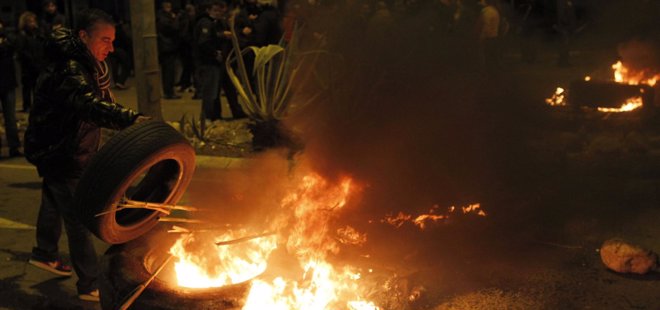
Streets cut all night by fire barricades in the popular neighborhood of Vallecas.
Actors occupied a centric theater for the day. Many artists also took part in the protests including oscarized director Pedro Almodóvar.
Evening "surround the Congress" protest charged by police before 20:00.
Police harassed pickets, injuring some (first injured by police violence in Xixon). Buses could not leave the hangar. Fire barricades in the harbor.
Trash collecting service blocked tonight in Uvieu (Oviedo).
The industrial and port city of Avilés reports all closed.
Bank offices and commercial centers closed by pickets.
Major road cuts in the miner districts, which report all closed (Mieres, Langreo, etc.)
Anticapitalist unions (CSI, CNT, CGT and SUATEA) complain that the mainstream yellow unions (CC.OO. and UGT) try to steal their demo by calling themselves with the same time
Cantabria: 90% stopped in the industrial night turn. Among the industries stopped are: Global Steel Wire, Saint Gobain Canalización, Draka, Trenzas y Cables (TYCSA) and Gamesa.
Zaragoza:
General Motors, Jonson Controls Alagón, Valeo Térmico, Exide, Tata Hispano Carrocera, Android Industries, Ronal Ibérica, Arcelor Mittal and Ti Group 100% stopped, among others. BSH-Balay, Lear, Mann Hummel, Ronal Ibérica, Johnson Controls and HP more than 80% workers walked out.
Large picket of 2000 closed bank offices. Two arrested.
At least two faculties closed. Clashes between pickets and private security mercenaries.
Some 10,000 people in the morning demo.
Huesca: Three arrested in the bike-picket.
Seville: Canal Sur could not broadcast at all.
Several regional TV stations were completely stopped
Córdoba
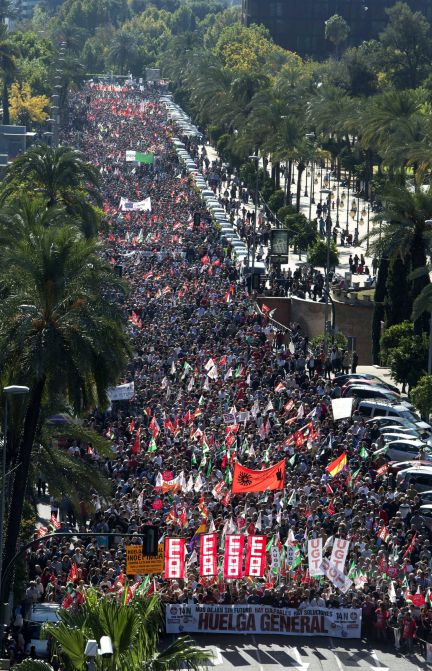
Córdoba: Some 45,000 people in the morning march.
Cádiz: A large demo of some 25,000 people heavily pressed by police.
Puerto Real: Airbus factory 100% stopped.
Granada:
A Mercadona supermarket was expropriated.
Several arrested in Pinos Puente.
More than 70,000 people in the evening demo (the city has just 237,000 inhabitants, what means that one of every three Granadinos (30%) was there).
Extremadura: major companies nearly completely stopped in the night turn at least.
Murcia: Violent clashes between a very intolerant police force, who attacked every picket on sight. People arrested for helping an injured victim of police brutality. Very large demo in spite of all.
Salamanca: Some 6000 people in the demo of the CNT alone. Major commercial center closed.
Toledo: a car went over two members of a picket at the entrance to the Arms Factory.
Ceuta: Nearly all closed. Large demo for the size of the sleepy colonial enclave, heavily affected by uneployment.
Catalan Countries:
Catalonia:
Barricades impeded any activity in Mercabarna (central fresh food distribution market) since 3:00 am.
SEAT and Nissan factories (cars) 100% closed.
TV3 completely blocked from broadcasting.
University's Biology Faculty occupied since the day before. An infiltrated police agent was kicked out causing massive police deployment in the surroundings.
Road and railroad cuts widespread at dawn in and around Barcelona.
A Consum supermarket expropriated by a feminist picket.
Huge "tide" of people reported at the afternoon demo in Barcelona.
At least 100,000 people in the alternative demo in Barcelona, the one called by the anticapitalist unions and social movements.
Mataró dawned with not a single petrol station working.
Tarragona: chemical industry area was totally stopped, as well as Pirelli (wheels), Mercadona logistic facilities, Codorniú (wines), Puleva (major food industry) and Makro. 30,000 marched in the afternoon.
(Update) Barcelona gathered such brutally high numbers of protesters that they can compare with the recent independentist demos (of one and 1.5 million) or seem to overshadow the huge figures seen in the last years in Cairo or Athens:
One of the most commented incidents is the police brutality against a young boy aged 13 and those people who protected him or protested the charge, as can be seen in this video:
Pickets could only delay the activity of Mercavalencia.
100% closed: Ford, buses and railroads (save minimal services), RTVV (regional TV, aka Canal 9), harbors. More than 80% closed: industry in general, university, mail. More than 50% closed: distribution, health, education, administration, justice.
Industry in general: 80% closed, distribution: 70%,
Very repressive environment, with police attacking almost everyone active on the strike. At least on journalist injured by police.
Violent clashes and barricades therefore.
At least 22 arrested and two injured by 16:00.
Majorca: several arrested in Palma at least.
Galicia:
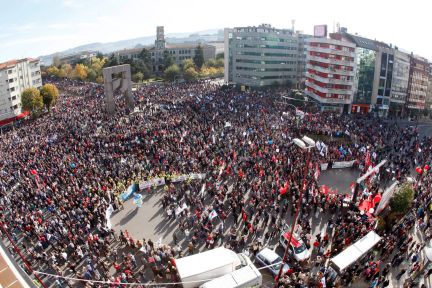
All closed everywhere according to even the less sympathetic media reports. At least 100,000 demonstrators in A Coruña. Four arrested in the protest.
Among other industries General Dynamics, Navantia and Arcelor-Mittal closed 100%.
Vigo demo
At least 8 people arrested in this country.
Estimated in 500,000 the number of demonstrators in all Galicia (with 2.8 million inhabitants, that is almost 20% of the citizenry marching against austerity just today).
Basque Country:
Majority unions (Basque nationalist ones) did not call for this strike, what caused irregular following with most people just ignoring the call the occasional heated argument with the Spanish nationalist pickets.
But anyhow...
In Navarre, where there was maybe some more support but mostly independent from the mainstream Spanish nationalist yellow unions:
Volkswagen 100% closed.
Pickets of the radical left unions ESK, CNT, CGT and Solidari in Pamplona today, emphasizing banks and the murder-suicides that their financial terrorism is causing:
From Ateak Ireki.
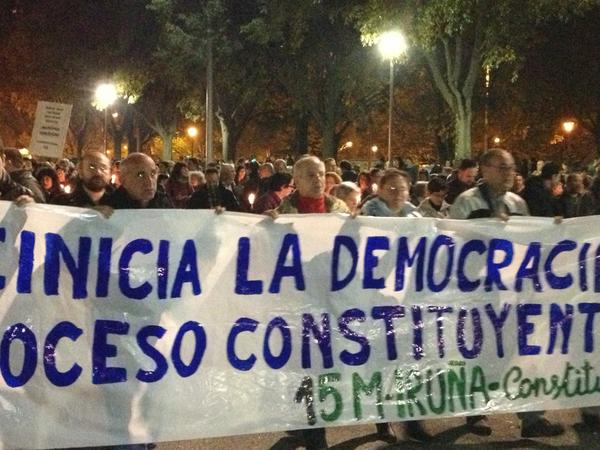
Demo in Iruñea (Pamplona):
Source: Ateak Ireki.
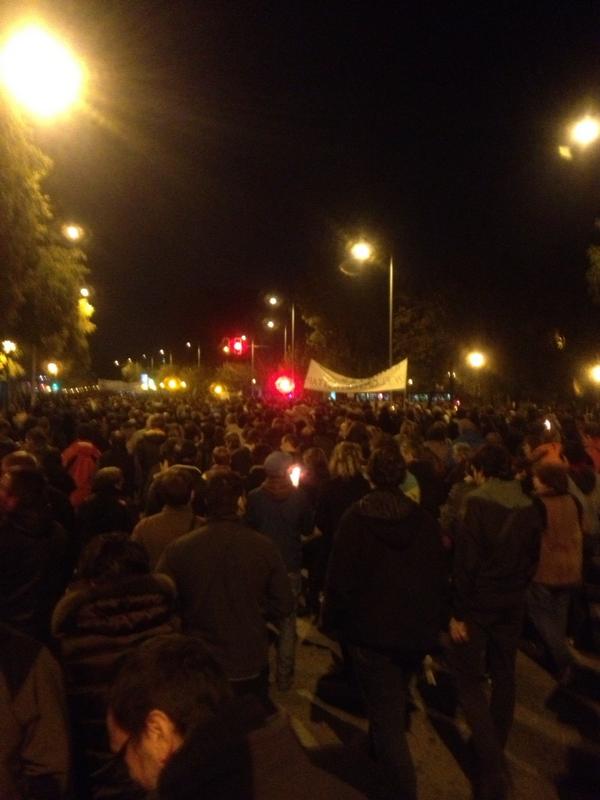
Huge alternative demo in the evening in Pamplona as well:
There were also protests in Baiona, in the Northern Basque Country:
Portugal:
The other major center of class struggle today was Portugal, where also a full fledged general strike was called.
I don't have much info as of now on Portugal but it seems that the following has also been massive, nearing 100%.
Police has brutally charged against the demo in Lisbon with ambulances coming and going for more injured. The aggressiveness of the mercenaries of the bourgeois oligarchy can easily be inferred by the fact that not less than three journalists have been injured, so imagine among commoners!
General strikes are illegal in Germany (German laws are very fascist in general, a legacy of the Cold War, when Germany and Japan were established by NATO as model states at the ideological and physical "front" with the Socialist bloc, recycling to some extent at least the fascist cadres of the previous decades).
However demonstrations have been reported at least in Berlin.
Capitalism kills and the two suicides of the last days in Andalusia and the Valencian Country, just before foreclosure was enforced, are just the tip of the iceberg:
Miguel Ángel Domingo, 53, was found dead by hanging yesterday at his home of Granada. Police confirmed that the eviction of his home was scheduled to take place in the next few days.
Also yesterday Manuel G. B., also 53 y.o., answered the bell at his home of Burjassot, Valencian Country, and, finding out it was the judiciary agent with order of eviction, kissed his son, 23, on the cheek and jumped out the balcony, dying hours later at hospital.
In Spain, even if you lose your home to foreclosure proceedings, you remain indebted for life to the banksters.
Update: a third man, this one younger, killed himself on Tuesday in Tenerife (Canary Islands) by jumping from a bridge as he lost job, girlfriend and home (foreclosured) all in a row.
This is a re-post (with very minor corrections) of an entry that I wrote in 2008 and which I believe should be of some interest in order to understand the ethnic conflicts that shatter the never consolidated Spanish state.
It is a very interesting question to make. After all, it is a country divided along ethnic lines, which one could well argue that never finished its unification process, where the periphery, particularly Basques and Catalans, often feel oppressed by an ethnic Castilian/Spanish rule.
But, in theory, all Spanish citizens are equal. And that has been largely the case since 1715, when the new Bourbon monarch supressed the self-rule of the realms of the Crown of Aragon, after the War of Spanish Succession. While it is often argued by Spanish historians that Spain was founded in the late 15th century, the reality is that it was only formed as a unitarian state (with the Basque exception) with this first Bourbon monarch, Philp V, more than 200 years later, after the other European posessions of the crown were lost (mostly to Austria).
I have been checking the origins (place of birth and/or where the family was estabilished) of all Prime Ministers (and the few non-monarchical chiefs of state) of Spain since this Philip V, founder of Spain as we know it (and also first to estabilish the charge of Secretary of State, that would later become Prime Minister - or "President of the Goverment", as the office is nowadays officially known in Spain). Skipping the interim ones and those who ruled less for than a full month (most of which are hard to find out about their origins, as they are widely unknown) , they make a total of 115, of which 95 can be safely known their origins and these were within modern Spain.
But before jumping to conclussions, let's define (admittedly with some arbitrariety) which are the ethnicities of Spain. I avoided to use the 15 (and two colonial bits of Morocco) modern Autonomous communities as such. It could have been a criteria but really many of those communities are just but capricious subdivisions of Castile with little or no distinct personality. Instead, I followed a more historical approach:
Iberian Peninsula 1212-1492
Above you can see the Iberian peninsula (then known as Spain) as it used to be in the 13th, 14th and 15th centuries. Then (and later on with the Habsburg dynasty) Castile was a unitarian kingdom, divided in provinces (in some cases called "kingdoms" because of historical reasons but with no autonomy) but Aragon was instead a federative crown formed (in Iberia) of four realms: Aragon, Catalonia, Valencia and Mallorca (Balearic Islands). Additionally (we will ignore Portugal here) there was Navarre and the three western Basque provinces that, even if annexed to Castile, were almost totally autonomous.
The Spanish constitution of 1978 recognizes four "historical nationalities": Basque Country, Catalonia, Galicia and Andalusia. The first two had autonomy historically but the latter two did not: Galicia is the "Portuguese speaking" (ok, ok, "Galician-speaking" but it's the same) part of the kingdom of Castile and, well, Andalusia... they have a strong accent and once were Muslims. In fact there was some controversy on wether Andalusia was a "nationality" but I will admit that they have their peculairities. So excepting Galicia and Andalusia, as well as the Basque Country, I will consider all the historical Kingdom of Castile (or Castile and Leon) as a single ethnical unity: Castile. I will also consider apart the Canary Islands because they are, in my opinion, more of a historical nationality than Andalusia and, as colonial posession, they definitively deserve a place apart.
I will also consider separate ethnicities here the four realms of the crown of Aragon (now each a separate autonomous community) and the Basque Country (Navarre included).
Official autonomous communities of the Kingdom of Spain (1983-2012)
Comparing with the official administrative division active for the last few decades, then I will consider the following ethnicities:
Galician: Galicia
Andalusian: Andalusia
Catalan: Catalonia
Aragonese: Aragon
Valencian: Valencian Community
Balear: Balearic Islands
Basque: A.C. of the Basque Country and F.C. of Navarre
Castilian: Asturias, Cantabria, Castile-Leon, La Rioja, Madrid, Extremadura, Castile-La Mancha and Murcia
I know it's arguable but it's also quite reasonable.
So where are the 115 historical Spanish prime ministers from? Voilá:
47 Castilian
26 Andalusian
7 Galicians [plus M. Rajoy, not yet in power when the article was first written]
4 Valencians
3 Basque
3 Catalans
2 Aragonese
2 Balearic
1 Canarian
6 from other European origins (mostly in the 18th century: 2 Italians, 2 French, 1 English and 1 Irish)
6 from former colonies (mostly in the 19th century: 2 from Argentina, 2 from Cuba, 1 from Mexico and 1 from the Philippines)
8 - I could not locate their origins with certainty
So there are 20 PMs that are useless for our purpose (foreigners, creole Spaniards or of unknown origin). But we can still consider the remaining 95.
The first element that strikes is that 73 prime ministers (76.8% of all) are either Castilian or Andalusian, while only three are Catalans (and two of them were presidents of the First Republic). There are only three Basques too but Basques are quite less in number than Catalans. Without even getting into figures yet, I know that Catalonia can be compared with Andalusia by population, and the Basque Country with Galicia. And it is quite striking that the Andalusian PMs are almost nine times the Catalan ones.
But let's compare data: population vs. number of Prime Ministers. We can get a discrimination ratio (positive or negative) from those figures.
Castile (as defined above) has 14.9 million people, 33.5% of the Spanish total, but it has 49.5% of the historical rulers. It has an excess (possitive discrimination ratio) of +48%.
Andalusia has 7.84 million inhabitants, 17.9% of Spanish citizens... but it had 27.4% of the prime ministers. It has a discrimination ratio of +53%.
Catalonia has 7.00 million people, 15.9% of Spain's total but only 3.16% of the historical rulers. Its discrimination ratio is -80%. Would it not have been for the failed First Republic, it would have been much worse.
Valencia has 4.69 million people, 10.6% of the total but only 4.21% of historical PMs. Its discrimination ratio is -60%.
Galicia has 2.76 million people, 6.3% of the total and 7.37% of historical rulers. Its discrimination ratio is +17%.
The Southern Basque Country has 2.72 million people, 6.2% of Spain, but only 3.16% of the historical rulers. Its discrimination ratio is of -49%.
The Canary Islands have 1.97 million people, 4.5% of Spain, but only 1.05% of the historical rulers (one). Their discrimination ratio is almost as bad as that of Catalonia: -77%.
Aragon has 1.27 million people, 2.9% of Spaniards, and had 2.11% of rulers. Its discrimination ratio is -28%.
The Balearic Islands have 980,000 inhabitants, 2.2% of Spanish citizens, and had 2.11% of PMs. Its discrimination ratio is nearly null (in spite of being Catalan speakers): -4%.
From these figures we can see that there are the following categories:
1. Most favored ethnicities: Andalusians and Castilians
2. Almost neutrally treated ethnicities: Galicians, Balears and Aragonese
3. Clearly discriminated ethnicities: Catalans, Canarians, Valencians and Basques
Maybe Catalans and Basques have the biggest share of economic power (as from the gross internal product of these countries) but when it comes to political power, they are among the most discriminated against ethnicities of Spain, together with Valencians (largely Catalan-speakers) and Canarians (the first and last overseas colony). Castilians (Andalusians included) rule the country clearly.
Raw data and maps from Wikipedia (English and Spanish language versions).
In Madrid thousands went out to reject cuts in the social budget and the destruction of workers' rights, in Dos Hermanas, Andalusia, a German supermarket (Lidl) was occupied, within the context of the Worker March, promoted by the Andalusian Nationalist Left union (SAT).
Capitalists cheer EU's fascist impositions and demand faster bail out to be paid by the workers
Meanwhile the Spanish capitalist syndicate (CEOE) demanded that the European "bail out" to Spain happens already. Because they want the pretext to apply even more class violence against the working class within the administrative boundaries of the Spanish realm.
The extremist declarations[es] today of the vice president of the Spanish capitalist syndicate Arturo Fernández, demanding that Madrid begs for the European bailout as soon as possible and does not wait anymore, evidence who is directing all this operation of reorganizing public expenditure from minimal social welfare to the banks and corporations with the pretext of a crisis that not for being anymore real excuses all the class aggressions at all.
While the Spanish conservatives in power would seem to prefer to wait until November, after the Basque and Galician elections leave them without any more predictable electoral commitments for some years, the great bourgeoises are in a hurry to make sure that they can squeeze even more their workers and that they get more subsidies and tax benefits instead of the poor.
But for the workers it would be much better that the state declares bankruptcy (not that it's necessary: there's a lot to cut in military and police spending yet) that to be sacrificed to the moloch of the eternally growing debt, like Haiti was 200 years ago by a merciless France.
The debt of Spain, not counting the Bankia scam, is not too high so it's still time to drop the banks, cut in NATO and move on, restoring investment in solar energy, research, etc. Not that they will do it, but it's the most reasonable option from the viewpoint of society as a whole.
The mismanagement of this crisis by the reactionary right will push the country to an implosion that can only culminate in a revolution, exactly as in Greece and Italy and maybe other European states in due time. For that reason the government is protecting the colonels and generals who, against the law, are making fascist proclamations and rattling sabers.
Sabers that today are ultimately powerless however.
As you may know the Banco Bilbao Vizcaya Argentaria (BBVA) is the largest Basque bank and second largest one of the Spanish realm. Its offices in the Andalusian town of Utrera have been occupied today, as part of the mobilization and disobedience campaign that is the Worker March promoted by the Andalusian Workers' Union (SAT).
The nonviolent action, which mustered the comprehension and even support of bank workers and customers, took place simultaneously with the daily press release. This time police abstained from using violence in the eviction and nobody was arrested.
In previous days other bank offices or corporate sees have been occupied as well: Zara-Inditex in Granada a few days ago or that of Banesto yesterday in Málaga.
The march journey concluded at Los Palacios, whose mayor joined the protest before La Caixa, another big bankster, which has abused small savers with the scam of the "preferential stock", which was sold as equivalent to a long-term account, abusing the naivety of the people.
The Andalusian Worker March continues with its string of nonviolent actions against the injustices of Capitalism. Today twelve activists occupied a bank office of Banesto in Casabermeja, remaining inside for 45 minutes. Police arrested them eventually.
The March, under the slogan Andalusia standing!, is closely watched by a massive police deployment, however they seem unable to impede their actions, which often happen at the sidelines of the march itself.
Communist MP Alberto Garzón protested the arrests denouncing in Twitter that the true white collar criminals are never arrested.
Student unions of several nations under the boot of the Spanish state have called for a day of struggle on October 11th. These are unions from the Basque Country, Galicia, Catalonia, Andalusia, Castile, Asturias, Aragon and Cantabria. Among their claims is that each nation has the right to decide on their own education programs and methods and that the only way to achieve that is with full sovereignty (versus the Spanish imperialist centralist imposition).
At least in Catalonia, Basque Country and Galicia the journey will be one of student strike.
In spite of the protests of the rotten paladins of private property and the stinky fascist right, the reality is that the symbolic but also real expropiations of supermarkets, occupations of banks and palaces and farmlands that is promoting the Andalusian Workers' Union (SAT) along with sympathizers in Andalusia, Extremadura and elsewhere, are being compared with Gandhi and Rosa Parks, who smashed the status quo with their active (never passive) disobedience and nonviolent uprising.
Then it was the colonialist imposition, the despicable apartheid... now it is private property itself. We are getting closer to the essence of the problem.
They began taking public lands for the landless peasants, expropriating food at supermarkets for the have-nothings, invading the palace of a member of the royal family and taking a refreshing bath at the swimming pool, symbolically occupying an office of La Caixa bank, and everyday marching under the merciless sun of August in Andalusia against the international debt, against foreclosures, against the impunity of banksters and the other robber barons, for the agrarian reform and very specially for a basic income for all.
Today they arrived to Cádiz, where tens of thousands went to the streets to welcome and share a moment with the people who are becoming the strange attractor of the Euro-chaos in the Southwestern corner of the subcontinental geography.
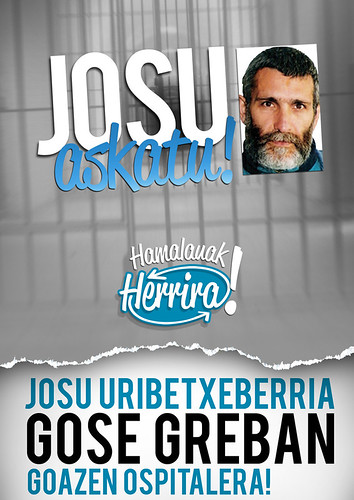
It has just been known that some 35 Basque political prisoners in Fresnes (men), Villefranche sur Sâone, Sevilla II and Castelló II, have initiated a hunger strike in solidarity with terminally ill Josu Uribetxeberria, also in hunger strike himself, whose humanitarian release we all demand immediately.
According to law and jurisprudence issued by the European Court of Human Rights, to which Spain is legally bound, Uribetxeberria should have been released years ago. While banksters like Rato and their fascist acolytes like Aguirre or Camps remain at large, wealthy and even holding the reigns of power in some cases, Basque freedom fighters are applied the death penalty with lengthy torture, no matter all the peace initiatives ETA takes or the ridiculous bowing to pay homage to Capitalist victims of ETA that some alleged Basque patriots are bowing to.
It is the world upside down. Enough: there's no such thing as a unilateral peace and there's no peace without dignity, that has a different name: slavery and genocide.
Groups of activists of the Andalusian Workers' Union (SAT) expropriated food (basic products) from supermarkets in Écija and Arcos de la Frontera in order to give it to the people, either by means of charities or town halls.
In the relevant entry at their site, the SAT, criticizes Andalusian President Mr. Griñán with the following words (my translation):
Banks, which have left more than 300,000 families without home by means of inhuman evictions which happen everyday, are bailed out; one million and a half Andalusians, many of whom do not have any benefit, are left without a job; VAT (sales tax) is risen at the same time that an amnesty for tax evaders is decreed; billions of euros of public money, belonging to all us, are given away to banksters while they keep credit blocked for small companies and the self-employed; rights and social services are cut as if these were the ones causing the crisis; Christmas pay is taken from of public servants in order to give 23.5 billion euros to Bankia in the most expensive bank bail-out ever in the history of Spain... and for some journalists this is something normal and logic.
However giving first need food to families who have nothing to eat seems to them a terrible barbarity. In that sense manifested in Twitter President Griñán, who had no qualm in cutting rights and salaries to the workers of the Andalusian Junta and who, being Minister of Labor under Felipe González, applied a labor regressive and conservative policy that legalized precariousness and caused a general strike.
It is a shame to watch some well-fed chieftains like Griñán come out in defense of the interests of a large multinational like Mercadona which have many denounces for worker stalking. Griñán: you better shut up.
Bailing out people, that must be the priority in these times of crisis. Impede that these families lose their homes, give one immediately to those who lost it already; avoid that more jobs are destroyed, forbid immediately work redundancies and closure of companies and impel public job plans; stop giving money to the banksters, demand the immediate devolution of all public funds already given away and nationalize the banks; reduce the VAT, rise taxes to the wealthiest ones, persecute tax evasion... and, of course, give first need food to those who have nothing. And this, Mr. Griñán, is not any barbarity. Barbarity is what you do. Barbarism is this Capitalist system that you so eagerly defend.
The last paragraph looks like a program I would vote for, indeed.
Popular loot of first need food
Update:
The Spanish Government has ordered, at the instance of Mercadona corporation, that the circa 400 workers who took part in these popular expropriations be arrested and put to trial. He also criticized the support of United Left for this direct action (source: Público[es]).
Considering that the Andalusian prisons, designed to host some 7000 immates, are already at almost triple their capacity (more than 17,000), I suspect that the Working Class of Andalusia and all the Spanish State has found a less-violent or cuasi-nonviolent method to put the state against the ropes (and get to eat and and a bed to sleep for free), bypassing the major unions, so reluctant to call a permanent wildcat general strike as should be the case.
We can also go to Germany and assault supermarkets in Frankfurt... and let's see if Merkel blinks or what.
The alternative to theses less-violent self-bailout methods, would be what other working class activists are doing in Galicia, putting bombs against Spain and Capitalism (source: La Haine[ga/es]).
Or of course to march to the New Aushcwitz of death by unemployment and homelessness like sheep - not really an option.
So I'd dare say that this method of massive good-hearted robbery is a good method with lots of potential.