Showing posts with label Canary Islands. Show all posts

Friday, June 13, 2014

The tug-of-war of Spanish Neo-Fascist political repression

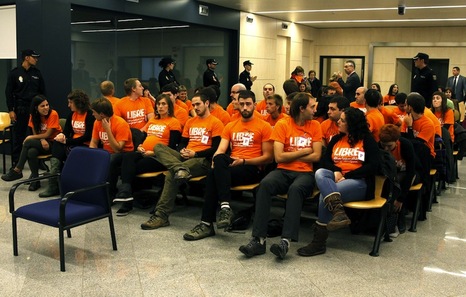
The Spanish Inquisition¹ acquits 40 Basque Youth activists (right: the trial). Good news? Well, so it would seem in principle but context matters a lot: these 40 Basque citizens have suffered prison, tortures and political persecution. They are now formally acknowledged as innocent but repression fell on them for many years, no apologies, no compensations, no nothing. In fact they can suffer again, as can I or anyone with dissident opinions, further repression at any time.

It is happening all the time. Not just dozens, maybe hundreds still suffer prison, like Arnaldo Otegi for having an opinion and/or a political activity, but new cases of political repression on opinion "crimes", torture and arbitrary imprisonment happen all the time.

This week, Tomás Madina, activist of the memorialist movement, which tries to reveal the truth of fascist murderous repression in the so-called "Spanish Civil War" (i.e. the Fascist military coup), was arrested by the Spanish Military Police, tortured and arbitrarily accused of being member of ETA ("all is ETA" doctrine, you know). He has been sent to prison by the Inquisition. Possibly he will be acquitted in the future (or maybe not) but he will anyhow have suffered the political repression in full force: arbitrary arrest, tortures, false accusations, time spent in prison, etc.

This is how the police state works today: innocent people are persecuted for their ideas and political activism, preventively tortured and imprisoned, then, years later, they are often set free, the intended damage done.


Repression against independent journalism growing

Among the victims of this kind of repression are journalists and media that does not bow to the monolithic institutional discourse. In the Basque Country this began with the closure of Egin newspaper, probably the best newspaper ever in the history of this country, with a lot of investigative journalism and very good news coverage and analysis in its late period, as well as the related Egin Irratia (radio) and Ardi Beltza magazine (investigative journalism monthly). Soon it was followed by another even more outraging attack against free expression with the closure of Egunkaria, the only Basque language newspaper, and the torture of its leading journalists.

The popular reaction was strong in both cases and successor media soon arose but huge damage was done anyhow, artificially forcing new staff and depriving these media of their economic assets. In the long run, a decade later, the cases were dismissed, the damage was already done.

This kind of repression has not ceased at all, although now it is more focused against the new Internet-based media, which offer information and analysis almost impossible to find in the bourgeois mainline old-school media.

In the Basque Country Apurtu.org was closed and some of its members arrested and tortured. Only for the case to be dismissed a couple of years later. Not before its successor site, Ateak Ireki, being closed on the same spurious grounds.


In all Spain

A peculiarity of our time however is the increased political dissidence in other parts of the residual Spanish Empire, including its Castilian core, and the subsequent generalization of the political persecution and repression.

Mainline bourgeois media are pictured as shields of the police state in this cartoon


Recently independent media from all the state have denounced this increase in political repression, with a huge list of cases:
  • Police attack against the offices of La Directa in Barcelona.
  • Closure of BurlataHerria.org (Navarre) under accusations of "apology of terrorism" (for reporting about political prisoners).
  • Arrest of La Haine journalist in Madrid, including violent beatings of other journalists who supported him.
  • Judicial persecution against the camera of Ahotsa.info (Navarre) for filming an "atheist procession".
  • Threats by the Spanish Inquisition against Topatu.info, forcing them to remove a video on the meeting Danbada Eguna or be closured.
  • Criminalization of Ahotsa.info by ABC newspaper (reactionary) for reporting on political arrests in real time.
  • Pointing out and criminalization of several photo-journalists of Madrid that were later arrested by the Spanish police. 
  • The already mentioned closure and persecution of Navarrese news sites Apurtu.org and Ateak Ireki. 
  • Arrest of La Haine journalist in the Unemployed People's March of 2012.
  • Arrest of two journalists of Periodismo Humano when they filmed an attempt by immigrants to cross the border wall of Melilla. 
  • Arrest of a journalist of LaTele.cat covering the "surround the Parliament" massive demo of 2011 in Barcelona.
  • Arrest of a journalist of Diagonal newspaper when taking photos of a police anti-immigrant raid in Madrid 2011.

Etcetera. They denounce that this kind of repression is typical of autocratic states like Colombia or Chile, as well as Spain.

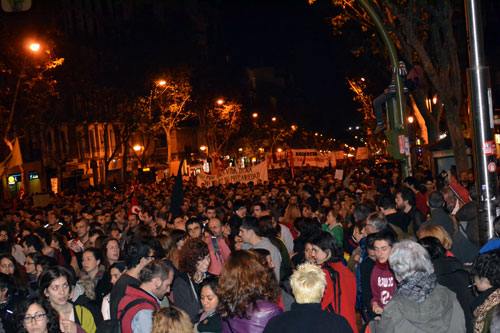
The political repression is not limited at all to persecution of journalists. Gratuituous police violence against protesters has become the norm, as well as huge fines for exerting the basic right to protest. Just to mention a recent case, police brutally attacked a huge number of citizens (below) protesting against the discourse of Minister Martínez Soria in Telde, Gran Canaria, arresting six and beating many more, including one woman with serious head injuries (right).

Another also every day more common variant of repression are spurious accusations of links to "terrorism". For example Galician independentist militant Maria Osorio has recently chosen to publicly go clandestine as a way  to rebel against the Spanish repression. This is of course not an easy choice.

Solidarity with her has taken form as the campaign "I also hide Maria Osorio in my home".

But while this kind of spurious "anti-terrorist" political repression has been so far more common against independentist activists, it seems that it is going to become a more generalized trend. The Spanish authorities have been these days warning against "Anarchist terrorism" in a clear attempt to generalize fake "anti-terrorist" repression to all the nations of the residual empire.

_________________________________________

¹ Spanish Inquisition: officially known as Audiencia Nacional, successor of Franco's Tribunal of Public Order, in charge of persecuting political dissidence and protecting the political and financier elites, as well as police agents. All major cases with some political significance go through this special political court located in Madrid.

Tuesday, June 10, 2014

Important protests for democracy and human rights in SW Europe

Sorry but I did not have time to mention them before and actually not even now, so I'll be extremely brief.

Basques demand right to decide with human chain

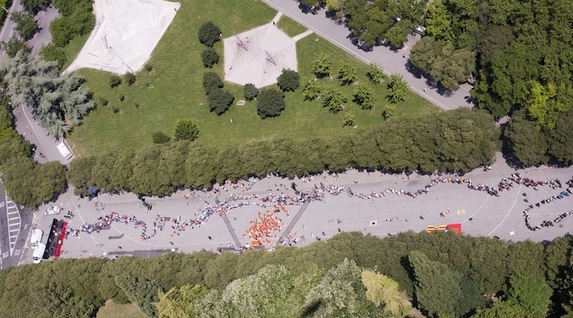
At least 150,000 Basque citizens joined their hands on Sunday to make a human chain from Durango to Pamplona in demand of self-determination.


→ Naiz Info (1, 2)


Spaniards rally for the Republic and a new Constitutional Process

In Madrid and many other cities.


Tercera Información

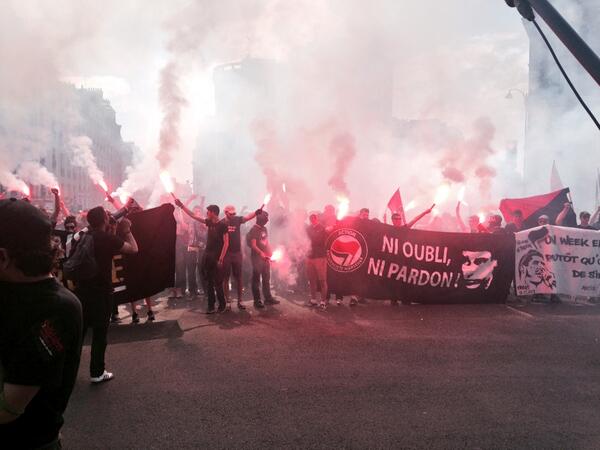
French marched against Fascism in the anniversary of the murder of Clement Méric


Revolution News


Canarians rallied against oil project that may destroy the environment


La Haine

Monday, January 28, 2013

Extreme capitalism = slavery

This is the model of development and job creation that the European neofascist propose for Spain: casinos and degrading decadence cum slavery.

Bourgeois perverts eat sushi extracted from a dying ocean on the body of a naked woman
Las Palmas Casino (Canary Islands)


That's the "way forward" that decadent late Capitalism seems to offer as only option: sell your body and life for a few euros to satisfy the endless predatory hunger of the ineffable markets, embodied in the faces and behavior of those degenerates.

Of course "workers" have no right to even go to the bathroom.

And worse: the media sells this as the way to go, as great innovation and what not.

In Spain proper, South of the Ebro river down to the seas that bath the Sahara, there does not seem to be anything else in offer: after demolishing the promising solar energy and diverse research projects accumulated through a decade or two. It seems that the heirs of Aznar has chosen the same road to nowhere: earlier it was the brick bubble and now it is the casino and prostitution bubble. All mafiosi from around the world are welcome: this is not even half-assed capitalism but raw decadence as gangsters like it.

Just like with Cuba under Batista.

And the colonies (Canary Islands, Al Andalus) get the worst of it, of course. They always did and they always will... unless they rise up.

Unemployment in Spain (2011): green < 15%, yellow: 15-20%, red > 20% (source)

Source: La Haine[es].

Monday, December 10, 2012

Obituary: Antonio Cubillo

Cubillo after the assassination attempt
The leader of the historical Movement for the Independence and Self-Determination of the Canarian Archipelago (MPAIAC), Antonio Cubillo, died today at the venerable age of 82 years. 

Cubillo and his movement, founded in 1968, were even recognized once by the Organization of the African Union, however the popularity of the struggle for independence in Canary Islands never got too much popular support. 

The MPAIAC was mostly active as means of a Algiers-based radio station, although it also had an armed branch, the Guanche Armed Forces, which made several attacks in the late 1970s. A police officer who attempted to deactivate a bomb in 1978 is their only fatal victim.

In 1978 Cubillo was attacked with a knife by a thug allegedly at the service of the Spanish Government leaving him severely handicapped for the rest of his life. The culprit was sentenced to death so he could not speak. Since then the Spanish authorities have blamed the CIA (???).

Naiz Info includes today a brief obituary but, maybe more interestingly for those fluent in Spanish language, a video debate between Cubillo and some other characters of that period, of doubtless historical interest.


Thursday, November 15, 2012

General Strike update

Kaos en la Red has published this nice multi-panorama of the various demos yesterday evening in the Spanish state:

And then you will say that we are just seven or eight

It has also been known that the number of arrested in the realm of the Bourbons has been raised to 142, with some other 74 injured.

We did not have any news from Canary Island yesterday but today it has been known that the Anarchists took over the mainstream yellow unions at the Gran Canaria demonstration end, showing that the twin unions are more and more questioned everywhere ··> La Haine (video).

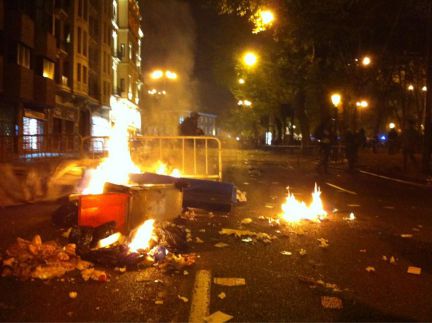
In Madrid there were several events of direct confrontation with the cops, who in some cases had to run away in panic. Fire barricades have also been reported.


··> photogallery of the unitary (anticapitalist) bloc's demo in Madrid:


CNT also reported from several ill-known locations, many of which had low following and small demos.

For the wider coverage see yesterday's report.

Friday, October 26, 2012

Spain: three suicides in few hours caused by foreclosures

Capitalism kills and the two suicides of the last days in Andalusia and the Valencian Country, just before foreclosure was enforced, are just the tip of the iceberg:

Miguel Ángel Domingo, 53, was found dead by hanging yesterday at his home of Granada. Police confirmed that the eviction of his home was scheduled to take place in the next few days.

Also yesterday Manuel G. B., also 53 y.o., answered the bell at his home of Burjassot, Valencian Country, and, finding out it was the judiciary agent with order of eviction, kissed his son, 23, on the cheek and jumped out the balcony, dying hours later at hospital. 

In Spain, even if you lose your home to foreclosure proceedings, you remain indebted for life to the banksters. 

Update: a third man, this one younger, killed himself on Tuesday in Tenerife (Canary Islands) by jumping from a bridge as he lost job, girlfriend and home (foreclosured) all in a row.

Source: Sare Antifaxista[es] (link 1, link 2, link 3).

Tuesday, October 16, 2012

Ethnically speaking, who rules Spain?

This is a re-post (with very minor corrections) of an entry that I wrote in 2008 and which I believe should be of some interest in order to understand the ethnic conflicts that shatter the never consolidated Spanish state.

Originally posted at Leherensuge.

__________________________________ . __________________________________


Ethnically speaking, who rules Spain?


It is a very interesting question to make. After all, it is a country divided along ethnic lines, which one could well argue that never finished its unification process, where the periphery, particularly Basques and Catalans, often feel oppressed by an ethnic Castilian/Spanish rule.

But, in theory, all Spanish citizens are equal. And that has been largely the case since 1715, when the new Bourbon monarch supressed the self-rule of the realms of the Crown of Aragon, after the War of Spanish Succession. While it is often argued by Spanish historians that Spain was founded in the late 15th century, the reality is that it was only formed as a unitarian state (with the Basque exception) with this first Bourbon monarch, Philp V, more than 200 years later, after the other European posessions of the crown were lost (mostly to Austria).

I have been checking the origins (place of birth and/or where the family was estabilished) of all Prime Ministers (and the few non-monarchical chiefs of state) of Spain since this Philip V, founder of Spain as we know it (and also first to estabilish the charge of Secretary of State, that would later become Prime Minister - or "President of the Goverment", as the office is nowadays officially known in Spain). Skipping the interim ones and those who ruled less for than a full month (most of which are hard to find out about their origins, as they are widely unknown) , they make a total of 115, of which 95 can be safely known their origins and these were within modern Spain.

But before jumping to conclussions, let's define (admittedly with some arbitrariety) which are the ethnicities of Spain. I avoided to use the 15 (and two colonial bits of Morocco) modern Autonomous communities as such. It could have been a criteria but really many of those communities are just but capricious subdivisions of Castile with little or no distinct personality. Instead, I followed a more historical approach:

Iberian Peninsula 1212-1492


Above you can see the Iberian peninsula (then known as Spain) as it used to be in the 13th, 14th and 15th centuries. Then (and later on with the Habsburg dynasty) Castile was a unitarian kingdom, divided in provinces (in some cases called "kingdoms" because of historical reasons but with no autonomy) but Aragon was instead a federative crown formed (in Iberia) of four realms: Aragon, Catalonia, Valencia and Mallorca (Balearic Islands). Additionally (we will ignore Portugal here) there was Navarre and the three western Basque provinces that, even if annexed to Castile, were almost totally autonomous.

The Spanish constitution of 1978 recognizes four "historical nationalities": Basque Country, Catalonia, Galicia and Andalusia. The first two had autonomy historically but the latter two did not: Galicia is the "Portuguese speaking" (ok, ok, "Galician-speaking" but it's the same) part of the kingdom of Castile and, well, Andalusia... they have a strong accent and once were Muslims. In fact there was some controversy on wether Andalusia was a "nationality" but I will admit that they have their peculairities. So excepting Galicia and Andalusia, as well as the Basque Country, I will consider all the historical Kingdom of Castile (or Castile and Leon) as a single ethnical unity: Castile. I will also consider apart the Canary Islands because they are, in my opinion, more of a historical nationality than Andalusia and, as colonial posession, they definitively deserve a place apart.

I will also consider separate ethnicities here the four realms of the crown of Aragon (now each a separate autonomous community) and the Basque Country (Navarre included).


Official autonomous communities of the Kingdom of Spain (1983-2012)

Comparing with the official administrative division active for the last few decades, then I will consider the following ethnicities:
  • Galician: Galicia 
  • Andalusian: Andalusia 
  • Catalan: Catalonia 
  • Aragonese: Aragon 
  • Valencian: Valencian Community 
  • Balear: Balearic Islands 
  • Basque: A.C. of the Basque Country and F.C. of Navarre 
  • Castilian: Asturias, Cantabria, Castile-Leon, La Rioja, Madrid, Extremadura, Castile-La Mancha and Murcia

I know it's arguable but it's also quite reasonable.

So where are the 115 historical Spanish prime ministers from? Voilá:
  • 47 Castilian 
  • 26 Andalusian 
  • 7 Galicians [plus M. Rajoy, not yet in power when the article was first written]
  • 4 Valencians 
  • 3 Basque 
  • 3 Catalans 
  • 2 Aragonese 
  • 2 Balearic 
  • 1 Canarian 
  • 6 from other European origins (mostly in the 18th century: 2 Italians, 2 French, 1 English and 1 Irish) 
  • 6 from former colonies (mostly in the 19th century: 2 from Argentina, 2 from Cuba, 1 from Mexico and 1 from the Philippines) 
  • 8 - I could not locate their origins with certainty
 
So there are 20 PMs that are useless for our purpose (foreigners, creole Spaniards or of unknown origin). But we can still consider the remaining 95.

The first element that strikes is that 73 prime ministers (76.8% of all) are either Castilian or Andalusian, while only three are Catalans (and two of them were presidents of the First Republic). There are only three Basques too but Basques are quite less in number than Catalans. Without even getting into figures yet, I know that Catalonia can be compared with Andalusia by population, and the Basque Country with Galicia. And it is quite striking that the Andalusian PMs are almost nine times the Catalan ones.

But let's compare data: population vs. number of Prime Ministers. We can get a discrimination ratio (positive or negative) from those figures. 
  • Castile (as defined above) has 14.9 million people, 33.5% of the Spanish total, but it has 49.5% of the historical rulers. It has an excess (possitive discrimination ratio) of +48%. 
  • Andalusia has 7.84 million inhabitants, 17.9% of Spanish citizens... but it had 27.4% of the prime ministers. It has a discrimination ratio of +53%. 
  • Catalonia has 7.00 million people, 15.9% of Spain's total but only 3.16% of the historical rulers. Its discrimination ratio is -80%. Would it not have been for the failed First Republic, it would have been much worse. 
  • Valencia has 4.69 million people, 10.6% of the total but only 4.21% of historical PMs. Its discrimination ratio is -60%. 
  • Galicia has 2.76 million people, 6.3% of the total and 7.37% of historical rulers. Its discrimination ratio is +17%. 
  • The Southern Basque Country has 2.72 million people, 6.2% of Spain, but only 3.16% of the historical rulers. Its discrimination ratio is of -49%. 
  • The Canary Islands have 1.97 million people, 4.5% of Spain, but only 1.05% of the historical rulers (one). Their discrimination ratio is almost as bad as that of Catalonia: -77%. 
  • Aragon has 1.27 million people, 2.9% of Spaniards, and had 2.11% of rulers. Its discrimination ratio is -28%. 
  • The Balearic Islands have 980,000 inhabitants, 2.2% of Spanish citizens, and had 2.11% of PMs. Its discrimination ratio is nearly null (in spite of being Catalan speakers): -4%.
From these figures we can see that there are the following categories:

1. Most favored ethnicities: Andalusians and Castilians

2. Almost neutrally treated ethnicities: Galicians, Balears and Aragonese

3. Clearly discriminated ethnicities: Catalans, Canarians, Valencians and Basques

Maybe Catalans and Basques have the biggest share of economic power (as from the gross internal product of these countries) but when it comes to political power, they are among the most discriminated against ethnicities of Spain, together with Valencians (largely Catalan-speakers) and Canarians (the first and last overseas colony). Castilians (Andalusians included) rule the country clearly.

Raw data and maps from Wikipedia (English and Spanish language versions).

Sunday, April 8, 2012

Cuban exile kills himself after subsidy retrieved

Albert Santiago du Bouchet Hernández, a Cuban exile who was living from subsidies from the Spanish regime and saw them suppressed with the recent draconian cuts killed himself in Canary Islands after being faced with the harsh reality of Capitalism. 

Another exile, Juan Herrera Costa, declared months ago that he was willing to return to Cuba since he was being deprived, just like anyone else in this death camp of the European Union, of means of subsistence under the Capitalist system. 

That would not have happened to them in Cuba, where every citizen is guaranteed the basics, including home, food and healthcare. However, as Disidente del Capitalismo points out, these people were, it seems, hoping to live like rock stars out of their status of "Cuban dissidents". The reality is very different: they have to survive as any worker and that's anything but easy.

As La Polla Records sang already in the 1980s:

Come jumping over the Berlin Wall,
come to this free world smiling,
soon you will see with your tired eyes, 
our blessed freedom!

The truth: I do not know
what you come here for.
The truth I will tell you:
there's nowhere to run to!

In this paradise life sucks
what's wrong with you, kid, are you crying?
When are you going to find out
that the Wall is a lie!


Source: Disidente del Capitalismo, various TV channels.

Tuesday, June 28, 2011

Simultaneous Nazi attacks in 'Spanish' islands cause several injured

A German homeless man is in severe condition after Spanish Nazis attacked him with paint, which he drank and breathed as result. This happened in Palma de Mallorca tonight.

In La Laguna (Tenerife, Canary Islands), about the same time, 4:00 am, a group of Nazis attcked youths who tarried in the leisure area of the city known as El Cuadrilátero, yelling "ultras!" and injuring four, none severely. Police intervened but arrested nobody.

Source: Sare Antifaxista[es] (Majorca, Tenerife).

Tuesday, April 5, 2011

Thousands march through Madrid demanding labor rights


More than 4000 people called by Basque, Galician, Catalan and Canarian national worker unions have rallied in Madrid demanding labor rights. The march was opened by a unitary trilingual banner which read:
  • In Basque: Let us decide life and work conditions in our country
  • In Galician: No to pensions and collective bargaining reform
  • In Catalan: Right to decide our working conditions
Cries (in various languages) included stuff like: independence!; there's no lack of money but excess of robbers; Comisiones-UGT: unions of the establishment; no, no no, no to the reform; the struggle is the only way; PP-PSOE: the same shit is; etc.

The march, animated by Galician bagpipers, was welcomed at the gates of the Ministry of Work by the Basque percussion of a txalaparta. There speakers from two Basque (ELA, LAB) and one Galician (CIG) union took turns to speak, essentially rejecting the ongoing reform that makes firing workers even easier and cheaper, consolidates job precariousness and modifies the correlation of forces in favor of the patrons' cartel while weakening the working class. They also criticized the role of the institutional unions, CC.OO. and UGT, which have signed such ignominious pacts without even attempting to resist at all.

Sources: Gara, Sare Antifaxista.