Showing posts with label stateless nations. Show all posts

Friday, October 27, 2017

Catalan Parliament approves independence

The Parliament of Catalonia approved this afternoon the independence of Catalonia (full text of the declaration, in Catalan). The voting was secret and the results were as follows: 70 yes, 10 against and 2 blank votes and 52 absentees (hardcore Spanish nationalists who don't recognize the right of Catalonia to self-determination). There seems to be one missing vote in the account, nobody seems to care.

People celebrate Catalan Independence near Parliament

With this action Catalonia ends all procrastination in favor of negotiation, which has not been listened to by Spain at all. On the contrary, the Spanish government, which is weak electorally but, thanks to the many tricks of the Neo-Francoist constitution still has absolute majority in the Senate*, and has managed anyhow to muster the support of the so-called "Spanish Socialst Worker Party" to approve also today the suspension of Catalan autonomy, activating article 155 or the Spanish Constitution, the kind of constitutional provision that Hitler was fond of resorting to in order to consolidate his power some 70 years ago.

Today a conflict between two sovereign states begins: one enjoys international recognition and has 95.000 police agents (plus the military, which won't surely be used because there's no war), the other is unrecognized (yet) and will fight only with the power of NONVIOLENT POPULAR RESISTANCE. Who will win?

I forecast that Catalonia will prevail. Why? Because they have already demonstrated their willpower, discipline and nonviolent firmness, in previous confrontations such as the referendum of October 1st, the General Strike of October 3rd and many other episodes of popular struggle in the last many years.

Against that determination Spain can only exert force. Its appeals to Catalan unionists to walk out have failed (sure: they brought many buses from Spain proper but rallied very few people from Catalonia itself) so they only have the farce of Spanish laws and courts that are, since today, not legal in Catalonia anymore. And they have 95.000 ill-paid and overworked police agents who will soon be shown as useless to implement Spanish law against millions and millions of disobeying Catalans.

Catalonia is Kosova on steroids: it is much larger, richer and visible than poor little Kosova was when it had to confront, in the pre-Internet era, a similar situation. Back then it was obvious that any solution not implying the independence of Kosova would fail. It took eight years of very brutal Serbian occupation but they eventually succeeded, not without a blitz war.

The situation is nevertheless different in Catalonia: Kosova did not matter, it was a mere humanitarian issue, but Serbia/Yugoslavia did not matter much either. Spain however has major geostrategical relevance because of the Strait of Gibraltar (plus French historical backyard geostrategy), so its NATO allies won't betray her. But Catalonia also has major strategical relevance, being one of two main knots linking the Iberian Peninsula to Europe (the other is the Basque Country) and this is a trump card the Catalans can play: sabotaging via strikes and blockades the commercial routes will no doubt have a demolishing impact in Spain's economy and its international reputation. 

Additionally Spain is effectively bankrupt: only the European Central Bank buys Spanish bonds these days, the pensions' reserve fund has been exhausted and Spain is financially unable to pay for almost anything. This is going to lead to a major crisis in Spain but a crisis that will shatter Europe and the World. Because so far the bankruptcy crisis had been delayed in Europe so far but now it will become absolutely unavoidable. 

That's the bargaining chip of the brave Catalan People: that's how a People determined to fight (noviolently) can bring the World to a halt. 

Catalonia will be free. The whole World Order (itself in deep crisis) cannot impede it. How could it? Catalonia is (together with the Basque Country) the motherland of Insubmissió: some three decades ago we gloriously defeated the Spanish Army with NONVIOLENT RESISTANCE, and Catalan society has learned that lesson well, probably better than us Basques. They cannot be defeated, they will prevail and teach the World a lesson.

_____________________________

* Every Spanish province, regardless of population or ethnicity, gets 4 senators, three of which go to the most voted party and the fourth to the second one. Most Spanish provinces are rural, nearly empty provinces of Castilian or assimilated ethnicity.

Wednesday, October 18, 2017

Spain imprisons Catalan "Gandhis", Catalonia walks out in protest

Yesterday morning the Spanish Inquisition (Audiencia Nacional, its conceptual heir) jailed Jordi Sánchez (Catalan National Assembly) and Jordi Cuixart (Omnium Cultural), leaders of two of the most important social movements that have been pushing ahead with Catalan patriotic mobilization and the process of self-determination.

Freedom Jordi Sánchez and Jordi Cuixart. We want them at home!

Protests have been massive across the country. Another sign of Catalan independence being absolutely impossible to repress:


Barcelona (1)

Barcelona (2)


Palma de Mallorca (Balears)


Ripoll


Sitges


Vilanova i la Geltrú

There have been also some protests in Madrid, the Basque Country, etc.

(Credit for most pictures: CjSand).

Tuesday, October 3, 2017

General strike today in Catalonia

1917: sickle and hammer.

2017: tractor and computer.


"Muy Bastas" explain:
Viva the Farmers!!
  1. The Farmers said they would cut the French border with the tractors.
  2. Hundreds of national police agents have gone there to impede it.
  3. It was a trick. When the cops arrived they found nobody there.
  4. The tractors then blocked the highway and roads further south, so the cops can't go back.
They won't be able to do anything against an organized People.

Today a General Strike for freedom was called in Catalonia by several minor labor unions including COS, CGT and CNT and backed by the CUP (socialist independentist party). This call was made several days ago, even before the brutal repression of this Sunday.

In order not to be displaced by a call they did not control but that was going to be followed anyhow by most Catalans, the "moderate" camp has called for a day of "National Halt", which has been seconded by other unions, parties and even capitalists. It is unclear how exactly such a thing as a "National Halt" happens but it somewhat overshadows the fact that there is a political general strike called by the most combative unions and the CUP.

In any case the General Strike has been a massive success: Catalonia is nearly stopped, except for multitudes protesting nearly everywhere. Romanian homeless activist Lagarder Danciu, who forged a name for himself by staging one-man protests against corruption in his adoptive homeland, among other activities, offers us an example of how massive this is:


Another visual example of how a true General Strike is made is offered by this photo shared by one of my favorite bloggers, Borroka Garaia Da! (It's Time of Struggle!):


If you follow the link, you will find the Spanish-language version of the communication of Endavant (Forward), the more radical (i.e. more coherent and serious) half of the CUP.  They argue that the referendum was a success in spite of all the repression and that it was an overwhelming victory for the "yes" to independence. 

Therefore they say that a Catalan Republic must be proclaimed this very week, rejecting any call for "pacts" or "dialogue", which would be attempts to invalidate the referendum. 

They call for the General Strike, they denounce the brutal repression against the Catalan people and they argue that the forces that oppose Catalan independence are the same ones that are attacking the rights of the working class. They conclude that:

The General Strike must be the starting point for the Popular Movement to move ahead, to change everything, to guarantee the conquest of social and labor rights and for the implementation of the right to self-determination. 

Visca Catalunya lliure! Viva the struggle of the Peoples!

Monday, October 2, 2017

Catalonia defeated Spain by sheer will of freedom

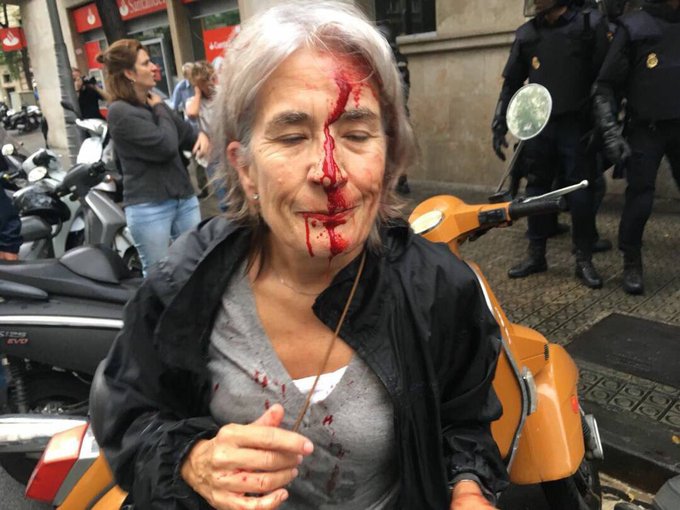
Yesterday it was a most important day. You all surely know by now about the brutal repression by the Spanish police forces against the Catalan independence referendum and, most importantly, about the brave popular resistance by millions of self-organized citizens in each and every electoral center. 

2.262.424 Catalans managed to vote and had their vote counted. Electoral centers including other 700 thousand electors were closed by the repressive forces. The electoral census is 5.3 million. Among the votes issued and counted the results were: 2.020.144 (90,09%) "yes", 176.566 (7,8%) "no", 45.586 (2%) "blank" and 20.129 (0,89%) "null votes".

One could get lost arguing on the validity of the vote under such quite obviously exceptional and most difficult circumstances, what really matters is the civic pride and nonviolent power demonstrated by the Catalan People, and, on the opposite side, the blind brutality shown by the Spanish state, determined to defend the francoist concept of "indissoluble unity" of the state no matter what. 

What really matters is that, maybe more than ever before, the State of Spain has been shown to be morally bankrupt, a true failed state in the making. Hopefully the socio-political crisis will extend to the rest of the lands occupied by the residual empire. Some signs of it happened yesterday, with thousands protesting in Madrid and Seville, among other Spanish cities (and also in places like London, and earlier in Bilbao and Amsterdam, etc.) in solidarity with Catalonia and its right to self-determination.

Tomorrow there is a General Strike called in Catalonia in support for this right to choose but, quite obviously, marked also by the rejection to repression and authoritarianism. Even if the unions calling for the strike are relatively small (nationalist union COS and libertarian unions CGT and CNT), the strike is backed by the major civic force in all this Catalan uprising: the Catalan National Assembly (ANC) and its right-wing ally Omnium Cultural, as well as by key political forces like the Popular Unity List (CUP), so it is predictable that it will be a massive walk out. 

However this is only one step and one restricted to Catalonia. In my opinion, what will be critical now is whether Spaniards themselves will begin mobilizing, not just or mainly in solidarity with Catalonia, but on their own platforms such as the demolition of the mafioso authoritarian regime consecrated by the controversial constitution of 1978, which was agreed behind closed doors and backed mostly because anything was better than the Fascist dictatorship. 

The constitution is nearly impossible to reform (needs a wide agreement of all-Spain parties because of a horrible electoral system that massively favors rural Castile and hence conservative forces), so only forcing the hand of the twin party system PP-PSOE will work. It's even reasonable to consider that only a true revolution, a constituent process from below, will do the job. 

Sadly enough, the big political hope of Spain, the novel party Podemos (We Can) has so far limited itself to posturing. They basically seem to restrict themselves to try to form a coalition with the PSOE (center-left?) and only very slowly advance on the path of reforms. Clearly insufficient. Also they are clearly renouncing to resort to mass mobilization, which is happening on its own, and they have growing internal quarrels.

So it is unclear how the situation will evolve. Yet it is clear that it is evolving and very fast. 

Once again my applause and respects to the brave People of Catalonia for daring to defend their freedoms in what is clearly an example for the rest of Europe and the World. Visca Catalunya lliure! Viva the struggle of the Free Peoples!

Friday, September 22, 2017

Barcelona is Tahrir Square 2017

The mobilization in Catalunya is very impressive, massive, total, truly revolutionary, a true constituent moment in the making.

Barcelona, yesterday night.


Against that what can the Spanish state, with a corrupt government with minority backing in Parliament, representing more than ever before the (barely reformed) Fascist nature of the state? Well, they are throwing in everything they have, which is brute force. Thousands of police agents have been moved to Barcelona and hosted in three cruise vessels... like this one:


Total failure, right?

It's "Brand Spain", also known as "ACME". And this is the most likely result:


It's not just a "marketing" failure, it's not just surrealism at its best (or worst), it is that with every single repressive move more and more people join the rebels. People who were not in favor of the referendum now favor it, people who were not in favor of independence now say they will vote for it, even in Spain proper the mobilizations in favor of Catalonia are much larger than those against it, which so far have not gathered more than a handful or two of fascists. 

The dock workers have rejected to serve the three police ships, Catalan unions have called for a general strike beginning on October 3rd (the referendum will be on Oct. 1st), in Madrid a demonstration aiming to "surround Congress" has been called for Oct. 5th, these days we have seen thousands of people demonstrating in solidarity with Catalonia all around the rest of the Spanish state, plus also very large protests against local issues (Murcia) or general most serious affairs (Linares). If Madrid keeps the repression against Catalonia they are going to see how the Catalan fire expands to all the peninsula, there's no way around that, particularly because there is no end to the Catalan "Procès" other than independence (or its defeat via referendum, most unlikely at this point). And they just do not have enough cops...

Remember that moment in the Tunisian Revolution of 2011 when the protesters realized that they were many many more than the cops, pushed back and won?

Remember that moment in the Egyptian Revolution of 2011 when the police van shooting water cannons against the demonstrators run out of water and had to retreat, allowing the People to take Tahrir Square again?

That moment will happen, somehow, at some point, also in Catalonia and maybe even in Madrid soon, the rage is just too big and the regime too stagnated, corrupt and discredited. The #MAMBO has just begun. Pay attention because this is most important not just for Catalonia, not even for Spain, but for all Europe.

Wednesday, September 20, 2017

Catalonia: Spain escalates repression, shoots itself on the foot.

Military police car taken over by protesters
Telegraphically: This morning the Spanish state has assaulted the Catalan Government (Generalitat) and arrested 12 people, including many high officers of the elect government. Last minute info indicates that masked police forces have surrounded the offices of the radical left independentist party Popular Unity Lists (CUP). Several separatist parties have abandoned the Spanish Congress as result. The center of Barcelona is full of people in spontaneous demonstration. Protests are being held in other places as well, including here in Bilbao (Basque Country). The only de facto all-Spain opposition party Podemos has called for a conference of mayors and other elect officers tomorrow in Zaragoza (the Spanish nationalist right-wing parties PP and Ciudadanos have not been invited, the Spanish nationalist center-left PSOE has rejected to go but all other forces are going). While we can't say the situation is "revolutionary", it is certainly most anomalous and in many sense "pre-revolutionary", particularly because the Spanish state cannot effectively fight against the peoples, much less with the extremely low level of legitimacy it has after so much corruption, austericide and repression. We cannot exclude at this point that a general strike of political nature could be called, even if the main unions are quite sheeply and definitely unionist.

The situation is definitely critical in any case. Some relevant Twitter hashtags: #ReferèndumCat, #MAMBO.

Monday, October 24, 2016

IMNSHO: Spain is about to collapse

*IMNSHO = "in my not so humble opinion"

Where do I begin at: Catalonia?, the irreversible PASOKization of the centenary labor party PSOE?, the upcoming reelection of the boss of the mega-corrupt and reform-fascist PP?, Greece?, Yugoslavia?, Haiti maybe?

Maybe I will begin better with the infamous lapsus linguae of the Secretary General of the People's Party (PP), María Dolores de Cospedal:

We have worked very hard to loot this country

This lapsus linguae or betrayal of the subconscious happened to Ms. Cospedal not once but twice in two separate speeches in two different years. She is the second highest ranking officer in the PP, just after President Mariano Rajoy, she has been President of her region, Castilla-La Mancha, and she is most likely to be appointed minister, maybe even vice-president in the new government to be formed in the next few weeks. 

As top commander of the PP, she is of course involved in all kind of corruption scandals, of which it seems only the tip of the iceberg is known and under trial, including the destruction of key evidence.

Their discourse is almost far-right: strongly in favor of the privileges of the Catholic Church, against human rights (for example they passed the "muzzle-law" by which police can arbitrarily impose huge fines, without any judiciary supervision, on anyone protesting or filming police repression, journalists included), high taxes for the poor and extremely low for the rich, austericide (massive cuts and privatization of social services), histrionic pseudo-patriotism in order to rally the dumb around police, the army, the king and the monuments to Franco and his minions) and lackeyish serfdom towards the banksters, local or international, including their extremely irregular dictatorship on the European Union, the so-called Troika

Their real intentions are not always obvious, typical politicians are illusionists after all, but sometimes they do commit revealing errors like this one, stating what they are really about: to keep Spain as a Banana Kingdom they can plunder at whim, as their ilk has done always, since at least Roman times, when the colonial entity named Spain (Hispania) was first established. 

They have a problem though: the younger generations are having nothing of it, they have been deceived so much with the "European dream" that they truly believe they are entitled to be like Germany or Denmark, and not as Greece or Haiti, are they are scheduled to be by the powers that be. And, unlike some Eastern Europeans, they have absolutely no ill feelings towards "communism", even the Soviet-style one, which they acknowledge at least provided jobs, homes and progress, and a quite loved sister country such as Cuba. More moderate versions of radical social-democracy like those experimented with in Venezuela, Nicaragua, Bolivia or Ecuador are seen with even more sympathy. Language and personal connections do help with that, naturally.

However the bourgeois-owned media and, critically, the older generations are much less adventurous: often they have their lives solved (and theirs may well be the only income supporting several unemployed or underemployed younger relatives) and, as most older people, don't think that taking risks is a good idea. Because of high unemployment and low natality in the last many decades, the demographic pyramid is almost reversed and the old are way too many voters. This delays change but cannot impede it in the mid-run, also it prevents the reactionary forces from forming shock squads, as the retirees are not really for that kind of action (and when they are, they rather take the other direction: that of protests and solidarity with the younger generations). Their only force is in an ever shrinking voter power, not just shrinking because of the unavoidable deaths but also because even they are every day more aware of being deceived. 

They have another problem: separatism, particularly strong in Catalonia and the Basque Country, with Catalonia set decidedly in the course of unilateral separation. This the Spanish nationalists are trying to use as rally point for the rest of the peoples of the state and also, as they have always done, as distraction from the other much more serious problems, which are the forced application of the Troika's designs, of austericide, in all the state and not just in Catalonia. 

The latest development, with the "opposition" PSOE (literally Spanish Socialist Worker Party, often shortened to "Spanish Party" to make justice to their real policies) shooting itself in the head in order to allow the right to govern for the banksters, is that these will "abstain" in the relevant vote. In practical terms it means that the party has been kidnapped by a, mostly Andalusian, authoritarian provisional administration, whose aim is to delay sine die any form of internal democracy (the militants are very upset) while allowing the PP and Brussels to do what they will. They will try to posture maybe but they most likely will do almost everything that the Troika and the local oligarchs demand. 

If you hear "Susana Díaz" these days in relation to the political situation in Spain you can translate it as "Venizelos", same thing.

So Spain is like Greece in its sad fate by design of the Big Capital, like Yugoslavia in its complex and hardly solvable inter-ethnic conflicts, that can go extreme at any moment now, and like South Korea in population and GDP. It is much bigger than Greece and much more "strategically relevant" than Yugoslavia, holding two key US/NATO bases that control the entrance to the Mediterranean Sea and the British enclave of Gibraltar. 

It is very large in size (one of the largest European countries, after Russia and France) but its army, not popular at all, after ruling the country in successive coups for most of the last two centuries, is quite small however: 50,000 army troops (half of them officers) and other 50,000 military police, plus some navy (one aircraft carrier, 11 frigates, 18 patrol ships) and air force (138 combat airplanes). It used to be much larger in times of Franco and up to the mid-90s, with up to 300,000 forced recruitment soldiers, but we made sure they would not be able to count on us anymore by a long and very successful campaign of civil disobedience. 

So how is post-military Spain going to be able to impose itself and the Troika against millions of people (more than five million, most of them young, have voted to Podemos and their allies; the pro-independence demonstrations in Catalonia have gathered sometimes almost two million people). Are 25,000 soldiers enough? It depends on how brutal they are willing to go, I guess, but the more brutal they are the less legitimacy they will have left, both inside and abroad. 

So, while it is conceivable that they can occupy Catalonia (just as Serbia did with Kosova for more than a decade -- but with a much larger army, total control of the media and widespread use of state terrorism, all of which are not available for the Spanish case), they are only bringing themselves to a cul-de-sac which they cannot control. Much more likely is that Catalonia effectively establishes its effective independence, maybe with some difficulty at first, and remains unrecognized like Somaliland for some time (too important to be ignored forever). 

But we will see now, because Rajoy has declared that his first goal will be to impose "the law" in Catalonia and that means "war" (not necessarily outright open war, not yet surely, but a situation of unsolvable conflict which can only evolve perilously). 

This is of course the main pretext for the PSOE to shoot themselves dead in support of their alleged "rival": intransigent nationalism. The real reason however is to keep the "cordon sanitaire" around Podemos and allies so the international bankster mafia and the Troika remain in charge and continue applying their austericidal policies in all the state of Spain, as well as elsewhere in Europe. 

Spain has never gone through a successful revolution but I have the strong feeling that now is going to experience one: with 50% of youth unemployment (and the other half in precarious jobs or emigrating) and no light at all at the end of the tunnel (actually the global crisis is going to explode again any day), and no constructive reforms whatsoever being done, there is just no other option, no other way ahead. Only inertia keeps it from exploding in ways even more radical than Greece but the Catalan conflict is a keystone, not in restoring the power of the corrupt and decadent "regime of 1978" but in accelerating the process of change in ways that, as in all revolutionary processes, are too unpredictable. 

And it is a process that is going to affect heavily the rest of Europe. Maybe right now, north of the Pyrenees, the tendency is towards demagogic authoritarian and racist nationalism of the worst kind (Le Pen and the likes) but that is no solution at all, only mindless scapegoating. It may remain relatively strong for some time, it may even make a breakthrough in some particularly backward states like Poland or Austria, but there is absolutely no future in that, they offer no solution but more of the same (but worse: more violent and stupid even). If Europe is going to survive this crisis it needs a totally different attitude: one that is daring to experiment and that is willing to make sure that those that are responsible and cooperative are not the victims of the heartless psychopaths that make up the ranks of the oligarchy.

In Spain the parties of the regime have cut all links with common sense and are heading ruthlessly towards the increase of the conflict at all levels (both against Catalonia and against Spain itself, against its own core population). And they lack the legitimacy nor the real forces for doing that, so it's going to be a major implosion sooner than later.

Let us brace ourselves because it's going to be really harsh.

Wednesday, October 19, 2016

Catalonia nullifies Franco's "justice"

Companys in prison
Believe it or not, in Spain the illegal totalitarian actions of the Fascist dictatorship of Franco are still within the law. The Parliament of Catalonia, in the process of active secession from Spain, has been the first one to declare some of them null.

Specifically the Catalan Parliament declared yesterday all military trials under Franco to be null and void of any juridical effect. Better late than never, I guess. 

One of the most infamous such military trials was the one against Catalan President Lluis Companys (ERC), who was killed as result. 

In spite of some 40 years passing since the (way too peaceful) death of the tyrant, almost nothing has been done in Spain to counter the effects of the fascist tyranny. Only now, under the cover of a very limited Law of Historical Memory, local governments have begun to rename streets that were apologetic of fascism, remove statues of Franco and other fascist icons, unearth the remains of some of the victims of Fascist terror, scattered by the roadsides of the country, etc. However resistance is not trivial, mostly from the ranks of the ruling "Christian-Democratic" party PP and the Catholic Church (which in Spain is extremely conservative and has been losing adepts without remedy since decades ago).

Source: Nueva Tribuna[es].

Thursday, July 28, 2016

Catalonia moves one step closer to independence, challenging Spanish tribunal

Yesterday the Catalan Parliament moved the stateless nation one step closer to independence by approving eleven conclusions of the Commission for the Constituent Process, step that had been explicitly forbidden by the Spanish Constitutional Court, court that had been explicitly declared irrelevant by the Catalan Parliament as well.

The eleven points were passed with 72 votes in favor (in a few instances with 83 as the 11 members of Catalonia Can Indeed, akin to United We Can, supported or abstained here and there). They are (my aproximate translation from the Catalan original):

1. Right now there is no room for the recognition of the right to decide of the Catalan People inside the constitutional juridical frame of the Spanish state. The only possible way of exercising this right is via the disconnection and the activation of a distinct constituent process.

2. The People of Catalonia has the legitimacy to initiate its own constituent process, that is also democratic, based on the citizens, transversal, participative and legally binding, with the recognition, support and backing of the Catalan institutions.

3. The compared experiences of other countries back the road taken by Catalonia to build a singular model of constituent process according to our own social, cultural, political and economic circumstances.

4. We must take care that the methodological frame of the constituent process remains consensual, known, transparent and shared by all society and the institutions backing it. The constituent process must have the capability of including all ideological sensibilities since the very beginning and also at the time of fixating the indicators, the calendar and all other questions that affect the method to move forward.

5. The constituent process will have three phases: a first one of participative process, a second one of disconnection with the state and call of constituent elections in order to conform a Constituent Assembly, which will redact a project of Constitution. In the third phase, it will be ratified at popular level through a referendum.

Puigdemont and Gabriel, leaders of the independentist movement
6. The preliminary participative process will have as main organ a Constituent Social Forum (FSC) made up by representatives of the organized civil society and the political parties. The FSC will debate and formulate a set of questions on specific contents of the future constitution that will be answered by the citizenry via processes of citizen participation. The result of this citizen participation will make a binding mandate for the members of the Constituent Assembly, who will have to incorporate them in the redaction of the project of Constitution.

7. After the citizen participation phase, the disconnection with the legal frame of the Spanish state will be completed through the approval of the laws of disconnection by the Parliament of Catalonia and a unilateral mechanism of democratic exercise that will serve to activate the call of the Constituent Assembly (AC). The laws of disconnection are not susceptible of control, suspension or impeachment by any other power, court or tribunal.

8. The Parliament of Catalonia backs the constituent process that has to be carried to term in our country. To that effect it urges the Government of the Generalitat to give to the citizenry the resources needed to be able to carry a grassroots constituent debate that remains transversal, plural, democratic and open. To that effect, the Parliament of Catalonia will create a commission for the following of the constituent process.

9. Once it is called, elected and constituted, the Constituent Assembly will enjoy full powers. Its decisions will be of compulsory fulfillment for all other public powers, as well as for physical and legal persons. None of its decisions will be either susceptible of control, suspension or impeachment by any other power, court or tribunal. The AC will establish mechanisms to grant the direct, active and democratic participation of individuals and the organized civil society in the process of discussion and elaboration of proposals for the project of constitution.

10. Once the AC has approved the project of constitution, a constitutional referendum will be called so the People of Catalonia approves or rejects in peaceful and democratic manner the text of the new constitution.

11. Since the beginning, a gender perspective must be incorporated in a transversal manner and with a dual strategy, in order to address the historical inertias of our society and that the constituent process will also be for all, women and men.

Spanish nationalists got very angry
The eleven points were backed by the coalition "Together for the Yes" (JxS, backed by the Catalan Party of the Democrats and the Catalan Republican Left, but with most seats occupied by independents, 62 seats) and the People's Unity List (CUP, a revolutionary left-wing grassroots independentist party, 10 seats). The coalition "Catalonia Can Indeed" (akin to all-Spain United We Can) voted in favor of points 2, 4 and 11 only, abstaining for points 3 and 8, while voting against the other six points, the ones that directly challenge the Spanish legal corset. They have 11 seats.

The People's Party (PP, 11 seats), which controls the caretaker government in Madrid, voted against all 11 points, while the Socialist Party (PSOE, 13 seats) rejected to vote altogether and the Spanish ultra-nationalist "Citizens" (C's) party (20 seats) stormed out of the building in anger. 


Spain has been without a functioning government for months


The timing of the Catalan step forward does not only seems to serve to mend wounds in the rather unstable pro-independence coalition between JxS and the CUP, whithered by disagreements on the budget, which was not approved (not "social" enough for the CUP), but also affects the stagnated negotiations for the formation of a government in Spain, in which the Catalan Nationalists may be decisive.

There are five possible coalitions with pure mathematics (176 seats are needed):

1. PP-PSOE or grand coalition of the two major parties, hampered by the subjective "need" of the PSOE to remain as "leader of the opposition" (otherwise leaving that role to the leftist upstarts of Unidos Podemos). Another major obstacle is the insistence of Mariano Rajoy, besieged by endless corruption scandals and rejected by every single other party, to be the candidate.

2. PP-UP: unrealistic, as they represent polar opposites.

3. PP-C's-PDC: they are all center-right parties but the former two are Spanish nationalists while PDC (former CDC) is Catalan nationalist, and they are in clear crash course these days. Hypothetically PP and C's could make very major concessions (a federalist reform of the constitution) in exchange of the latter deactivating the independence process but it is very hard to see how this could happen, much less after the new step towards independence taken in Barcelona and the declarations of PDC speaker, Mr. Homs, that they will not support neither Rajoy nor any other candidate of the PP. 

4. PSOE-UP-C's: seems most unlikely, as UP and C's are also polar opposites (socialism vs ultra-capitalism, federalism vs. ultra-centralism). The PSOE tried to do something like this (but with them governing solo, without seriously negotiating with UP) in the recent past and was rejected.

5. PSOE-UP-PDC-ERC-PNV, where PDC and ERC are Catalan nationalist forces (center-right and center-left respectively) and PNV is a Basque nationalist (or regionalist) one (center-right). This one used to be the coalition most favored by United We Can (UP) but has been harmed by the abstention of the peripheral nationalist forces in the formation of the board of Congress, which has been interpreted by some as flirting with the PP. For the PSOE, which is much strongly Spanish-nationalist, it is rather undesirable, particularly with the Catalan challenge going on.

There is a sixth possibility that adds up to 175 seats, exactly half of the Spanish Congress, which would include PP, C's, PNV and the small regionalist Canarian party PNC-CC (1 seat), which has already declared their intention to help in government formation, but it is a nightmare scenario for the Basque Nationalist Party (PNV), because there are regional elections this fall (late October in principle but may be moved forward to September) and for them allying with the rotten and rather extremist PP would be a major burden, no matter what they get in exchange. It would still be one seat short of a majority anyhow. 

The PNV has already said that Rajoy is a no-no and that they will demand a solution to the issue of ETA (disarmament, prisoners, etc., today blocked by the intransigence of the PP) but it has been rather ambiguous otherwise. In any case it is very difficult to imagine the PNV backing a government that represses the Catalan push for independence, it would be a major shame for them and could even start an internal rebellion: too much. 

So the conflict Spain-Catalonia is seriously affecting governance in Spain, although it is not the only issue: the irruption of Podemos (now Unidos Podemos, after they merged with United Left) and the endless spat of corruption scandals affecting the conservative PP also add up.

Tuesday, March 15, 2016

Nationalism. How to overcome it?

Often people talk about nationalism with generalizing negativeness. For many people: one word equals one simple meaning, or at least that's how they use it. However the simple meaning attempted to convey is as subjective as the speaker. Let's try to clarify.

Since the 1930s and 40s, the word nationalism has become negatively loaded in English, while its synonym patriotism is instead preferred, as it conveys more positive connotations. This seems to come from the use in English journalism of the word "nationalist" to refer to fascists, notably Franco's, when actually he and his followers hated that word, which they associated with Basque and Catalan independentism, calling themselves nacionales, that is: nationals, without the "-ism". In Spanish it is the other way around: it is the word patriotism and its root patria (fatherland), which is loaded with negative connotations, precisely because Franco and his mind-slaves used and abused it, while nationalism has for many positive connotations, precisely because democrats and socialists used it with preference. It's all very capriciously loaded on 20th century historical accidents.

The Basque language case is different: Spanish borrowings follow the Spanish cultural rule but Basque lacked originally for any word for nation, let alone fatherland, different than herri (people or country). So back in the late 19th century, when the Arana brothers reinvented Basque Nationalism in terms that have gone mainstream, they also invented many neologisms of their own, quite arbitrary, thought, one of them being aberri (fatherland, from Sumerian and/or Semitic aba = father, in funny amateurish linguistic exercise¹). The derived word abertzale, now fully consolidated, would then translate as patriot but, as this term is seen as negative in the Iberian Peninsula, it is translated as nationalist instead This may sound odd for native English speakers but that's how the subjectivity of meanings go, depending on cultural specifics. Specifics that have a very shallow history in any case.

In addition to that fatherland and patriot have clear patriarchal connotations (they directly appeal to the father and the father's line), while nation and nationalist do not (they appeal to the place and community of birth instead: natio = birth). This may also weight for some in their choice of words and one can well argue that they are indeed more neutral etymologically speaking.

All these arbitrary, subjective and slippery concepts associated with words are not useful for the analysis I intend to make here. I will therefore consider patriotism and nationalism as the synonyms they actually are, and just use nation and nationalism, avoiding hence the patriarchal load of the word patriot.

Two types of nations and two types of nationalism

What is a nation? For many it has become synonym of an established state. However that's not the original meaning and is only a forced recycling imposed by those so-called nation-states in concert, particularly those who fear their own minority nations' rightful claims to sovereignty, to self-rule.

As I said before, nation comes from a Latin word natio, meaning birth. Traditionally and often also in modern speech it refers to a distinctive ethnic community (Greek: ἔθνος = nation). As nation and state were often dissociated in ancient times, at no time this concept meant state (Lat. res publica = public thing, the word state does come from Lat. status but with a modern evolution in meaning) nor polity (Greek: πόλις = city). Only with the invention of modern nationalism, which is the idea that state and nation should be the same, either by giving a state to each existing nation or by forcing all people in each state to be assimilated into the core nation (or sometimes even exterminated or expelled, i.e. various forms of genocide). 

We see in the very definition of nationalism that it has two contradictory implications. In fact this means that there are two types of nationalism: defensive nationalism, that of stateless nations striving for self-rule, possibly in the form of a new nation-state, and aggressive nationalism, that of states and its core nations, trying to absorb everybody in their boundaries into the core nation or even expel/mass-murder them. 

I will argue here that the categories are therefore:
  1. People-nationalism: a nation is formed naturally (historically, ethnogenetically) and it deserves its own self-rule, sovereignty, independence and possibly state. 
  2. Imperial-nationalism: a nation is only those that control a state and everybody who falls out of the line must be punished. This one has two variants:
    1. Roman style: the outlier nations must be assimilated.
    2. Racist style: the outlier nations must be exterminated and/or expelled.
Imperial nationalism is intrinsically genocidal, either in the "soft" cultural way or in the "hard" murderous one. To some extent every single established nation-state falls into this category. It may be latent but it is there and sooner than later it will become a problem. Even nations that have not yet achieved independence and that are therefore victims of others' imperial-nationalism face this reactionary risk if they ever manage to succeed in their legitimate fight for freedom. 

Of course people-nationalism is invariably legitimate, as long as the people-nation historically holds a territory. By this I mean that, for example, it does not apply to Israel, which is an artificial colony on other people's territory, i.e. falls into a sui-generis variant of imperial-nationalism of the racist and genocidal type, the worst type of all. 

But it can perfectly happen and does happen that a successful people-nationalism turns petty imperial-nationalism once statehood is achieved. For example the very legitimate Norwegian or Finnish nationalism, turns out as problematically genocidal, at the very least in the cultural way, towards the Sámi nation; the very legitimate Dutch or Portuguese nationalism turned out imperialist against African, American and Asian nations. 

I guess that's why many people dislikes the very concept of nationalism. However this stand is utterly naive and, almost invariably, turns out as accomplice of imperial-nationalism. 

The naivety of anti-nationalism

Anti-nationalism cannot exist. It can be, I guess, subjectively imagined but it is an error of concept. Nations do exist naturally (historically) and often come into conflict with other nations. You cannot just erase them, just like you cannot erase history, customs, languages, etc. Doing so could only be done by assimilation, always unfair for the new arrivals, into a larger nation. 

For example we may imagine a single unified Humankind that only speaks English and holds not anymore any customs, even the calendar may be redesigned to be religion-neutral, proclaiming next year as "year one" of Human Unification. However this would indistinct from an overwhelming success of English imperial-nationalism. Same thing, mutatis mutandi, if the chosen language is Chinese, Arabic or Spanish. One can be passionately humanist but one cannot be naive. It is almost impossible that an artificial language like Esperanto could succeed but, even in such case, it would still be loaded (Esperanto is heavily Latin and other Indoeuropean-based, not neutral at all). 

Anti-nationalism is therefore, as such, heavily utopian in concept and camouflaged imperial-nationalism in practice. In fact most anti-nationalists I know are just Spanish-nationalists with a very poor pretext and/or a most worrisome confusion. 

Democratic Confederalism as only real solution

The concept of Democratic Confederalism is a quite new one by that name, one proposed very creatively and wisely by Kurdish nationalists aiming to overcome this profound problematic. How? Going beyond the concept and praxis of the state, proclaiming in theory and practice the states obsolete and illegitimate: only the self-given democratic institutions of each community have real legitimacy but none of them is legitimate to interfere into the internal affairs of any other democratically self-ruled community. Common affairs will be taken care of via freely established confederate institutions.

The concept by that name may be new but we do have a historical model for something very similar to such solution in Switzerland. A model that, in general terms, has withstood the test of time, with a record longevity of almost 800 years, something that no other democratic polity can claim. It is a system that is not only based on very radical decentralization, even in its current more centralist form, not just for the cantons (states) but also for the municipalities, but also on a democracy that is far more real than that of any other state I know: with referendums being a regular way of establishing or challenging laws, something that in nearly every other democratic (?) country is rejected as chaos and anarchy, populism and what not! 

Switzerland is not a nation-state but a multi-national federation, exactly what we need at larger scale, world-wide even. 

Of course our Kurdish comrades go a step or two further but the basic idea is the same one. This is the only way out of the nationalist quagmire: one that respects, on democratic and confederal basis, the differences as something that makes us better, not that attempts to suppress everything and everyone that is different and wants to remain so. 

The issue is not being not-nationalist or anti-nationalist, that's just a stupid ill-thought or outright hypocritical stand, the issue is going beyond the state. The problem is not in the nation but in the state, whose greater or lesser lack of democracy is nothing but tyranny.


____________

¹ It was then en vogue for every other language to claim relatedness to Sumerian and Basque was no exception. There are two basic words in Basque vocabulary that have an ab(a)- root: one is apaiz (priest), which clearly evolves from romance for abbot, having in turn a recent Semitic (Hebrew) root aba=father; the other is "abere" (domestic animal or livestock) much older and quite possibly related to Sumerian "ab", meaning cow, as well as some other words scattered in West Asian vocabulary. In this case it's probably a very old Neolithic term and has nothing to do with the idea of "father" or "parent".

Sunday, March 13, 2016

Wahabi style massacres by Turkish Army in Kurdistan

Burned alive, beheaded... Sounds familiar? Sounds to DAESH. And that is exactly what "our NATO friend" Turkey is doing against its own (forced) citizens in Kurdistan:


Between 45 and 50 people were burned alive in one of the buildings, according to a local woman speaking to Whiteman. What is worse, many of the victims appear to have been cold-bloodedly beheaded by the Turkish troops, she said.

It's not just Cizîr‎ (Cizre in Turkish) but everywhere, also in the Northern capital Amed (Diyarbakır in Turkish), with a population of almost a million people:


Is this a new Armenian Genocide? A Kurdish Genocide in the making? Quite possibly, let's not forget that Erdogan has openly expressed his admiration of Hitler. 

“The objective of the Erdogan government is to completely have a genocidal campaign against the Kurds, because that’s what’s now occurring,” said Gregory Copley, editor of the journal Defense and Foreign Affairs. “This is now genocide, because the Turkish government has denied that there is any major military operation underway there.”

Erdogan and his growingly totalitarian Islamist regime are a terrorist force that is causing utmost grief in the territories of Syria, Iraq and Turkey itself, either via his puppet militias (Al Nusra, DAESH, etc.) or directly with the Turkish Army. He must be removed and made to pay for his crimes.

Thursday, January 28, 2016

Curfew imposed on Northern Kurdistan capital of Diyarbakir

Several districts of the effective capital of Northern Kurdistan, Diyarbakir (known as Amed to Kurds), have been put under total curfew by the occupant power, Turkey. People has been forced to leave the area, while those who remain can't go out even to recover the bodies of their dead children.

The situation of North Kurdistan is everyday more similar to that of Palestine: discrimination and genocide under massive military occupation.

Turkey: hands off Kurdistan now!


In related news, several Basque, Valencian and Castilian internationalists, as well as Kurdish exile, were arrested yesterday by Spanish police under the accusation of trying to join Kurdish forces fighting for democracy and socialism. Spain, as usual, joins forces with Turkey and the Islamists against the will of the peoples.

Update (Jan 30): Grand Inquisitor¹ Eloy Velasco has declared the small party Refundación Comunista (Communist Refoundation) illegal for the next year for allegedly aiding the PKK, forcibly closing their sees in Madrid and Valencia. Most of the arrested have been set free but two, including the Kurdish one, have been sent to prison, a bail of 10,000 and 6000 euros respectively are demanded.

¹ Naturally I mean judge of the political tribunal Audiencia Nacional, infamous for all kind of political persecutions and also for aiding the impunity of politicians.


Monday, December 21, 2015

Spain's elections produce totally 'hung' Parliament

So extremely hung that only the, rather unnatural, coalition of the traditional twin parties PP (tories) and PSOE (Blairite pseudo-labor) could from a stable majority. But this is most unlikely to happen because it would be a near-suicide for the PSOE, already in serious trouble. 

Any predictable right-leaning majority is strictly impossible, while a left leaning majority is technically possible but would need to include the Catalan independentists (17 seats counting both parties, which are allied for independence in Catalonia) and that is simply unacceptable for the PSOE, strongly committed to Castile-centric Jacobin style unionism. 

So, barring a most unstable minority government, which would need in any case at least passive support by the PSOE, not allowing them to play the opposition role, the most likely scenario is a repetition of the elections in few months. 


The overall results

This is a snapshot of the new Spanish Congress (taken from Público, where I'm also getting other data from):

Note: 29 seats of coalitions are here presented as Podemos', 11 seats of coalitions are presented as PP's

As you can see the Conservatives (PP) hold better than expected (most polls forecast around 110-115 seats), while their "renewal" sidekick Ciudadanos (C's, pseudo-liberal, rather reactionary in fact) demonstrated to be a relative fiasco, getting many less votes and seats that Falsimedia (popular collective nickname for the bourgeois media) was forecasting for them. 

In any case the PP has lost almost four million votes and about one third (63) of their former seats. And not all them have gone to their FIDESZ-style replacement C's, whose leaders were often unable to even explain why one should vote for them. Heh, why not?, I guess. Or rather: why yes? Why to vote to the party whose main goal was to preserve the status quo, offering their help to whoever else would win, except to Podemos?

It is clear nevertheless that there is a strong right-winger vote in Spain, particularly among the older generations, and that it is amplified in terms of seats (the Senate is much worse, with the PP nearing a majority) thanks to a very distorted electoral system that dramatically favors depopulated rural provinces, where people has only very limited choice. I'll get to that later. 

The PSOE holds a bit better than expected, thanks largely to this rural provinces' over-representation distortion and its strongholds of Andalusia and Extremadura. But it is anyhow severely injured and has lost 1.5 million votes relative to the 2011 elections, which were already very poor results for the historical party that once helped to forge Pablo Lafargue (Marx' collaborator and son-in-law, author of the must-read book The Right to Be Lazy and first Socialist member of the French National Assembly). Their historically bad results in the urban provinces (fourth place in Madrid for example) are very symptomatic of an ailing force that manages to resist but won't last for much longer after having betrayed their historical ideals in such unforgivable ways. 

As for Podemos... better than Falsimedia predicted, a bit short for their dreams maybe. Good performance in general terms but weak in core Spain, getting their best results in the periphery, in some cases clear provisional borrowings from nationalist forces.

Seats obtained in each province (click to enlarge)


Coalitions are effectively impossible

A stable majority requires 176 seats, however:
  1. PP+C's: 163
  2. PSOE+Podemos+IU: 161 
The rest can be functionally split in two categories: (a) the Basque nationalists and Canarian regionalists, who have not enough seats to offer, and therefore do not matter at all, and (b) the Catalan nationalists, who have 17 seats and in pure theory could be decisive, as have been in the past. However these two Catalan parties (Catalan Republican Left, ERC, and Democracy and Freedom, DL, formerly Democratic Convergence of Catalonia) are immersed in leading the Catalan independence process and would not demand less than legal reforms that allow for self-determination. This is something that Podemos and IU can assume but that the PSOE will not. 

Other options:
  1. PSOE+Podemos+C's: it is almost unthinkable considering the polar opposites that Podemos and C's are. If anything this kind of unnatural coalition could just serve to reform the electoral law prior to new elections, little more, and it does not look like something the PSOE wants to do. Also the position of the PP in the Senate is so strong that it could maybe veto any such attempt of reform.
  2. PP+PSOE: their voters share musical tastes (horrible ones, don't ask) and the twin parties share a general view of the unitary state, European Union, NATO and the TTIP, but that doesn't seem like enough, particularly because the PSOE can only expect to suffer for taking part in such kind of alliance, including probably a break up of the party itself, something that has not happened since the Communist Party was formed in the 1920s. It'd be the the final suicidal Pasokization of the PSOE. Nuff said.


Overview of the biased electoral system

By law 102 of the 350 seats are assigned to the 50 provinces (two each) and the African "plazas" (one each), then the remaining 248 seats are apportioned by provinces according to last census' population (in some cases like Soria and the African towns they get zero). 

The assignment of seats is not proportional either but is attributed by the so-called D'Hont system, after removing all lists that didn't reach 3% of legal votes. The D'Hont system divides each list's vote figure by integer numbers (1/1, 1/2, 1/3, 1/4, etc.) and then assigns one seat to each resulting figure in order of these artificially resulting figures. It approaches proportionality in large circumscriptions but not in smaller ones. 

The whole system is designed to be "conservative", favoring the large consolidated parties with strong presence in all the territory, notably rural provinces with very little population. It is not as extremely distorting as the Anglosaxon "winner takes all" system (which I consider outright bipolar-fascist) but tends to that anyhow. 

The over-representation of rural areas has hardly any comparison and it strongly favors rural Castile and other semi-assimilated low population areas where "caciquismo" and conservatism is strong:

Most over-represented provinces in the Spanish electoral system


The election of the Senate is even more ridiculously distorted. The apportioning is vaguely inspired on that of the USA, with four seats being attributed to each province, of which each elector can vote to three only. The voting is technically nominal but in practical terms the result is invariably that three senators go to the most voted list and one to the second one. Of course provinces are mere administrative divisions akin to English counties or French departments and have none of the federal self-rule that US states enjoy, nor do they have in most cases any ethnic or other distinctive feature making them deserving of such representation privileges. On the contrary: their over-representation weights strongly in favor of Castile-centric nationalist uniformity.

In addition to all that, voting for the million-plus expatriates (mostly economic exiles, naturally unhappy with how things go) has become so nightmarishly impossible that they are effectively denied the right to vote.


Analysis of the results of the three major parties


The People's Party (conservatives) has done a bit better than expected, in spite of losing almost 5 million voters. Thanks to its wide implementation through the state (except in the Basque Country and Catalonia, where it is clearly much weaker) and the already discussed rigging of the representation, they manage to hold a quite undeserved plurality and can veto any attempt at constitutional or most other legal reforms.

PP (and participated coalitions): performance by province
We can consider the PP to be the Castilian National Party, sort of: the party of the caciques, embodying the worst of Spain: its backwardness, its powerlessness, its perennial inability to come together in a progressive project of any sort, its consolidated corruption, its unbearable nostalgia of the 16th century, the ghosts of Torquemada and Franco. All that is still strong, but not everywhere: its weak spots are the stateless nations of the Northeast (Basque and Catalan countries) and the assimilated but largely colonial regions of the South: Andalusia and Canary Islands. The reactionary PP is the most strongly favored by the extreme distortions to popular representation. 

The Spanish Socialist Worker Party (PSOE) used to be the glue that held Spain together, with strong performance in Catalonia, the Basque Country, Madrid and, of course, its stronghold of Andalusia, however today it is much much weaker and does not look like it can recover, failing to produce illusion in the masses after way too many betrayals and no sign of internal change. 

PSOE performance by province

In the map above it is most symptomatic how the PSOE fails to perform in key urban areas like Madrid, Barcelona, Valencia, etc., having lost almost all support in the peripheral stateless nations but also in the capital. It has become almost a rural party and that is not enough, much less for a party that pretends to be left-leaning and to appeal to the working class. 

The only big city they keep strong at is Seville. All the rest is quite pathetic for a party of the caliber of the PSOE. If Lafargue or Pablo Iglesias the elder would raise from the dead, they would cry. 

They are almost naturally being replaced by Podemos, which had a good showing but is however not yet strong enough:

Podemos and participated coalitions: performance by province

Podemos and its participated coalitions (in Catalonia, Valencian Country, Galicia and Huesca province) has performed best in the peripheral nations. It is still very weak in Castile (with some honorable exceptions, notably Madrid) and even in Aragon and Andalusia. Many of the votes obtained (alone or in coalition) in the Catalan Countries, Galicia or the Basque Country are clearly borrowed from the nationalist left. In many senses Podemos embodies in these elections the relative vigor of the peripheral "Spain" (the Spain that largely does not want to be Spain or that would accept to be only in radically different conditions of ethnically re-balanced federalism at best). Their discourse accepting the right to self-determination (favoring a union of the willing, so to say) has surely been key for those peripheral results. This is the kind of discourse that core Spaniards often hate, preferring to impose their Castile-centric uniformity by violent means. All that may explain, at least to a large extent the striking differences in performance of the new party in the various areas. 

Of course, these peripheral areas are also in many cases the progressive avant-guard of the state and have been so for centuries already, but it is very difficult for a party to fly an understanding discourse with Catalan or Basque grievances and get any sympathies in core Spain, entrenched in Greater Castilian (alias Spanish) nationalism. 

Another reason for their relatively weak performance in core Spain is that they wrongly chose to run separately from United Left, with whom they formed coalitions in several countries (Valencia, Catalonia, Galicia) but not elsewhere. This stubbornness about running solo in core Spain is not justified and has clearly damaged them. I haven't got time to study how many seats they have lost for this stupid reason but my hunch is that around a dozen, enough to form a coalition government with the PSOE probably, one in which they could be leaders even.  

Update: Podemos+IU would have got 14 extra seats according to El Diario, mostly at the expense of the PP (-9) and C's (-4):


If Podemos+IU would have run together (right) compared with actual results (left)

This would have allowed for a left-leaning PSOE+Podemos+coalition government, short of just 3 seats to get absolute majority. Tactical support by Basque or Catalan nationalists would still be needed but feasible, particularly if institutional reform in federalist direction was agreed upon.

(Note: the El Diario's estimate seems to be missing two seats from the total count, not sure why. In any case they have an excellent 25 panels' analysis of the elections that I must recommend). 

On the good side, they have consolidated their position in places like Madrid, Cádiz or Asturias, with interesting results also in places like Burgos, La Rioja, Valladolid, León and quite markedly in Canary Islands too. Overall they appear very strong but let's be clear: (1) they could have been stronger in coalition with United Left and (2) many of their votes are borrowed from the nationalist or federalist ethnic left or direct product of the coalition with them (Valencian Country, Galicia, Huesca province). 


Notes on Catalonia and the Basque Country

Catalonia is immersed in a secessionist process with a strong enough majority formed by three parties: DL (center-right), ERC (center-left) and CUP (radical grassroots left). The former two run in coalition to the so-called plebiscitary elections in September and came short of a majority, awaiting till present day some sort of arrangement with CUP. CUP does not run to the Spanish elections and called for abstention, however it's probable that many of its voters chose to vote either ERC (which included a CUP member in their list) or En Comú Podem (the wide Barcelona-inspired coalition in which Podemos, but also United Left, participated). These two lists came second and first in Catalonia, with DL coming fourth and PSOE third (the vote was quite fragmented).

Overall a possible interpretation is that the leftist ideas are strong in Catalonia and that Artur Mas (DL) should probably allow someone more to the left to become the President, what would be surely supported by the CUP. This would put the independence process back on track, being a key issue in the institutional crisis that Spain is going through. One that has no easy legal solution but that may well be decided by unilaterally by Catalans themselves. Or so they are set to do in any case.

In the Basque Country I have to underline the very poor performance of the leftist nationalist Euskal Herria Bildu coalition. It owes probably to several reasons: on one side it is a key state election in which the all-Spain parties (namely Podemos) get all the attention and interest, more so as they are openly in favor of self-determination, on the other side there is a rather strong undercurrent of criticism to the current party-centered structures and way-too-moderate attitudes of the coalition. This may have led many to either abstain or vote for Podemos, arguably a more participative party. 

Of particular annoyance is the over-representation in the lists of the social-democratic (?) Eusko Alkartasuna party, including some quite disliked individuals, for example Opus Dei member Rafael Larreina (who openly stands against abortion rights) and his protegee the infamous Lorena López de Lacalle, whose political trajectory is wormish, both imposed in the lists against the decision of the popular assemblies. 

Ironically Podemos also imposed candidates to the local structures (controlled until recently by a very dubious character: Roberto Uriarte, of sad anti-labor trajectory and extremist Spanish nationalist attitudes). Uriarte and his cadres resigned as reaction, Podemos-Euskadi being now led by an electoral committee (a most provisional circumstance), but this resignation was perceived positively by many, with the imposed candidate being much more pro-Basque than the former secretary. 

This puts Podemos in the Western Basque Country (Navarre is a different case, its leadership being much more acceptable) in a very unusual situation: it has no active leadership, it has a weak membership (the 15-M protests were weak in the Western Basque Country, so the grassroots did not naturally coalesce) but it has a huge voting pool (although much is borrowed from EHB and will surely return to their natural coalition in regional elections, to be held soon), which is basically looking at Madrid, not the local leadership, weak and contested.

Another interesting development in the Western Basque Country is that most likely, and for the first time in history, a leftist coalition has hope to take the government and displace the perennial liberal-conservative PNV rule. There are many difficulties for this to happen but it is clear that Podemos appeals to a less "ethnicist" urban working class that EHB has difficulties in reaching to and that both formations potentially complement each other and could rule together for the good if they can overcome their mutual distrust. We'll see.