Showing posts with label Humankind. Show all posts

Wednesday, July 10, 2013

Fukushima: corium hitting the water table

I guess it was inevitable as the process of China syndrome goes on that the  corium (amorphous mass of nuclear-reacting material from the destroyed reactors) would eventually reach the water table, which is not far under the foundations of the seaside destroyed facility.

China syndrome process, from Roundtree7 (good article)

Unlike what happened in Chernobyl, where this process was at least delayed by means of the construction of a new underground floor at the risk of the lives of many workers, in Fukushima that has not been attempted at all, plausibly because the water table was simply too shallow. The whole consequences of the interaction of this extreme heat source with the water table are not yet known (will it explode?) but one thing is clear: the radiation levels are climbing fast, especially in the water:

Water sampled from the well Monday contained 9,000 becquerels of cesium-134 per liter and 18,000 becquerels of cesium-137, both about 90 times the levels found Friday, Tepco said. The well is near the turbine building for reactor 2 and about 25 meters from the plant’s harbor.

TEPCO is dissimulating these developments by means of not updating their English language site, although the scary data is anyhow available in Japanese (still not really reliable, as Mochizuki points out). 

Whatever they admit to, what is clear is that two years after the initial catastrophe the situation is not under control and looks like it will never be, releasing more and more radiation to the Pacific Ocean and the atmosphere in a destruction spiral that threatens all Humankind.

Sunday, December 9, 2012

Why on Earth do I think that Capitalism will cause Human extinction?


A commented by the name of BT London asked me (under a previous comment by me):

Why on earth do you think ‘the system’ is going to kill ‘Humandkind’? This is ludicrous hyperbole.

There were some other answers, surely very valid, but just for the record, this was mine (after a minor typo correction):

Mostly because the ecology of planet Earth is collapsing (global warming, nuclear catastrophes, depleted oceans, deforestation madness, widespread growing pollution, Monsanto-made destruction of soils, overpopulation). It may still be soon enough to contain such collapse but I’m already despairing admittedly. 

No hyperbole here at all: either we destroy the (Capitalist) system or it will destroy us (and most other species). Earth will stay and maybe life will flourish again in due time but without us humans. 

We have most unusual capacities for an animal species but we are clearly not at the level of collective responsibility that such capacity demands. A few may be but most aren’t and certainly the powerful are against Earth in almost every single case. 

But without Earth’s life support we are nothing and there’s no colony in Mars to run away to in the foreseeable future, mind you.

Today’s alternative is Ecosocialism or extinction.

Wednesday, May 2, 2012

May Day photos

< Gasteiz - Basque Country

Source: Berria


New York City >

Source: Occupy Wall Street


< Barcelona

Source: Kaos en la Red, which also reports of important police repression


Venezuela, demanding a revolutionary work code:

Source: Tercera Información

< Madrid

Source: La Haine


Quebec >

Source: The Commune


< Nicaragua

Floating the memory of comandante Borge

Source: LINyM


Bogotá (Colombia) > 

Source: Contra Info


< Athens

Source: Indymedia Athens


And so many others... 

Tuesday, May 1, 2012

May Day!

In most of Earth May Day, the International Day of the Working Class, is a holiday. But there are some places where it is not: one of them is Saudi Arabia, another one is the Vatican and then there is the USA. 

This May Day has particular relevance in this last country because the North American Working Class has been awakening and there are efforts to celebrate May Day with class-conscious protests in line with last year's Occupy movement which has made a major and widespread call for a general strike on this day.


There are surely other actions called for around North America but I do not know them at the moment. The causes for anger are the same as before the winter: nothing has changed but there has been a period of inactivity and the organization is probably not too strong. The fact that, after so many decades of apathy and lack of consciousness, North Americans have began to mobilize as a working class society and even form a movement is a very important sign. I do expect at least some meaningful mobilization today north of Río Grande. 

Elsewhere I also expect some action. Even if May Day has become sort of an institutionalized holiday, the class struggle ambient has been growing a lot these last months and years and people is very angry in places like Europe, North Africa or India. I do expect at least some heat in some places even if The RevolutionTM is scheduled for today nowhere that I know of.

But these things are never properly scheduled, you know, they have the bad custom of coalescing unexpectedly under the pavement and invite you to the party when it's almost over. So be aware, be ready to fight and have a happy and radical May Day wherever you are.


Tuesday, February 1, 2011

Egypt march, the 60s and Brzezinski's global awareness

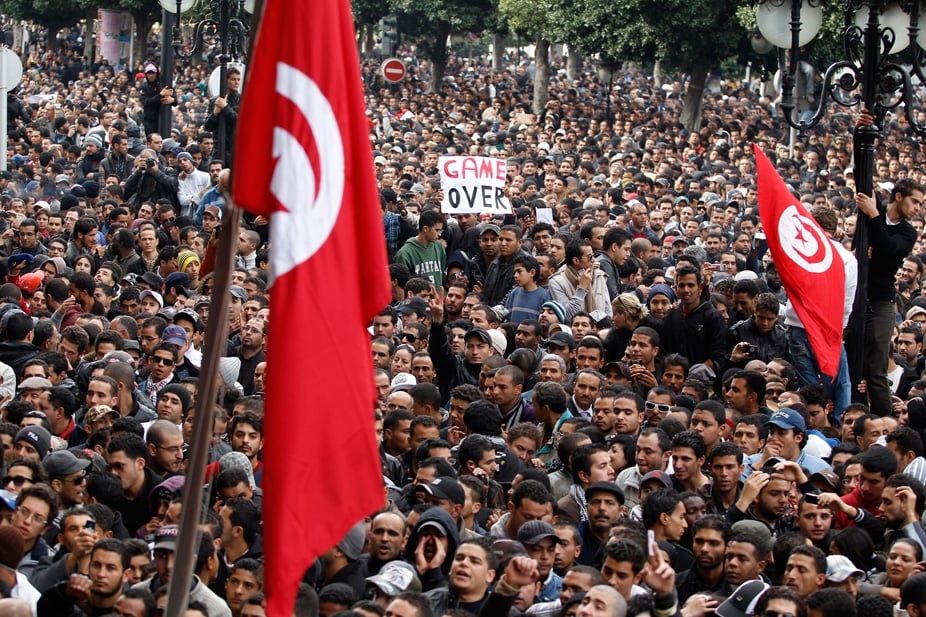
Today will be the million man march (what about women?!) called by the Egyptian popular revolt against the dictatorship. The name and in many aspects the meaning of this march is reminding of the march lead by Martin Luther King Jr. in Washington D.C. in 1963.

But actually I see even more resemblances with May 1968, when the French Mubarak, Gral. De Gaulle, had to flee to Germany to be reassured by the occupation forces of their backing in case of direct conflict with the people.

It was after these revolutions of 1968 when the Situationist International decided its own dissolution, for a good reason: their ideas had become mainstream so they were not needed anymore.

However the effect of 1968 or the 60s in general (which should effectively impede any lasting dictatorship for lack of interest in leaders or discipline anymore, a property of advanced/late Capitalism) has not been the same through the world. I'd dare say that the effects have been concentric and in most areas belated by decades or even more.

For example, I'd say that the 60s of Iberia did not happen before the 1970s. In Latin America, these social advances would not happen till the late 80s, the same as in Eastern Europe (after the aborted attempt of 1968, which gave decadent Stalinism some 20 years more of pathetic survival... but also an abrupt uncontrolled end).

In the Arab World they are only happening now, more than 40 years after the original explosions in the core Western countries.

Andrew Gavin Marshall writes these days at Global Research that maybe we are witnessing a global revolution. Possibly the best of that article is not Marshall's but a highly informative quote from an enemy of the people, the ideologue of Imperialism Zbigniew Brzezinski (originally published in NYT 2008):

For the first time in human history almost all of humanity is politically activated, politically conscious and politically interactive... The resulting global political activism is generating a surge in the quest for personal dignity, cultural respect and economic opportunity in a world painfully scarred by memories of centuries-long alien colonial or imperial domination... The worldwide yearning for human dignity is the central challenge inherent in the phenomenon of global political awakening... That awakening is socially massive and politically radicalizing... The nearly universal access to radio, television and increasingly the Internet is creating a community of shared perceptions and envy that can be galvanized and channeled by demagogic political or religious passions. These energies transcend sovereign borders and pose a challenge both to existing states as well as to the existing global hierarchy, on top of which America still perches...

The youth of the Third World are particularly restless and resentful. The demographic revolution they embody is thus a political time-bomb, as well... Their potential revolutionary spearhead is likely to emerge from among the scores of millions of students concentrated in the often intellectually dubious "tertiary level" educational institutions of developing countries. Depending on the definition of the tertiary educational level, there are currently worldwide between 80 and 130 million "college" students. Typically originating from the socially insecure lower middle class and inflamed by a sense of social outrage, these millions of students are revolutionaries-in-waiting, already semi-mobilized in large congregations, connected by the Internet and pre-positioned for a replay on a larger scale of what transpired years earlier in Mexico City or in Tiananmen Square. Their physical energy and emotional frustration is just waiting to be triggered by a cause, or a faith, or a hatred...

[The] major world powers, new and old, also face a novel reality: while the lethality of their military might is greater than ever, their capacity to impose control over the politically awakened masses of the world is at a historic low. To put it bluntly: in earlier times, it was easier to control one million people than to physically kill one million people; today, it is infinitely easier to kill one million people than to control one million people.

Notice how surprised and scared the ideologue of US Imperialism sounds. However this acknowledgement of a reality that cannot be anymore controlled, much less by police or even military means (other than nuclear genocide, if this is an option) actually honors Brzezinski, because he's among the few on the ranks of the oppressors really able to understand this change, a change that has happened in the last decades, that is global and that defines the new revolutionary subject. 

Or actually the old revolutionary subject elevated to a power never seen before. Brzezinski reads this as "insecure lower middle class" but it is actually more like intellectually apt and hyperconnected working class.

This and no other is the revolutionary subject, the social worker, as described by A. Negri, for instance, the only intellectual I know of who has been able to re-read Marxism in 21st century terms: terms of a perfected Capitalism (Toyotism) and terms of a perfected Working Class that is finally able to realize the dream of direct democracy at all levels, with emphasis on control of production. 

Back to Gavin Marshall, his article is too centered on the Middle East to really dig into the matter that inspires his headline. But certainly he has a point: the Empire, any empire, cannot control the People of the World anymore and these intifadas that are shattering North Africa and maybe beyond are a clear symptom, together with, for instance the revolt in Greece and other European countries, of an ongoing global class consciousness awakening. 

I think it is still soon to allow for a global revolution but it is something that may well happen along this decade in one way or another.

Friday, October 29, 2010

Globalization, Empire and Decadence

For those readers with a decent grasp of Spanish I must recommend this article of Jorge Beinstein at Rebelión:

Declinación del capitalismo, fin del crecimiento global, ilusiones imperiales y periféricas, alternativas (Declive of capitalism, end of global growth, imperial and peripheral illusions, alternatives).

It's really long and has little waste but I'll try to make a synthesis for those who can't read Spanish:

The bravadoes of capitalist success of the 1990s are gone. Now the best that capitalist ideologues can come up with is a mythical W shape for the economy that would, eventually, in a distant future, recover its past glory. Of course this is a false prospect: there's no recovery. 

Capitalism has succeeded in creating finally the first global economy but this success is also its decadence. This is the first condition for the overcoming of the Capitalist stage of history.

Our time is defined by the cooling of global capitalism and the failure of the central economies in keeping themselves on top. As reaction the Empire attempts to use its greatest advantage: military power. The Empire has launched an array of offensives in Eurasia, Africa and specially Latin America in an attempt to keep itself together and weaken its competitors (the BRIC basically).

Today the imperial power system is based on a state reason founded on the desperation generated by a senile brain... 


But the Empire is sick, it is huge but it is plagued of weak spots, time is its foe: it brings new economic woes, new social degradation, and amplifies the areas of autonomy and rebellion.

The economic stimuli only briefly patched the problem, while creating another one: debt. Now the austerity measures again can only be patch and one at a huge cost of legitimacy.

Now the dilemma of the imperial leaders is either to keep piling up debt (a short-term patch) or to enter a long depression in the hope of regaining control (a long-term disaster). It is a false alternative however: there are no options, no horizon of hope for the system. 

The roots of the crisis are old however: they come from the 1970s (or even earlier), when the overproduction was canalized into the military and financial departments (increasing military spending and relaxing financial controls). These reforms allowed to contain the crisis but degraded the whole structure: real productive capital declined and virtual, parasitic, financial capital thrived instead.

Critically, depredation replaced reproduction. 

Actually the predatory tendency was part of the system since its foundations but until these reforms, it was subservient of the reproductive role of society as a whole. Now reproduction does not seem to matter anymore: it's just like a global Tortuga island where all wealth is obtained by robbery or scam and spent almost at the moment.

There is no tomorrow, no plan. 

Seen in the long run, the Capitalist system of the 19th century did not simply chain up falls and recoveries but actually, after each recession, the system recomposed itself by accumulating more and more parasitic (financial) capital. The financial cancer irrupted in full at the change of century and eventually obtained total control several decades later. 

The discourse of progress and modernity obscured this fact, which, when evidenced, was considered backwards, a taint on the otherwise glorious colors of the titanic march of humankind to a better future (future that never really arrived, by the way). 

Where is the future that our old men forged?, sang a punk band from around here already in the early 80s.

Meanwhile the Military-Industrial Complex, whose parasitic nature should also be obvious (main cause of deficit, does not anymore generate many jobs, lives off destruction and death) took a central role as well. It became integrated with the financial and energetic sectors in one single massive oligopoly of parasitic nature. 

In synthesis: there is a perverse dialectic relationship between the expansion of the global mass of profits, its growing speed, the multiplication of civil and military bureaucratic structures of social control, global concentration of income, rise of the parasitic tide and the depredation of the ecosystem. 

This causes that overcoming Capitalism is not anymore the most necessary step in order to continue progressing but firs of all because Humankind needs to survive.

Capitalism and Anglo-Saxon civilization are the same thing. Europe and Japan languish at the shadow of US decadence, Chinese growth has been based on exports towards these declining markets. There doesn't seem to be an alternative as the US Empire decays. 

Not within the Capitalist system certainly. 

Meanwhile the peripheries have forged a history of struggles and organization, often defeated but still part of the social memory. In Latin America specially the old oligarchies are losing control. The US plan of restoring the old boys is destined to fail. Through the World, the empire is a thread of unstable vassals and protectorates, whose internal dynamics, expression of the crisis of underdeveloped modernity, are not anymore under imperial control and that actually challenge directly the imperial foundations.

In the periphery is the BRIC also, regional barons rather than true challengers, whose success is based in their very integration in Global Capitalism. They can maybe realize national capitalism to some extent but this must get them, sooner than later, facing the same barriers that affect the Empire they mirror. No hope either in those models that are not truly autonomous. Nothing is today.

Meanwhile the resistances, presented in the media as lost causes, unable to effectively challenge the monstrous military, economic and propaganda machine of the empire, survive against all odds. They stubbornly refuse to surrender and/or reappear with new forms.

But they are fragmented. Somewhat ironically the globalization of these necessarily local struggles appears as the necessary evolution of Humankind, as the necessary form of our collective survival.

So far the synthesis.


Opinion: Socialism or Capitalism Cancer and Death?

I agree with all the article, a rare occurrence. 

I agree that Capitalism has degenerated into a mere parasitism, what was unavoidable; that it has brought us so far but is unable to bring us to port and unless removed from office will get the ship wrecked and all us dead or worse. 

I think that the Empire has two good historical comparisons: one is a blend of late republic and late empire of Rome, the other, maybe the best comparison is the Habsburg Empire of Charles V and Philip II, with its meteoric rise and fall, its oversizing and its facing multiple foes all around. It is also an example that has all the qualities of Western Modernity. 

But there is one difference: the difference between the print and the Internet. The speed of communication.

There are other differences: Capitalism has organized huge transforming (productive) forces indeed but I see the Internet as the culmination of globalization and more or less effective reunion of Humankind into a single intellectual network with no or few bounds and near instantaneous impact. So it embodies the rest somehow. Similarly the printing machine represents better than anything else Early Modernity (even Late Modernity). It was the print what had the Protestants organized for instance, even if the Empire also made use of it. Hundreds of years later it was also the print which brought the bourgeois system to power and even in the last century it was central... until the Internet took over. 

This is something the article does not ponder except in a very general sense. If Modernity was the Age of Print, what will be the Age of Internet? It should not be the same: it never happens that way.

Sure: I'm ignoring a bit the impact of telephone, radio and TV but you will excuse me for that I hope: they are more a transition than any stable stage and could not really take the place of the printing machine, be it Gutenberg's or the Vietnamese.

Whatever the exact details of future developments, we are at a historical crossroads like no one before. There is a lot of potential here: billions of people, mostly good people, a global quasi-instant network of collective thought, persistent insurgencies nearly everywhere, growing awareness. There is also a huge challenge like never before, beginning by our environmental survival (us in our environment: Earth), continuing by how to organize so many people at a scale of democracy never before known and ending on the thorny details of how to organize a post-capitalist economy with no real precedents. 

I honestly do not feel at the height of the challenge and probably neither do you. But that is the challenge and we are here (by chance, by destiny...) to face it the best we can. 

For what they were we are, for what we are they will be. Ya know.