Showing posts with label Corsica. Show all posts

Friday, December 18, 2015

Corsica: nationalist victory

The new Assemby of Corsica:
orange = Per a Corsica,
pink = Prima a Corsica,
blue and grey = French Right
A "detail" that was somehow buried in the news by the issue of the rise of fascism in France and the striking similitude between the three main state-wide parties in their growing totalitarianism is that the French colony of Corsica, the nationalists achieved a major victory, finally getting to rule the Mediterranean island.

The elections were won by the independentist coalition Per a Corsica (For Corsica), with the leftist regionalists Prima a Corsica (Corsica First) coming second, French unionist parties had a mediocre result. 

Per a Corsica is made up of leftist Corsica Libera and centrist Femu a Corsica. Prima a Corsica is a leftist coalition of the Left Front and left-leaning independents. It is not independentist but neither centralist (reminds of the Catalan coalition Catalonia Can Indeed).

Obviously with 35% of the popular vote (2nd round for the Presidency, which fell to Gilles Simeoni, of Femu a Corsica) and short of a majority in seats (24/51), the Corsican nationalists cannot attempt to impel yet a separatist process but the tendency is there and will probably stay. The composition of the chamber seems to demand a relatively leftist policy, although I am a bit skeptical that the "moderate" president will be keen to implement them, surely leading to frictions as is happening in Navarre. 

In any case my congratulations to the Corsican people for taking steps ahead, moderate as they may be in favor of their self-rule and for giving a color note to the otherwise very sad electoral landscape of the French state.

Sunday, December 6, 2015

Fascists lead the vote in the French regional elections

Regional lead by party: black = FN, blue = LR, fuchsia = PS
The fascist party National Front, led by Marine Le Pen, has obtained around 30% of the vote in the first round of the regional elections, leading the tally in eight of the thirteen European regions of the French Republic (data from the four regions of America and Africa is still not available). 

The second best performing party was the conservative The Republicans of corrupt and authoritarian former President Sarkozy with around 27% of the vote, while the ruling Socialists (social-liberals) came third with roughly 23%. The divided real left parties (Front de Gauche, Greens) may have obtained together around 10-15% of the vote, a bit more if the much weaker Communist Party and Worker Struggle would be included.

The participation was very low, barely 40% in the departament encompassing the Northern Basque Country and Bearn, for example. 


Corsica: nationalists perform well

The nationalist list Femu a Corsica came second in the Mediterranean colony, with more than 17% of the vote, while the regionalist Rassembler pour la Corse came third with 13% of the vote, ahead of Sarkozy's LR (12%). Corsica Libera got some 8%. Unlike in the mainland, the fascists performed badly in the country of Pasquale Paoli, with a mere 9%. 

In the Brittany region (smaller than historical Brittany), the regionalist list Yes Brittany gathered 8%. 


Very worrisome

While indeed that one of every four French citizens, at least, is voting fascist is most worrying, I'm even more worried, if that is possible, about the return of Sarkozy (most likely indirect outcome) and the rightist drift of the PS, which has imposed a permanent state of emergency in the Hexagon. An outright victory of Le Pen would just be the logical outcome of such reactionary evolution across the whole of society, and it would not be significantly different from the autocratic rule of Sarkozy or Valls. France is clearly going down the drain of authoritarianism and that's very bad, for the French of course but also for all the rest of Europe.

Thursday, June 26, 2014

Corsica: National Liberation Front abandons armed struggle

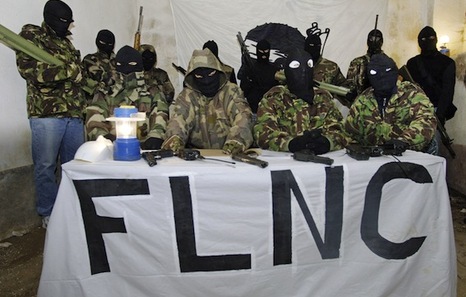
FLNC press conference in 2006
The National Liberation Front of Corsica (FLNC) announced yesterday their decision of unconditionally abandoning armed struggle, beginning a demilitarization process and a gradual exit from clandestinity. 

They make a call to the Corsican elects to implement a new negotiated statute with the French state, as well as an exit for prisoners and other victims of political repression.

They underline that their decision means changing from a phase of armed resistance to one of constitution of a true Corsican political power.

They recall that their historical armed action, which began in 1976, had a significant impact in the struggle against touristic speculation but that, starting now, their members will reject armed actions in Corsica and France. 

They denounce that, since the invasion of 1769, which destroyed the Corsican Republic (a true forgotten pioneer of democracy in Europe and the World), France has treated the island as a colony, installing nepotism and cronyism as the centerpieces of political power. 

They also link their struggle to that of other peoples of Western Europe such as Ireland, the Basque Country, Scotland and Catalonia, rejecting as well this European Union of the states 
... which denies the rights of the peoples, their cultural specificities and traditions, subjecting them to the yoke of senseless rules whose only goal is the domination of big trading cartels, despising the environment, citizen health and social achievements.
Source: Naiz Info[es].


Historical background

Flag of Corsica
Like many other Mediterranean islands, Corsica has a convoluted history of invasions by mainland based powers, be them European or African.  Between 1347 and 1729 Corsica was ruled by the Republic of Genoa. The Corsican Revolution achieved, after 26 years of struggle, the foundation of an independent republic in 1755, which was an influential pioneer of democracy and founded the first university of the island at Corte. 

In 1767, a throughly defeated Genoa sold their "rights" to Corsica to the Kingdom of France, which invaded the island in 1769. Pasquale di Paoli, leader of the Corsican Revolution and President of the Executive Council, had to find refuge in England. 

For a brief period Paoli supported the French Revolution of 1789 but soon became disenchanted with Jacobin hyper-centralism and allied himself with the English, establishing a short lived kingdom (1794-76). 

The island was attributed to Britain in 1814 but London gave it to France.

After the loss of Algeria, some 18,000 French settlers (known as "pied-noirs") were installed in Corsica. Today it is estimated that some 50,000 French live in Corsica, plus some other 50,000 immigrants from other countries. Corsica has a population of c. 322,000 people, a third of them without roots in the island.

In the 1960s Corsican nationalism resurfaced and in 1976 the National Liberation Front began its armed struggle, largely directed against settlers' properties and the tourism industry. Since 1979 they managed to "bring the Corsican problem to France" by repeatedly bombing many Paris-based banks, the Court of Law and killing several military policemen.

Upon the election of social-democrat François Miterrand as President of France, the FLNC decreed a cease-fire but were soon disappointed by the French reaction and returned to struggle. On August 19th 1982 they attacked 99 targets in a single day.

A second cease-fire, this time negotiated with Paris, began in 1988 but it only caused splits within the guerrilla. These divisions stepped up in the 1990s, including deadly clashes between the factions.

In 1998 the Prefect of Corsica, Claude Erignac was killed by the FLNC.

In 2009 the FLNC was reunified. Even if not much publicized, the FLNC has been continuously carrying armed attacks against French colonial interests. In 2011, for example, they claimed responsibility of 38 attacks in just four months, however in that same communication they announced their wish for peace.

Yesterday, June 25th 2014, the FLNC declared a unilateral cease-fire, demanding a new political statute for Corsica and a solution for the political prisoners and other victims of state repression.

Tuesday, September 3, 2013

Oil spill threatens Corsica

A 40 km long oil spill threatens the island of Corsica and in particular the Natural Reserve of Scandola, World Heritage (UNESCO). The source of the spill is unknown but probably originate in some oiler ship which decided to clean up its tanks, illegally, at the sea. 

It is estimated that only 10-20% of the sheen are hydrocarbons, what may somewhat limit the impact. Whatever the case if the NE winds continue the spill will hit Corsica in few days. 

Sources: News 24, Gara[es].

Monday, June 11, 2012

Basque Nationalist advance electorally in the North... and other stories from the elections in the French Republic

Because of the French imperialist-chauvinist political structure, the Northern Basque Country has no political organization whatsoever, not even a department, not even electoral districts. However the Basque Nationalist bloc (Euskal Herria Bai!) manages to get a slightly growing percentile of vote in the three historical regions in spite of all. 

On the worrying side the fascists of the National Front are also in that same zone of votes.

The electoral districts that divide the Northern Basque Country for the French elections (only results above 5% shown, the two leading candidates go for second round):

6th district (mostly South and Central Lapurdi): 
  1. UMP (French unionist right): 35.4%
  2. PS (French unionist center-left): 31.6%
  3. EH Bai! (Basque Nationalist mostly left coalition): 9.8%
  4. FN (French nazis): 6.3%
5th district (North Lapurdi and parts of Low Navarre):
  1. PS (French unionist center-left): 37.7%
  2. NC (French unionist center-right): 30.4%
  3. FN (French nazis): 7.1%
  4. FdG (French communists): 5.6%
  5. EH Bai! (Basque Nationalists): 5.3%
4th district (most Low Navarre, all Zuberoa and much of Bearn as well):
  1. PS (French unionist center-left): 32%
  2. MoDem (French unionist center-right):  26.28%
  3. UMP (French unionist right): 17.6%
  4. FdG (French communists): 7.6%
  5. EH Bai! (Basque Nationalists): 6.8%

Vote leader per commune in all the Atlantic Pyrenees department (Northern Basque Country and Bearn):

PS-red, UMP-blue, MoDem-orange, EH Bai!-yellow, Jean Grenet-cyan (source)


Overall in the French Republic

The results in France reinforce the twin party system with the ominous shadow of the nazis, relatively poor result for the two blocs of the left and collapse of the divided center-right (MoDem, NC).

  1. PS (center-left): 29.4%
  2. UMP (right): 27.1%
  3. FN (nazis): 13.6%
  4. FdG (communists): 6.9%
  5. EE-LV (greens): 5.5%

Screenshot from L'Humanité


Corsica

Femu a Corsica, a nationalist-and-green coalition, will fight for a seat in the 1st district of Upper Corsica and in the 2nd district of Southern Corsica, where they reached second position, with 24.7% and 21.3% of the vote. Corsica Libera, which run separately, did not obtain such good results but still mustered 3-8% of the vote, depending on the district. 


Kanaky (New Caledonia) and Polynesia

The Melanesian colony, formally a special collectivity, voted massively for the socialist and nationalist Kanak candidates (yellow) in the rural areas, however the southern districts, largely inhabited by European settlers, rather supported the conservative unionist parties (blue).

The FLNKS, which fought a bitter guerrilla war in the recent past, wins in the 2nd district (all the country but Noumea and the smaller islands) with 36%, while it has been displaced in the 1st district by the unionist forces.

In French Polynesia (overseas territory) also, the nationalist candidates seem to be fielding strong, gathering 29% of the vote and second position.


Martinique

Another French and EU territory with strong nationalist sentiment is the Caribbean colony of Martinique. The Martinican Independence Movement seems to be performing very strong: 40% in the 4th district, 28% in the 1st district (first force in both), 19% in the 3rd district but a mere 3% in the north (2nd district).

Sources: Kazeta[eu], Naiz[es], L'Humanité[fr],Liberation[fr].