Here there go my latest thoughts on the latest developments of the Arab Revolution:
Libya - protecting civilians or killing them?
There are serious concerns that the, rather unilateral, NATO intervention in Libya is overdoing it. The no-fly zone resolution of the UNSC was approved with ample leeway for all kind of direct attacks as the ones that Sarko and company are executing trigger-happily. The Arab League has already protested them, as they say that the UNSC resolution is intended to protect civilians, not to attack them.
A political reference in the area, the Workers' Communist Party of Tunisia (PCOT), which spearheaded to some extent the Tunisian Revolution and supports the Libyan rebels,
is against the intervention because it can only serve to uphold Western interests in the area.
Other Tunisian forces have diverse opinions. In general the ones more to the left are opposed to any foreign intervention because they fear it may damage the revolution overall, including in Tunisia itself. The Islamists are also opposed, while the Liberals (center-right forces) are supportive of NATO's attacks.
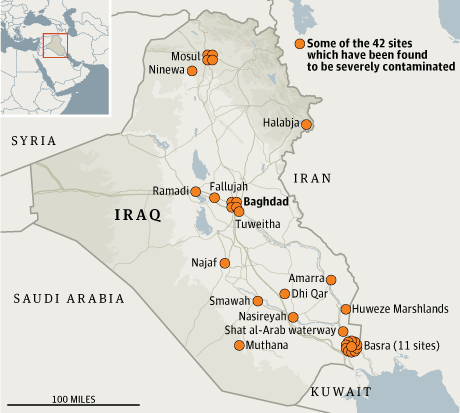
Personally, I am highly concerned about the possible use of depleted uranium ammo, which has already caused widespread health problems in Bosnia and Iraq. There is nothing in the UN resolution or in the declarations of Sarko and co. that suggests that they are not using depleted uranium in the bombings.
I also subscribe to the evaluation of the PCOT, because now the Libyan rebels have suddenly become a Western protectorate. True that without the intervention they may be all dead by now but with the intervention they have become indebted with Sarko and NATO in general, what is always something bad and dangerous.
Yemen - rapidly evolving situation, officers stage coup

Yemen looks every day more like a tactical victory for the Arab Revolution. Three top ranking officers have
brought their troops to the streets to protect the demonstrators, after the regime attempted to quell the revolution bloodily in the last days, after several ministers resigned in protest and after Saleh sacked his entire cabinet eventually.
This is a de facto coup, an Egyptian way out of a situation that has become unsustainable and impossible to win by the regime. Saleh has not yet been ousted but that seems now a mere technicality.
Egypt - minimal constitutional changes upheld in referendum
Only 15% of voters opposed the minimal constitutional changes promoted by the Egyptian Junta. The remnants of Mubarak's party and their satellite Muslim Brotherhood party promoted the yes vote, while liberal and leftist parties opposed it on diverse argumentations (constitutional assembly should be called, they have no time to organize for upcoming elections...)
The reforms remove some of the most abusive regulations of Mubarak's regime but leave the system essentially untouched. Most NO votes came from the urban areas, while the rural zones went overwhelmingly for the YES, highlighting a divide between city and country in the North African country.
Only 41% of voters exerted their right, still a much higher fraction than in past tightly controlled and even rigged votes under Mubarak. The details of the approved reforms can be read
here.
Update (mar 23): add
Syria to the equation.
Police stormed a mosque in the southern town of Daraa, at the border with Jordan, killing some. While the revolt has yet to extend to the whole country, demonstrations have happened already in several cities. That's who the Tunisian uprising began: not in the capital but in the provinces... and has proven to be a much more solid revolution than others for that reason.