Showing posts with label Peru. Show all posts

Friday, July 5, 2013

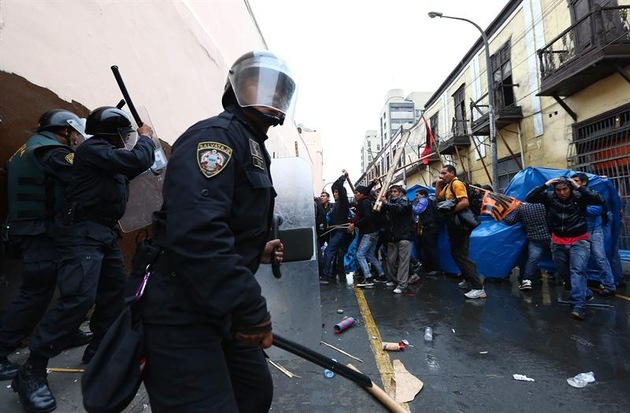
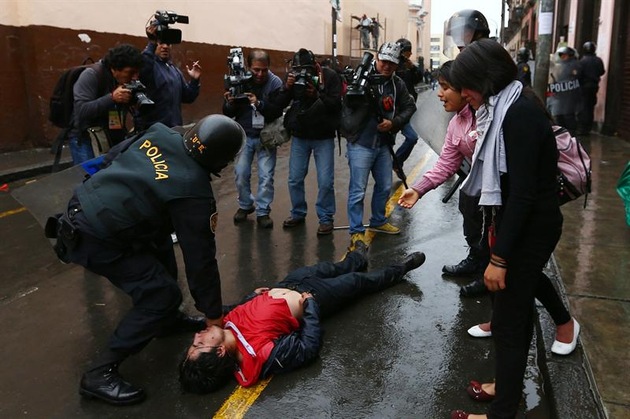
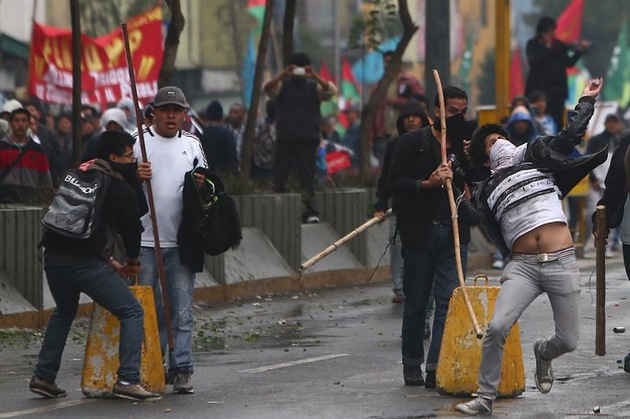
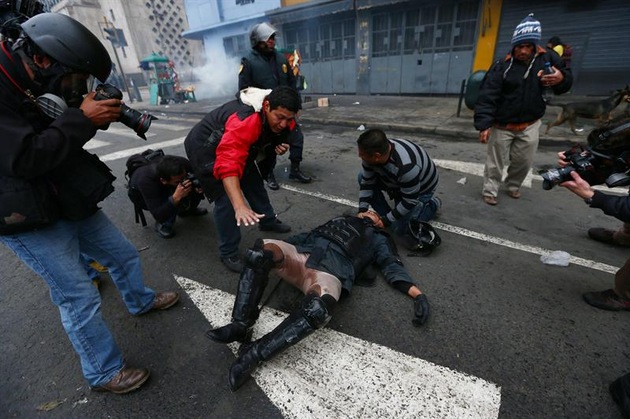
Peru: protesters besiege Congress, violent clashes

Police responded with tear gas and water cannons, among other weapons, to the attempt by demonstrators to reach the Congress of the Republic in Lima. The protests are being held against the new Public Service Law and have clogged all major cities, including Cuzco, Arequipa, Lima, Iquitos, Cajamarca, Ayachucho or Ica.

In Lima it was mostly the student demo the one involved in the clashes, which left three injured among civilians and two among police forces.


Source: Webguerrillero[es].

Sunday, June 16, 2013

Peru: large protests against fascist control in universities

Some six thousand students marched through the streets of Cuzco against the new University Law, which severely restricts freedom of speech and university autonomy. 


There were clashes between police and students on Thursday and Friday.

Source: Webguerrillero[es].

Tuesday, April 24, 2012

Amazon basin way to many and way too big reservoirs threaten the Amazon basin itself

From Everyone (PLoS ONE community blog)

Note: the Public Library of Science (PLoS) is a leading open access (free) scientific publisher and PLoS ONE is their lead magazine (the 21st century's Nature, so to say).

Although the nationally celebrated Earth Day has just passed, it’s important to consider our impact on the environment every day.  In their recently published article “Proliferation of Hydroelectric Dams in the Andean Amazon and Implications for Andes-Amazon Connectivity,” authors Matt Finer and Clinton N. Jenkins highlight a constant environmental concern; meeting the world’s growing energy demands. Finer and Jenkins developed a strategic ecological impact assessment of planned dams from the Andes to the Amazon. Their findings point to the need for this kind of heightened environmental awareness every day.

Abstract
Due to rising energy demands and abundant untapped potential, hydropower projects are rapidly increasing in the Neotropics. This is especially true in the wet and rugged Andean Amazon, where regional governments are prioritizing new hydroelectric dams as the centerpiece of long-term energy plans. However, the current planning for hydropower lacks adequate regional and basin-scale assessment of potential ecological impacts. This lack of strategic planning is particularly problematic given the intimate link between the Andes and Amazonian flood plain, together one of the most species rich zones on Earth. We examined the potential ecological impacts, in terms of river connectivity and forest loss, of the planned proliferation of hydroelectric dams across all Andean tributaries of the Amazon River. Considering data on the full portfolios of existing and planned dams, along with data on roads and transmission line systems, we developed a new conceptual framework to estimate the relative impacts of all planned dams. There are plans for 151 new dams greater than 2 MW over the next 20 years, more than a 300% increase. These dams would include five of the six major Andean tributaries of the Amazon. Our ecological impact analysis classified 47% of the potential new dams as high impact and just 19% as low impact. Sixty percent of the dams would cause the first major break in connectivity between protected Andean headwaters and the lowland Amazon. More than 80% would drive deforestation due to new roads, transmission lines, or inundation. We conclude with a discussion of three major policy implications of these findings. 1) There is a critical need for further strategic regional and basin scale evaluation of dams. 2) There is an urgent need for a strategic plan to maintain Andes-Amazon connectivity. 3) Reconsideration of hydropower as a low-impact energy source in the Neotropics.


Thursday, February 2, 2012

Peru: Great National March for Water begins against mining and water privatization

Yesterday February 1st, began in several villages and towns of Peru the Great National March for Water in support for the indigenous communities affected by the mining projects of Cajamarca (North).

The demonstration is against the privatization of water, the intervention in water heads and glacier basins and the recognition of access to water as a fundamental human right. Additionally they also demand a pause in mining concessions and prohibition of the use of mercury and cyanide in the extractive processes.

There are 148 open and 67 latent water conflicts in the Andean country. The most affected regions are Puno, Ancash, Cajamarca and Cuzco. 55% of these environmental conflicts are caused by extractive activities and externalizing costs to the environment.

They happen since mining and oil corporations, legal or illegal, entered native communities, without respecting the right to consultation, the environment, the Andean cosmovision nor the natural resources needed by the peoples to live.

In 2011 there were already violent confrontations between the People and the capitalists, backed by the state. 

In Puno water pollution reaches 80% and only 25% of the people can access safe water. There are more than two thousand mining concessions in that region. 

Among other activities, there will be a  water, mining and welfare forum in Lima on Feb 8th and 9th. An informal Hydric Justice Court will try and impose moral sanctions against environmental criminals. 

Source: LINyM[es].


Update (Feb 3): Police impeded the march to reach the controversial and most important mining project in Cajamarca, known as Conga (LINyM[es])

Tuesday, January 31, 2012

From the Net: 'Isolated Amazonian tribe makes uncomfortable contact' (The Archaeology Network)

Peruvian authorities say they are struggling to keep outsiders away from a clan of previously isolated Amazon Indians who began appearing on the banks of a jungle river popular with environmental tourists last year.

The behavior of the small group of Mashco-Piro Indians has puzzled scientists, who say it may be related to the encroachment of loggers and by low-flying aircraft from nearby natural gas and oil exploration in the southeastern region of the country.

Clan members have been blamed for two bow-and-arrow attacks on people near the riverbank in Madre de Dios state where officials say the Indians were first seen last May.

One badly wounded a forest ranger in October. The following month, another fatally pierced the heart of a local Matsiguenka Indian, Nicolas "Shaco" Flores, who had long maintained a relationship with the Mashco-Piro.

Sunday, January 22, 2012

Squids radioactive in Peru after Fukushima

Fukushima Diary reports today that squids in Peru have been detected with beta rays (internal contamination), presumably from Fukushima nuclear catastrophe, which is leaking radiation and radioactive materials to atmosphere and ocean continuously (never mind distributing them within Japanese products, which are exported uncontrolled for radiation). 

While I'm not aware that Peruvian squids specifically are exported a lot (although it is probable), Argentinean ones are and it's not that far away.

Wednesday, October 12, 2011

Echoes of the Class War (Oct 12) - Nonviolence to be not tolerated, proclaims Boston Mayor

Lots of stuff, and more and more every day. The world is boiling in crisis and revolution and I try to grasp a bit of it... but I can't even almost keep pace.

But what has got really into my dreams is the mayor of Boston, some Thomas Menino guy, proclaiming that nonviolence will not be tolerated. If nonviolence not, then what? Violence? I hope he was not inciting people to armed uprising, I understand that it's a crime under certain laws.
According to the Gandhian aphorism, this is the third step: they fight you. Then you win.


There is a call for World Revolution Day for this Saturday 15th. While I do not think that a revolution can be pre-scheduled, there are demonstrations and protests called in many many towns of all continents. Check them out.


Europe:


Basque Country:

Important meeting of international facilitators in Donostia (San Sebastian) next Monday. Among those taking part is Jonathan Powell,  former Cabinet Chief under Tony Blair and one of the main actors in the Northern Irish peace process. Former Taoiseach Bertie Ahern is also expected, although the names of those taking part have not been unveiled yet ··> Gara[es], Basque Peace Process.


Trailer (in English) of the documentary "Manual to fabricate a terrorist" ··> Vimeo (via Ateak Ireki[eu]).


England: blockading Westminster bridge (monday 10th) against public healthcare cuts ··> video at PO


Ukraine: sentence against Tymoshenko (··> Al Jazeera) is what it seems to be: a very pathetic plot to consolidate Yushenko by destroying all opposition. I'm no supporter of Tymoshenko but if that's all Yanukovich can gather against her, she is innocent: the price was unilaterally imposed by Russia after long winter blackmail cuts that shattered Europe and this kind of trial is totally unprecedented.


North Africa:

Egypt: Deputy PM Hazem El-Beblawi resigned on the massacre performed by the army but his resignation was rejected ··> Al Jazeera.


West and Central Asia:

Palestine:

Zionist forces fire against fishermen in Gaza waters ··> Uruknet

Violations against detainees in hunger strike increase ··> Uruknet.


Iran: actress Marzieh Vafamehr to be lashed and imprisoned for taking part in critical movie and allowing to filmed without the stupid cloth prison the ayatollahs (men) impose to women ··> BBC.

Georgia and Kazakhstan, two quite authoritarian regimes of the region, to ban communist parties ··> Kaosenlared[es], Solidnet.


Yemen: thousands of women demonstrate against Saleh ··> video at PO.


America:

Canada: Michael Schmidt (right), defender of the right to drink raw milk, on hunger strike along with supporters from all North America ··> Food Freedom, The Bovine.


USA: 

Confusing claims of Iran being behind alleged terror plot in Washington D.C. ( ··> Al Jazeera) do not seem to convince anybody. However they could be used to launch a war in order to attempt a distraction from major internal problems ··> Charlie Pottins: 'Assassination? That's our game'.
Radiation leak at Brookhaven, NY, not announced in 10 days ··> EneNews.

Boston: police charges against Occupy Boston demonstrators, notably war veterans, mayor proclaims "we will not tolerate civil disobedience!" ··> Naked Capitalism (incl. video), The Guardian, video at PO, another video at the local Fed.

NYC police is often privately paid and act as private guards (with a public badge and authority) ··> report at Naked Capitalism

Washington D.C.: protest continues near White House ··> video at PO, another video with anti-war rally combined.

Columbus, Ohio: rally at state house ··> video at PO

Colorado Springs demo ··> video at PO.

Los Angeles: thousands demonstrate at Bank of America ··> video at PO.

There's also some activity reported in Oakland ··> Ah, Mefistophelis.


Honduras: 

Another farmer murdered in Bajo Aguán. Santos Seferino Zelaya, 35,  was shot dead yesterday by security guards of terrorist landowner Miguel Facussé ··> LINYM[es].

Soldiers threaten farmer with slow death: we will cut your fingers so you will slowly bleed to death was the 'protection' offered to this 'lucky' farmer, Walter Sabillón, by the troopers that the state deployed in his area Bajo Aguán ··> LINYM[es].


Colombia: S.O.S. prisoner Diomedes Carvajalino: the Colombian terrorist state denies medical treatment for this person's left leg's infection that will probably kill him. Diomedes, 28, is bound to a wheelchair because of the tortures suffered after his arrest in 2002 ··> Kaosenlared[es].


Peru: President Humala sacks police commanders in corruption purge ··> BBC.


Argentina: the People against the mining multinationals ··> 25 mins. documentary at the new Al Jazeera program Activate.


East Asia:

More than just Burmese in this state
Myanmar (Burma) and Kachin Country: 

Interesting analysis of the dams and ethnic conflict in the Kachin Country ··> GeoCurrents

Kachin rebels lose major stronghold as government advances ··> The Irrawadi.


Japan: 

Worker dies while decontaminating rice field ··> Fukushima Diary, EneNews.

Interview with Fukushima Daiichi workers at a German TV (with English subtitles) ··> video at Ex-SKF.


Opinion (economy): 'Has China just hit stall speed?' ··> Yves Smith at Naked Capitalism.

Saturday, June 25, 2011

Other four people dead and 74 injured yesterday in Peru students' protest

Alan García seems to want to be put to trial for crimes against humankind: his last days of mandate are all covered in blood. I just mentioned that five people were killed in Juliaca and I read now that other four were murdered in Huancavelica, further Northeast, in the center of Peru. 

Three of them killed by police forces either by shot or beatings: Oswaldo Quispe Lázaro, 22, Iván Cora Quispe, 30 and Davyi Huallalani Martínez, 14. A fourth demonstrator, Julio Páucar, died accidentally while flipping a truck over a to set up a barricade.

Local police admitted that there were police infiltrated among the protesters and that the deaths happened in the context of fights between these plain-clothes policemen and demonstrators. They admitted to have live ammunition (bullets and pellets) to repress the protests.

The protests mean to prevent that half of the local university's budget goes to a semi-private project that they consider unnecessary in nearby Tayacaja, in the same region, that has only 450,000 inhabitants as a whole. They argue that this project only obeys to political reasons and that it does not consider the real educative needs of the region. 

According to Ana Delgado (La Haine), some 270 social conflicts are extremely hot around the country as outgoing President Alan García faces his last 40 days in power. Then President elect Ollanta Humala will assume power, hopefully for the better.

Police kills five in Peru anti-mining protest

Peruvian police has killed five anti-mining protesters who, in a group of at least one thousand, attempted to blockade twice the international airport of Juliaca, at Lake Titicaca, not far from the Bolivian border. After these massacres protesters stormed a police station in the nearby town of Azángaro.

The project belongs to Bear Creek mining company, from Canada. Local citizens, mostly of Aymara ethnicity, oppose the project because it should cause major environmental destruction while bringing very few benefits at all for the affected communities. 

Source: AFP.

Demonstration against the mining project


Update (Jun 27): the mining license was revoked by President García. Bear Creek will sue the government for this reason  - Reuters (via PO)

Monday, June 6, 2011

Humala to become President of Peru

The recount at the Peruvian Presidential elections yesterday gave already a safe (even if narrow) victory to Ollanta Humala versus the candidate of the Empire and oligarchy, Keiko Fujimori, who had all the support of the media. 

In the worst case, Peruvians would have chosen the lesser evil and would have appointed the first President of the Republic whose blood comes largely from the first inhabitants and not colonists, be them European or Japanese. This is particularly important as Peruvians are 45% Native Americans and another 37% is considered Mestizo, which in Peru is probably just Native who have lost their language and cultural roots. That is as much as 82% of Native and Mestizo Peruvians. However, like many other American states, Peru has suffered from a deeply rooted (albeit not institutionalized) racist society that pushed Native Americans and Mestizos to serve the tiny Creole oligarchy of European ancestry (15% of the population). It has been that way since the time of Pizarro but it is beginning to change.

More difficult is to discern where will Humala and his Peruvian Nationalist Party lead the country in the near future. It is clear in any case that he has good relations with neighboring Bolivia's Evo Morales, who pledged his support already in the 2006 elections, when he ran against Alan García, losing by a tiny margin. 

Humala is openly Bolivarian, that is, he adheres to the notion of the Greater Fatherland proposed by Simón Bolívar for Spanish-speaking America, and has a loosely left-wing political program, which is more like center-left. Nothing too radical in principle, as the main tenet of his program seems to be nationalism. It is this aspect what is really welcome because Peru was the penultimate US neocolony in South America and with Humala's victory, no doubt, the Empire loses another pillar and the Colombian narco-state becomes a bit more isolated.