Showing posts with label Pacific Ocean. Show all posts

Wednesday, April 22, 2015

Fukushima killing hundreds of millions of animals, driving species to extinction, in Pacific Ocean

There's been some time since I last dedicated time to the Fukushima catastrophe but nothing has improved at all: the "China syndrome" has been confirmed, the situation is absolutely out of control and the effects are becoming more and more serious and widespread. 

Two snippets from EneNews (published today) illustrate how bad it is, but remember that these are just a couple of details in a continuous flood of very bad news:

1. Hundreds of millions of animals dead in North Pacific Ocean in the last two years, dozens of species annihilated → LINK

2. Power outage at Fukushima NPP and new mass discharge to the Ocean of radioactive water → LINK

Tuesday, July 15, 2014

Fukushima news

Fukushima emergency... blog has today a batch of more info, unavoidably bad news, on the ongoing nuclear disaster of Japan. I'm just listing a few here, if you really want to know please follow the specialist blogs and sites.


Fifth reactor under serious problems

On one side reactor number 5, originally spared, from the catastrophe is now under major cooling problems, with no solution in sight. This has been ongoing for a week or more now but the it becomes more and more serious as the situation is not being brought under control in any non-provisional way.


Offshore dumping sites around Japan hit by earthquakes

In the map to the right it seems surprisingly obvious that these offshore dumping areas for radioactive and other highly toxic materials are right on top of major fault lines. So good for those who trust the engineers' qualification and seriousness.

On the other hand it underlines that radioactive pollution in the North Pacific Ocean is probably not only caused by Fukushima but also for a whole half century of nuclear madness, which has left lots of residues on land but also under the sea. 

Independent researchers are prevented from investigating the radioactivity around Japan and only governments and the UN agency IAEA (under tight control by the Nuclear Lobby) are allowed to do so.

→ original article at FEWCWD.


Fukushima radiation in Philippines: no dose is "harmless"
 
Dr. Romeo F. Quijano writes from Philippines reporting that the authorities have finally acknowledged that Fukushima fallout has reached the country, although they are minimizing its importance. Excerpt:
For the past several years, health research on the effects of ionizing radiation exposure has focused on estimating the number of excess radiation-induced fatal cancers and excess severe genetic diseases to be expected in a population given the average estimated exposure to radiation for the country. Other radiation-related human tragedies such as earlier occurrence of cancers, endocrine disorders, immune dysfunction, developmental disorders, and other illnesses are not included. This averaging approach also fails to deal with global distribution of air and water with the result that deaths and the cumulative damage to future generations are not limited to one country.

The painful human experience from ionizing radiation since the US dropped nuclear bombs on Hiroshima and Nagasaki in 1945 has stimulated a tremendous growth in understanding the harmful effects of ionizing radiation on the human body, despite the official suppression of independent scientific data by the nuclear powers. Thanks to independent scientists, we now know that radiation has no safe level.

As early as 1955, Dr. Alice Stewart. who was head of the Department of Preventative Medicine at Oxford University, discovered that the number of children dying of leukemia had risen 50% in only a few years. She determined that babies born to mothers who had a series of maternal X-rays of the pelvic region during pregnancy were twice as likely to develop leukemia or cancer as babies of mothers who had not been X-rayed. These diagnostic X-rays exposed the patient to extremely low doses of radiation. Other researchers have since verified these findings and have shown the number of mutations to be in direct ratio to the amount of radiation received by the reproductive organs.

In 1970, Dr. Thomas Mancuso, a professor of occupational health at the University of Pittsburgh, was commissioned by the Atomic Energy Commission to study the “biological effects, if any, of low-level ionizing radiation among workers employed in atomic energy facilities”. It was expected that Mancuso’s study would find that nuclear work was safe. However, Dr. Mancuso's team found a definite relationship between low levels of radiation and the development of certain types of cancer in spite of the fact that all workers employed were specifically selected for their excellent health. They discovered three kinds of cancers among the workers: lung cancer, pancreatic cancer and cancers of blood-forming tissues, particularly Myeloma. The cancers were occurring at well below the radiation exposure levels of the official limit of five rads per year. This meant that the current standards for nuclear safety might be twenty times too high. However, there were powerful forces who suppressed the research. Mancuso’s funding was cut off and he was ordered not to publish his findings. He was denied further access to the workers’ data. In 1977 he was ordered to give up his files or have them seized.  Practically everyone who sided with Mancuso were subjected to character assassination or lost their funding. The government would only allow studies of workers health records to be performed by labs under them. The data of workers health became the virtual monopoly of a small group of government sponsored scientists and were unavailable to the larger scientific community.


Fukushima women demand government resignations

Fukushima Women against Nukes have demanded in press conference the resignation of Environment Minister Nobuteru Ishihara as well as a sensible change in the government policies about nuclear pollution and, particularly, its effect on children.

They also denounce the obscurantism and shameless cheating of the Government in measuring radiation and evaluating the danger it poses for the population.

They also feel extremely upset for the lack of support by the authorities to the nuclear refugees.

They denounce that the Government is only concerned with hiding the problem.

Monday, June 23, 2014

Fukushima myths vs facts

Fukushima emergency, what can we do? discusses today eight myths found in the Internet regarding what is certainly the World's worst nuclear catastrophe, warning against exaggeration, while also against denial.

This is a fact (actual radioactive deposition measured in the immediate aftermath of Fukushima catastrophe):


This is a myth (it actually represents risk of tsunami after the March 2011 Fukushima earthquake and not radiation in any way):


All the story at Fukushima emergency...


Update: the original post seems to have been deleted but I feel I don't have a choice here because it already has comments, etc. So I'm copy-pasting from the RSS feed for your reference:


We’ve spotted a number of myths about the Fukushima nuclear disaster on Facebook and in forums that we’d like nothing more than to debunk. The age of many of these myths is irrelevant, as every day brings forth “new” posts rooted in their misinformation.
 1, THE INFAMOUS PACIFIC OCEAN DEATH MAP

No, this is not a map of anything related to radiation from the Fukushima Daiichi nuclear disaster. It is a map of potential tsunami heights from NOAA.

 While this misconception has been integral to creating awareness broadly over the ongoing situation, it has also seeded a lot of misinformation.


2, FUKUSHIMA RADIATION HIT SAN FRANCISCO
A recent video of a man at Half Moon Bay whose geiger counter alerted of high radiation levels while standing on the beach went viral, and has created an echo chamber of misunderstanding.
His geiger counter was detecting radiation, although it was naturally occurring radiation from the thorium-rich granite within the sand, and not from Fukushima. It’s equally perplexing that an official response from Dean Peterson, county environmental health director “noted that many innocuous items could spike the radiation levels in an area, including red-painted disposable eating utensils“. This seemingly sarcastic statement only furthered unrest over the issue, and took focus away from credible sources which have been reporting the phenomenon for the better part of a century.
Analysis of kelp has found that it has been contaminated to a certain low level. To what extent might be revealed by the further ongoing studies as the one lead by Ken Buesseler conducting analyses all along the West Coast from Alaska down to South California seaching for eventual Cesium 134/137 and Strontium contamination. ( Cesium‐137 = 1.4 Bq/m3 Cesium‐134 <0 .2="" bq="" font="" m3="">
Only a detailed mapped analysis would reveal the real extent of the Fukushima contamination of the ocean along the West Coast. Unfortunately no such study is at the time being conducted on West Coast soils.
Related: Safecast blog – Radiation on California Beaches


3, ALL FISH IN THE PACIFIC ARE NOW RADIOACTIVE

Based on test results from both California and Alaska, trace amounts of Fukushima radiation are in fact showing up in a few coastal fish, but certainly not all of them. Currently measured levels are at this point very, very low.
According to the Canadian Department of Fisheries and Oceans, the oceanic plume is just starting to hit Alaska, and will begin hitting the majority of the West Coast in March2014. The numbers they are predicting will also be very low.
While all governments have proven to be a rather untrustworthy source for information on Fukushima, there are independent groups doing their own Cesium 134/Cesium 137 only testing up and down the coast and posting test results, and they too are not showing important level of contamination.
Though again they should test for strontium 90 and other radionuclides as well.
Related: Vancouver Food Radiation Monitoring, Loki Fish, and Berkeley University’s RadWatch.
While fish closer to Japan are showing high levels of radiation, on our coastal fisheries as far as Cesium 134 it is not yet present in high amount.
But you have to keep in mind that any amount of internal contamination, low or high can be fatal.

4, AN UNDERGROUND EXPLOSION IS HAPPENING AT FUKUSHIMA 
Multiple reports by TEPCO around Christmas 2013 of steam rising from Reactor 3 have prompted interpretations from all corners of the internet.
Steam rising from Reactor 3 is nothing new. It happens regularly, and has been happening since day one of the incident. 
What caused the steam over Fukushima reactor 3? There are a few reasons; The steam has a habit of forming after rainfall in the area, and some experts say the rain is making its way down to the reactor core, heating up, and evaporating.
Many people also believe the reactor core has breached both primary and secondary containment, and portions of it may still be fissioning which produces steam. Steam is not a good thing, but it is not a new thing, and there was no underground explosion. 
In fact multiple radiactive toxic gassing is permanently occuring on Daiichi site, that is very alarming in itself. Continually releasing a heavy load of radionuclides into our atmosphere, carried in every direction by the winds, bioaccumulation into the sea and onto the lands.

5, THE OTHER MAP; NRC FALLOUT MAP

After inquiring with the NRC directly, this was their response: 
Hello Mr. Mattingly, 
The “radiation plume” map was an anonymously produced falsehood and not a creation of the NRC or any other government agency. The creators of the false map also used the logo of the Australian nuclear regulator. The “Pacific deadzone” map has also been debunked as a distortion of a tsunami height simulation. The third map in that collage is also a complete falsehood. 
Please let me know if you have any additional questions. 
Scott Burnell Public Affairs Officer U.S. Nuclear Regulatory Commission 
This doesn’t mean that North America was not hit with radiation; The Comprehensive Nuclear-Test-Ban Treaty Organization runs an International Monitoring System with 321 sensors worldwide. 
Below is a map of what those sensors picked up. According to the sensor data, 1000 bequerels per square meter (1Kbq/m2) fell on the Western Seaboard of North America. If you would like to view the actual sensor data, accompanied with additional maps, you can do so here.

6, EVERYTHING IN THE PACIFIC IS DYING BECAUSE OF FUKUSHIMA
I am sure many of you have seen all of the reports of mass die-offs all over the pacific, herring in British Columbia bleeding from their eyeballs, the sea stars melting away all along the entire coast, polar bears and sea lions have mysterious oozing sores and their fur is falling out, a two headed whale washing up on shore, the sardine population collapsing, and countless more.
The problem with this myth is that scientists have yet to give a solid explanation for any of these. Not a single one of them. Is it from Fukushima? We don’t know. We thought we would mention this one as it is noteworthy, and everyone wants to know.
Is the entire ocean floor now 98% covered in dead sea life like many articles are stating? No. This National Geographic article is where all of that originated is only talking about one localized area, and it is only sea salps they are talking about. Again, they do not know what is causing it, and the entire ocean floor is not covered with dead animals.
As much as we would love to give you a solid answer on this topic, the data to prove, or disprove it, simply isn’t available at this point, so there is no point in assuming.
Though they are several species severely affected and dying in various locations, there might be actually several factors involved : acidification of the ocean, virus, Fukushima contamination. 
At this point it is therefore not conclusive and totally unfitting to amalgam all those happenings and to say that they are all caused only by Fukushima contamination.

7, POTASSIUM IODIDE WILL PRESERVE MY HEALTH 
 

The answer to this is double-sided; Different types of radiation do different things to your body. Some mimic calcium, some mimic potassium, some mimic iodine, etc. Potassium iodide is a form of iodine. When you take it, it fills up your thyroid gland with non-radioactive iodine, thus not leaving any room for radioactive iodine to be taken in.
It will only protect your thyroid. Potassium Iodine only protects your thyroid gland from Iodine 131 a radionuclide released at the first stage of a nuclear disaster and it has a radioactive decay half-life of about eight days . And it should therefore be taken at the very early stage of the disaster or few hors prior to enter a contaminated zone. It does not protect your body from the many other radionuclides released during a nuclear disaster.
Potassium iodide therefore should only be taken in the event of a radiological disaster. It has the potential to cause adverse health effects, however the potential risks are far lower than allowing radioactive iodine into your thyroid.
At the moment, Fukushima is not releasing anymore Iodine 131 into the atmosphere to warrant taking it. It is however a good idea to eat foods that are naturally high in iodine such as Southern Atlantic Seaweed, and leafy greens to not only protect yourself from possible future releases, but also for your health in general. 
If there is another major event at Fukushima, or elsewhere, you should have a conversation with a licensed medical professional on how much you should be taking, and for how long, depending on your geographical location, and proximity to the event.
8, PEOPLE NEED TO EVACUATE THE WEST COAST 
If the ongoing situation at Fukushima became toxic enough to warrant an evacuation of the West Coast, there would really be no safe place to evacuate to.

The radiation could circle the globe in a matter of days, just as the original plume from Fukushima did, and eventually pollute the entire planet.

However for smaller incidents, it’s not a bad idea to avoid the initial dispersal zone if it’s an
option.


CONCLUSION

We advise people, to read, dig deeper and verify any news article before to believe and share out an information, the gravity of the ongoing Fukushima disaster and its slow but sure contamination of our biosphere and of our food chain is bad enough, exaggerations, sensationalism are totally unneeded and uncalled for.

We should stick to trhe facts and not extrapolate too far, we should all act with a proper sense of responsibility, face the real problem but not feed into a paranoia.

We advise people to learn to measure radiation, and to learn as well basic radiation protective measures.

We advise you as a precautionary measure to not eat Pacific Ocean products, any tiny radionuclide present in any food is just a Russian roulette bullet waiting in due time to hit you.


Note: the original entry was not written by Citizen Perth, the usual author of Fukushima emergency..., but by some Dun Renard. This may have something to do with the deletion (???) - ask them.

Thursday, May 29, 2014

Fukushima An In Depth Documentary (13 mins)

Must watch: it is not just short but also very good, synthesizing in those few minutes nearly everything that we must know about the Fukushima nuclear catastrophe and the aggravation of the policy of denial.


Via: Fukushima Emergency...

Friday, March 7, 2014

Fukushima: even the pro-nuclears admit to unstoppable China syndrome now

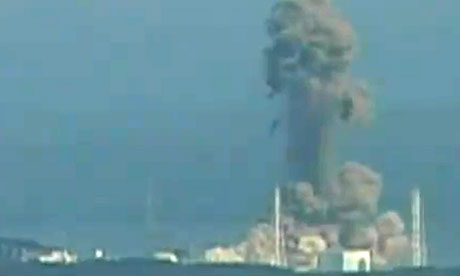
Reactor 3 nuclear explosion (March 13 2011)
As the third anniversary of the worst nuclear catastrophe ever approaches, and as the radioactive materials are already arriving to North America, brought by the implacable oceanic currents, it seems that this year we are going to see some some more honesty about the civilizational challenge that this unprecedented disaster means for Japan and the whole World, although always with a small mouth and trying to make up the ugly truth, as they are much more worried by a growing anti-nuclear public opinion (what they call "panic") than by widespread radioactive contamination. 

Maybe you remember that two years ago, in electoral campaign, the Japanese Government falsely claimed that Fukushima Daiichi had achieved cold shutdown, that everything was alright again. Those with some information could not believe them at all but it was just opium for the masses, and like the actual painkiller drug, its effect could only be temporary and merely hide and not at all solve the huge problem. 

Actually the catastrophe is most likely unsolvable and even the pro-nuclear magazine IEEE Spectrum admits to it now. Key excerpts:

The damaged reactor cores continue to glow with infernal heat, so plant employees must keep spraying them with water to cool them and prevent another meltdown. But the pressure vessels and containment vessels are riddled with holes, and those leaks allow radioactive water to stream into basements.

...

TEPCO officials have admitted frankly that they don’t yet know how to accomplish the tasks on their 40-year road map ...

...

Chernobyl and Three Mile Island, the only other commercial-scale nuclear accidents, can’t teach Japan much about how to clean up Fukushima Daiichi. The Chernobyl reactor wasn’t dismantled; it was entombed in concrete. The Three Mile Island reactor was defueled, but Lake Barrett, who served as site director during that decommissioning process, says the magnitude of the challenge was different. At Three Mile Island the buildings were intact, and the one melted nuclear core remained inside its pressure vessel. “At Fukushima you have wrecked infrastructure, three melted cores, and you have some core on the floor, ex-vessel,” Barrett says. Nothing like Fukushima, he declares, has ever happened before. 

...

Every day, about 400 metric tons of groundwater streams into the basements of Fukushima Daiichi’s broken buildings, where it mixes with radioactive cooling water from the leaky reactor vessels.

Actually that is a problem that all coastal reactors potentially face. While in Chernobyl (inland) there was enough distance between the reactor and the water table to proceed with the construction of a new concrete layer underground, in Fukushima that is simply impossible. Because nuclear reactors need water for cooling and steam production (it is actually the steam which moves the electricity generating turbines), all them are built near water sources, often at the coast, where the water table is always very shallow. 

As long as that melted fuel glows inside reactors 1, 2, and 3, Fukushima Daiichi will remain Japan’s ongoing nightmare...

The article goes over this issue very surreptitiously: what does it mean that the fuel, the corium, "glows"? 

The melted fuel may also have a lava-like consistency, with a hard crust on top but softer materials inside...

In other words: even if the massive amounts of water poured to the reactors may manage to temporarily cool down the outermost layer of the corium, and that way contain to some extent the damage, the monster is still very much alive inside.

In any case the pro-nuclear article is full of inappropriate false optimism with loads of crap about how robots theoretically "will" solve the problem somehow, apparently by breaking up the corium in manageable chunks. 

That is mere science fiction. While robots can indeed be very versatile, they are as susceptible to radiation as animals, including humans. Their electronics are not at all radiation-proof as was already proven in Chernobyl, where humans actually lasted for longer than bots (although of course they died in troves later on). 

The pro-nuke article does not say a word about this crucial problem. I guess it's better in their sick minds to keep the hopes up somehow, even if it is by means of blatant lies. Even if the new bots would be somewhat more resistant to radiation it is simply unthinkable that they can directly deal with the corium itself.

An even more outragingly blatant falsehood is:
Over the decades its radioactivity will gradually fade ...

That is absolutely false: while the half-life of some (but only some) of the lighter radioactive elements is relatively short, the molten fuel is essentially made of a mixture of enriched uranium and plutonium (MOX) and these heavy minerals have extremely long half-lives: almost 25,000 years for plutonium and not less that 700 million years in the case of uranium. These are absolutely mind-boggling figures for the human concept of time. As I said back in the day, radiation is forever.

Even a lighter element like cesium has a half-life of over 180 years, what means that to reduce its danger to 10%, needs some six centuries.

We are not talking decades here, we are not talking even centuries: we are talking of a nuclear hotspot that is going to be releasing huge amounts of radiation to the ocean and the atmosphere FOREVER. 

And no, the bots won't be able to solve it, at least not in the upcoming many centuries. Radioactivity is the disintegration of matter and nothing material can break into it and remain intact.


H/t: Energy News


See also: video of Arnie Gundersen on the radioactive accident (salt mine ceiling collapse with breach into nuclear canisters) near Carlsbad, New Mexico → FEWCWD.


See also: extreme danger at Hanford Site's dam → Energy News.

Sunday, December 15, 2013

TEPCO finally admits that they failed to cool molten nuclear fuel at Fukushima

Remember that in March 2012 the Japanese Government lied to the whole World claiming that the cold shutdown had been achieved in Fukushima Daiichi? I do, because I was utterly scandalized knowing what I knew, knowing that it was the most criminal lie since the denial of the Holocaust... or maybe even worse. Millions of people, children included, in Japan and elsewhere are being exposed to the radioactive harm of the worst nuclear accident ever and all they cared about was to save face with a lie so big and so murderous.

Yesterday finally TEPCO admitted publicly (→ Asahi Shimbun) that they completely failed to even achieve a half-decent cool down of the three nuclear meltdowns and that they knew that since late March 2011:

... water failed to cool it and the other reactors efficiently, and could not stop the core meltdowns in the No. 1, No. 2 and No. 3 reactors.

I knew too. Not in such detail but it was quite obvious for anyone with a critical mind and some independent information.

“We should have shared the finding with the public in the belief it would help promote universal safety, but failed to do so,” said [a] TEPCO Managing Executive Officer... 

Yes you should indeed.


EneNews (which is the means by which I found those news) also reports in the same entry of a 2011 study on the consequences of Fukushima catastrophe:

Jiřina Vitázková & Errico Cazzoli, Estimate of Consequences from the Fukushima Disaster. NPSAG Research Reports 2011 → LINK

This study estimates that, at the time of its publication, more than two years ago, Fukushima was already almost four times as bad as Chernobyl. It's difficult to estimate how it is as of today but I would not be surprised if it is 10x as bad as Chernobyl already (or even worse). 

But, unlike Chernobyl, which is semi-contained, Fukushima is impossible to contain because of its proximity to the sea, and therefore to the underground water table as well, there are no human means to contain it at all. The catastrophic site will keep polluting forever in human terms, what means several Chernobyls every year. 

Nobody wants their children to have to put up with that, right?

I actually have serious doubts about the planet and human life being able to withstand such a nightmare in the long run but, assuming we can survive this mega-catastrophe, it is absolutely clear that nuclear energy must be eradicated immediately, before another even worse catastrophe happens. 

Also Japan should be completely evacuated, at the very least the Northern half of Honsu, including Tokyo Metropolis.

Saturday, September 28, 2013

USA bans food imports from almost half of Japan

Nothing less than 14 Japanese prefectures have been banned from exporting food to the USA. Previously it was just eight. 

The affected area includes: Fukushima, Aomori, Chiba, Gumna [sic - Gunma], Ibaraki, Iwate, Miyagi, Nagano, Niigata, Saitama, Shizuoka, Tochigig [sic - Tochigi], Yamagata and Yamanashi prefectures.


For some reason, two of the the three prefectures of Greater Tokyo (Tokyo and Kanagawa but not Chiba), totally surrounded by the banishment zone, are still allowed to export to the USA. Akita, in NW Honshu, is another pocket inside the red zone. 

Of course, it is very logical and reasonable to ask how can any international level games such as the Olympics be held in such conditions, but even more reasonable is to ask why is there not any plan to evacuate all that zone or at least the most severely affected areas? The children even? I know we are talking of millions but, well, precisely: Holocaust by conscious inaction is not any better than Holocaust by action.

This is the largest trade ban of the many that (very justifiably) plague Japan since the Fukushima nuclear catastrophe. For comparison, South Korea has a ban only on seafood and only affecting eight prefectures, while China and Taiwan ban food from 10 prefectures.

Source: EneNews, citing the FDA and Dong-A Ilbo. The map is my work (CC, as usual).

Monday, September 16, 2013

New nuclear accident in Western Japan as typhoon batters the country

While the destroyed Fukushima Daichi Nuclear plant braces for a likely direct hit of a powerful typhoon, known as number 18, that has already caused major radioactive water overflow to the ocean, another nuclear accident threatens Japan: Monju nuclear power plant's fast breeder has suddenly stopped and crews can't access the site because of landslides blocking the only road. This nuclear plant is located at Tsuruga, near Kyoto.

Consequences are unknown at the moment.

Saturday, September 14, 2013

Fukushima radiation continues climbing: x30 in just a week!

I already mentioned how this Tuesday water radioactivity in the collapsed nuclear power plant had spiked x15 in three days, well now, after six days, it is x30!

EneNews (citing NHK).

Thursday, September 12, 2013

Fukushima can't be fixed, let us be honest about it

There is an overly optimistic new blog in town about the Fukushima catastrophe. Fix Fukushima+ blog has the positive attitude of "hey, there is a problem, let's fix it". At the very least it does not try to hide the head in the sand as do the Japanese and North American authorities with the usual police state motto of "nothing to see here, move along". 

But it is totally unrealistic, sadly enough. The plan has several flaws but mostly just imagines that:
Since the US has battlefield atomic bombs in its inventory, it is likely that the defense department has developed radiation hardened battle robots.

Well, not quite. At least nobody ever heard of them and they seem most unlikely to exist, because robots like everything else fails against radioactivity. Radiation is not a mere poison, which only affects organic or certain materials and can be usually neutralized with an antidote: radiation is the destruction of matter itself. No material is radiation-proof, they may be more or less sensible but all them will collapse at some point, also the same as humans can't go around with thick lead armors to protect themselves from radiation (and only up to a point), the same happens to robots. It's mostly material density what acts as shield from radiation and that's why nuclear refuges are built deep underground (deep enough?) but neither humans nor robots can go around with such kind of massive weight, much less be able to work with it (they need joints, refrigeration, etc.)

Now, prove me wrong of course. I would be the first one happy about such a brutal catastrophe being able to be fixed. But being realistic that's not possible. It'd be easier, so to say, to use time-traveling technology and thwart nuclear energy development... but of course that's as much science fiction as radiation-proof robots able to act in extreme radiation environments. Nope. 

The reality is that Fukushima is impossible to fix. The only thing we can do is to be honest about it: evacuate North Honsu (at the very least the children) and probably other Pacific Ocean areas as soon as radiation levels become dangerous. That probably implies evacuating large metropolis like Tokyo (now), Los Angeles (soon quite reasonably), etc.

But they are not going to do that: there are too many business at stake and human life is meaningless to them in comparison to profit. Also within capitalist parameters, the huge amounts of resources needed to relocate so many people and reorganize their productive lives elsewhere are simply impossible to manage because there's no central planning authority, much less one which cares about the lives of children or people in general.

So they do the only thing conceivable to their mindset: extend and pretend until death catches them and the problem is transferred to someone else.

But that is simply not acceptable. It is not just not acceptable for the millions of Japanese who have already been declared expendable and told to smile in face of certain and painful death for themselves and their children, it is not acceptable for Humankind, very especially those who live around the North Pacific Ocean, whose waters are already being polluted with an endless flow of long-lived radioactive elements. 

But let's not forget that water is an open system: the waters of the Pacific are still not contained: they evaporate as mist and rain down who knows where, the fish captured over there goes to the tables all over the World without any effective radiation control system of any sort.

The reality is that Fukushima is here to stay, that it will keep polluting the World with an almost endless flow of radiation and that we can't do much about it other than, first of all acknowledge the extreme severity of the problem, and, then, evacuate the most damaged areas and stop treating human beings, notably the children, as expendable guinea pigs for the most macabre test ever!

Wednesday, September 11, 2013

Fukushima: radioactivity spikes x15 in just two days

In TEPCO's own words:
... tritium levels in water taken from a well close to a number of storage tanks holding irradiated water rose to 64,000 becquerels per liter on Tuesday from 4,200 becquerels/liter at the same location on Sunday.

Source: Reuters (via EneNews).

Saturday, September 7, 2013

Fukushima: reactors lose all water as soon as it goes in

This is just one of the many news I read daily on that brutal nuclear catastrophe of global implications which is Fukushima. I just can't keep up with all but the situation seems to be seriously deteriorating by the moment (or more likely it was all the time that way, just that we were not informed). 

A robot camera descending to Hell... I mean: one of the reactors of the devastated Fukushima Daiichi nuclear site, found barely "inches" of water where there should have been at least 4.5 meters. 

The video published by TEPCO shows that the 400 tons of water injected to reactor 1 go down the drain into the ground as soon as they are poured in. As the Japan Times explains:
The water used to cool the fuel eventually flows into the turbine building, where it is believed to mingle with water intruding from outside. The turbine building is also connected to an underground trench that runs toward the coast. Highly radioactive water from the trench is believed to be mixing with separate groundwater flows before entering the sea.

This does not just happen in reactor 1 but it is probably the case of the three reactors which were active when the catastrophe happened. The storage of "spent" fuel (actually more toxic than "unspent" one) in the reactors themselves, two of which violently exploded, while another collapsed almost completely because of radioactive erosion and seismic movements, only adds to the severity of the problem.

The water flow from the mountains and the tides seems to be entering freely inside the destroyed reactors, incorporating all kind or radionuclides before it goes to the sea. Then it travels quickly across the Pacific Ocean with only limited dilution to the coasts of Canada and the USA. While the Pacific Ocean is really big, it seems not to be big enough to face a single nuclear catastrophe.

Sources: Fukushima Emergency..., Energy News.


Also for sushi-lovers, Simply Info mentions that South Korea is banning more and more fish and seafood imports from Japan because this country does not control the radiation levels of its produce. 

Friday, August 23, 2013

Fukushima: water reservoir under plant is much bigger, much more contaminated

From ABC (via EneNews):

Deep beneath Fukushima's crippled nuclear power station, a massive underground reservoir of contaminated water that began spilling from the plant's reactors after the 2011 earthquake and tsunami has been creeping slowly toward the Pacific.

Now, 2 1/2 years later, experts fear it is about to reach the ocean and greatly worsen what is fast becoming a new crisis at Fukushima: the inability to contain vast quantities of radioactive water.

The looming crisis is potentially far greater than the discovery earlier this week of a leak from a tank that stores contaminated water used to cool the reactor cores. That 300-ton (80,000-gallon) leak is the fifth and most serious from a tank since the March 2011 disaster, when three of the plant's reactors melted down after a huge earthquake and tsunami knocked out the plant's power and cooling functions.

But experts believe the underground seepage from the reactor and turbine building area is much bigger and possibly more radioactive, confronting the plant's operator, Tokyo Electric Power Co., with an invisible, chronic problem and few viable solutions. Many also believe it is another example of how TEPCO has repeatedly failed to acknowledge problems that it could almost certainly have foreseen — and taken action to mitigate before they got out of control.

(... continues).


Regardless. What is clear is that you can't put gates to the sea, or in general to the flow of water (and air) through the planet. Each time a nuclear plant is built a huge danger is created because, among other reasons, there's always water nearby (they need it in huge amounts for the plant to work) and while in inland waters this is a huge problem hard to control, at the seaside it is simply total madness because the water table is in direct contact with the sea and almost indistinct from it. 

There's no good solution for Fukushima, which is totally unmanageable and off the scale - other than evacuating all North Honsu (and probably also all the Pacific coast of North America, where the vast majority of all radiation goes to). What we can still do is to struggle to close all other nuclear plants and impede that new ones are opened.

However we face the annoying issue of nuclear weapons (the real reason behind nuclear energy) being too desirable for every power-mongerer. So we have to work even further and harder into subverting the social relations of power radically if we really expect to ever solve this suicidal process of nukes and their terrible and long term consequences.

Note: I'm in general letting the media to speak out on Fukushima for a change. You will excuse me for partly ignoring the stream of news that is almost drowning us these days, however, except minor details, this is about the same I (and even more so specialist bloggers) have been telling since March 2011. So I'd suggest that if you're interested in the detail of the latest developments to follow now (as before) the specialized Fukushima blogs. Here the info will be (sadly) rather sparse because, you know, the World is so big and I'm so small in comparison... that I can't dedicate my time to every single piece of news.

Wednesday, August 7, 2013

Suddenly the media awakens to the harsh reality of unsolvability and perpetual contamination from Fukushima

Suddenly all the major media seem to awaken to the dramatic importance that this accident and in particular its unbound radioactive water flow into the Pacific Ocean means. CNN, BBC and The Wall Street Journal (among others) are reporting seriously on the matter for the first time since the catastrophe began more than two years ago and reporting even if not in full detail how extremely radioactive water is just flowing uncontrolled to the sea.

Interestingly the WSJ video mentions that TEPCO is now considering to isolate the destroyed utility from underground waters from the mountains, after realizing that the wall built to isolate the plant from the sea was actually worsening the problem by rising the water level. 

Can they dig deep enough? Fast enough? What about rain? What about all the radioactive water that will have already polluted the ocean by then? What about the water they continuously pump in just to keep the corium cool and semi-stable?

Nukes are a nightmare.

Via Enenews.

Tuesday, July 30, 2013

Fukushima nuclear catastrophe: nuclear fire (video)

What seems to be the remains of reactor 3 developed a fire yesterday or the day before (unsure), as it is very apparent in this security camera video:


Visually it would seem to be reactor number 3 but the automatic translation of a Japanese news site provided by Fukushima Emergency... reads:

According to the leak of TEPCO officials, current, Unit 4 and Unit 3 and Unit 2 of the Fukushima Daiichi nuclear power plant, further, is that the site and its surrounding facilities, nuclear fuel and are beginning to burn.

What seems to imply that all three southern units are burning, although I cannot confirm this yet. 

Source: Fukushima Emergency... (link 1, link 2).

Monday, July 15, 2013

The absolutely mad radiation figures of Fukushima's ongoing 'China syndrome' - growing extremely fast!

William Boardman at Dissident Voice explains that we do not need to know what exactly is a measure such as Bequerel/liter (Bq/l), we just need to know that the Japanese Nuclear Regulatory Authority (NRA) considers 10 Bq/l the highest safe limit in regular drinking water (60 Bq/l for nuclear plants' drinking water).

Probably because the corium has reached the water table under the collapsed Fukushima Daiichi NPP, the radiation levels are spiking like crazy these days:

On July 5, radiation levels at Fukushima were what passes for “normal,” which means elevated and dangerous, but stable, according to measurements by the owner, the Tokyo Electric Power Company (TEPCO).
On July 8, radiation levels had jumped about 90 times higher, as typically reported. TEPCO had no explanation for the increase.
On July 9, radiation levels were up again from the previous day, but at a slower rate, about 22 per cent. TEPCO still had no explanation.
On July 10, Japan’s Nuclear Regulation Authority (NRA) issued a statement saying that the NRA strongly suspects the radioactive water is coming from Fukushima’s Reactor #1 and is going into the Pacific.

Then he provides some truly scary TEPCO (official) figures for July 8th:

9,000 becquerels per liter — On July 8, according to TEPCO, the company measured radioactive Cesium-134 at 9,000 becquerels per liter. Since TEPCO characterized this as 90 times higher than on July 5, the implication is that the earlier reading (about 100) was less than twice as toxic as the allowable limit and only 10 times more toxic than drinking water for civilians.

11,000 becquerels per liter – TEPCO’s measurement of Cesium-134 on July 9.
18,000 becquerels per liter — TEPCO measurement of Cesium-137 on July 8.
22,000 becquerels per liter – TEPCO’s measurement of Cesium-137 on July 9.
900,000 becquerels per liter – TEPCO’s measurement of the total radioactivity in the water leaking from Reactor #1. This radiation load includes both Cesium isotopes, as well as Tritium, Strontium and other beta emitters. There are more that 60 radioactive substances that have been identified at the Fukushima site. 

So, from almost safe levels (with many question marks because of the usual TEPCO obscurantism) on July 5th, the radiation being leaked to the Pacific Ocean had jumped a week ago (Jul 8-9) to 90,000 times the safe level. In just few days!

The latest official figure (from July 11th) is mirrored at Fukushima Diary, and is much worse (of course): 150,000,000 Bq/l, i.e. 15 million times the safe level!!!

Let's chew on these amazingly horrifying figures:
  1. July 5th: ~100 Bq/l (x10 safe level)
  2. July 8th: 900,000 Bq/l (x90,000 safe level: grew an average of almost 30,000 Bq/l per day)
  3. July 11th: 150 million Bq/l (x15,000,000 safe level: grew an average of almost 50 million Bq/l per day)
  4. If this explosive rhythm continues, today it should be like what?!

I honestly have no idea if and when this "spike" will reach its limit and what will happen afterwards (not declining surely), what I know is that this situation is totally out of control and is absolutely unprecedented. Humankind and all Earth is suffering the most ridiculously crazy radioactive pollution ever. 

And I also know that this is not in the first page of all newspapers as it should. Just by not looking at it the problem is not going to be solved at all! It may not even have any solution but whatever the case it must be talked about because, at the very least, the survivors (if there are any, an I'm beginning to doubt it) must learn from this cruel lesson. 

Wednesday, July 10, 2013

Fukushima: corium hitting the water table

I guess it was inevitable as the process of China syndrome goes on that the  corium (amorphous mass of nuclear-reacting material from the destroyed reactors) would eventually reach the water table, which is not far under the foundations of the seaside destroyed facility.

China syndrome process, from Roundtree7 (good article)

Unlike what happened in Chernobyl, where this process was at least delayed by means of the construction of a new underground floor at the risk of the lives of many workers, in Fukushima that has not been attempted at all, plausibly because the water table was simply too shallow. The whole consequences of the interaction of this extreme heat source with the water table are not yet known (will it explode?) but one thing is clear: the radiation levels are climbing fast, especially in the water:

Water sampled from the well Monday contained 9,000 becquerels of cesium-134 per liter and 18,000 becquerels of cesium-137, both about 90 times the levels found Friday, Tepco said. The well is near the turbine building for reactor 2 and about 25 meters from the plant’s harbor.

TEPCO is dissimulating these developments by means of not updating their English language site, although the scary data is anyhow available in Japanese (still not really reliable, as Mochizuki points out). 

Whatever they admit to, what is clear is that two years after the initial catastrophe the situation is not under control and looks like it will never be, releasing more and more radiation to the Pacific Ocean and the atmosphere in a destruction spiral that threatens all Humankind.

Sunday, December 9, 2012

Fukushima Daiichi could well explode again after earthquake

If someone thought that the Fukushima catastrophe was under control even slightly... they can justifiedly enter in panic hysteria mode now. 

Of course, if a it could not withstand the 2011 earthquake and tsunami, when it was still standing and radiation-caused materials' degradation was still limited, less reason to think they would when the whole structures are collapsed and radiation has mined the very structure of matter in all the facility.

Because that's what radiation does: alter and destroy matter, what for us is like the substance of the universe and the fundamentals we live on. It may be living matter (our bodies, nature...) or it may be inert matter but it erodes it all eventually. 

So after the 7.3 magnitude earthquake that the area suffered on December 7th, the already severely damaged Fukushima Daiichi structures, notably reactor no. 1, are showing worrying signs that may end with yet another explosion of the doomed (and dooming) facility. 

Since then the reports pile up about something going on: mystery pressure rise, "something corium-related" going on, hydrogen concentration risisng... and there may well be another larger earthquake any time. 

The troubling reports not only affected Fukushima I (Daiichi) but also Fukushima II (Daini), where internal pressure had to be readjusted manually after the tremor. 

Of course this is not something that only affects Japan but all the World and very especially North America, where winds and currents bring most of the radioactive problems generated in Japan, as this reconstruction shows quite blatantly (h/t Fukushima Emergency...):


Friday, December 7, 2012

Hawaii: uranium in urine

Hawaiian citizens protested the military testing of the so-called depleted uranium weapons in their territory (or anywhere else). They blame these tests and the lack of clean up after them for the finding of uranium in the urine of residents of the Pacific Islands.