For further info on what actually happened in 9/11 (which is not at all what the official version says), you may want to browse Architects & Engineers for 9/11 Truth, Pilots for 9/11 Truth or the International Center for 9/11 studies, among other sites (for instance: Voltaire Net has more than 500 articles on the matter, some of which reveal information not available elsewhere).
Thursday, February 25, 2016
9/11: follow the money (excellent documentary)
I watched yesterday this excellent video-documentary by The Corbett Report on the 9/11 money trail, and I can't but strongly recommend it:
For further info on what actually happened in 9/11 (which is not at all what the official version says), you may want to browse Architects & Engineers for 9/11 Truth, Pilots for 9/11 Truth or the International Center for 9/11 studies, among other sites (for instance: Voltaire Net has more than 500 articles on the matter, some of which reveal information not available elsewhere).
For further info on what actually happened in 9/11 (which is not at all what the official version says), you may want to browse Architects & Engineers for 9/11 Truth, Pilots for 9/11 Truth or the International Center for 9/11 studies, among other sites (for instance: Voltaire Net has more than 500 articles on the matter, some of which reveal information not available elsewhere).

Saudi road to nowhere: even the EP calls for isolating the theocracy
In an unprecedented resolution, the European Parliament has called for an arms embargo on Saudi Arabia in relation to its brutal military intervention in Yemen. Other issues such as the occupation of Bahrain, its horrible human rights record, the fact that it is a most cruel and totalitarian dictatorship or that it has been for decades behind Sunni Islamist terrorism everywhere, have not been included in the resolution, yet, considering the very conservative and imperialist policies that the EU institutions distill all the time, it is a remarkable vote and a sign that a growing amount of people in the West is getting most annoyed at the Islamist terror chaos unleashed in West Asia by NATO and its local allies: Saudi Arabia, Turkey and Israel primarily.
As you may know the EP has, sadly enough, almost no power (only approving or not the EU budget and minor stuff like that) but it still exerts a moral influence on the EU, being the only democratic body of this sui-generis confederation. Therefore we should not undermine its importance.
Forecast
Personally I feel that all what is happening will soon result in a dramatic socio-political crisis in Saudi Arabia: you can't rule a country of 30 million without other feedback than just police reports. Not for long in any case. The question of democracy is not merely a question of rights and freedoms but, from the rulers viewpoint, primarily one of feedback and cohesion.
Anyhow, with such low oil prices, the money is running out and Saudia is just rushing forward to nowhere, risking even a World War with its threats of invading Syria. If this happens, the conflict in West Asia will run out of control in no time: Iran will no doubt intervene, backed by Russia and China, and that would be a major event. My opinion is that the West will doubt and finally not intervene directly, largely because there is such an exhaustion of the fictional narrative of "war on terror" and "clash of civilizations" that a lot of people even in key power positions will be tempted to let Iran do the moping instead of risking not just World War but also internal political stability to save a totally despicable regime such as the Saudi one.
I can only imagine that, possibly, the Turkish intervention (which may be the key WW trigger) will be halted on its heels by a military coup and/or suspension of its NATO membership.
But I'm trying to be rational-optimistic. It can also all degenerate in an uncontrolled WW-like conflict, whose result may well be the destruction of Humankind. Let's try to avoid this worst possible outcome by all means necessary.
Tuesday, February 16, 2016
Turkey intervenes again inside Syria in support of Al Qaeda forces
RT reports that today is the third day of heavy shelling by Turkish (NATO) forces against YPG (Kurdish militias) trying to liberate the town of Azaz from the islamo-fascist terrorists. Turkish PM Davotuglu openly speaks of even greater intervention by the Turkish military if the attempts to liberate the strategical border town, a lifeline to terrorists, continue. Meanwhile the Russian Foreign Ministry denounced the attack as a breach of UN resolutions and called for Turkey to step out of Syria. Damascus also condemned Turkish actions as support of terrorism and has sent an official protest to the UN. Even France issued an ambiguous note rejecting the Turkish bombardment against Kurds.
A more detailed analysis by the independent site South Front shows that Turkey has also been transferring, through Turkish territory, Al Qaeda militants from the crumbling Latakia province front to the embattled town of Azaz.
Turkey embarrassment or battering ram of NATO?
The reckless attitude of Turkey in the Syrian (in-)civil war has brought a growing chorus of opinions (for example) claiming that Turkey should be expelled from NATO, because otherwise NATO members are formally obliged to defend Turkey against attacks, even if Turkey is the one provoking them, as they clearly are.
However these opinions remain low profile and as of now not a single government has formally asked the Islamist regime to be even temporarily suspended of membership in NATO or anything of the like. This has only one possible meaning: Turkey is acting within NATO directives and has more or less full backup from its NATO allies, notably Washington (which is the one calling the shots).
It also means that we are very close to World War III. Too close: the tensions are there and growing and any miscalculation by either side can be the straw that breaks the camel's back.
Podemos and NATO
Maybe the most criticized program stand of Podemos is that it is not questioning NATO in the short term (they call for a European alliance to replace it but otherwise nothing), unlike for instance Jeremy Corbyn is doing in Britain. Yesterday the new leftist party (which came third in the December elections and may well come first in the upcoming ones that will take place in June if government formation fails, as looks most likely) made public a draft government plan in a last ditch attempt to lure the socialdemocrats into a coalition government. Again the issue of NATO is missing and that is a problem of growing relevance in an international situation like the one that is going on at the Turkish-Syrian border. The least thing that a party with intention of forming government today can do is to ignore the immediate threat of all out international war caused by the aggressive and terrorist stand of Turkey, conveniently protected under the skirt of NATO. This absence of international policy is a major flaw in Podemos' program and political praxis. I understand that there are other priorities but when WW3 comes in force, with nukes raining all over our heads for no good reason at all, all those other priorities will become irrelevant in comparison.
Therefore I argue that NATO must be questioned, for many reasons but right now very particularly for the sole reason that Erdogan's Turkey is a regime we do not want to get bogged into defending, rather the opposite.
Sunday, February 14, 2016
The Nazis have been let loose in Calais
While police looks elsewhere, far right armed commandos are terrorizing immigrants in Calais, reports The Independent. The new brown shirts kidnap immigrants, including children as young as 10, and beat them with the most brutal methods, causing life-threatening injuries. The reports have not been just documented from many different victims and witnesses but are also confirmed by NGOs like Médecins sans Frontiers and Médecins du Monde.
Police itself has also been accused of taking part in beatings of minors in at least two cases. The "socialist" government of Hollande and Valls, concerned only with implementing an eternal state of emergency, does not seem to care.
It's totally sick!
Thursday, February 11, 2016
My new Spanish-language blog
I recently initiated a new Spanish-language blog titled Bagauda, whose content is intended to be both on politics and anthropology (I just don't have enough to say for two separate blogs), for a more specific readership which often has difficulty using English.
So far all the content is on politics, so I'm only announcing it here. I will announce it in my other (anthropology-oriented) blog when I have produced something of that type of content, which I will no doubt unless utter incapacity stands on my way.
It will have a European focus anyhow (I'm not sufficiently knowledgeable for most things American), mostly about issues affecting the Iberian Peninsula and whatever is related and no doubt with a Basque focus. Otherwise I'll keep publishing in English primarily.
Tuesday, February 9, 2016
Serious erosion of US economic hegemony in two key details

One is that Russia is about to replace the USA as main global wheat exporter. Being an agricultural exporter may seem minor but it is an strategical way to make sure you hold the pan by the handle and that, of course, in case of crisis your state is self-sufficient to feed its own people and maybe also its allies. The USA knows it and that is why agriculture is over-protected, mega-subsidized and systematically exempt from foreign trade agreements. A few decades ago only the USA, Canada and Argentina were global grain exporters. This is changing fast.
The other one is that Iran is selling oil for euros, not dollars anymore. This is a direct attack against the dollar hegemony and to the ability of the imperial power to finance its own deficit, caused by consumerism and military costs. The US' imperial power heavily depends on the denomination of oil in dollars but sales of oil in US dollars have decayed to just 60% globally. The last one in the OPEC who tried to do that was Saddam Hussein, however Iran is a much bigger and better backed state and therefore invasion is not likely at all.
Saturday, January 30, 2016
Did France organize the terror attacks in its own soil?
I would not be surprised at all. In fact it has been my suspicion from day one considering what is DAESH, who arms, leads and equips it, the obligatory "cui bono?" question and the disproportionate reaction of declaring a permanent state of emergency in the Hexagon, just as happened in the USA after 9-11.
But until now I had no evidence, just reasonable suspicion. Exiled French investigative journalist Thierry Meyssan shares now evidence, first published by the Croat newspaper Slobodna Dalmacija, that strongly supports the case.
The evidence is that the weapons used in the attack, and also the previous one against a controversial magazine and a Jewish supermarket, were bought in Croatia and moved to France through customs officers associated to the far-right National Front (FN) party, Claude Hermant.
Hermant is a shadowy character involved in what seems to be the so-called Deep State (or Gladio Network, which operates through all NATO and beyond), specifically the security department of the National Front (DPS), a true autonomous mini-army with wide connections with the overall state and not just the FN and, in opinion of Meyssan, directly controlled by the Elysée rather than by the FN:
In summary, Mr. Hermant belonged to a structure which, under cover of the security unit for the Front National, was unofficially charged by the Élysée with secret missions overseas. Today he is paid for freelance work by the Customs and the Gendarmerie, still without any official status. According to Slobodna Dalmacija, he bought decommissioned weapons in Serbia and recommissioned them himself, and that these were the weapons used in the attacks of January and November.
One could naively expect that maybe the police and judiciary would eventually unveil all this but in fact it seems most unlikely when the whole apparatus of the state is involved. Certainly Hermant, who is the weak link, was imprisoned but only because an independent tribunal from Calais got involved and not by the super-judges of Paris on charge of the main investigation: Christophe Tessier, Nathalie Poux et Laurence Le Vert. Le Vert, who is sadly well known to Basques for her many repressive interventions, is incidentally (but surely not accidentally) sister of Gérard Le Vert, the former boss of Hermant in the DPS.
Meyssan concludes:
In conclusion, either Mr. Hermant was working on infiltrating the terrorist cells who perpetrated the attacks, without their action having been prevented, or else – and this is less probable – his current superiors, probably in the Élysée, themselves participated in the organisation of the attacks. But it still has to be determined why, and in whose name, Claude Hernant’s superiors acted as they did.
Why would it be less probable, Mr. Meyssan? Isn't it apparent that the attacks serve the interest of the deep French state, primarily, against its own population and, secondarily, against the Syrian people and state? Isn't it obvious that the state of emergency, an effective dictatorship with few concessions for free expression and right to protest, is what the regime was looking for?
Another question would be why is France pursuing this totalitarianism right now, when it has no obvious threats (the social conflict arena has been pretty much idle since the general strike of 2010 and the Real Left is making no gains in elections)? My suspicion is that it is part of a wider pan-European plan but that somehow, at least by now, it has not been fully implemented, not yet, not in other states (although the Spanish "muzzle law" is pretty much the same thing, just that with no pretext at all). Why is France of all the European states leading the way to outright fascism?
Thursday, January 28, 2016
Curfew imposed on Northern Kurdistan capital of Diyarbakir
Several districts of the effective capital of Northern Kurdistan, Diyarbakir (known as Amed to Kurds), have been put under total curfew by the occupant power, Turkey. People has been forced to leave the area, while those who remain can't go out even to recover the bodies of their dead children.
The situation of North Kurdistan is everyday more similar to that of Palestine: discrimination and genocide under massive military occupation.
Turkey: hands off Kurdistan now!
In related news, several Basque, Valencian and Castilian internationalists, as well as Kurdish exile, were arrested yesterday by Spanish police under the accusation of trying to join Kurdish forces fighting for democracy and socialism. Spain, as usual, joins forces with Turkey and the Islamists against the will of the peoples.
Update (Jan 30): Grand Inquisitor¹ Eloy Velasco has declared the small party Refundación Comunista (Communist Refoundation) illegal for the next year for allegedly aiding the PKK, forcibly closing their sees in Madrid and Valencia. Most of the arrested have been set free but two, including the Kurdish one, have been sent to prison, a bail of 10,000 and 6000 euros respectively are demanded.
¹ Naturally I mean judge of the political tribunal Audiencia Nacional, infamous for all kind of political persecutions and also for aiding the impunity of politicians.
Update (Jan 30): Grand Inquisitor¹ Eloy Velasco has declared the small party Refundación Comunista (Communist Refoundation) illegal for the next year for allegedly aiding the PKK, forcibly closing their sees in Madrid and Valencia. Most of the arrested have been set free but two, including the Kurdish one, have been sent to prison, a bail of 10,000 and 6000 euros respectively are demanded.
¹ Naturally I mean judge of the political tribunal Audiencia Nacional, infamous for all kind of political persecutions and also for aiding the impunity of politicians.
Wednesday, January 27, 2016
PASOK in Spain
While there is yet not formal announcement, nor candidate, nor anything specific in positive, there are good reasons to suspect that a "great coalition" of the regime's parties has been agreed all the this time and only awaits formal announcement.
What has happened in the Spain in this last month that has installed that conviction in my mind and soon in that of everybody?
- Almost every single leader of the PSOE, even those who govern regionally with Podemos, have been vocal against any sort of pact with the rising star of the Spanish political spectrum. Emphasis has been on the issue of the right to self-determination for Catalonia and other stateless nations but it is clearly more than just that.
- PSOE and Podemos have barely talked with each other in all this time. Apparently only three short phone calls have taken place between the leaders of the parties, Pedro Sánchez and Pablo Iglesias. Meanwhile it is widely known that Sánchez talks every day with the leader of the, numerically irrelevant, yuppie party Ciudadanos.
- The PSOE has been consciously dedicated to humiliate, deprecate and sideline Podemos as much as they can:
- They pacted the composition of the boards of both chambers in a way that Podemos would get minimal representation. They had no problem promoting a member of their regional Basque ally, the conservative EAJ-PNV to the Senate's board however.
- They lent senators to the Catalan nationalists to allow them to have parliamentary groups but blockaded every attempt by the Podemos and United Left associated coalitions to form groups in the lower house.
- They have just supported a distribution of physical seats that places Podemos representatives on the back ranks, behind of much smaller groups, against all rules and traditions.
- When Podemos made a concise public offer of coalition, all second-rank PSOE leaders booed it, claiming it was a "humiliation" (no specific reason was ever provided). Pedro Sánchez did not openly decline it but his right hand, Luena, later explained to the press that they preferred to govern alone. With 80 seats?! Obviously another provocation and humiliation.
What do all these signs say? Clearly that the PSOE is committed to a "great coalition". Sure, Sánchez made the empty gesture of traveling to Lisbon to consult with his Euro-party colleague and current Prime Minister there A. Costa, who leads also a coalition government with the real left parties, who have extracted major programmatic concessions, but what has done this side of the border has been absolutely nothing other than posing for the cameras and sabotaging his potential ally. So the writing on the wall is clear and every day more so: there will be some sort of "great coalition" and no second elections.
Why no new elections? Because it would damage the PSOE and Ciudadanos at the expense of the PP and Podemos. They could in theory allow for a PSOE-Podemos coalition without further supports but the PSOE would be further damaged, something that Sánchez cannot probably afford as the weak leader he is. Anyhow it is obvious by now that this coalition will never coalesce.
Tuesday, January 26, 2016
Friday, January 22, 2016
Anatolia's Hitler keeps on murdering civilians in Kurdistan
In legal theory all Turkish citizens are equal and the Turkish state should protect them all. In reality if you're Kurdish that does not apply at all.
Video of the latest massacre in the martyr town of Cizre (North Kurdistan), where you can see civilians marching behind a white flag, with the intent of collecting corpses or injured, being shot indiscriminately by Turkish occupation forces. Some were seriously injured, very possibly killed:
The whole series of videos are available at Bilal Gezer's Twitter account and have been also made public by RT.
If you search for Cizre in YouTube, for instance, you will find a lot of other massacres and cold blooded murders by the occupation forces. This is just the tip of the iceberg.
Thursday, January 21, 2016
Who are the conspirators behind the refugee crisis?
I say conspirators because at least two key events in this sequence of events were clearly organized, at least so it seems for the trained eye. One was the sudden wave of migrants from Turkey, which would have never happened without the blatant complicity of the Turkish government, which is also the main direct backer of Al Qaeda and DAESH in Syria and Iraq. This one was more or less "explained" when the EU made some concessions but is it enough explanation?
The other event was the alleged mass attack on New Year celebrations in Cologne, which remained unreported for days, only came to light (or is it darkness?) via Anglosaxon media and has so far been accompanied by not a single video or even photo evidence, something most strange when every other person goes around with a camera-equipped phone. Reports of an aborted similar episode in Finland have also surfaced but are equally dubious.
Interestingly, Voltaire Net discusses not these but the side effects: the campaign against specifically Angela Merkel, whose pro immigrant attitude (not at all out of altruism but of interest of the German national bourgeoisie, who expects to exploit as many immigrants as possible) has earned her a decline in popularity.
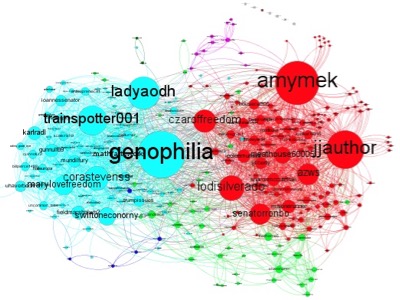
After analyzing the Tweeter accounts behind the campaign, the author, A. Fomin, concludes that they are several Tweeters (probably bots) operated apparently from the Western USA. Anglosaxon media, Western USA Tweeter bots... you get the idea, right?
Early January the notorious speculator and confessed sponsor of the refugee traffic to Europe George Soros gave an explicit interview to Wirtschafts Woche where he bitterly critisized Merkel’s stricter European and refugee policy suggesting that it would “cost her chancellorship” [2]. Simultaneously the hashtag #ArrestMerkel and “Merkel Has To Go” motto appeared in Twitter and gained an impressive circulation.
Fomin concludes that it is George Soros and far-right agit-prop bots which are the ones behind this strange campaign that may well cause the collapse of EU, regardless of Merkel's political destiny.
Why is Soros so angry at Merkel? It may well be because Germany has never been a genuine ally in his policies for Ukraine and against Russia, where the ultra-liberal capitalist has worked closely with European and Islamist fascists. But would it suffice to oust Merkel? Can Soros impose a German government that is sheepishly complacent with Anglosaxon bourgeoisie's policies? What do they gain if the EU collapses? Wouldn't such a chaotic situation push many European states into the arms of Russia or into outright independent socialism?
Massive booing of EU hymn in San Sebastian
Donostia seems not anymore what used to be: the bourgeois hymn of the bourgeois European Union was booed in that noisy parade that Donostiarrak hold every year the day of their patron, i.e. yesterday.
Borroka Garaia Da! explains why this makes sense and why it bothers so much to the Basque bourgeoisie. For example Basque workers have a productivity 27% above the European average but get paid 30% below the average, never mind the massive unemployment figures.
Basque companies invest most of their capital outside of the Basque Country: more than 60 billion euros are invested outside the country, while only 13 billion are invested inside.
The European Union as we know it and Capitalism in general does nothing for us at all, only supporting the imperialist occupation and colonization of our little country. We need another radically different framework, with or without the rest of Europe.
New planet in the solar system
 |
| Description of the orbit of the new planet and associated objects (Batygin & Brown) |
This kind of stuff does not happen every day: a new planet 10 times the mass of Earth has been inferred to exist in the outer reaches of the solar system, but has not yet been directly observed. Or has it?
Konstantin Batygin and Mike Brown have deduced (press release, study) the existence of this object from the trajectory of several anomalous transneptunian bodies of the type of Sedna, whose trajectories seem to orbit both the sun and a distant "super-earth" type planet, so remote that it takes 20,000 years to complete an orbit.
The Caltech team has not directly eyed the object. However...
A Swedish-Mexican team led by R. Liseau pre-published last month a study where they claimed to have directly spotted a possible outer solar system planet. After some controversy the second version of the pre-pub was withdrawn until further data was collected but the first version is still available online. Another pre-pub paper on the same issue was also authored by W. Vlemmings et al., co-authors of the previous one.
 |
| Direct observation of an object that might be a new planet (Liseau et al.) |
I do not know yet if the two studies are convergent or rather they refer to different objects. Neither is fully confirmed as of now in any case but something is almost certainly out there lurking in the depths of the Oort cloud.
Tuesday, January 19, 2016
The 1% owns half of World's wealth
Several recent reports by Oxfam reveal the brutal inequality of our global society (also at local level, although a few states like Finland redistribute a lot via taxes, dissimulating the problem).
The 1% owns already (projected) half of the so-called wealth. Of course it's just accounts and property deeds that can be disowned democratically at any time: money and property are just social functions, but social functions that allow to accrue real power in terms of media, lobbies, corrupt politicians and private armies of gangsters.

As you can see in the graph above, almost all of the income is concentrated in the top 10%. I conventionally equalize the top 10% with the bourgeoisie and the lower 90% with the working class and the reality of income seems to support this notion at least to a very large extent. While the figure here is global, the pattern is reproduced all across the globe: some states do redistribute some or even a lot but the overall class structure is not altered, just the benefits associated to belonging to each segment.
In the USA for example, income inequality has been growing absurdly since 1988, grabbing most of the benefits that are not direct investor profits of the economic growth. It is quite difficult to spot the average salary growth in the following figure, so I'll give you a hint: it's painted in green and it's almost zero.

This lack of growth in salaries is not at all related to "productivity" as is sometimes claimed but just to the the ability of the triumphant bourgeoisie to collect growing surplus value from the work of their slaves employees, seemingly unable to defend themselves (ourselves) from those arbitrary and most painful impositions.

Just 80 individuals control as much wealth as the poorest 50%.
The names of the top 10 parasites in some key economic sectors are listed. The lead clearly corresponds to those speculating in finance: Warren Buffet (USA), Michael Bloomberg (USA), Carl Icahn (USA), Alaweed Bin Talal Al-Saud (Saudi Arabia), George Soros (USA), Joseph Safra (Brazil), Luis Carlos Sarmiento (Colombia), Mikhail Prokhorov (Russia), Alexei Mordashov (Russia) and Abigail Johnson (USA).
Quoting Buffet: there is indeed a class war and my class [the bourgeoisie] is winning.
Or better, translating a punk song from the 90s (La Polla):
Ferocious Misery has taken the streets,Greed is raping Liberty,the weak whimper while they are squeezedtheir complaints are forgotten.
[Politician:]
"We are familiar with the situationand we're going to solve it soon.Now I turn aroundand when you leave please close the door".
[Workers:]
"What can we do?", asks the majority."What can be done if there's no solution.We don't want to know: there is no exit.Let's see what say those above".
[Trade Unionist:]
"Keep calm, it's not so serious,make another effort till the end of the month.Meanwhile I am happysuckling from the budget".[Capitalist:]"Fuck off and shut up!That's how life is!I don't know what you're crying about.That's how life is!What the fuck do you want?!That's how life is!You're dirtying my carpet!"[Publicist:]"Tough uncivilized nonconformist:come to our arms, let yourself be tamed.If you're young and rebel,Coca-Cola understands you!"
And the rich join forces in the final fight
as they march singing their 'International',
they pay their tithes to God
and the World is a time bomb!
That's how life is!
That's how life is!
That's how life is:
you can get a cough.
Original Spanish-language track follows:
Time to wake up, guys. Even The Matrix is not what it used to be...
Wednesday, January 13, 2016
Saudi Arabia's swan song
 |
| Main sects in West Asia |
The current developments in West Asia clearly signal the end of the Saudi monarchy: they are trying to control much more than they can ever hope to manage while they have less legitimacy than even North Korea or Israel.
It must be said first of all that the prominent human rights leader that the House of Saud murdered a few days ago, Nimr al-Nimr can only be compared to figures like Martin Luther King or Monsignor Romero, with whom he shares the cleric profession and now also the condition of martyr, not a mere religious martyr but a martyr for freedom, respect and common sense.
As the other religious-political figures I mention here, he led a peaceful protest movement against oppression and injustice, against the worst tyranny on Earth: the House of Saud. Not an easy task, he surely knew the risks since day one, yet he and his sympathizers dared to challenge the totalitarian theocracy and hope for the best. The best hasn't come, not yet certainly. The Saudi mafia smashed them mercilessly and invaded Bahrain, where a sister movement was about to topple a similar tyranny.
I must say that I that I do not share the faith of any of the aforementioned leaders but, even from this significant ideological distance, I must speak for their courage, as well as for that of the many less known people who also fought for freedom, with them or in other places, occasions, movements.
By killing him, the House of Saud has only brought one step nearer its own end: martyrs are way too often the light that guides peoples to fight for freedom. Making martyrs is a most risky bet, one that even the stinkingly rich House of Saud can't afford to make.
Much less when they have their hands full with problems they are unable to manage.
I was reading the almost invariably lucid Pepe Escobar on this matter and I must agree with him: Saudi Arabia does not know how to play geopolitical chess... or backgammon either. I'm an enthusiast of good boardgames and particularly the game of Diplomacy (best multiplayer boardgame ever, not for the faint hearted) and you definitely don't play that way, or rather: you don't play that way and have any chances at winning or even surviving. You do not, definitely, want to fight many conflicts in many different fronts at the same time, you do not definitely want to get into a new war before winning the previous one, and, if you depend on some protector, as the Sauds do, you do not want to cause more trouble than they are willing to put up with, lest you will be sacrificed.
If at least the Sauds would have a slim hope of winning any of the impossible scenarios they have gotten themselves into, be it Syria, Iraq or Yemen, be it Bahrain or its own internal instability, let alone a possible scenario of direct war with Iran that would automatically cut off global oil provisions for a long term... but they do not. Unlike in the game (can't be that good: the map is not reality), it's not just about winning battles and conquering provinces: in real life you have to win peace, and that's the hardest part of all. And a ridiculously pompous absolutist intolerant sexist medievalist theocracy has not the slightest chance to win even within the palatine circles, every day more agitated at the extreme risks assumed by the new king, by the name of Salman, a very elderly man, and his appointed heir (and de facto ruler) Prince Mohammad.
It is as if the reactionary European order that dominated the 19th century was managed not by consensus of four or five major powers but single-handedly by King Ludwig "the Mad" of Bavaria. Even Mad Ludwig was not as mad as to attempt so much but his decadent lifestyle ruined the country, Ludwig was deposed and Bavaria was annexed to the new state of Germany, with the only remaining privilege of issuing its own stamps.
Is that the destiny of the palaces of the Saud clan? Probably. I can't define a precise timeline but it is every day more clear that they are totally desperate and that Fate only awaits for the best moment to topple them.
When Fate decides is the right time, the tyrant will be toppled from inside, maybe after growing unrest, probably after some foreign policy fiasco such as the foreseeable loss in Syria and Iraq in few months, much as happened to Mubarak. A gattopardist regime, probably under some other prince, will then take power and try to bargain some reforms, not too many, but without clear legitimacy and with growing pathetism in every action, things may well spiral out of control and get the realm split in three or more states: a conservative stronghold in the center, an unstable most populated region in the West and a Shia-dominated republic in the East, possibly joined with Bahrain and normalizing relations with Iran and Iraq. This Shia-dominated East is where all the oil is.
The model that worked until Bush Sr. tricked Iraq into a pointless war, destabilizing everything, was a model established almost a century ago by Britain: the resources were not in the hands of the inhabitants or even some sort of arbitrary but locally legitimate figurehead, but in the hands of rather alien Sunni Arab powerhouses. These powerhouses have been terminated thoughtlessly by the twisted games of the Bush clan, out of fear of secular pan-Arabism and the desire to reinforce the direct military presence in the strategic inner sea. Ironically enough Saud can't exist without Saddam: in spite of one being fanatically religious and the other presumptively secularist, both exerted the domination of Sunnis over Shias by Machiavellan British design inherited by the USA. This kind of undemocratic power system just cannot work in the present time, not for long at least, and therefore the House of Saud is bound to fall.
There is a lot of confusion about what is the so-called "Arab Spring" among certain Left, which confuses the genuine desire for democracy and human rights, maybe even some degree of socialism, with the crude manipulations of the Western powers. No revolution exists in a vacuum and the Arab one could not be different: the various powers will no doubt intervene one way or another, with more or less success, but the revolutionary process in itself was and is genuine. And it has not yet ended, not at all.
Saturday, January 9, 2016
Thousands march for amnesty and return of Basque prisoners
Some 70 thousand people marched through Bilbao and Baiona this evening to demand the return of Basque political prisoners and amnesty.
According to Naiz Info, 63,000 joined the demonstration in Bilbao, while some 8000 did at the twin one of Baiona.

Internationalist support was also present, with the flags of several nations of Europe and America, as well as the corresponding political delegations, also taking part.
Update (Jan 12): Rafael Tsavko published his own footage of the demo:
Update (Jan 12): Rafael Tsavko published his own footage of the demo:
Monday, December 21, 2015
Spain's elections produce totally 'hung' Parliament
So extremely hung that only the, rather unnatural, coalition of the traditional twin parties PP (tories) and PSOE (Blairite pseudo-labor) could from a stable majority. But this is most unlikely to happen because it would be a near-suicide for the PSOE, already in serious trouble.
Any predictable right-leaning majority is strictly impossible, while a left leaning majority is technically possible but would need to include the Catalan independentists (17 seats counting both parties, which are allied for independence in Catalonia) and that is simply unacceptable for the PSOE, strongly committed to Castile-centric Jacobin style unionism.
So, barring a most unstable minority government, which would need in any case at least passive support by the PSOE, not allowing them to play the opposition role, the most likely scenario is a repetition of the elections in few months.
The overall results
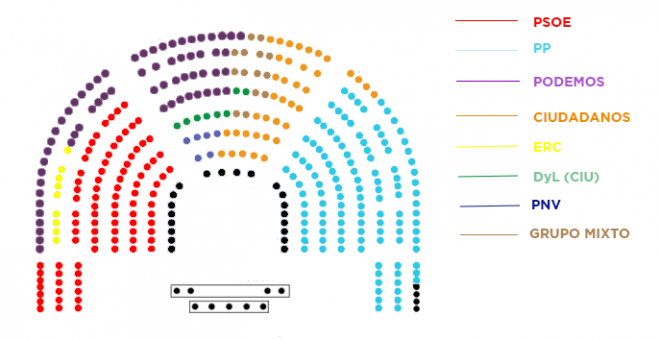
This is a snapshot of the new Spanish Congress (taken from Público, where I'm also getting other data from):
 |
| Note: 29 seats of coalitions are here presented as Podemos', 11 seats of coalitions are presented as PP's |
As you can see the Conservatives (PP) hold better than expected (most polls forecast around 110-115 seats), while their "renewal" sidekick Ciudadanos (C's, pseudo-liberal, rather reactionary in fact) demonstrated to be a relative fiasco, getting many less votes and seats that Falsimedia (popular collective nickname for the bourgeois media) was forecasting for them.
In any case the PP has lost almost four million votes and about one third (63) of their former seats. And not all them have gone to their FIDESZ-style replacement C's, whose leaders were often unable to even explain why one should vote for them. Heh, why not?, I guess. Or rather: why yes? Why to vote to the party whose main goal was to preserve the status quo, offering their help to whoever else would win, except to Podemos?
It is clear nevertheless that there is a strong right-winger vote in Spain, particularly among the older generations, and that it is amplified in terms of seats (the Senate is much worse, with the PP nearing a majority) thanks to a very distorted electoral system that dramatically favors depopulated rural provinces, where people has only very limited choice. I'll get to that later.
The PSOE holds a bit better than expected, thanks largely to this rural provinces' over-representation distortion and its strongholds of Andalusia and Extremadura. But it is anyhow severely injured and has lost 1.5 million votes relative to the 2011 elections, which were already very poor results for the historical party that once helped to forge Pablo Lafargue (Marx' collaborator and son-in-law, author of the must-read book The Right to Be Lazy and first Socialist member of the French National Assembly). Their historically bad results in the urban provinces (fourth place in Madrid for example) are very symptomatic of an ailing force that manages to resist but won't last for much longer after having betrayed their historical ideals in such unforgivable ways.
As for Podemos... better than Falsimedia predicted, a bit short for their dreams maybe. Good performance in general terms but weak in core Spain, getting their best results in the periphery, in some cases clear provisional borrowings from nationalist forces.
 |
| Seats obtained in each province (click to enlarge) |
Coalitions are effectively impossible
A stable majority requires 176 seats, however:
- PP+C's: 163
- PSOE+Podemos+IU: 161
The rest can be functionally split in two categories: (a) the Basque nationalists and Canarian regionalists, who have not enough seats to offer, and therefore do not matter at all, and (b) the Catalan nationalists, who have 17 seats and in pure theory could be decisive, as have been in the past. However these two Catalan parties (Catalan Republican Left, ERC, and Democracy and Freedom, DL, formerly Democratic Convergence of Catalonia) are immersed in leading the Catalan independence process and would not demand less than legal reforms that allow for self-determination. This is something that Podemos and IU can assume but that the PSOE will not.
Other options:
- PSOE+Podemos+C's: it is almost unthinkable considering the polar opposites that Podemos and C's are. If anything this kind of unnatural coalition could just serve to reform the electoral law prior to new elections, little more, and it does not look like something the PSOE wants to do. Also the position of the PP in the Senate is so strong that it could maybe veto any such attempt of reform.
- PP+PSOE: their voters share musical tastes (horrible ones, don't ask) and the twin parties share a general view of the unitary state, European Union, NATO and the TTIP, but that doesn't seem like enough, particularly because the PSOE can only expect to suffer for taking part in such kind of alliance, including probably a break up of the party itself, something that has not happened since the Communist Party was formed in the 1920s. It'd be the the final suicidal Pasokization of the PSOE. Nuff said.
Overview of the biased electoral system
By law 102 of the 350 seats are assigned to the 50 provinces (two each) and the African "plazas" (one each), then the remaining 248 seats are apportioned by provinces according to last census' population (in some cases like Soria and the African towns they get zero).
The assignment of seats is not proportional either but is attributed by the so-called D'Hont system, after removing all lists that didn't reach 3% of legal votes. The D'Hont system divides each list's vote figure by integer numbers (1/1, 1/2, 1/3, 1/4, etc.) and then assigns one seat to each resulting figure in order of these artificially resulting figures. It approaches proportionality in large circumscriptions but not in smaller ones.
The whole system is designed to be "conservative", favoring the large consolidated parties with strong presence in all the territory, notably rural provinces with very little population. It is not as extremely distorting as the Anglosaxon "winner takes all" system (which I consider outright bipolar-fascist) but tends to that anyhow.
The over-representation of rural areas has hardly any comparison and it strongly favors rural Castile and other semi-assimilated low population areas where "caciquismo" and conservatism is strong:
 |
| Most over-represented provinces in the Spanish electoral system |
The election of the Senate is even more ridiculously distorted. The apportioning is vaguely inspired on that of the USA, with four seats being attributed to each province, of which each elector can vote to three only. The voting is technically nominal but in practical terms the result is invariably that three senators go to the most voted list and one to the second one. Of course provinces are mere administrative divisions akin to English counties or French departments and have none of the federal self-rule that US states enjoy, nor do they have in most cases any ethnic or other distinctive feature making them deserving of such representation privileges. On the contrary: their over-representation weights strongly in favor of Castile-centric nationalist uniformity.
In addition to all that, voting for the million-plus expatriates (mostly economic exiles, naturally unhappy with how things go) has become so nightmarishly impossible that they are effectively denied the right to vote.
Analysis of the results of the three major parties
The People's Party (conservatives) has done a bit better than expected, in spite of losing almost 5 million voters. Thanks to its wide implementation through the state (except in the Basque Country and Catalonia, where it is clearly much weaker) and the already discussed rigging of the representation, they manage to hold a quite undeserved plurality and can veto any attempt at constitutional or most other legal reforms.
 |
| PP (and participated coalitions): performance by province |
We can consider the PP to be the Castilian National Party, sort of: the party of the caciques, embodying the worst of Spain: its backwardness, its powerlessness, its perennial inability to come together in a progressive project of any sort, its consolidated corruption, its unbearable nostalgia of the 16th century, the ghosts of Torquemada and Franco. All that is still strong, but not everywhere: its weak spots are the stateless nations of the Northeast (Basque and Catalan countries) and the assimilated but largely colonial regions of the South: Andalusia and Canary Islands. The reactionary PP is the most strongly favored by the extreme distortions to popular representation.
The Spanish Socialist Worker Party (PSOE) used to be the glue that held Spain together, with strong performance in Catalonia, the Basque Country, Madrid and, of course, its stronghold of Andalusia, however today it is much much weaker and does not look like it can recover, failing to produce illusion in the masses after way too many betrayals and no sign of internal change.
 |
| PSOE performance by province |
In the map above it is most symptomatic how the PSOE fails to perform in key urban areas like Madrid, Barcelona, Valencia, etc., having lost almost all support in the peripheral stateless nations but also in the capital. It has become almost a rural party and that is not enough, much less for a party that pretends to be left-leaning and to appeal to the working class.
The only big city they keep strong at is Seville. All the rest is quite pathetic for a party of the caliber of the PSOE. If Lafargue or Pablo Iglesias the elder would raise from the dead, they would cry.
They are almost naturally being replaced by Podemos, which had a good showing but is however not yet strong enough:
 |
| Podemos and participated coalitions: performance by province |
Podemos and its participated coalitions (in Catalonia, Valencian Country, Galicia and Huesca province) has performed best in the peripheral nations. It is still very weak in Castile (with some honorable exceptions, notably Madrid) and even in Aragon and Andalusia. Many of the votes obtained (alone or in coalition) in the Catalan Countries, Galicia or the Basque Country are clearly borrowed from the nationalist left. In many senses Podemos embodies in these elections the relative vigor of the peripheral "Spain" (the Spain that largely does not want to be Spain or that would accept to be only in radically different conditions of ethnically re-balanced federalism at best). Their discourse accepting the right to self-determination (favoring a union of the willing, so to say) has surely been key for those peripheral results. This is the kind of discourse that core Spaniards often hate, preferring to impose their Castile-centric uniformity by violent means. All that may explain, at least to a large extent the striking differences in performance of the new party in the various areas.
Of course, these peripheral areas are also in many cases the progressive avant-guard of the state and have been so for centuries already, but it is very difficult for a party to fly an understanding discourse with Catalan or Basque grievances and get any sympathies in core Spain, entrenched in Greater Castilian (alias Spanish) nationalism.
Another reason for their relatively weak performance in core Spain is that they wrongly chose to run separately from United Left, with whom they formed coalitions in several countries (Valencia, Catalonia, Galicia) but not elsewhere. This stubbornness about running solo in core Spain is not justified and has clearly damaged them. I haven't got time to study how many seats they have lost for this stupid reason but my hunch is that around a dozen, enough to form a coalition government with the PSOE probably, one in which they could be leaders even.
Update: Podemos+IU would have got 14 extra seats according to El Diario, mostly at the expense of the PP (-9) and C's (-4):
This would have allowed for a left-leaning PSOE+Podemos+coalition government, short of just 3 seats to get absolute majority. Tactical support by Basque or Catalan nationalists would still be needed but feasible, particularly if institutional reform in federalist direction was agreed upon.
(Note: the El Diario's estimate seems to be missing two seats from the total count, not sure why. In any case they have an excellent 25 panels' analysis of the elections that I must recommend).
Update: Podemos+IU would have got 14 extra seats according to El Diario, mostly at the expense of the PP (-9) and C's (-4):
 |
| If Podemos+IU would have run together (right) compared with actual results (left) |
This would have allowed for a left-leaning PSOE+Podemos+coalition government, short of just 3 seats to get absolute majority. Tactical support by Basque or Catalan nationalists would still be needed but feasible, particularly if institutional reform in federalist direction was agreed upon.
(Note: the El Diario's estimate seems to be missing two seats from the total count, not sure why. In any case they have an excellent 25 panels' analysis of the elections that I must recommend).
On the good side, they have consolidated their position in places like Madrid, Cádiz or Asturias, with interesting results also in places like Burgos, La Rioja, Valladolid, León and quite markedly in Canary Islands too. Overall they appear very strong but let's be clear: (1) they could have been stronger in coalition with United Left and (2) many of their votes are borrowed from the nationalist or federalist ethnic left or direct product of the coalition with them (Valencian Country, Galicia, Huesca province).
Notes on Catalonia and the Basque Country
Catalonia is immersed in a secessionist process with a strong enough majority formed by three parties: DL (center-right), ERC (center-left) and CUP (radical grassroots left). The former two run in coalition to the so-called plebiscitary elections in September and came short of a majority, awaiting till present day some sort of arrangement with CUP. CUP does not run to the Spanish elections and called for abstention, however it's probable that many of its voters chose to vote either ERC (which included a CUP member in their list) or En Comú Podem (the wide Barcelona-inspired coalition in which Podemos, but also United Left, participated). These two lists came second and first in Catalonia, with DL coming fourth and PSOE third (the vote was quite fragmented).
Overall a possible interpretation is that the leftist ideas are strong in Catalonia and that Artur Mas (DL) should probably allow someone more to the left to become the President, what would be surely supported by the CUP. This would put the independence process back on track, being a key issue in the institutional crisis that Spain is going through. One that has no easy legal solution but that may well be decided by unilaterally by Catalans themselves. Or so they are set to do in any case.
In the Basque Country I have to underline the very poor performance of the leftist nationalist Euskal Herria Bildu coalition. It owes probably to several reasons: on one side it is a key state election in which the all-Spain parties (namely Podemos) get all the attention and interest, more so as they are openly in favor of self-determination, on the other side there is a rather strong undercurrent of criticism to the current party-centered structures and way-too-moderate attitudes of the coalition. This may have led many to either abstain or vote for Podemos, arguably a more participative party.
Of particular annoyance is the over-representation in the lists of the social-democratic (?) Eusko Alkartasuna party, including some quite disliked individuals, for example Opus Dei member Rafael Larreina (who openly stands against abortion rights) and his protegee the infamous Lorena López de Lacalle, whose political trajectory is wormish, both imposed in the lists against the decision of the popular assemblies.
Ironically Podemos also imposed candidates to the local structures (controlled until recently by a very dubious character: Roberto Uriarte, of sad anti-labor trajectory and extremist Spanish nationalist attitudes). Uriarte and his cadres resigned as reaction, Podemos-Euskadi being now led by an electoral committee (a most provisional circumstance), but this resignation was perceived positively by many, with the imposed candidate being much more pro-Basque than the former secretary.
This puts Podemos in the Western Basque Country (Navarre is a different case, its leadership being much more acceptable) in a very unusual situation: it has no active leadership, it has a weak membership (the 15-M protests were weak in the Western Basque Country, so the grassroots did not naturally coalesce) but it has a huge voting pool (although much is borrowed from EHB and will surely return to their natural coalition in regional elections, to be held soon), which is basically looking at Madrid, not the local leadership, weak and contested.
Another interesting development in the Western Basque Country is that most likely, and for the first time in history, a leftist coalition has hope to take the government and displace the perennial liberal-conservative PNV rule. There are many difficulties for this to happen but it is clear that Podemos appeals to a less "ethnicist" urban working class that EHB has difficulties in reaching to and that both formations potentially complement each other and could rule together for the good if they can overcome their mutual distrust. We'll see.
Sunday, December 20, 2015
Iraq: US providing air cover for DAESH
The US bombing that killed some 25 Iraqi soldiers and injured other 20 was no mistake, according to Iraqi military sources: they think that the USA is providing air cover for the Islamic State and preventing the liberation of Fallujah that way.
Commander Hakim al-Zamili, speaking to RT, said:
We don't believe it was a technical mistake. We constantly see that the United States are trying to provide air cover to Islamic State. They are preventing us from making an offensive. I think everyone is now convinced that the United States is not sincere in its fight against Islamic State. Maybe they have another agenda. The Pentagon, the CIA and other agencies in the US are trying to make a [rift] between Sunnis and Shiites in Iraq. They are trying to tear [apart] Iraq with the help of their allies like Turkey and the Gulf states.
I do not believe it either. The USA and allies are all the time operating in favor of the Islamic State, as well as other fundamentalist terrorist groups, in spite of their constant denials and of their use of the terror organization as pretext for unilateral intervention inside the territory of sovereign states, against international law, as well as for the establishment of perpetual emergency rule in Europe and North America.
Saturday, December 19, 2015
What to expect in tomorrow's key all-Spain elections
Today is meditation day and I'm going to meditate rather loudly. Not about what I'm going to vote, which I have already and meticulously decided, but on what to expect after election day, which is tomorrow, Day of the Sun and hopefully sunny enough.
Legal polls used to give a significant share to pseudo-centrist ultra-nationalist all-Spain maverick yuppie party Ciudadanos but, after seeing their actual results in the recent regional and municipal elections (Catalonia excepted, where they collected the majority of the unionist vote) and comparing with pre-election polls, it became clear that they are very much inflated, probably because they are the pet project of NATO's secret services in order to prevent a second "Syriza scenario", times five in size. This tendency: inflating C's and deflating Podemos has been going on in all the polls. In spite of all the latest legal polls suggested a clear recovery of Podemos and fall of C's.
In this last week it is illegal in all the arbitrary political demarcation of Spain to publish or spread electoral opinion polls, however it is perfectly legal in Andorra, another much smaller capricious shape in our political maps, where El Periòdic newspaper has been publishing a series of daily polls on the Spanish elections.
Illegal as it is I won't mention them but rather will write some fiction on the elections taking place in the imaginary Theocracy of Catholica, as commented in the palace of the Bishop of Urgell. Any semblance with reality is a mere coincidence.
According to the rumors coming from the Bishop's Castle, the Pope's Party, led by Cardinal Mario Redcheek, will still get a plurality in tomorrow's elections but with a mere 26% of the vote (Christians are not anymore what they used to be, where is the Inquisition?!) and some 109 councilors His Holiness will need massive support to continue in power in the Theocracy.Sadly for the PoPe, the C'IA is not gathering enough dissident votes and his chief operating officer A. Riverside is expected to get only 16% of the popular support and a mere 52 councilors.The Catholic Reform Party of the most handsome mannequin Peter Saints will probably collect 21% of the devotees' support and some 86 councilors.The Heretic Party of Paul Churches and affiliated coalitions will get 20% and some 73 councilors, while the Atheist Union will get 4% and 3 seats. Other parties, including more or less irreducible Gauls and Apaches, never fully subjugated by Rome, get 13% of the vote and some 30 councilors.The situation is so bad that Cardinal Redcheek went to Rome (or wherever) to report to Popess Angela I and apparently said that the Heretics were coming second maybe, causing her surprise and that of her majordomo Ronald Husk, as can be seen in this priceless video, no doubt filmed by Satan himself.The Cardinal's fears are not based only on Urgell's data but mostly on internal secret polls of which it is mortal sin to even discuss but which give an even better position to the Heretics and announce a greater fiasco of the Reform and C'IA parties. Sinful as it may be, fruit sellers through the Theocracy's markets are spreading the news with coded prices.
So, back to reality, what to expect? A most hung parliament in which no single nor probably even two parties can form a majority. What, considering the extremely challenging situation in Catalonia, whose political parties have been in the past critical in allowing for stable majorities but are now alienated by a hostile Spanish (Great Castilian) nationalist revival, makes the situation most volatile.
While I don't think that the guys at Electomanía got this quite right, this is their Electo-Forecast (a bit optimistic for Podemos and C's IMO, a bit too pessimistic for the PSOE), they are the experts so who am I to argue:

More after actual results come by.
Subscribe to:
Posts (Atom)