Tuesday, January 19, 2016

The 1% owns half of World's wealth

Several recent reports by Oxfam reveal the brutal inequality of our global society (also at local level, although a few states like Finland redistribute a lot via taxes, dissimulating the problem). 


The 1% owns already (projected) half of the so-called wealth. Of course it's just accounts and property deeds that can be disowned democratically at any time: money and property are just social functions, but social functions that allow to accrue real power in terms of media, lobbies, corrupt politicians and private armies of gangsters. 


As you can see in the graph above, almost all of the income is concentrated in the top 10%. I conventionally equalize the top 10% with the bourgeoisie and the lower 90% with the working class and the reality of income seems to support this notion at least to a very large extent. While the figure here is global, the pattern is reproduced all across the globe: some states do redistribute some or even a lot but the overall class structure is not altered, just the benefits associated to belonging to each segment. 

In the USA for example, income inequality has been growing absurdly since 1988, grabbing most of the benefits that are not direct investor profits of the economic growth. It is quite difficult to spot the average salary growth in the following figure, so I'll give you a hint: it's painted in green and it's almost zero.


This lack of growth in salaries is not at all related to "productivity" as is sometimes claimed but just to the the ability of the triumphant bourgeoisie to collect growing surplus value from the work of their slaves employees, seemingly unable to defend themselves (ourselves) from those arbitrary and most painful impositions.


Just 80 individuals control as much wealth as the poorest 50%. 

The names of the top 10 parasites in some key economic sectors are listed. The lead clearly corresponds to those speculating in finance: Warren Buffet (USA), Michael Bloomberg (USA), Carl Icahn (USA), Alaweed Bin Talal Al-Saud (Saudi Arabia), George Soros (USA), Joseph Safra (Brazil), Luis Carlos Sarmiento (Colombia), Mikhail Prokhorov (Russia), Alexei Mordashov (Russia) and Abigail Johnson (USA). 


Quoting Buffet: there is indeed a class war and my class [the bourgeoisie] is winning.

Or better, translating a punk song from the 90s (La Polla):
Ferocious Misery has taken the streets,
Greed is raping Liberty, 
the weak whimper while they are squeezed
their complaints are forgotten.

[Politician:]
"We are familiar with the situation
and we're going to solve it soon.
Now I turn around 
and when you leave please close the door".

[Workers:]
"What can we do?", asks the majority.
"What can be done if there's no solution.
We don't want to know: there is no exit.
Let's see what say those above".

[Trade Unionist:]
"Keep calm, it's not so serious,
make another effort till the end of the month.
Meanwhile I am happy
suckling from the budget".

[Capitalist:]
"Fuck off and shut up!
That's how life is!
I don't know what you're crying about.
That's how life is!
What the fuck do you want?!
That's how life is!
You're dirtying my carpet!"

[Publicist:]
"Tough uncivilized nonconformist:
come to our arms, let yourself be tamed.
If you're young and rebel,
Coca-Cola understands you!"
And the rich join forces in the final fight 
as they march singing their 'International',
they pay their tithes to God
and the World is a time bomb!
That's how life is!
That's how life is!
That's how life is:
you can get a cough.

Original Spanish-language track follows:


Time to wake up, guys. Even The Matrix is not what it used to be...

Wednesday, January 13, 2016

Saudi Arabia's swan song

Main sects in West Asia
The current developments in West Asia clearly signal the end of the Saudi monarchy: they are trying to control much more than they can ever hope to manage while they have less legitimacy than even North Korea or Israel. 

It must be said first of all that the prominent human rights leader that the House of Saud murdered a few days ago, Nimr al-Nimr can only be compared to figures like Martin Luther King or Monsignor Romero, with whom he shares the cleric profession and now also the condition of martyr, not a mere religious martyr but a martyr for freedom, respect and common sense. 

As the other religious-political figures I mention here, he led a peaceful protest movement against oppression and injustice, against the worst tyranny on Earth: the House of Saud. Not an easy task, he surely knew the risks since day one, yet he and his sympathizers dared to challenge the totalitarian theocracy and hope for the best. The best hasn't come, not yet certainly. The Saudi mafia smashed them mercilessly and invaded Bahrain, where a sister movement was about to topple a similar tyranny. 

I must say that I that I do not share the faith of any of the aforementioned leaders but, even from this significant ideological distance, I must speak for their courage, as well as for that of the many less known people who also fought for freedom, with them or in other places, occasions, movements. 

By killing him, the House of Saud has only brought one step nearer its own end: martyrs are way too often the light that guides peoples to fight for freedom. Making martyrs is a most risky bet, one that even the stinkingly rich House of Saud can't afford to make. 

Much less when they have their hands full with problems they are unable to manage. 

I was reading the almost invariably lucid Pepe Escobar on this matter and I must agree with him: Saudi Arabia does not know how to play geopolitical chess... or backgammon either. I'm an enthusiast of good boardgames and particularly the game of Diplomacy (best multiplayer boardgame ever, not for the faint hearted) and you definitely don't play that way, or rather: you don't play that way and have any chances at winning or even surviving. You do not, definitely, want to fight many conflicts in many different fronts at the same time, you do not definitely want to get into a new war before winning the previous one, and, if you depend on some protector, as the Sauds do, you do not want to cause more trouble than they are willing to put up with, lest you will be sacrificed. 

If at least the Sauds would have a slim hope of winning any of the impossible scenarios they have gotten themselves into, be it Syria, Iraq or Yemen, be it Bahrain or its own internal instability, let alone a possible scenario of direct war with Iran that would automatically cut off global oil provisions for a long term... but they do not. Unlike in the game (can't be that good: the map is not reality), it's not just about winning battles and conquering provinces: in real life you have to win peace, and that's the hardest part of all. And a ridiculously pompous absolutist intolerant sexist medievalist theocracy has not the slightest chance to win even within the palatine circles, every day more agitated at the extreme risks assumed by the new king, by the name of Salman, a very elderly man, and his appointed heir (and de facto ruler) Prince Mohammad. 

It is as if the reactionary European order that dominated the 19th century was managed not by consensus of four or five major powers but single-handedly by King Ludwig "the Mad" of Bavaria. Even Mad Ludwig was not as mad as to attempt so much but his decadent lifestyle ruined the country, Ludwig was deposed and Bavaria was annexed to the new state of Germany, with the only remaining privilege of issuing its own stamps.

Is that the destiny of the palaces of the Saud clan? Probably. I can't define a precise timeline but it is every day more clear that they are totally desperate and that Fate only awaits for the best moment to topple them. 

When Fate decides is the right time, the tyrant will be toppled from inside, maybe after growing unrest, probably after some foreign policy fiasco such as the foreseeable loss in Syria and Iraq in few months, much as happened to Mubarak. A gattopardist regime, probably under some other prince, will then take power and try to bargain some reforms, not too many, but without clear legitimacy and with growing pathetism in every action, things may well spiral out of control and get the realm split in three or more states: a conservative stronghold in the center, an unstable most populated region in the West and a Shia-dominated republic in the East, possibly joined with Bahrain and normalizing relations with Iran and Iraq. This Shia-dominated East is where all the oil is. 

The model that worked until Bush Sr. tricked Iraq into a pointless war, destabilizing everything, was a model established almost a century ago by Britain: the resources were not in the hands of the inhabitants or even some sort of arbitrary but locally legitimate figurehead, but in the hands of rather alien Sunni Arab powerhouses. These powerhouses have been terminated thoughtlessly by the twisted games of the Bush clan, out of fear of secular pan-Arabism and the desire to reinforce the direct military presence in the strategic inner sea. Ironically enough Saud can't exist without Saddam: in spite of one being fanatically religious and the other presumptively secularist, both exerted the domination of Sunnis over Shias by Machiavellan British design inherited by the USA. This kind of undemocratic power system just cannot work in the present time, not for long at least, and therefore the House of Saud is bound to fall. 

There is a lot of confusion about what is the so-called "Arab Spring" among certain Left, which confuses the genuine desire for democracy and human rights, maybe even some degree of socialism, with the crude manipulations of the Western powers. No revolution exists in a vacuum and the Arab one could not be different: the various powers will no doubt intervene one way or another, with more or less success, but the revolutionary process in itself was and is genuine. And it has not yet ended, not at all.

Saturday, January 9, 2016

Thousands march for amnesty and return of Basque prisoners

Some 70 thousand people marched through Bilbao and Baiona this evening to demand the return of Basque political prisoners and amnesty. 

According to Naiz Info, 63,000 joined the demonstration in Bilbao, while some 8000 did at the twin one of Baiona.


Internationalist support was also present, with the flags of several nations of Europe and America, as well as the corresponding political delegations, also taking part.


Update (Jan 12): Rafael Tsavko published his own footage of the demo:


Monday, December 21, 2015

Spain's elections produce totally 'hung' Parliament

So extremely hung that only the, rather unnatural, coalition of the traditional twin parties PP (tories) and PSOE (Blairite pseudo-labor) could from a stable majority. But this is most unlikely to happen because it would be a near-suicide for the PSOE, already in serious trouble. 

Any predictable right-leaning majority is strictly impossible, while a left leaning majority is technically possible but would need to include the Catalan independentists (17 seats counting both parties, which are allied for independence in Catalonia) and that is simply unacceptable for the PSOE, strongly committed to Castile-centric Jacobin style unionism. 

So, barring a most unstable minority government, which would need in any case at least passive support by the PSOE, not allowing them to play the opposition role, the most likely scenario is a repetition of the elections in few months. 


The overall results

This is a snapshot of the new Spanish Congress (taken from Público, where I'm also getting other data from):

Note: 29 seats of coalitions are here presented as Podemos', 11 seats of coalitions are presented as PP's

As you can see the Conservatives (PP) hold better than expected (most polls forecast around 110-115 seats), while their "renewal" sidekick Ciudadanos (C's, pseudo-liberal, rather reactionary in fact) demonstrated to be a relative fiasco, getting many less votes and seats that Falsimedia (popular collective nickname for the bourgeois media) was forecasting for them. 

In any case the PP has lost almost four million votes and about one third (63) of their former seats. And not all them have gone to their FIDESZ-style replacement C's, whose leaders were often unable to even explain why one should vote for them. Heh, why not?, I guess. Or rather: why yes? Why to vote to the party whose main goal was to preserve the status quo, offering their help to whoever else would win, except to Podemos?

It is clear nevertheless that there is a strong right-winger vote in Spain, particularly among the older generations, and that it is amplified in terms of seats (the Senate is much worse, with the PP nearing a majority) thanks to a very distorted electoral system that dramatically favors depopulated rural provinces, where people has only very limited choice. I'll get to that later. 

The PSOE holds a bit better than expected, thanks largely to this rural provinces' over-representation distortion and its strongholds of Andalusia and Extremadura. But it is anyhow severely injured and has lost 1.5 million votes relative to the 2011 elections, which were already very poor results for the historical party that once helped to forge Pablo Lafargue (Marx' collaborator and son-in-law, author of the must-read book The Right to Be Lazy and first Socialist member of the French National Assembly). Their historically bad results in the urban provinces (fourth place in Madrid for example) are very symptomatic of an ailing force that manages to resist but won't last for much longer after having betrayed their historical ideals in such unforgivable ways. 

As for Podemos... better than Falsimedia predicted, a bit short for their dreams maybe. Good performance in general terms but weak in core Spain, getting their best results in the periphery, in some cases clear provisional borrowings from nationalist forces.

Seats obtained in each province (click to enlarge)


Coalitions are effectively impossible

A stable majority requires 176 seats, however:
  1. PP+C's: 163
  2. PSOE+Podemos+IU: 161 
The rest can be functionally split in two categories: (a) the Basque nationalists and Canarian regionalists, who have not enough seats to offer, and therefore do not matter at all, and (b) the Catalan nationalists, who have 17 seats and in pure theory could be decisive, as have been in the past. However these two Catalan parties (Catalan Republican Left, ERC, and Democracy and Freedom, DL, formerly Democratic Convergence of Catalonia) are immersed in leading the Catalan independence process and would not demand less than legal reforms that allow for self-determination. This is something that Podemos and IU can assume but that the PSOE will not. 

Other options:
  1. PSOE+Podemos+C's: it is almost unthinkable considering the polar opposites that Podemos and C's are. If anything this kind of unnatural coalition could just serve to reform the electoral law prior to new elections, little more, and it does not look like something the PSOE wants to do. Also the position of the PP in the Senate is so strong that it could maybe veto any such attempt of reform.
  2. PP+PSOE: their voters share musical tastes (horrible ones, don't ask) and the twin parties share a general view of the unitary state, European Union, NATO and the TTIP, but that doesn't seem like enough, particularly because the PSOE can only expect to suffer for taking part in such kind of alliance, including probably a break up of the party itself, something that has not happened since the Communist Party was formed in the 1920s. It'd be the the final suicidal Pasokization of the PSOE. Nuff said.


Overview of the biased electoral system

By law 102 of the 350 seats are assigned to the 50 provinces (two each) and the African "plazas" (one each), then the remaining 248 seats are apportioned by provinces according to last census' population (in some cases like Soria and the African towns they get zero). 

The assignment of seats is not proportional either but is attributed by the so-called D'Hont system, after removing all lists that didn't reach 3% of legal votes. The D'Hont system divides each list's vote figure by integer numbers (1/1, 1/2, 1/3, 1/4, etc.) and then assigns one seat to each resulting figure in order of these artificially resulting figures. It approaches proportionality in large circumscriptions but not in smaller ones. 

The whole system is designed to be "conservative", favoring the large consolidated parties with strong presence in all the territory, notably rural provinces with very little population. It is not as extremely distorting as the Anglosaxon "winner takes all" system (which I consider outright bipolar-fascist) but tends to that anyhow. 

The over-representation of rural areas has hardly any comparison and it strongly favors rural Castile and other semi-assimilated low population areas where "caciquismo" and conservatism is strong:

Most over-represented provinces in the Spanish electoral system


The election of the Senate is even more ridiculously distorted. The apportioning is vaguely inspired on that of the USA, with four seats being attributed to each province, of which each elector can vote to three only. The voting is technically nominal but in practical terms the result is invariably that three senators go to the most voted list and one to the second one. Of course provinces are mere administrative divisions akin to English counties or French departments and have none of the federal self-rule that US states enjoy, nor do they have in most cases any ethnic or other distinctive feature making them deserving of such representation privileges. On the contrary: their over-representation weights strongly in favor of Castile-centric nationalist uniformity.

In addition to all that, voting for the million-plus expatriates (mostly economic exiles, naturally unhappy with how things go) has become so nightmarishly impossible that they are effectively denied the right to vote.


Analysis of the results of the three major parties


The People's Party (conservatives) has done a bit better than expected, in spite of losing almost 5 million voters. Thanks to its wide implementation through the state (except in the Basque Country and Catalonia, where it is clearly much weaker) and the already discussed rigging of the representation, they manage to hold a quite undeserved plurality and can veto any attempt at constitutional or most other legal reforms.

PP (and participated coalitions): performance by province
We can consider the PP to be the Castilian National Party, sort of: the party of the caciques, embodying the worst of Spain: its backwardness, its powerlessness, its perennial inability to come together in a progressive project of any sort, its consolidated corruption, its unbearable nostalgia of the 16th century, the ghosts of Torquemada and Franco. All that is still strong, but not everywhere: its weak spots are the stateless nations of the Northeast (Basque and Catalan countries) and the assimilated but largely colonial regions of the South: Andalusia and Canary Islands. The reactionary PP is the most strongly favored by the extreme distortions to popular representation. 

The Spanish Socialist Worker Party (PSOE) used to be the glue that held Spain together, with strong performance in Catalonia, the Basque Country, Madrid and, of course, its stronghold of Andalusia, however today it is much much weaker and does not look like it can recover, failing to produce illusion in the masses after way too many betrayals and no sign of internal change. 

PSOE performance by province

In the map above it is most symptomatic how the PSOE fails to perform in key urban areas like Madrid, Barcelona, Valencia, etc., having lost almost all support in the peripheral stateless nations but also in the capital. It has become almost a rural party and that is not enough, much less for a party that pretends to be left-leaning and to appeal to the working class. 

The only big city they keep strong at is Seville. All the rest is quite pathetic for a party of the caliber of the PSOE. If Lafargue or Pablo Iglesias the elder would raise from the dead, they would cry. 

They are almost naturally being replaced by Podemos, which had a good showing but is however not yet strong enough:

Podemos and participated coalitions: performance by province

Podemos and its participated coalitions (in Catalonia, Valencian Country, Galicia and Huesca province) has performed best in the peripheral nations. It is still very weak in Castile (with some honorable exceptions, notably Madrid) and even in Aragon and Andalusia. Many of the votes obtained (alone or in coalition) in the Catalan Countries, Galicia or the Basque Country are clearly borrowed from the nationalist left. In many senses Podemos embodies in these elections the relative vigor of the peripheral "Spain" (the Spain that largely does not want to be Spain or that would accept to be only in radically different conditions of ethnically re-balanced federalism at best). Their discourse accepting the right to self-determination (favoring a union of the willing, so to say) has surely been key for those peripheral results. This is the kind of discourse that core Spaniards often hate, preferring to impose their Castile-centric uniformity by violent means. All that may explain, at least to a large extent the striking differences in performance of the new party in the various areas. 

Of course, these peripheral areas are also in many cases the progressive avant-guard of the state and have been so for centuries already, but it is very difficult for a party to fly an understanding discourse with Catalan or Basque grievances and get any sympathies in core Spain, entrenched in Greater Castilian (alias Spanish) nationalism. 

Another reason for their relatively weak performance in core Spain is that they wrongly chose to run separately from United Left, with whom they formed coalitions in several countries (Valencia, Catalonia, Galicia) but not elsewhere. This stubbornness about running solo in core Spain is not justified and has clearly damaged them. I haven't got time to study how many seats they have lost for this stupid reason but my hunch is that around a dozen, enough to form a coalition government with the PSOE probably, one in which they could be leaders even.  

Update: Podemos+IU would have got 14 extra seats according to El Diario, mostly at the expense of the PP (-9) and C's (-4):


If Podemos+IU would have run together (right) compared with actual results (left)

This would have allowed for a left-leaning PSOE+Podemos+coalition government, short of just 3 seats to get absolute majority. Tactical support by Basque or Catalan nationalists would still be needed but feasible, particularly if institutional reform in federalist direction was agreed upon.

(Note: the El Diario's estimate seems to be missing two seats from the total count, not sure why. In any case they have an excellent 25 panels' analysis of the elections that I must recommend). 

On the good side, they have consolidated their position in places like Madrid, Cádiz or Asturias, with interesting results also in places like Burgos, La Rioja, Valladolid, León and quite markedly in Canary Islands too. Overall they appear very strong but let's be clear: (1) they could have been stronger in coalition with United Left and (2) many of their votes are borrowed from the nationalist or federalist ethnic left or direct product of the coalition with them (Valencian Country, Galicia, Huesca province). 


Notes on Catalonia and the Basque Country

Catalonia is immersed in a secessionist process with a strong enough majority formed by three parties: DL (center-right), ERC (center-left) and CUP (radical grassroots left). The former two run in coalition to the so-called plebiscitary elections in September and came short of a majority, awaiting till present day some sort of arrangement with CUP. CUP does not run to the Spanish elections and called for abstention, however it's probable that many of its voters chose to vote either ERC (which included a CUP member in their list) or En Comú Podem (the wide Barcelona-inspired coalition in which Podemos, but also United Left, participated). These two lists came second and first in Catalonia, with DL coming fourth and PSOE third (the vote was quite fragmented).

Overall a possible interpretation is that the leftist ideas are strong in Catalonia and that Artur Mas (DL) should probably allow someone more to the left to become the President, what would be surely supported by the CUP. This would put the independence process back on track, being a key issue in the institutional crisis that Spain is going through. One that has no easy legal solution but that may well be decided by unilaterally by Catalans themselves. Or so they are set to do in any case.

In the Basque Country I have to underline the very poor performance of the leftist nationalist Euskal Herria Bildu coalition. It owes probably to several reasons: on one side it is a key state election in which the all-Spain parties (namely Podemos) get all the attention and interest, more so as they are openly in favor of self-determination, on the other side there is a rather strong undercurrent of criticism to the current party-centered structures and way-too-moderate attitudes of the coalition. This may have led many to either abstain or vote for Podemos, arguably a more participative party. 

Of particular annoyance is the over-representation in the lists of the social-democratic (?) Eusko Alkartasuna party, including some quite disliked individuals, for example Opus Dei member Rafael Larreina (who openly stands against abortion rights) and his protegee the infamous Lorena López de Lacalle, whose political trajectory is wormish, both imposed in the lists against the decision of the popular assemblies. 

Ironically Podemos also imposed candidates to the local structures (controlled until recently by a very dubious character: Roberto Uriarte, of sad anti-labor trajectory and extremist Spanish nationalist attitudes). Uriarte and his cadres resigned as reaction, Podemos-Euskadi being now led by an electoral committee (a most provisional circumstance), but this resignation was perceived positively by many, with the imposed candidate being much more pro-Basque than the former secretary. 

This puts Podemos in the Western Basque Country (Navarre is a different case, its leadership being much more acceptable) in a very unusual situation: it has no active leadership, it has a weak membership (the 15-M protests were weak in the Western Basque Country, so the grassroots did not naturally coalesce) but it has a huge voting pool (although much is borrowed from EHB and will surely return to their natural coalition in regional elections, to be held soon), which is basically looking at Madrid, not the local leadership, weak and contested.

Another interesting development in the Western Basque Country is that most likely, and for the first time in history, a leftist coalition has hope to take the government and displace the perennial liberal-conservative PNV rule. There are many difficulties for this to happen but it is clear that Podemos appeals to a less "ethnicist" urban working class that EHB has difficulties in reaching to and that both formations potentially complement each other and could rule together for the good if they can overcome their mutual distrust. We'll see.

Sunday, December 20, 2015

Iraq: US providing air cover for DAESH

The US bombing that killed some 25 Iraqi soldiers and injured other 20 was no mistake, according to Iraqi military sources: they think that the USA is providing air cover for the Islamic State and preventing the liberation of Fallujah that way. 

Commander Hakim al-Zamili, speaking to RT, said: 
We don't believe it was a technical mistake. We constantly see that the United States are trying to provide air cover to Islamic State. They are preventing us from making an offensive. I think everyone is now convinced that the United States is not sincere in its fight against Islamic State. Maybe they have another agenda. The Pentagon, the CIA and other agencies in the US are trying to make a [rift] between Sunnis and Shiites in Iraq. They are trying to tear [apart] Iraq with the help of their allies like Turkey and the Gulf states.

I do not believe it either. The USA and allies are all the time operating in favor of the Islamic State, as well as other fundamentalist terrorist groups, in spite of their constant denials and of their use of the terror organization as pretext for unilateral intervention inside the territory of sovereign states, against international law, as well as for the establishment of perpetual emergency rule in Europe and North America.

Saturday, December 19, 2015

What to expect in tomorrow's key all-Spain elections

Today is meditation day and I'm going to meditate rather loudly. Not about what I'm going to vote, which I have already and meticulously decided, but on what to expect after election day, which is tomorrow, Day of the Sun and hopefully sunny enough. 

Legal polls used to give a significant share to pseudo-centrist ultra-nationalist all-Spain maverick yuppie party Ciudadanos but, after seeing their actual results in the recent regional and municipal elections (Catalonia excepted, where they collected the majority of the unionist vote) and comparing with pre-election polls, it became clear that they are very much inflated, probably because they are the pet project of NATO's secret services in order to prevent a second "Syriza scenario", times five in size. This tendency: inflating C's and deflating Podemos has been going on in all the polls. In spite of all the latest legal polls suggested a clear recovery of Podemos and fall of C's.

In this last week it is illegal in all the arbitrary political demarcation of Spain to publish or spread electoral opinion polls, however it is perfectly legal in Andorra, another much smaller capricious shape in our political maps, where El Periòdic newspaper has been publishing a series of daily polls on the Spanish elections.

Illegal as it is I won't mention them but rather will write some fiction on the elections taking place in the imaginary Theocracy of Catholica, as commented in the palace of the Bishop of Urgell. Any semblance with reality is a mere coincidence.

According to the rumors coming from the Bishop's Castle, the Pope's Party, led by Cardinal Mario Redcheek, will still get a plurality in tomorrow's elections but with a mere 26% of the vote (Christians are not anymore what they used to be, where is the Inquisition?!) and some 109 councilors His Holiness will need massive support to continue in power in the Theocracy. 

Sadly for the PoPe, the C'IA is not gathering enough dissident votes and his chief operating officer A. Riverside is expected to get only 16% of the popular support and a mere 52 councilors.

The Catholic Reform Party of the most handsome mannequin Peter Saints will probably collect 21% of the devotees' support and some 86 councilors. 

The Heretic Party of Paul Churches and affiliated coalitions will get 20% and some 73 councilors, while the Atheist Union will get 4% and 3 seats. Other parties, including more or less irreducible Gauls and Apaches, never fully subjugated by Rome, get 13% of the vote and some 30 councilors. 

The situation is so bad that Cardinal Redcheek went to Rome (or wherever) to report to Popess Angela I and apparently said that the Heretics were coming second maybe, causing her surprise and that of her majordomo Ronald Husk, as can be seen in this priceless video, no doubt filmed by Satan himself. 

The Cardinal's fears are not based only on Urgell's data but mostly on internal secret polls of which it is mortal sin to even discuss but which give an even better position to the Heretics and announce a greater fiasco of the Reform and C'IA parties. Sinful as it may be, fruit sellers through the Theocracy's markets are spreading the news with coded prices

So, back to reality, what to expect? A most hung parliament in which no single nor probably even two parties can form a majority. What, considering the extremely challenging situation in Catalonia, whose political parties have been in the past critical in allowing for stable majorities but are now alienated by a hostile Spanish (Great Castilian) nationalist revival, makes the situation most volatile. 

While I don't think that the guys at Electomanía got this quite right, this is their Electo-Forecast (a bit optimistic for Podemos and C's IMO, a bit too pessimistic for the PSOE), they are the experts so who am I to argue:


More after actual results come by.

Friday, December 18, 2015

Corsica: nationalist victory

The new Assemby of Corsica:
orange = Per a Corsica,
pink = Prima a Corsica,
blue and grey = French Right
A "detail" that was somehow buried in the news by the issue of the rise of fascism in France and the striking similitude between the three main state-wide parties in their growing totalitarianism is that the French colony of Corsica, the nationalists achieved a major victory, finally getting to rule the Mediterranean island.

The elections were won by the independentist coalition Per a Corsica (For Corsica), with the leftist regionalists Prima a Corsica (Corsica First) coming second, French unionist parties had a mediocre result. 

Per a Corsica is made up of leftist Corsica Libera and centrist Femu a Corsica. Prima a Corsica is a leftist coalition of the Left Front and left-leaning independents. It is not independentist but neither centralist (reminds of the Catalan coalition Catalonia Can Indeed).

Obviously with 35% of the popular vote (2nd round for the Presidency, which fell to Gilles Simeoni, of Femu a Corsica) and short of a majority in seats (24/51), the Corsican nationalists cannot attempt to impel yet a separatist process but the tendency is there and will probably stay. The composition of the chamber seems to demand a relatively leftist policy, although I am a bit skeptical that the "moderate" president will be keen to implement them, surely leading to frictions as is happening in Navarre. 

In any case my congratulations to the Corsican people for taking steps ahead, moderate as they may be in favor of their self-rule and for giving a color note to the otherwise very sad electoral landscape of the French state.

Turkey giving sarin to DAESH and other ongoing stuff around the murderous Islamist farce

As you may know by now (or maybe not because Western media just does not report on most important matters), Turkish MP Eren Erden (CHP) presented evidence of Turkey providing the Islamic State (DAESH) with sarin ingredients. 

Instead of treating the matter as the outrageous scandal it is, the ruling AKP is treating it as a matter of "treason", much as the independent media is being persecuted for revealing other weaponry supply by Ankara to the terrorist organization. 

All non-surprising to some extent (the totalitarian tendencies of Erdogan and company are well known by now, as is their support to the DAESH) but still very worrisome and worth mentioning, particularly as  I am subject of a state that has pledged alliance via NATO to this terrorist regime, and that is also the case of many of my readers. 

Erdogan's maneuvers are unthinkable without the blessings of NATO and therefore we can only understand terror attacks such as the one of the Bataclan as self-attacks of NATO (against commoners, not strategic assets or members of the elite), as the bombs that Orwell's Oceania dropped on the proletarian suburbs of London in order to justify its militaristic and totalitarian regime, blaming them on the always elusive and distant enemy. 

Like Orwell's Oceania, NATO also needs its own regular season of hatemins. Yes, "1984" is a must-read, we may not have reached that far yet (check: no black helicopter hovering outside the window, not tonight at least) but we are dangerously close and every other day a step closer.


The Saudi coalition that is not

Another curious development in the neocolonial front of West Asia is the announcement by the worst dictatorship of Earth (alias: our best friends the Saudi monarchy), a regime historically even more deeply immersed in the development of Sunni fundamentalist terrorism than Turkey, who are total noobs in comparison, of a coalition of 32 states and several terrorist Syrian organizations in order to "fight DAESH" (read: fight secularism in Syria and elsewhere).

As soon as it was announced some of its main alleged members, Indonesia and Pakistan, rejected to be involved. Nobody had even asked them: the "coalition" seems to be a mere oriental fantasy that would be ridiculous if thousands of real people would not be on the crosshair of Saudi megalomania, nowadays affecting mainly Syria and Yemen but also extended through much of the World via Al Qaeda and DAESH. 

As Prof. Chossudovsky says, we must change the overall Western Imperial Regime in order to make the World a safer place. A place where there is no place for dictators like Erdogan or Ibn Saud, for genocidal regimes like Israel, and where we are not anymore afraid of a bunch of psychopaths with a religious pretext and an agenda of self-attacks dictated by the generals and spies of NATO.

Sunday, December 6, 2015

Fascists lead the vote in the French regional elections

Regional lead by party: black = FN, blue = LR, fuchsia = PS
The fascist party National Front, led by Marine Le Pen, has obtained around 30% of the vote in the first round of the regional elections, leading the tally in eight of the thirteen European regions of the French Republic (data from the four regions of America and Africa is still not available). 

The second best performing party was the conservative The Republicans of corrupt and authoritarian former President Sarkozy with around 27% of the vote, while the ruling Socialists (social-liberals) came third with roughly 23%. The divided real left parties (Front de Gauche, Greens) may have obtained together around 10-15% of the vote, a bit more if the much weaker Communist Party and Worker Struggle would be included.

The participation was very low, barely 40% in the departament encompassing the Northern Basque Country and Bearn, for example. 


Corsica: nationalists perform well

The nationalist list Femu a Corsica came second in the Mediterranean colony, with more than 17% of the vote, while the regionalist Rassembler pour la Corse came third with 13% of the vote, ahead of Sarkozy's LR (12%). Corsica Libera got some 8%. Unlike in the mainland, the fascists performed badly in the country of Pasquale Paoli, with a mere 9%. 

In the Brittany region (smaller than historical Brittany), the regionalist list Yes Brittany gathered 8%. 


Very worrisome

While indeed that one of every four French citizens, at least, is voting fascist is most worrying, I'm even more worried, if that is possible, about the return of Sarkozy (most likely indirect outcome) and the rightist drift of the PS, which has imposed a permanent state of emergency in the Hexagon. An outright victory of Le Pen would just be the logical outcome of such reactionary evolution across the whole of society, and it would not be significantly different from the autocratic rule of Sarkozy or Valls. France is clearly going down the drain of authoritarianism and that's very bad, for the French of course but also for all the rest of Europe.

Turkey invades Syria

Yesterday I had to report that Turkey had invaded parts of Iraq, today that it has done the same in Syria, almost simultaneously, occupying and fortifying a position across the border, not far from the Islamist capital, Raqqa, with the effect of splitting the Kurdish-controlled area in two and guaranteeing the oil, arms and zombie trade between th Caliphate and the Turkish state. 

Together with the "sneakers on the ground" (actual but hidden US military presence in Northern Iraq, that has been going on for some time) and the apparent Turkish confirmation of installing a military base near Mosul, with apparent complicity of the contested pro-Washington regime in Southern Kurdistan (Iraq), the NATO intervention in (and against) these two beleaguered states is fait accomplí

Erdogan: the new Mussolini!

Saturday, December 5, 2015

Turkey invades Iraq

With the likely aim to aid their embattled Islamic State (DAESH) puppet allies and consolidate the (Washington and Tel Aviv promoted) "Hornets Nest", under threat of extermination by the joint Russian and Syrian offensive, Turkey has sent troops to Mosul District, an area under DAESH control but disputed by Kurdish militias. 

Iraq has demanded the immediate exit of the Turkish invader force but this request is likely to be ignored by Erdogan's unbearable cynicism.

Ankara claims that it is just "an incursion" and that they are there "to train Iraqi troops". What "Iraqi troops" might those be (if at all)? Only those of the Islamic State. 

The most obvious aim of the attack is probably to set a barrier between DAESH and Kurdish forces, which might otherwise take control of Mosul, the second largest city of Iraq and a key hub in the oil smuggling business of the DAESH and the Erdogan clan. 

This mafioso-terrorist association of the Ankara regime and the DAESH puppet of the Pentagon has been denounced for a long time in the alternative media but only recently, after Turkey downed a Russian jet in a calculated act of war, the usually reserved Moscow government has provided strong evidence of this association. Iraq has also denounced the illegal trade and I guess this is yet another reason for Erdogan pushing it within the frail Iraqi borders. 

What can happen? Well, Iraq has let clear that they do not want US "boots on the ground" within their borders no matter what, pretexting that Shia militias had threatened to kill them but actually because they do not trust Washington nor their semi-autonomous protectorates (Tel Aviv, Ankara, Riyadh) at all. This underlines the alignment of Iraq, a major oil producer (second only to Saudia before the troubles began), with Iran, Russia and China, something that surely is not taken lightly in Washington nor in Ankara. 

Russia had pondered to extend their air operations into Iraq, while China did openly offer its air forces to Baghdad last year in order to fight DAESH. Recently China also signed a military base agreement with Djibouti, located at the strategical Bab-el-Madeb strait, near Yemen, and which also holds a French naval base. So the whole region is each day resembling a mini World War scenario, in which the Western Empire (NATO-plus) is clearly not afraid of provoking its Eurasian rivals into greater intervention, nor these seemingly coy about replying with a "bring it, cowboy", sorta.

Nevertheless I think that a likely development will be the destabilization of Saudia and Turkey themselves, because the Eurasian allies must know that only playing a defensive "cold war" is not enough, that Washington and their satellites must feel the pain themselves, else they will never be brought to any sort of semi-good faith negotiation or understanding. As Sun Tzu said: in order to win the war, take what the enemy values most.

Sunday, November 29, 2015

From islamic terror to state terror: France brutally smashes Climate March

The effects of the prolonged and probably to be permanent state of emergency in France are already becoming patent: the Climate March was crushed today by the French police with tear gas and batons, just because... there is no right to demonstrate anymore in the Republique. 

Hundreds of people were arrested. 

The result of capricious state over-reaction to the terror attacks is that France is now heading to become a Islamic State of its own kind. Maybe not Islamic but similarly fascist in any case.

Russia Today.

Wednesday, November 25, 2015

Forecast: Moscow's reaction?

Russia Today's latest poll:

After Turkey shot Russian jet over Syria Moscow will:
  • respond to Ankara with economic sanctions
  • intensify bombing campaign on Syria-Turkey border
  • establish no-fly zone along Syria-Turkey border
  • increase support to Kurdish fighters 

Most correct answer (in my humble opinion): all of the above. And probably something else that nobody has yet anticipated, not me either.

The relation between Russia and NATO has been degrading in the last years, beginning precisely in Syria:
  1. 2011: NATO and allies (Saudia, Zionistan, Qatar) begin proxy military intervention in Syria
  2. June 2011: China and Russia veto anti-Syrian UN Security Council resolution
  3. 2012: China and Russia veto another anti-Syrian UN Security Council resolution
  4. Winter 2013-14: NATO intervenes via proxy in Ukraina: Euromaidan putsch, largely manned by Neo-Nazi death squads
  5. 2013-14: The so-called Islamic State (DAESH) expands to Iraq (Fallujah conquered in January 2014, Mosul conquered in June)
  6. Late Winter 2014: Crimea democratically self-determinates in favor of annexation to Russia
  7. 2014: NATO & allies initiate economic sanctions against Russia, Russia responds with counter-sanctions
  8. 2014-15 Ucraine conflict stagnates, unsolved
  9. Fall 2015: Russia intervenes in Syria in favor of the Damascus regime, putting the Islamists in a very difficult situation. Some Islamic State groups are flown to Ukraine and Yemen by their state allies
  10. November 24: Turkey shoots down a Russian bomber in Syria, local Turcoman militias shoot and kill the pilot, the co-pilot is rescued. NATO blesses Turkey's attack: they claim that Turkey has "the right to defend itself" but Syria does not. 
What can happen now? On one side it is clear that Russia is deeply offended and has canceled all cooperation with NATO members regarding Syria. On the other extreme, all-out war, which would be nuclear war, is almost certainly a no-go zone, no matter what... or almost. Anything in  between can happen however. 

Russia has shown that they can lay back and wait for the best moment to counter-strike, they have also shown that they can respond very quickly and effectively against provocations, be it in Crimea or in South Ossetia.

Turkey clearly cowers under the skirt of NATO but that does not make the Erdogan regime invulnerable, not at all. Erdogan has in his megalomaniac and authoritarian rise offended many people, even inside the, once all-powerful, Turkish Military. Of course the Left, be it Kurdish or Turkish, hates Erdogan, but he also has enemies in the Right. 

Turkey's Achilles' heel is anyhow the very consolidated Kurdish guerrilla (PKK), which, after upholding a unilateral cease-fire for many years, was pushed into war again recently. Erdogan is known to have used the Islamic State as pretext to bomb Kurdish positions and even civilians in both Syrian and Iraqi territory. Violations of sovereign airspace by Turkey are just a matter of course in fact, and they are usually unmistakable acts of war. 

Even if Putin and co. probably hate it, their best chance at retaliation against Turkey is in fact arming the Kurdish rebels, just as Turkey and their allies (NATO or otherwise) have been arming groups in Syria and Iraq. Why do I say that they probably hate it: mostly because the PKK is a leftist revolutionary force and the Putin regime in Russia is a Right-wing bourgeois conservative force. They have almost nothing in common, except one thing: both have the same enemy: Erdogan and his Islamist regime. And the enemy or my enemy is my friend. But it cannot be an easy relation, no matter what, because the enemy of the PKK is Capitalism, while Putin is a guardian of Capitalism, who sympathizes with reactionary forces like Le Pen, the Lega Nord and the UKIP. But life makes strange allies, you know.

Tuesday, November 24, 2015

Erdogan tries to trigger World War III


Putin described the attack as "a stab in the back,
carried out against us by accomplices of terrorists".
Turkey has shot down a Russian airplane in Syria (source 2), apparently killing one of the pilots and getting the other to be captured by some militia allied of the Islamists.

Regardless of whether the airplane accidentally stepped or not into Turkish airspace (Russia says nope), the attack is a clear act of war. Terrorist Islamist Turkey feels backed by NATO (otherwise they would not have dared to) and is trying to bring Russia and NATO to start the feared World War III, which implies, almost certainly, total destruction of Humankind by nuclear suicide. 

Turkey is well known as the main direct backer of the Islamist terrorists who, among many other crimes, attacked Paris earlier this month. The very legitimacy of Erdogan's latest electoral "victory" is heavily under question as many observers consider that the polls were rigged, also the campaign was marred by repression against the media and state-organized terror attacks against the opposition campaign. 

The attitude of Erdogan is clearly one of provocation and we should all take this most seriously because, make no mistake, this is an act of war and Russia would be totally legitimate to respond with military means. However this could drag NATO into an all-out war, which would quickly escalate into nuclear war, with catastrophic consequences for all Humankind, probably extinction.


Update: mapping footage made available by Russia clearly indicates that the bomber never entered Turkish territory and that the attack took place inside Syria. In other words: the only air space violation was done by the Turkish fighter.

Russia has also announced the first counter-measures: all bombings will be escorted by fighter jets and air defense of the Syrian coastal strip will be reinforced by air-defense cruiser Moskva.

I expect more counter-measures however, notably economic sanctions but also probably (just my guess so far) that Russia will arm the Kurdish guerrilla in ways that will be able to effectively challenge the Turkish armed forces, much like Turkey arms the Islamists in Syria. Until now the Kurds had been mostly on their own, because their socialist ideals made them ineligible for aid by any power, all of which are bourgeois regimes but today's attack is a step too far by Ankara and I'm sure it will not go unanswered.

Sunday, November 22, 2015

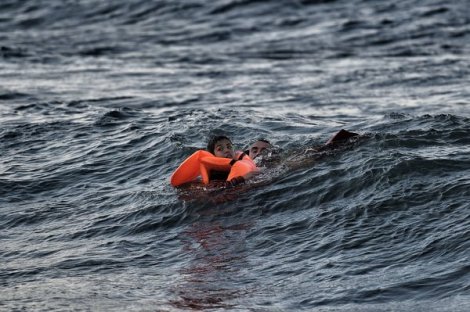
Chaos and death among refugees in Lesbos

From the Greek Left Review:

Life in Lesbos: “The Children’s Feet Are Rotting – You Guys Have One Month and Then All These People Will Be Dead”

“There are thousands of children here and their feet are literally rotting, they can’t keep dry, they have high fevers and they’re standing in the pouring rain for days on end. You have one month guys, and then all these people will be dead”.

read full story at Greek Left Review.

As More Children Drown, Volunteers on Lesbos Say Rescues Are Left Largely to Them

“We have lines of children half dead waiting to be hung upside down so we can pound the water out of their tiny lungs — boat after boat,’’ Trace Myers, a volunteer from England, wrote on her Facebook page. “We have ambulances, wailing, soaked, terrified people.”

read full story at Greek Left Review.

Tuesday, November 17, 2015

"Patriot Act" in France

The DAESH attacks in Paris are, I understand, controlled and authorized by NATO's "Deep State". Much like the 9/11 attacks in the USA 14 years ago, they have two objectives:
  1. To provide a "Pearl Harbor" style justification for foreign military intervention, in this case clearly focused on Syria and ignoring the actual supporters of the DAESH, such as Saudi Arabia and its Gulf vassals, Turkey or the United States, among others (Putin recently mentioned 40 countries, several of which have seats in the G20). 
  2. To induce a state of panic among the European population, French particularly, in order to push ahead with anti-democratic and repressive new legislation and de facto measures. This part can be split in three categories:
    1. Anti-immigration (in spite of the fact that the authors of the attacks were French or Belgian and that they had been freely traveling in and out of the Schengen area without police ever interfering).
    2. Against free transit of people in the European Union. This is about the only good thing we get from this confederacy: that the artificial borders are less apparent. 
    3. Reinforcement of authoritarian tendencies and particularly of the police state, dismantling democracy and human rights for the sake of "security".
soldiers patrol Paris
However the police state clearly failed to prevent the attacks, attacks that had been announced (for example the erratic Spanish political analyst J. Verstrynge considered a French 9/11 style attack certain and immediate in a debate two weeks ago, citing French government sources). The Schengen area was already suspended on the pretext of the Climate Summit and this was totally useless: the terrorists could travel between Paris and Brussels unhindered. Many increments of the police state (telecom spying without judicial authorization, among others) had already been approved after the Charlie Hebdo attacks and these were totally useless. The police state is useless, especially if it is the Deep State who organizes the attacks. Without purging our own hawks and secret services this kind of attacks can only happen once and again, if the shadow commanders think they are useful for their agenda of rallying the masses in favor of militarism, imperialism and repression. 

Anyway, what is happening now (source: Gara) is that President Hollande and PM Valls (what's up with France's hyper-successful police ministers: first Sarkozy, now Valls?) are promoting an increase of the police state. By the moment there is an extension of the state of emergency for three months, much more than the usual 12 days. But what they are proposing is a change of the constitution to the worse. In spite of the French nationality of the terrorists, their focus is xenophobic: allowing banning the entry in the Hexagon to double nationality citizens, speedy ways of expulsion of immigrants, and even the removal of the nationality for those indicted with "terrorism" charges (not for looting the public treasury like Sarkozy?). This last measure goes against the International Declaration of Human Rights which clearly states that people have the right to a nationality and not to be deprived of it. 

They will also forbid associations inciting to hate but it does not seem like the fascist National Front and their xenophobic discourse will be included.

Additionally more jobs will be created in the police apparatus: 5000 new gendarmes, 2800 new judiciary workers and 1000 new border officers. 

An interesting read is also Tierry Meyssan's article on the attacks. A bit clouted with lots of details but emphasizing that it is the Deep State who's running the show, largely the Pentagon directly (people like Petraeus, Clinton or Allen, and of course we can't forget the long menacing shadow of Sarkozy). Interestingly he mentions that the very day of November 13 the emergency services of Paris held a drill of reaction against multiple terrorist attacks. Coincidence? This kind of "coincidences" happen too often, so most certainly not.

Sunday, November 15, 2015

Police let Bataclan attackers act for almost three hours

Update: it has surfaced (a witness trapped inside listening to the terrorists' conversations, which were all in perfect French, it seems) that the attackers were trying to negotiate and that the police may have managed it as a hostage crisis. This would explain the delay.

Three hours in which the attackers were murdering people!

Almost three hours after the carnage began, grenade blasts and automatic gunfire marked the moment police stormed the building to free those still trapped inside. (Herald Sun)

‘They are hiding in some kind of room in the dark and they text(ed) me, and they are very afraid, of course, and they are waiting for the police to intervene, but it’s been over two hours now and this is terrible.’ (journalist J. Pierce talking about some friends trapped inside, Euractive)


Watch also what WeAreChange informal news channel has to say:


Among other interesting things, they mention how Twitter and Facebook are tolerating DAESH recruitment through those social media and how the latter even is actively persecuting those who try to expose the terrorist recruiters.

Against terrorism, arm the people

We have become helpless sheep. That is one of the aspects that the terror attack against random workers in France highlights. If the people would have been armed, the death toll would have been much smaller: the attackers would have been quickly eliminated by some among the citizenry. 

Instead we Europeans have become dependent on the dangerous "protection" of the armed forces (police, army). There are a couple of exceptions in Switzerland and Austria, where people does have the right to own arms (and where there are no terror attacks, incidentally), but otherwise that's the norm across Europe: citizens can't protect ourselves, we are strictly dependent on the state. 

We need to regain the right to be armed, a proud people is an armed people. Anything else is just sheep awaiting the slaughter, regardless of who is the author.

"An act of war"? Against whom?

Several French newspaper opened yesterday with the term "guerre" (war) in their headers. Later, the President of the Republic, François Hollande, spoke to the media using the expression "an act of war". 

It is becoming obvious that the "French 9/11", again an attack not against oligarchies or the state apparatus but against common workers, is meant to direct the public opinion in the direction of war. But against whom?

The most obvious answer is the Islamic State or DAESH. However the DAESH is not a real state but a terrorist gang with only some weak territorial control, heavily disputed by the legitimate states of Syria and Iraq and many other forces such as the Kurdish militias, Hizbollah, the Iranian and Russian military and even as of late the elusive Free Syrian Army, which Moscow now claims is aiding them against DAESH. 

The DAESH however has sponsors that can be named: Turkey, Saudi Arabia, Qatar, the United States of America and some other allies, including France itself. So is France going to declare war to the USA? To Saudi Arabia? To Turkey or Qatar? To its own secret services under NATO? It may sound like a joke but it is a very pertinent question. 

Saturday, November 14, 2015

On the wake of the Paris massacre

I woke up today with the horrible news of a brutal massacre in Paris. Seven coordinated terrorist attacks against the civilian population caused 126 deaths, 83 severely injured and 132 with lesser injuries. The attacks also caused the declaration of the state of emergency, the deployment of the army in the city and partial closure of borders.

The only possible reaction is that of anguish and rage. There is no coceivable justification for indiscriminate attacks against the civilian population, not even under conditions of war, being considered a war crime. These are crimes against Humankind and deserve our utmost rejection. 

Also there is no possible justification of any sort: the French Republic is not actively involved in Syria (some of the attackers cried "this is for Syria!") except verbally and, if anything, as NATO member and close collaborator with the USA, Britain, Saudi Arabia, Israel and Turkey, it would covertly support the Islamists, using them only as poor pretext to attack the anti-Islamist forces of Damascus. 

I know that keeping lucidity under such powerful emotional stress is difficult but we must, no matter what. 

The analytic question qui bono? must be formulated and properly answered. My best answer so far is that such an attack is a strong push for greater French, European and NATO intervention in Syria, where DAESH terror is being used as pretext to attack the secularist regime of Damascus. 

A more logical reaction would be however to intervene against the totalitarian and authoritarian regimes that actively support Islamist terror, namely: Saudi Arabia, Qatar, Turkey and Israel, as well as repressing the hawkish factions in Washington and London, who do exactly the same.

Of course, that will not happen but it is the logical follow up.

Society can only be secular: let's fight against religious fanaticism everywhere because it is nothing but fascism.


See also: 26 things you must know about DAESH (Global Research)

Friday, November 13, 2015

Yemeni forces capture Saudi town of Al Raboah

Yemeni "rebel" forces (Sana'a government) captured the Saudi border town of Al Raboah (also Ar Raboah) earlier this month (sources: ABNA, Khabar Agency, Odio de Clase[es]). When Saudi Arabia began its military intervention in Yemen this Spring, I predicted that something like this would happen eventually. It may be just the beginning.

Raw footage of the takeover (source: Almasirah TV):