Showing posts with label grassroots organization. Show all posts

Saturday, June 22, 2013

Brazil: Passe Livre calls off protests in Sao Paulo because of fascist infiltration

The Passe Livre (Free Pass) movement of Sao Paulo, a small grassroots organization of some 40-50 people who initiated the massive protests in Brazil, has decided to call off demonstrations in Sao Paulo after fascist provokers were spotted in the demos, harassing and attacking left-wing activists and causing widespread outrage. 

Lucas Monteiro, speaker of the movement, declared to Terra Magazine that they will not call more marches in the largest city of Brazil by the moment, although they will continue to work towards the zero tariff.

This does not necessarily apply to other states and cities, where the MPL cells are autonomous. 

Source: Webguerrillero[es].

Monday, January 14, 2013

The not-so-subtle nature of sectarianism


THE SUBTLE CHARACTERISTICS OF SECTARIANISM.


(originally published at Critical Mass, Nov-9-2012)

In a previous article (‘Sectarianism and the question of a general strike) I identified ten characteristics of sectarianism obtained from the works of Marx, Engels, Lenin and Trotsky. Despite my severe reservations concerning the Leninist and Trotskyist positions and traditions, on the question of sectarianism, they made important observations. However, my own experience during the past 50 years of anti-capitalist involvement, revealed two additional ones.  The first was the absolute denial by sectarians of being sectarian, whist not even being aware of, or considering, the full range of the characteristics of sectarianism. The second was the characteristic of being dishonest with each other and with the working class.

These are two characteristics shared by all political groupings who are in competition with each other for leadership of populations including those seeking to lead the working and oppressed.  This is because elite forms of leadership require influence over those who can be influenced and manoeuvres against any rival leadership bids. Within the anti-capitalist struggle this sectarian characteristic of dishonesty takes the following forms. Sectarians;
  1. Often exaggerate or inflate the numbers (or active members) they have in their group. (In order to appear stronger and more influential than they actually are.)
  2. Often exaggerate or embellish their actual influence among their chosen target audiences. (Usually for the same reasons as point one.)
  3. Often claim that decisions made essentially by individuals represent the decisions of the group. (As point one, but also to give the appearance of genuine, active, democratic practices.)
  4. Often hide their true intentions to other participants while offering a substitute intention and working toward their witheld intention and in the process undermine unity. (Because the true intentions may be rejected by potential participants.)
  5. Often hide or deny problematic situations or dubious practices within their own ranks. (Since potential recruits would be more likely to refrain from joining or associating with them.)
  6. Often violently attack those who expose, sectarianism, hypocrisy or deviousness in their group whether this exposure comes from within or without. This often takes the form of a clandestine character assasination of individual or group critics. (In order to defend their self-promoted, superior image.)
  7. Often vigorously defend their own allies, irrespective of any transgressions they may have carried out. (Because they are more committed to group results than principles.)

All the above practices are  the stuff of politics in general and is the stuff of sectarian traditions within the anti-capitalist struggle. It would be difficult if not impossible to find a group on the left that hasn’t practiced one or more of the above and many of the additional characteristics in the previously noted article. However, it is obvious, that when such thinly disguised characteristics and practices come to light – as eventually they must – it causes disgust and repulsion among those who are genuinely committed to unity and trust.

Such revelations often result in a loss of individuals to the anti-capitalist struggle. For so many left groups are sectarian that many view these characteristics as fundamental to anti-capitalism in general, instead of the sectarian mentality in particular. This loss to the anti-capitalist struggle represents not just the numbers involved but the talents, skills and energy these individuals take with them.

This drain on the anti-capitalist movement has taken place over several decades and it cannot be surprising.  Solidarity and trust are essential features to develop the anti-capitalist struggle. If they are lacking, then all positive development is lost, and only suspicion and a fractured, splintered disunity remains. Which is fundamentally what I hope we – and others – are trying to overcome.

If we are to genuinely succeed in creating a different tradition within the anti-capitalist left, than that of past generations, then certain things follow. I suggest adherence to at least the following six principles would begin to create a different non-sectarian culture among anti-capitalists which could only have positive results.
  1. Opposition to Capitalism in all its economic, social and economic forms.
  2. Opposition to dogmatism and sectarianism.
  3. Opposition to polemical distortion in disagreements.
  4. Opposition to disrespect, sarcasm, and intimidation.
  5. A commitment to sharing information and understanding.
  6. A refusal to allow theoretical differences to impede or prevent joint action.

For the 10 characterisitics of sectarianism see Sectarianism and the question of a General Strike.

Roy Ratcliffe (November 2012)


= Reblogged from Critical Mass =

Sunday, December 23, 2012

New Basque Left Independentist party: Eusko Ekintza

A new Basque political party has been presented to the media this Saturday 22nd in Navarrese town of Altsasu. Eusko Ekintza (Basque Action) gathers people from the Nationalist Left, Eusko Alkartasuna and other unorganized sectors and describes itself as anticapitalist, left-leaning and independentist.

They claim that the new party is a reality not represented in the current spectrum of parties and organizations currently existent in the Nationalist Left but do agree with their general goals of independence and socialism, but they put the emphasis in a socialism founded on a strong public, communitarian and cooperative sector.

In the words of Gotzone Rekondo:
Our ultimate goal is however the achievement from this very day of a new economic, social and political system in which we the people self-organize from below and that would eventually replace the capitalist system.

Emphasis is also placed on the means of struggle towards independence, which should be for them nonviolent disobedience and decentralized grassroots organization from below by mean of popular assemblies.
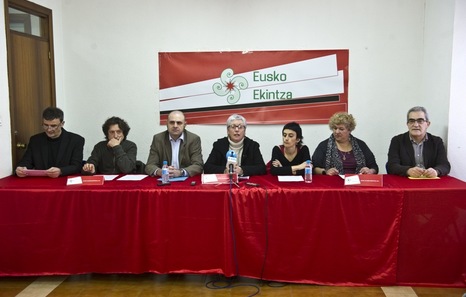
Press conference of the new party today in Altsasu. From left to right: Enrique Lertxundi, Jakue Pascual, Santi Merino, Arritxu Santamaría, Gotzone Rekondo, Nekane Garmendia and Peio Mari Olaeta.


They direct their alliances' policy to all organizations in the Basque Country, France, Spain and Europe that share their goal of overcoming of the Capitalist system and the unfair organization of the territory.

Previously they had indicated their intention to join the Basque ample Left Independentist coalition that is EH Bildu. The most notable representative of this bloc, candidate to Lehendakari Laura Mintegi already showed her openness towards this new party.

The public faces of this new party so far are:
  • Peio Mari Olaeta: member of Euskaria foundation, former member of Eusko Alkartasuna (EA, socialdemocrats, members of EH Bildu) and member of the critical platform Ezkerretik Bilduz (Uniting from/by the Left), Gasteiz.
  • Nekane Garmendia: councilor of Ultzama, Navarre, by Bildu, and generally active in the formation of Bildu in the old kingdom.
  • Gotzone Rekondo: Basque language activist from NW Navarre.
  • Enrique Lertxundi: attorney, consciencious objector, antimilitarist and advocate of nonviolent action to independence, from Donostia.
  • Jakue Pascual: intellectual of autonomous ideology, author of Anarkherria, Tellurics of Basque Liberation, Mari's Toy, etc., Bilbao.
  • Santi Merino: member of Eusko Alkartasuna until recently, from Donostia.
  • Arritxu Santamaría: member of Ezkerretik Bilduz and historian (→ video on the history of EAE-ANV), from Lapurdi. 

Not sure what to think but it certainly looks that they may embody sociological and political tendencies which do not have room in Sortu (too monolithic) or in Eusko Alkartasuna (too social-democrat) or in the rather irrelevant Alternatiba (breakaway faction of the all-Spain United Left coalition). I could well sympathize with much of what they say however I am also very wary to see people who come from EA and have been undeservedly vocal against ETA's armed struggle while not generating an alternate nonviolent movement themselves. 

Those people remind me of the heated debates that we had in the Conscientious Objection Movement almost two decade ago and in which there was a dominant sector that, on one side, wanted (or pretended to want) to promote a nonviolent campaign for the independence of the Basque Country  but then, on the other side, was not willing to take any steps until ETA abandoned armed struggle. Those were also often the ones who wanted to scrap the sentence that recognized the right to self-defense from the ideological declaration of the movement, totally missing or rather mischievously distorting the point of nonviolence as understood by Gandhi himself.

I have the feeling that there are the two kinds here: the good hearted ones, probably most, and then those from EA, which is a party I can't stand, really. You cannot constitute an anticapitalist politics with the socialdemocrats and you cannot wait to initiate a nonviolent movement until those who (right or wrong) chose armed struggle give up, wasting two decades. 

But we'll see what is all about in due time. I have very mixed feelings.

Partial sources[es]: Naiz Info, Público.

Saturday, May 21, 2011

May 15 Movement extends itself in time

The May 15 Movement of Madrid has made an appeal to organize popular assemblies in towns and neighborhoods through the metropolitan region. These meetings will take place next Saturday May 28. 

So far there will be assemblies in the following neighborhoods of Madrid: Carabachel, Lavapiés, Usera, Arganzuela, Chamberí, Puente de Valleas, Tetuán, Moratalaz, Moncloa Aravaca, Batán, Guindalera, Retiro, La Elipa, Barrio de la Concepción, San Blas, Villaverde Alto, Hortaleza, Barajas, Salamanca, Barrio del Pilar  and Prosperidad, and also in the following metropolitan towns: Leganés, Alcobendas, Aranjuez, San Lorenzo de El Escorial, Alcorcón, Móstoles, Pozuelo de Alarcón, Manzanares el Real, Colmernar Viejo and Getafe. 

Click to expand to printable ultra-large version
 On Sunday 29 at noon there will be People's Assembly of Madrid at Puerta del Sol. 

Valencia protest
The Puerta del Sol is absolutely crowded, so the demonstrators attempted to expand the protest to Plaza de la Ópera this morning. But police thwarted this movement. 

This was also something that the camp at Valencia had to do, taking the roads around the City Hall Plaza, in spite of official silence on an authorization request, in order to grant the necessary comfort for the demonstrators. 

Source: Tercera Información[es] (link for Madrid, for Valencia)